When you move from buying finished products to building your own lighting brand, everything changes. Pricing matters—but consistency, reliability, and supplier capability matter much more.
For wholesalers, project contractors, and private-label brands, choosing the right OEM partner for solar lighting can determine whether your business scales smoothly—or struggles with returns, delays, and quality issues.
This guide breaks down what actually matters when selecting an OEM solar lighting manufacturer.
Why OEM Solar Lighting Is Growing Fast


More buyers are shifting to OEM because it allows:
- Brand differentiation
- Better margin control
- Custom product features
- Long-term supply stability
But OEM also introduces risks—especially if you rely on the wrong supplier.
1. Product Consistency Is More Important Than Price
Many factories can produce a good sample.
Far fewer can deliver consistent quality across 1,000–10,000 units.
What to verify:
- Are components standardized across batches?
- Do they have documented QC processes?
- Can they share defect rate data?
👉 A low unit price means nothing if 10% of your products fail in the field.
2. Understand the Core Components (Not Just the Design)


In solar lighting, performance depends on internal components:
Key elements:
- Solar panel (efficiency & type)
- Battery (capacity & lifespan)
- LED chip (brightness & stability)
- Controller (charging/discharging logic)
👉 Serious OEM suppliers will clearly specify these—not hide them behind marketing terms.
3. Customization: What’s Actually Possible?
Many buyers assume OEM means unlimited customization. In reality, it depends on the factory.
Common customizable elements:
- Logo branding
- Color temperature (e.g., 2700K / 3000K / 4000K)
- Brightness levels
- Materials and finishes
- Packaging
Less flexible areas:
- Internal structure
- Mold design (unless large volumes)
👉 Ask early: What requires a new mold? What can be modified easily?
4. Certifications and Compliance Are Not Optional


If you’re selling in regulated markets, your products must comply.
Common requirements:
- CE (Europe)
- RoHS (hazardous substances)
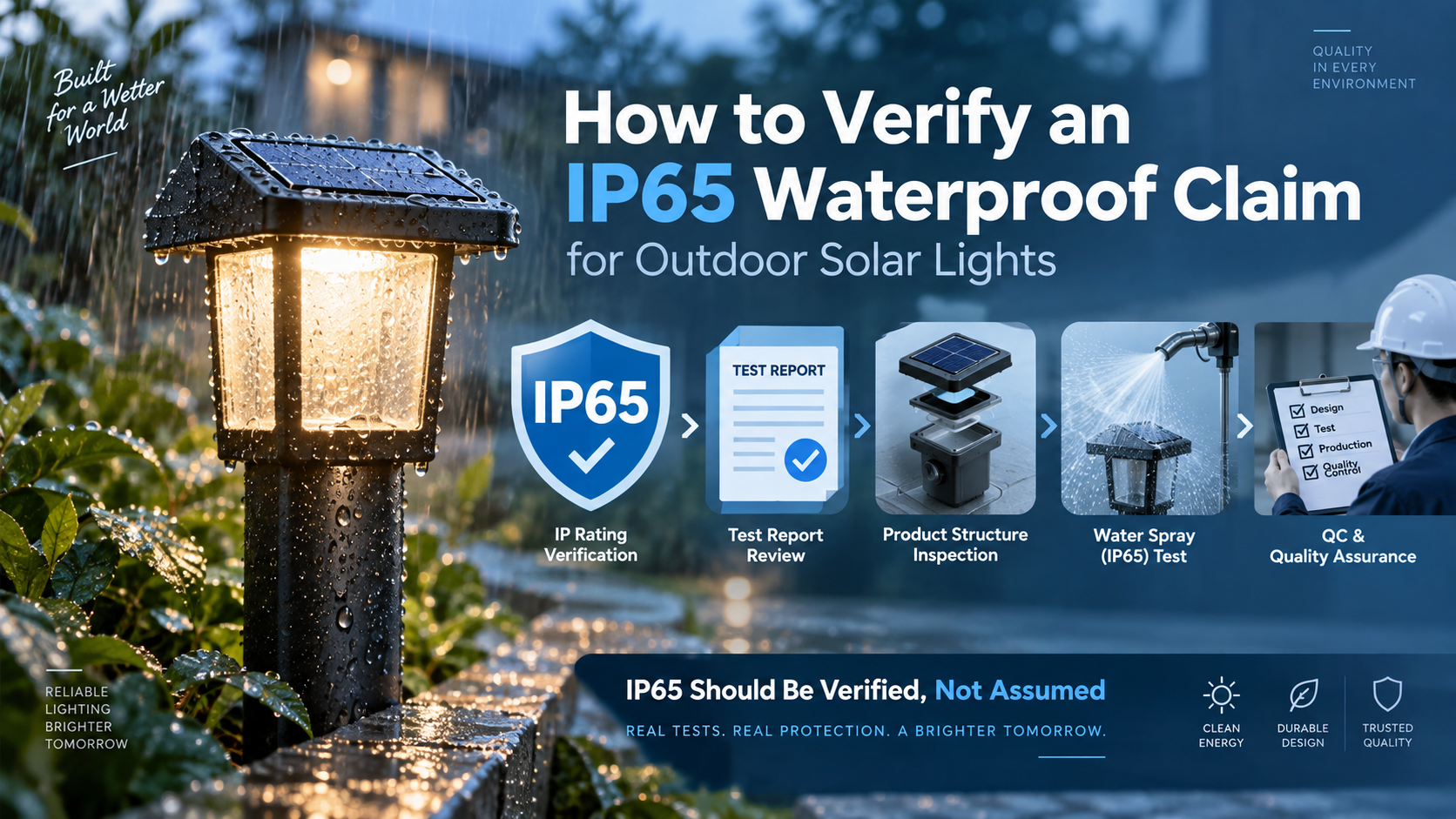
- IP ratings (waterproof levels)
- MSDS for batteries
👉 Don’t just ask “Do you have certificates?”
Ask: “Are these certificates valid for this exact product model?”
5. Lead Time and Production Capacity
A common OEM mistake: choosing a supplier that cannot scale.
Questions to ask:
- What is the standard lead time?
- What happens during peak season?
- Can they handle repeat large orders?
👉 Delays don’t just affect inventory—they affect your reputation with clients.
6. Packaging and Branding: Small Details, Big Impact

For wholesalers and retailers, packaging is part of the product.
Consider:
- Retail-ready packaging vs bulk cartons
- Drop protection for shipping
- Brand presentation
- Instruction manuals
👉 Good packaging reduces damage and increases perceived value.
7. After-Sales Support and Warranty
This is where many OEM partnerships fail.
Clarify upfront:
- Warranty duration (typically 1–3 years)
- Replacement policy
- Spare parts availability
- Response time for issues
👉 A reliable supplier supports you after delivery, not just before payment.
8. Sample Testing: Never Skip This Step
Before placing bulk orders:
- Test brightness and runtime
- Check charging performance over several days
- Inspect materials and finish
- Simulate real outdoor conditions
👉 If possible, test in your actual project environment.
9. Red Flags to Watch For
Avoid suppliers who:
- Cannot clearly explain product specifications
- Offer prices far below market average
- Refuse to provide samples
- Have inconsistent communication
- Cannot verify certifications
👉 If something feels unclear early on, it usually gets worse later.
Final Takeaway
OEM solar lighting is not just about manufacturing—it’s about building a reliable supply chain for your business.
The best buyers don’t chase the lowest price. They focus on:
- Consistent quality
- Transparent specifications
- Scalable production
- Strong after-sales support
Because in the long run, a dependable OEM partner is not a cost—it’s a competitive advantage.
For LEDORA and other lighting brands, mastering OEM sourcing is the key to delivering products that not only look good—but perform reliably in real-world conditions, project after project.