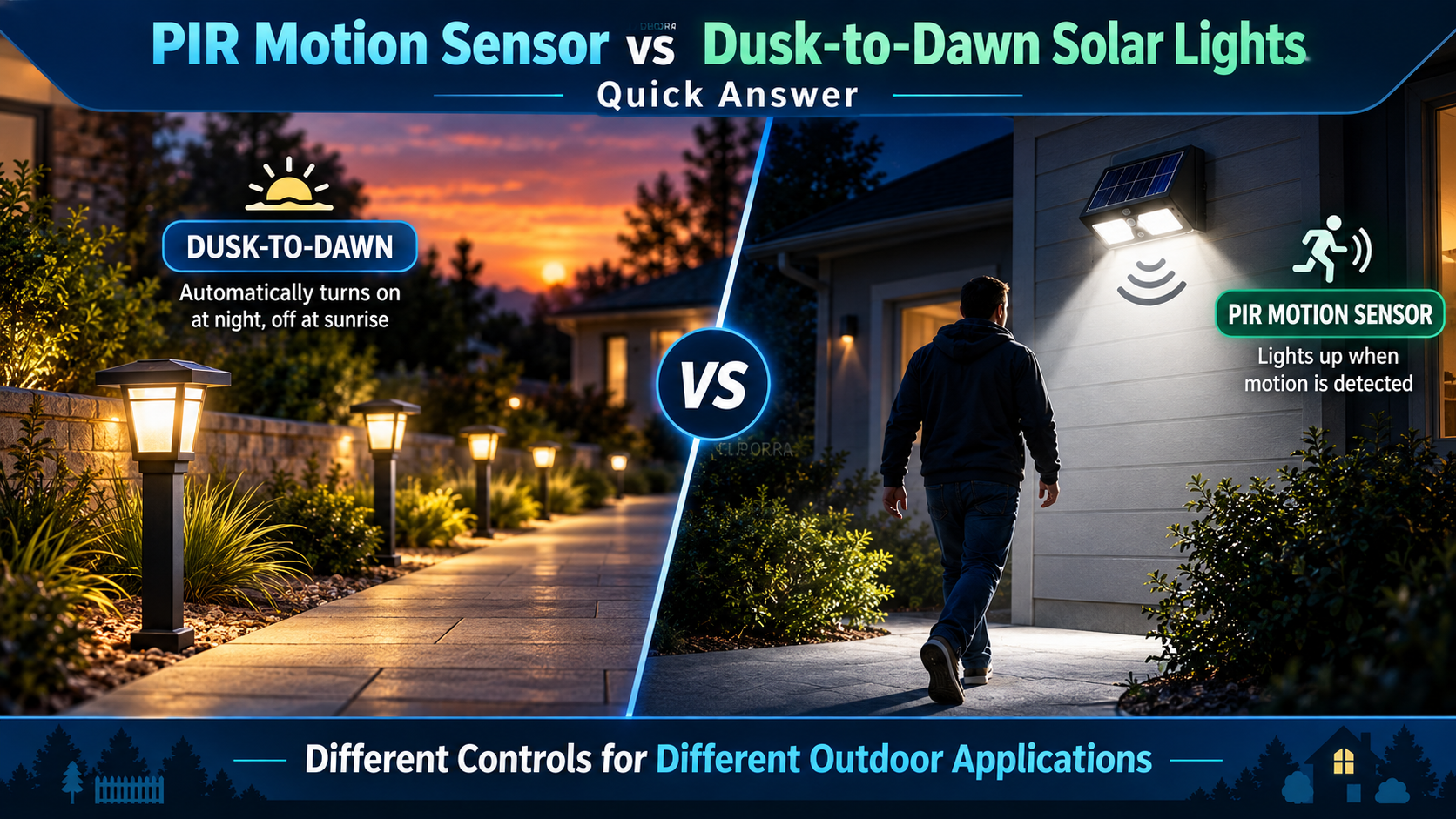
Ni-MH batteries are generally suitable for low-power decorative solar lights, while lithium-ion batteries are often a better choice for brighter pathway lights, motion sensor lights and products requiring a larger energy reserve.
However, battery chemistry alone does not determine product quality.
Wholesale buyers must evaluate the complete lighting system, including battery voltage, actual capacity, solar panel output, LED power, lighting mode, charging conditions and product structure.
A correctly matched Ni-MH system can perform better than a poorly designed lithium-ion system. Similarly, installing a larger lithium battery will not improve runtime when the solar panel cannot fully recharge it.
This guide explains how Ni-MH and lithium-ion batteries are used in solar garden lights and how importers, wholesalers, retailers and private-label brands can select the right configuration.
Buyers looking for a complete product range can also visit LEDORA’s solar garden lights manufacturer and OEM supplier page.

Why Battery Selection Matters in Solar Garden Lights
A solar garden light works as a small independent energy system.
During the day, the solar panel collects energy and charges the rechargeable battery. At night, the battery supplies electricity to the LED light source and controller.
The battery affects:
- Available energy storage
- Product voltage
- Nighttime operating time
- Maximum LED brightness
- Motion sensor performance
- Charging requirements
- Product cost
- Housing dimensions
- Shipping documentation
- After-sales performance
The U.S. Department of Energy explains that batteries store chemical potential energy and release it as electrical energy when required. Buyers can review the official DOE explanation of how batteries work for additional technical background.
In solar lighting, the battery must work together with the solar panel and LED load. Evaluating one component without reviewing the others can lead to unrealistic performance expectations.

What Is a Ni-MH Battery?
Ni-MH means nickel-metal hydride.
In solar garden lighting, Ni-MH batteries are commonly available in AA or AAA-style cylindrical formats. A typical individual cell has a nominal voltage of approximately 1.2V.
LEDORA’s existing solar garden light range includes decorative, ground and pathway products using configurations such as:
- 1.2V AA Ni-MH battery
- 400mAh capacity
- 600mAh capacity
- 700mAh capacity
- Small solar panels designed for low-power LEDs
Ni-MH batteries are commonly found in:
- Decorative solar flower lights
- Solar firefly lights
- Small pathway lights
- Solar fence lights
- Low-lumen ground lights
- Seasonal solar decorations
- Simple dusk-to-dawn products
Their relatively simple format makes them suitable for compact and price-sensitive solar lighting products.
Advantages of Ni-MH Batteries
Suitable for Low-Power Products
Many decorative solar lights use only one or several low-power LEDs. These products do not require the larger energy reserve associated with high-brightness motion sensor lights.
A properly matched Ni-MH battery can provide sufficient energy for decorative illumination.
Familiar AA or AAA Format
Some Ni-MH batteries use familiar AA or AAA dimensions. This can make battery replacement easier when the product structure allows the battery compartment to be opened.
Suitable for Entry-Level Retail Programs
Ni-MH configurations can help manufacturers control product cost for:
- Supermarket promotions
- Seasonal garden ranges
- Gift products
- Decorative multipacks
- Entry-level ecommerce products
Practical for Simple Control Systems
Products using basic dusk-to-dawn operation, steady-on lighting or simple flashing modes may not require a high-voltage battery system.
Limitations of Ni-MH Batteries
Ni-MH batteries are generally less suitable for products that require:
- High lumen output
- Large numbers of LEDs
- Long periods of high brightness
- Powerful PIR motion sensing
- Multiple high-output lighting modes
- Large-area illumination
A small Ni-MH battery may also provide limited energy during cloudy periods when the product receives insufficient charging.
This does not mean Ni-MH is a poor battery. It means the battery must be used in an application that matches its available voltage and stored energy.

What Is a Lithium-Ion Battery?
Lithium-ion batteries are rechargeable batteries commonly used in products requiring higher voltage, greater energy storage or stronger output.
Solar outdoor lights frequently use cylindrical lithium-ion formats such as 18650 cells.
Typical configurations may include:
- 3.7V 1200mAh
- 3.7V 1500mAh
- 3.7V 1800mAh
- 3.7V 2200mAh
- 3.7V 2400mAh
- Larger customized battery packs
Lithium-ion batteries are commonly used in:
- Solar motion sensor lights
- High-brightness pathway lights
- Solar wall lights
- Solar flood lights
- Security lights
- Large solar spotlights
- Solar ceiling lights
- Remote-controlled lighting
- Products with multiple lighting modes
LEDORA offers several outdoor lighting categories that use larger rechargeable battery systems. Buyers can review the current solar garden light collection for available product structures.
Advantages of Lithium-Ion Batteries
Higher Energy Storage in a Compact Product
Lithium-ion batteries can provide a larger energy reserve without requiring multiple AA-style cells.
This is useful when the product needs:
- Higher brightness
- More LEDs
- Longer high-output operation
- Motion detection
- Remote control
- Multiple functional modes
Higher System Voltage
A typical 3.7V lithium-ion cell provides a higher nominal voltage than a single 1.2V Ni-MH cell.
This makes lithium-ion configurations suitable for lighting systems requiring stronger electrical output.
Better Suitability for Functional Lighting
Motion sensor lights may need to switch rapidly from standby mode to high brightness.
A lithium-ion battery is often a more practical choice for this type of application because the system requires more energy than a small decorative light.
LEDORA’s solar outdoor motion sensor lights illustrate the type of outdoor product where battery performance, sensor control and brightness must be considered together.
Limitations of Lithium-Ion Batteries
Lithium-ion batteries usually increase:
- Component cost
- Control-circuit requirements
- Battery protection requirements
- Transport documentation
- Product testing requirements
- Quality-control responsibility
The supplier must verify the battery, charging circuit, protection system and solar panel as one complete configuration.
Lithium batteries are also subject to specific transportation requirements. Buyers arranging air shipments should review current IATA battery shipping guidance and confirm requirements with their carrier or freight forwarder.

Ni-MH vs Lithium-Ion Battery Comparison
| Comparison Factor | Ni-MH Battery | Lithium-Ion Battery |
|---|---|---|
| Common solar light format | AA or AAA-style cell | 18650 cell or battery pack |
| Typical individual cell voltage | Approximately 1.2V | Approximately 3.6–3.7V |
| Common application | Decorative and low-power lighting | Brighter and functional lighting |
| Product examples | Flower lights, firefly lights, small path lights | Motion lights, wall lights, flood lights |
| Energy storage | Usually lower in compact solar products | Usually higher in comparable product space |
| System complexity | Relatively simple | Requires suitable protection and charging control |
| Product cost | Usually lower | Usually higher |
| High-brightness suitability | Limited | More suitable |
| Motion sensor suitability | Limited for small cells | Commonly used |
| Shipping requirements | Generally simpler | Additional lithium battery rules may apply |
| Best sales channel | Entry-level and decorative retail | Functional, premium and security lighting |
This table provides general guidance rather than a universal rule.
Battery performance depends on:
- Cell quality
- Actual capacity
- Internal resistance
- Charging circuit
- Solar panel output
- LED efficiency
- Lighting mode
- Outdoor temperature
- Production consistency
Two batteries carrying the same printed capacity may not deliver identical real-world performance.
Why Buyers Should Compare Watt-Hours, Not Only mAh
One of the most common sourcing mistakes is comparing batteries only by milliamp-hours.
Battery capacity in mAh does not account for voltage.
A more useful basic comparison is watt-hours:
Watt-hours = Voltage × Amp-hours
For example:
| Battery Configuration | Basic Stored Energy |
|---|---|
| 1.2V 600mAh Ni-MH | Approximately 0.72Wh |
| 3.7V 1200mAh lithium-ion | Approximately 4.44Wh |
| 3.7V 1800mAh lithium-ion | Approximately 6.66Wh |
| 3.7V 2400mAh lithium-ion | Approximately 8.88Wh |
These figures show why a 600mAh Ni-MH cell and a 600mAh lithium-ion cell are not directly equivalent.
However, watt-hours still do not guarantee runtime.
A high-brightness lithium-powered product may consume significantly more energy than a single-LED decorative light. Therefore, a larger battery can still produce a similar operating time when the LED load is much higher.
Wholesale buyers should request the following together:
- Battery chemistry
- Nominal voltage
- Rated capacity
- Solar panel voltage and current
- LED quantity
- LED power
- Lighting mode
- Tested charging time
- Tested working time
- Testing conditions

Which Battery Is Better for Different Solar Lights?
Decorative Solar Flower and Firefly Lights
Recommended starting point: Ni-MH
These products usually prioritize:
- Attractive appearance
- Warm decorative lighting
- Competitive retail price
- Simple dusk-to-dawn operation
- Lightweight packaging
- Seasonal sales
A 1.2V Ni-MH configuration may be sufficient when the LED load is low and the solar panel is properly matched.
Small Solar Fence and Deck Lights
Recommended option: Ni-MH or lithium-ion, depending on brightness
A low-lumen fence light may work well with Ni-MH.
A brighter fence light with PIR sensing or several operating modes may require a lithium-ion battery.
Solar Ground Lights
Recommended option: Depends on LED quantity and output
Small stainless steel ground lights with several low-power LEDs frequently use Ni-MH batteries.
Higher-output ground lights or products requiring stronger illumination may use lithium-ion batteries.
Waterproof structure is especially important because ground-mounted products are exposed to rain, moisture and possible standing water.
Solar Pathway Lights
Recommended option: Both are possible
Decorative pathway stakes can use Ni-MH batteries.
Brighter pathway lights with motion sensors, multiple brightness levels or larger LED arrays are more likely to use lithium-ion batteries.
Buyers can review LEDORA’s guide to choosing solar garden lights for wholesale orders for other factors that should be evaluated with the battery.
Solar Wall and Motion Sensor Lights
Recommended starting point: Lithium-ion
These products typically require:
- Higher lumen output
- Fast transition to high brightness
- PIR sensor operation
- Several lighting modes
- Larger solar panels
- Greater energy storage
Solar Decorative Seasonal Lights
Recommended starting point: Ni-MH for simple products
For example, selected decorative solar lawn products use 1.2V AA Ni-MH batteries and multiple lighting modes.
Buyers can view this solar decorative lawn light as an example of a Ni-MH-powered seasonal product.
What Affects Solar Light Battery Runtime?
Solar Panel Output
The solar panel must provide enough energy to recharge the battery during the available daylight period.
A larger battery combined with a very small solar panel may remain partially charged.
LED Power Consumption
The number of LEDs does not tell the complete story.
Buyers should also check:
- LED type
- Individual LED power
- Operating current
- Brightness level
- Control mode
Lighting Mode
A motion sensor light may remain at low brightness for most of the night and use high brightness only when movement is detected.
This can extend operating time compared with continuous high-brightness operation.
Sunlight and Installation Position
Charging performance may decline when the solar panel is:
- Under trees
- Beneath a roof
- Facing the wrong direction
- Covered by dust
- Installed in long periods of cloudy weather
Outdoor Temperature
Battery performance can change at very high or low temperatures.
Wholesale buyers should ask whether the supplier has tested the selected model for the expected market and seasonal conditions.
Battery Quality and Production Consistency
A sample can perform well while bulk production delivers inconsistent runtime if battery specifications change during mass production.
The approved sample and purchase order should clearly record:
- Battery brand or approved equivalent
- Chemistry
- Voltage
- Capacity
- Cell dimensions
- Protection requirements
- Tested working time
Battery Testing for Wholesale Orders
Before approving a bulk solar light order, buyers should request or conduct several tests.
Voltage Inspection
Confirm that the battery voltage matches the approved specification.
Capacity Testing
Printed capacity alone is not sufficient. Sample batteries should be charged and discharged under controlled conditions to evaluate usable capacity.
Charging Test
Test the complete product under suitable solar or simulated charging conditions.
Discharge and Runtime Test
Record:
- Starting battery voltage
- Lighting mode
- LED brightness
- Total operating time
- Voltage after discharge
- Test temperature
Cycle Testing
Repeated charging and discharging helps identify batteries that lose performance quickly.
High- and Low-Temperature Evaluation
This is especially useful for products intended for markets with cold winters or hot summers.
Bulk Production Consistency
Randomly selected batteries and completed lights should be tested from mass production rather than relying only on pre-production samples.

Shipping and Compliance Considerations
Battery chemistry can affect logistics and documentation.
Lithium-ion cells and batteries are subject to specific transport testing, packaging, marking and documentation requirements.
The UN Manual of Tests and Criteria includes lithium cell and battery testing procedures under subsection 38.3. Buyers can review the UNECE transport testing information when discussing lithium battery documentation with suppliers and freight forwarders.
For lithium-powered solar lights, buyers may need to confirm:
- UN 38.3 test documentation
- Battery test summary
- MSDS or SDS
- Transport classification
- Packaging requirements
- Marking and labeling
- Air or sea shipping conditions
- Carrier-specific requirements
Requirements depend on battery configuration, shipment method, packaging and destination.
European buyers should also monitor the applicable EU Batteries Regulation, which covers sustainability, labeling, collection and other battery-related requirements.
Buyers should confirm current legal and shipping requirements with qualified compliance professionals and logistics providers before shipment.
How Wholesale Buyers Should Choose
Use the following practical framework.
Choose Ni-MH When:
- The product uses one or a few low-power LEDs
- Decorative effect is more important than high brightness
- The target market requires a competitive price
- The product uses a simple dusk-to-dawn function
- AA or AAA battery replacement is preferred
- Shipping simplicity is important
- The solar panel and battery are designed for a low-power system
Choose Lithium-Ion When:
- The product requires higher brightness
- A PIR motion sensor is included
- The product uses many LEDs
- Several brightness modes are required
- A larger energy reserve is needed
- The available housing space is limited
- The buyer accepts additional battery and shipping requirements
Do Not Select a Battery Based Only On:
- The highest printed mAh
- The lowest unit price
- The battery name
- One sample’s runtime
- A supplier’s general statement
- Competitor listings
The final decision should be based on the complete solar lighting system.
Questions to Ask Your Solar Light Supplier
Before approving a model, ask:
- What battery chemistry does the product use?
- What are the battery voltage and rated capacity?
- Is the capacity actual, minimum or typical?
- What solar panel voltage and current are used?
- How long does a complete charge require?
- Under what conditions was runtime tested?
- Does the product operate at constant brightness?
- Does brightness decrease as the battery discharges?
- Is the battery replaceable?
- Is a protection circuit included?
- What battery documents are available?
- Will the same battery configuration be used in bulk production?
- Can the battery be customized?
- Will customization require a larger solar panel?
- How will the product be packed and transported?
OEM Battery Customization
LEDORA supports OEM and ODM discussions for selected solar garden lights.
Depending on product structure and order quantity, customization may involve:
- Battery capacity
- Battery chemistry
- Solar panel size
- Lighting mode
- LED quantity
- Product color
- Logo printing
- Private-label packaging
- Instruction manuals
- Barcode labels
Battery customization cannot be treated as a simple component replacement.
Increasing battery capacity may also require changes to:
- Solar panel output
- Charging circuit
- Internal product space
- Waterproof structure
- Product weight
- Charging time
- Packaging
- Compliance documents
The technical configuration should be reviewed and tested before mass production.

Frequently Asked Questions
Is a lithium battery always better than a Ni-MH battery?
No. Lithium-ion batteries provide advantages for higher-power products, but Ni-MH batteries can be suitable for low-power decorative solar lights. The best option depends on the complete product design.
Why do many decorative solar lights use Ni-MH batteries?
Decorative lights often use low-power LEDs and simple dusk-to-dawn operation. A properly matched Ni-MH battery can provide sufficient energy while helping control product cost.
Why do motion sensor solar lights usually use lithium batteries?
Motion sensor lights often require higher brightness, multiple operating modes and a larger energy reserve. Lithium-ion batteries are generally better suited to these requirements.
Can battery capacity be compared by mAh alone?
No. Buyers should consider both voltage and capacity. Watt-hours provide a more useful basic energy comparison.
Does a larger battery guarantee longer runtime?
No. Runtime also depends on solar charging, LED power, controller efficiency, lighting mode and environmental conditions.
Can LEDORA customize the battery capacity?
Battery customization is available for selected projects, subject to technical feasibility, product structure, order quantity and testing.
Are lithium batteries more difficult to ship?
Lithium batteries are subject to specific transport testing, packaging, marking and documentation requirements. Buyers should confirm the current rules with their supplier, freight forwarder and carrier.
Is a replaceable battery better for solar garden lights?
A replaceable battery can make maintenance easier, but the battery compartment must still maintain suitable outdoor protection. The best structure depends on the product and target market.
What battery information should appear in a quotation?
The quotation should identify battery chemistry, voltage, capacity and relevant product configuration. Buyers should also confirm solar panel output and tested working time.
Should buyers test batteries before mass production?
Yes. Sample approval should include charging, capacity, runtime and functional testing. Random testing should also be performed during mass production.
Final Recommendation
Ni-MH and lithium-ion batteries should not be judged as simply good or bad.
Ni-MH is often a practical choice for decorative, low-power and price-sensitive solar garden lights.
Lithium-ion is generally more suitable for brighter products, motion sensor lighting, larger LED arrays and advanced operating modes.
For wholesale buyers, the correct decision is based on the balance between:
- Battery energy
- Solar panel output
- LED consumption
- Required runtime
- Product cost
- Application
- Target market
- Shipping requirements
- Quality-control capability
A well-designed solar light is not defined by the largest battery. It is defined by how effectively all components work together.
Request a Solar Garden Light Battery Comparison
LEDORA supplies solar pathway lights, ground lights, fence lights, decorative garden lights and motion sensor outdoor lighting for wholesalers, retailers, ecommerce sellers and private-label brands.
Contact us to request:
- Solar garden light catalogue
- Ni-MH and lithium model comparison
- Battery and solar panel specifications
- Sample quotation
- OEM packaging options
- Battery documentation
- Bulk order pricing
- Estimated production lead time
Contact LEDORA for a solar garden lighting quotation.
You can also explore our complete solar garden light product range or visit the LEDORA Alibaba supplier page for additional product information.