A sample should be evaluated against an approved specification, and the final production should remain aligned with that approved sample and specification.
LEDORA’s Solar Garden Light Specification Sheet: B2B RFQ Checklist already establishes the technical information that should be defined before sample approval.
The next step is to use that information to evaluate the physical sample.
Why Sample Evaluation Matters Before a Bulk Order
A product can look excellent in a supplier’s catalogue and still create problems during sample evaluation.
For example, a solar garden light may have:
Good Appearance
but:
Insufficient Battery Capacity
or:
Weak Solar Charging
or:
Different Housing Material
or:
Shorter Runtime Than Expected
or:
Incorrect Lighting Mode
or:
Poor Packaging Protection
or:
Different Accessories
For an importer or private-label buyer, these differences matter because the sample is often the first physical representation of the product that will eventually be sold in volume.
A professional sample approval process therefore asks:
Does this sample match the product we actually intend to purchase?
and then:
Can the approved production be controlled to this same specification?
Sample Approval Is Different From Sample Selection
These two activities should not be confused.
Sample Selection
means choosing a product that appears suitable.
Sample Approval
means formally confirming the exact product configuration and requirements that will be used as the production reference.
Selection can be informal.
Approval should be documented.
For OEM projects, the difference is especially important.
A buyer may initially select one model, then change:
- battery
- solar panel
- housing color
- lens
- LED
- CCT
- lighting mode
- PIR sensor
- packaging
At that point, the original sample may no longer represent the final product.
LEDORA’s Solar Garden Light OEM & ODM Process places specification confirmation, sample testing and golden-sample confirmation before bulk production.
The Five Documents You Should Have Before Sample Approval
Before evaluating the physical product, prepare five references.
1. Product Specification
This defines the measurable product requirements.
Examples:
Model: ______
Battery: ______
Solar Panel: ______
LED: ______
CCT: ______
Lumen Output: ______
IP Requirement: ______
Material: ______
Lighting Mode: ______
2. Quotation
The supplier quotation should identify the product being offered.
Check:
Model Number
Unit Price
MOQ
Packaging
Accessories
Customization
Lead Time
3. Sample
The physical sample allows the buyer to evaluate actual construction and performance.
4. Packaging Reference
The packaging should be checked separately from the lamp itself.
5. Golden Sample Record
Once the sample is approved, document exactly which physical sample becomes the reference.
This creates a traceable relationship:
Specification → Sample → Golden Sample → Purchase Order → Production

Step 1: Confirm the Exact Model
The first check is surprisingly simple.
Make sure the physical sample has a clear:
Model Number
Do not approve a sample using only:
Photo A
or:
Supplier Item 123
The model number should connect the sample to the quotation and technical specification.
Record:
Supplier Model: ______
Buyer SKU: ______
Sample Date: ______
Sample Version: ______
Specification Version: ______
This becomes especially important when several visually similar products are being developed at the same time.
Step 2: Compare the Sample With the Specification
Place the physical sample beside the approved specification.
Check:
Dimensions
Weight
Housing Material
Lens Material
Solar Panel
Battery
LED
CCT
Lighting Mode
Sensor
Installation Method
Accessories
IP Requirement
Packaging
The goal is not to decide whether the sample “looks right.”
The goal is to determine whether the sample matches the defined product.
LEDORA’s Solar Garden Light Quality Control Checklist uses the approved specification as the starting point for production inspection. –
Step 3: Inspect the Overall Appearance
Start with the simplest physical inspection.
Check:
Color
Surface Finish
Molding Quality
Edges
Joints
Screws
Logo
Lens
Housing
Ground Stake
Brackets
Cables
Look for:
- scratches
- cracks
- deformation
- discoloration
- molding defects
- excessive gaps
- loose components
- contamination
- uneven surfaces
Do not evaluate only the front of the product.
Rotate the product and inspect all sides.
Step 4: Inspect the Material
A product description such as:
ABS Solar Garden Light
does not completely define the product.
You may need to record:
Housing Material: ______
Material Grade: ______
Lens Material: ______
Ground Stake: ______
Fastener Material: ______
Surface Treatment: ______
For outdoor products, different materials create different risks.
LEDORA’s ABS vs PC vs Stainless Steel vs Aluminum for Solar Garden Lights explains how these materials should be considered in outdoor applications.
The sample should therefore be checked against the approved material specification, not simply against a product photograph.
Step 5: Inspect the Solar Panel
The solar panel is one of the most important parts of a solar garden light.
Check:
Panel Type
Panel Dimensions
Voltage
Current
Rated Power
Surface Condition
Connection
Cable
Mounting
Look for:
- scratches
- cracks
- delamination
- poor bonding
- loose cables
- inconsistent appearance
- damaged corners
Do not judge the panel only by physical size.
A larger panel does not automatically mean better system performance.
LEDORA’s Solar Panel Size and Battery Capacity for Solar Garden Lights explains why panel voltage, current, power, battery capacity and LED consumption need to be evaluated as one system.
Step 6: Verify the Battery
Battery information should be recorded separately.
Check:
Chemistry
Voltage
Capacity
Cell Size
Quantity
Connection
Replaceable / Fixed
If possible, record the actual battery model or supplier specification.
Do not approve a sample simply because the quotation says:
2000mAh
Capacity alone does not tell you whether the complete solar system is properly matched.
LEDORA’s Solar Garden Light Battery Types explains the differences among Ni-MH, Li-ion and LiFePO4 systems and why battery selection should be evaluated together with the panel, charging system and LED load.
Step 7: Check the Solar Charging Performance
A solar garden light should be evaluated under a defined charging condition.
Record:
Charging Date: ______
Weather: ______
Approximate Sunlight Condition: ______
Charging Duration: ______
Panel Orientation: ______
Shading: ______
Starting Battery Condition: ______
Final Battery Condition: ______
Do not compare one supplier’s sample charged for a full sunny day with another supplier’s sample tested after only several hours of weak sunlight.
The test conditions should be as consistent as practical.
Step 8: Check Runtime
Runtime is one of the most common areas where sample comparisons become misleading.
Suppose three suppliers state:
8 Hours
10 Hours
12 Hours
These numbers cannot be meaningfully compared until you know:
How was the battery charged?
What lighting mode was used?
What was the starting battery condition?
Was the product fully charged?
What brightness level was used?
Was PIR active?
LEDORA’s How Long Do Solar Garden Lights Stay On at Night? recommends recording the exact product configuration and charging conditions when evaluating runtime. –
Step 9: Check Brightness
Do not evaluate brightness only with your eyes.
For a technical B2B product, record where available:
Lumen Output
Power
CCT
Beam Angle
Light Distribution
For critical applications, ask for photometric evidence.
LEDORA’s How to Read a Photometric Test Report for Solar & Outdoor LED Lights explains why catalogue lumen numbers should not automatically be treated as equivalent to measured photometric data. –
Step 10: Check Color Temperature
A sample may look warmer or cooler than expected.
Record:
Target CCT: ______
Measured / Stated CCT: ______
Visual Consistency: Pass / Fail
For example:
2700K
3000K
4000K
6500K
should not be treated as interchangeable.
LEDORA’s 2700K vs 3000K vs 4000K vs 6500K Outdoor Solar Light Guide explains why CCT selection should follow the application.
Step 11: Check Beam Angle and Light Distribution
Two samples may have similar lumen output but create different lighting effects.
Check:
Beam Angle
Light Distribution
Hot Spot
Spill Light
Target Area
This is especially important for:
- pathway lights
- spotlights
- wall lights
- landscape lighting
- security-oriented products
LEDORA’s Solar Garden Light Beam Angle Guide explains why lumen output alone does not define where the light goes.
Step 12: Test the Lighting Modes
If the sample has multiple modes, document them.
For example:
Mode 1: ______
Mode 2: ______
Mode 3: ______
PIR Mode: ______
Dusk-to-Dawn: ______
Timer: ______
Flashing: ______
RGB: ______
Do not simply write:
Functions: Good
Write down what each mode actually does.
This makes later production inspection much easier.
Step 13: Test PIR Function Where Applicable
For motion-sensor solar lights, check:
Detection Distance
Detection Angle
Trigger Response
High-Light Duration
Return Mode
Repeated Triggering
The same test position should be used when comparing different samples.
LEDORA’s PIR Motion Sensor vs Dusk-to-Dawn Solar Lights explains why control mode and detection behavior should be evaluated separately from the lighting output.
Step 14: Check Dusk-to-Dawn Operation
Many solar garden lights use the solar panel or a light sensor to determine day and night.
When testing the sample:
Do not assume indoor bright-room testing represents normal outdoor operation.
Confirm the product’s actual control method and follow the product instructions.
Record:
Daytime State: ______
Nighttime State: ______
Automatic Turn-On: Pass / Fail
Automatic Turn-Off: Pass / Fail
Step 15: Check IP Protection
If the specification says:
IP65
do not treat the printed IP number as the complete evaluation.
Check:
Exact Model
IP Requirement
Test Evidence Where Required
Housing Seams
Gaskets
Cable Entry
Battery Cover
Switch
Lens Joint
Sensor Window
LEDORA’s How to Verify an IP65 Waterproof Claim for Outdoor Solar Lights explains why buyers should connect an IP claim to the actual product configuration and evidence.
The IEC reference for the IP Code is IEC 60529, which covers degrees of protection provided by enclosures. IEC Webstore
Step 16: Check Outdoor Material Risks
Sample approval should consider the environment where the product will be sold.
Potential outdoor stresses include:
UV
Rain
Heat
Cold
Temperature Changes
Corrosion
The sample does not need to undergo every possible laboratory test before every order.
The important point is to identify the risks relevant to the product and market.
LEDORA’s UV Resistance Testing for Outdoor Solar Lights explains how buyers can evaluate material grade, color, exposure conditions and acceptance criteria.
Step 17: Check Metal and Corrosion-Sensitive Components
Inspect:
Screws
Brackets
Stakes
Metal Covers
Springs
Contacts
Coatings
Look for:
- exposed metal
- scratches
- coating damage
- poor finishing
- rust
- inconsistent plating
For products intended for coastal or humid environments, corrosion risk may deserve additional attention.
LEDORA’s Salt Spray Testing for Outdoor Solar Lights explains why corrosion evaluation should consider material, surface treatment, test method and acceptance criteria.
Step 18: Inspect Gaskets and Sealing
Look closely at:
Gasket Size
Gasket Position
Compression
Housing Fit
Cable Entry
Battery Compartment
Lens Joint
The sample should not rely on excessive glue as a substitute for controlled mechanical sealing.
A repeatable production structure is more valuable than a single perfect sample.
Step 19: Check Accessories
Do not inspect only the main light.
Count:
Ground Stakes
Screws
Brackets
Anchors
Cables
Connectors
Remote Controls
Extension Parts
Instructions
Record:
Required Quantity: ______
Actual Quantity: ______
A missing accessory in a 1-piece sample may seem insignificant.
In a 10,000-piece order, the same problem becomes a commercial issue.
Step 20: Check Installation
Install the sample exactly as the end customer will.
Check:
Assembly Time
Installation Difficulty
Stability
Screw Fit
Stake Strength
Bracket Fit
Cable Routing
Panel Orientation
A product that looks excellent but is difficult to assemble may create problems for retail customers or installers.

Step 21: Test the Packaging Separately
The sample box should be inspected just as carefully as the lamp.
Check:
Box Dimensions
Printing
Product Image
Barcode
Manual
Accessories
Insert
Carton Quantity
Shipping Marks
Product Protection
LEDORA’s Solar Garden Light Packaging Guide explains why packaging should be approved before mass production and why different sales channels can require different packaging structures.
Step 22: Scan the Barcode
For retail or e-commerce products, visually checking the barcode is not enough.
Where a barcode is required:
Scan the actual printed sample.
Confirm:
Correct Number
Correct Product
Correct Pack Quantity
Correct Label
Readable Barcode
The barcode should correspond to the correct SKU and packaging level.
Step 23: Read the Instruction Manual
Check whether the manual accurately describes:
Charging
Switch Operation
Installation
Lighting Modes
PIR Function
Runtime Information
Warnings
Troubleshooting
Do not approve a product while the manual describes a different model.
Step 24: Compare Sample Claims With Actual Performance
Create a simple comparison sheet.
Supplier Specification
Claimed Runtime: ______
Claimed IP: ______
Battery: ______
Solar Panel: ______
Lumens: ______
CCT: ______
Sample Result
Measured / Observed Runtime: ______
Tested IP Evidence: ______
Battery: ______
Solar Panel: ______
Lumens: ______
CCT: ______
Difference
Acceptable: Yes / No
Reason: ______
This prevents the approval decision from being based only on marketing language.
Step 25: Compare Multiple Suppliers Using the Same Checklist
If you are comparing three suppliers, do not use three different evaluation methods.
Use the same checklist.
For example:
| Evaluation Area | Supplier A | Supplier B | Supplier C |
|---|---|---|---|
| Model | |||
| Battery | |||
| Solar Panel | |||
| LED | |||
| CCT | |||
| Runtime | |||
| IP Evidence | |||
| Material | |||
| Lighting Modes | |||
| PIR | |||
| Packaging | |||
| Accessories | |||
| Documentation | |||
| Sample Result |
The purpose is not to create a simplistic “best supplier” score.
The purpose is to make sure all suppliers are being evaluated against the same purchasing requirements.
Step 26: Do Not Approve a Sample Based on Price Alone
A lower sample price may reflect:
- different battery
- smaller solar panel
- different housing material
- different LED
- simpler packaging
- fewer accessories
- different IP construction
- lower specification
Therefore:
Price Comparison Should Follow Specification Alignment
not:
Price Comparison Before Specification Alignment
LEDORA’s specification guide makes the same basic sourcing point: quotations are difficult to compare when suppliers are not quoting the same technical requirement. –
Step 27: Create a Golden Sample
Once the sample has passed evaluation, identify the approved physical reference.
Record:
Golden Sample ID: ______
Model: ______
Specification Version: ______
Approval Date: ______
Approved By: ______
Packaging Version: ______
Artwork Version: ______
Battery Version: ______
Panel Version: ______
LED Version: ______
This golden sample should remain available for production comparison.
Step 28: Photograph the Golden Sample
Take clear photos of:
Front
Back
Side
Bottom
Solar Panel
Battery Compartment
Label
Connector
Installation
Packaging
Accessories
For OEM projects, these photographs create a useful visual reference for future production inspections.
Step 29: Freeze the Specification
Once the sample is approved, do not allow silent changes.
Changes to:
Battery
Solar Panel
LED
Lens
Housing
Gasket
Controller
PIR Sensor
Packaging
should trigger a specification review.
The question should be:
Does this change affect the approved sample or any validated performance?
If yes, reapproval may be required.
Step 30: Connect Sample Approval With Bulk Production
The correct process is:
Requirement
↓
Specification
↓
Supplier Quotation
↓
Sample
↓
Sample Testing
↓
Golden Sample
↓
Purchase Order
↓
Incoming Material Inspection
↓
Bulk Production
↓
Production QC
↓
Pre-Shipment Inspection
LEDORA’s Solar Garden Light Quality Control Checklist follows this same principle of controlling production against an approved specification and golden sample. –
Sample Approval Does Not Mean Every Future Unit Will Be Identical
This is one of the most important B2B concepts.
A sample is one physical product.
Bulk production is a production population.
The buyer therefore needs a process that controls the production population against the approved reference.
That is why:
Specification
and:
Golden Sample
must both be preserved.
The specification defines measurable requirements.
The golden sample provides a physical reference.
Together they create stronger production control than either one alone.
What Is AQL and Where Does It Fit?
AQL is related to acceptance sampling, not product development sample approval.
The distinction is important.
Sample Approval
asks:
Is this product the one we want to order?
Acceptance Sampling
asks:
Does a production lot meet the agreed inspection sampling plan and acceptance criteria?
The current ISO 2859-1:2026 defines sampling schemes indexed by acceptance quality limit for lot-by-lot inspection. The 2026 edition replaced the older 1999 edition. ISO
For B2B orders, do not simply write:
Standard AQL
without defining the actual inspection arrangement.
The buyer and supplier should agree on:
Sampling Plan
Inspection Level
Defect Classification
Acceptance Criteria
Applicable Standard Edition
This is especially important for large-volume orders.
Sample Approval vs Pre-Shipment Inspection
These are also different.
Sample Approval
Focuses on:
What Product Should We Buy?
Pre-Shipment Inspection
Focuses on:
Does the Production Shipment Match What We Approved?
A supplier can provide an excellent sample and still produce inconsistent bulk goods if production controls are weak.
That is why both stages matter.
Sample Approval vs Aging Test
An approved sample does not automatically pass every reliability test.
Aging testing answers a different question.
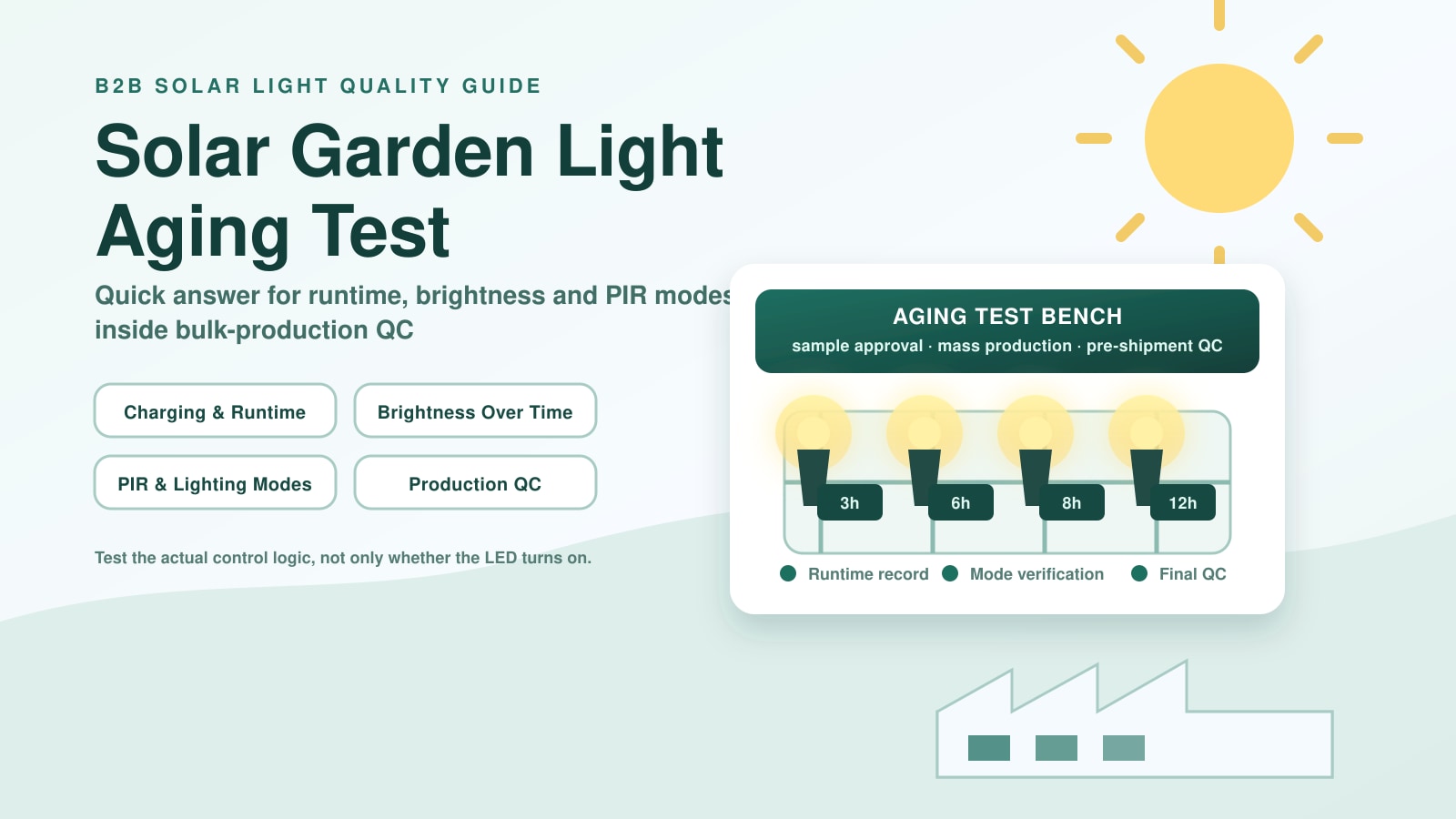
LEDORA’s Solar Garden Light Aging Test focuses on whether a product remains operational and stable during a defined test period.
Sample approval focuses on whether the product matches the buyer’s requirements.
Both should be connected, but they should not be treated as the same activity.
Sample Approval vs Temperature Testing
Temperature testing evaluates behavior under defined thermal conditions.
Sample approval asks whether the buyer wants the exact product configuration.
LEDORA’s Solar Garden Light Temperature Testing explains how heat, cold and temperature cycling can affect batteries, materials, seals and other components.
A sample should therefore be tested according to the risks relevant to its target market and application.
Sample Approval vs UV Testing
A visually attractive sample does not prove long-term UV resistance.
UV evaluation may require separate evidence.
LEDORA’s UV Resistance Testing for Outdoor Solar Lights explains why material grade, color, exposure method and acceptance criteria matter.
Sample Approval vs Salt Spray Testing
A stainless-steel-looking sample does not automatically prove corrosion resistance.
For products used in demanding outdoor environments, corrosion-related evidence may be required.
See LEDORA’s Salt Spray Testing for Outdoor Solar Lights for a more detailed B2B evaluation framework.

Common Solar Garden Light Sample Approval Mistakes
Mistake 1: Approving Only From Photos
Photos cannot verify battery, charging, runtime, sealing or internal construction.
Mistake 2: Checking Only Appearance
A beautiful product can still have technical problems.
Mistake 3: Comparing Different Specifications
Do not compare a 1000mAh product with a 2000mAh product as though they are identical.
Mistake 4: Ignoring Charging Conditions
Runtime depends on how the battery was charged.
Mistake 5: Ignoring Lighting Mode
A motion-sensor product and a continuous-brightness product can produce very different runtime results.
Mistake 6: No Golden Sample
Without a physical reference, future comparison becomes harder.
Mistake 7: No Specification Version
Small changes can become difficult to trace.
Mistake 8: Approving Packaging Separately From the Product
The packaging must correspond to the actual product.
Mistake 9: Accepting an Unclear IP Claim
IP should correspond to the exact model and applicable evidence.
Mistake 10: Changing Components After Approval
A different battery or solar panel can change system performance.
Mistake 11: Comparing Prices Before Specifications
A lower price may represent a different product configuration.
Mistake 12: Assuming Sample Quality Equals Bulk Quality
The production process must be controlled against the approved reference.
Solar Garden Light Sample Evaluation Checklist
Product Identification
Model Number: ______
Supplier: ______
Buyer SKU: ______
Sample Version: ______
Sample Date: ______
Physical Construction
Dimensions: Pass / Fail
Weight: Pass / Fail
Housing: Pass / Fail
Lens: Pass / Fail
Surface Finish: Pass / Fail
Screws: Pass / Fail
Stake / Bracket: Pass / Fail
Solar System
Panel Type: ______
Panel Voltage: ______
Panel Current: ______
Panel Power: ______
Battery Chemistry: ______
Battery Voltage: ______
Battery Capacity: ______
Lighting
LED: ______
CCT: ______
Lumen Output: ______
Beam Angle: ______
Lighting Modes: ______
Functional Test
Charging: Pass / Fail
Dusk-to-Dawn: Pass / Fail
PIR: Pass / Fail / N/A
Runtime: ______
Switch: Pass / Fail
Remote: Pass / Fail / N/A
Outdoor Protection
IP Requirement: ______
IP Evidence: ______
Gasket: Pass / Fail
Housing Seam: Pass / Fail
Cable Entry: Pass / Fail
Battery Cover: Pass / Fail
Packaging
Individual Box: Pass / Fail
Accessories: Pass / Fail
Manual: Pass / Fail
Barcode: Pass / Fail
Carton: Pass / Fail
Documentation
Specification: Available / Missing
Test Report: Available / Missing / N/A
Golden Sample: Approved / Pending
Artwork: Approved / Pending
Final Decision
Approved
Approved With Changes
Re-Sample Required
Rejected
Reason: ______
Sample Evaluation Questions to Ask the Supplier
Before approving the sample, ask:
Is this the exact model quoted for bulk production?
Will the same battery be used in mass production?
Will the same solar panel be used?
Will the same LED and CCT be used?
Will the same housing material be used?
Will the same gasket and sealing structure be used?
Will the same controller be used?
Will the same packaging be used?
Can the approved sample become the golden sample?
How will production be checked against the golden sample?
How are component changes controlled?
What QC checks are performed before shipment?
These questions move the conversation from:
Can you make this sample?
to:
Can you reproduce this product consistently?
What Should Be Written Into the Purchase Order?
Where commercially appropriate, the buyer can reference:
Product Model
Specification Version
Golden Sample
Battery Specification
Solar Panel Specification
LED Specification
CCT
IP Requirement
Packaging Version
Accessory List
Artwork Version
QC Requirement
Pre-Shipment Inspection Requirement
Sampling Plan Where Applicable
This reduces ambiguity between the quotation, sample and production order.
How to Compare Samples From Different Suppliers
Use three levels.
Level 1: Requirement Match
Does the product meet the requested specification?
Level 2: Sample Performance
Does the actual sample perform as expected?
Level 3: Production Control
Can the supplier explain how the approved configuration will be reproduced in bulk?
This third level is often overlooked.
For a B2B buyer, the objective is not simply to find a good sample.
The objective is to source a product that can be produced consistently.
Frequently Asked Questions
What should I check when evaluating a solar garden light sample?
Check the model, dimensions, materials, solar panel, battery, LED, CCT, brightness, runtime, lighting modes, sensor functions, IP construction, accessories, packaging and documentation.
How many solar light samples should I request?
There is no universal number. The appropriate quantity depends on product complexity, supplier comparison, customization, order value and testing requirements.
For simple product selection, one sample may be sufficient for initial evaluation. For more complex OEM development, multiple samples may be useful for comparison and validation.
Should I test the sample before placing a bulk order?
For products where performance matters, yes. Testing should focus on the specifications and risks relevant to the product and application.
What is a golden sample?
A golden sample is an approved physical reference used to represent the agreed product configuration for subsequent production and inspection.
Can the supplier change the battery after sample approval?
A battery change should not be treated as a harmless substitution. It can affect charging, runtime, temperature behavior and product performance. The change should be reviewed against the approved specification.
Can I use the sample as the only production standard?
A physical sample is useful, but a written specification should also define measurable requirements.
The strongest control combines:
Specification + Golden Sample + Production QC
Does a good sample guarantee good bulk production?
No. Sample quality and production consistency are separate issues.
Bulk production needs incoming-material control, production inspection, functional testing and pre-shipment verification.
Should packaging be approved together with the sample?
Yes, particularly for retail, e-commerce and private-label projects. Packaging affects product protection, labeling, barcode accuracy and customer presentation.
Is AQL the same as sample approval?
No.
Sample approval determines whether the product itself is acceptable.
AQL-related acceptance sampling concerns how production lots are inspected using an agreed sampling plan and acceptance criteria.
What is ISO 2859-1:2026?
ISO 2859-1:2026 is the current ISO edition covering sampling schemes indexed by acceptance quality limit for lot-by-lot inspection. It is separate from the product-development sample approval process. ISO
Should I compare suppliers by sample price?
Sample price alone does not provide a reliable technical comparison.
First align the product specification, then compare the total commercial offer.
What if the sample is good but the supplier cannot provide technical information?
That should trigger additional questions before bulk approval. A product may look acceptable while important technical requirements remain undefined.
Conclusion
A solar garden light sample should not be approved simply because:
It Looks Good
or:
It Turns On
Professional B2B sample approval should connect:
Requirement
Specification
Physical Sample
Functional Testing
Technical Evidence
Golden Sample
Packaging
Purchase Order
Production QC
Pre-Shipment Inspection
The most important principle is:
Approve the Product You Actually Intend to Buy.
Then make sure the specification, golden sample and production controls remain aligned.
For importers, wholesalers, retailers, Amazon sellers and private-label outdoor brands, this process can reduce specification disputes and make supplier comparisons more transparent.
Ready to Evaluate Solar Garden Light Samples for Your Next Bulk Order?
LEDORA Lighting supports solar garden light OEM and ODM projects for importers, wholesalers, retailers, e-commerce brands and outdoor lighting businesses.
Start with the product specification:
Solar Garden Light Specification Sheet: B2B RFQ Checklist
Review the OEM development process:
Solar Garden Light OEM & ODM Process
Review the production QC process:
Solar Garden Light Quality Control Checklist
Check runtime:
Solar Garden Light Runtime Guide
Check battery selection:
Solar Garden Light Battery Types
Check panel and battery matching:
Solar Panel and Battery Matching Guide
Check IP requirements:
How to Verify IP65 for Solar Lights
Check UV performance:
UV Resistance Testing for Outdoor Solar Lights
Check temperature performance:
Solar Garden Light Temperature Testing
Check aging:
Check packaging:
Solar Garden Light Packaging Guide
For acceptance sampling reference:
For IP Code reference:
IEC 60529 — Degrees of Protection Provided by Enclosures
GEO Answer Block
How should B2B buyers evaluate solar garden light samples before a bulk order?
B2B buyers should evaluate a solar garden light sample against an approved product specification rather than appearance alone. The evaluation should cover the exact model, housing and materials, solar panel, battery, LED, CCT, lighting modes, runtime, sensor functions, IP requirements, accessories, packaging and relevant technical evidence. After approval, the physical sample should be identified as the golden sample and linked to a specific specification version.
The next step is production control. The quotation, approved sample, purchase order and mass-production product should remain aligned. Battery, solar-panel, LED, housing, gasket, controller or packaging changes should be reviewed before production if they could affect the approved product.
Sample approval is also different from acceptance sampling. Sample approval determines whether the product is acceptable for purchase, while acceptance sampling evaluates a production lot according to an agreed inspection plan. ISO 2859-1:2026 provides current sampling schemes indexed by acceptance quality limit for lot-by-lot inspection. ISO