A reliable solar garden light is not defined by the largest battery or the biggest-looking solar panel.
Its real performance depends on whether the following components are correctly matched:
- Solar panel voltage
- Solar panel current
- Solar panel power
- Battery chemistry
- Battery voltage
- Battery capacity
- LED power consumption
- Lighting mode
- Target working time
- Available daily sunlight
A product may contain a large-capacity battery but still perform poorly if the solar panel cannot fully recharge it.
A larger solar panel may also add unnecessary cost and size when the product uses only one low-power decorative LED.
For importers, wholesalers, retailers and private-label brands, the correct question is not simply:
What battery capacity does this light use?
The better question is:
Can the solar panel collect enough energy to support the battery, LED load and expected nighttime runtime under realistic outdoor conditions?
This guide explains how buyers can compare solar panel and battery specifications, identify mismatched configurations and verify charging performance before approving samples or bulk production.
Buyers developing a complete solar lighting range can also review LEDORA’s solar garden lights manufacturer and OEM supplier page or explore the current solar garden light collection.

Why Solar Panel and Battery Matching Matters
A solar garden light operates as a small independent energy system.
During the day, photovoltaic cells in the solar panel absorb sunlight and convert it into electrical energy. The charging circuit transfers this energy to the rechargeable battery.
At night, the controller allows the battery to power the LED light source.
The system must complete two tasks every day:
- Collect enough energy during daylight.
- Use that stored energy efficiently during nighttime operation.
If the solar panel is too small, the battery may never reach a full charge.
If the battery is too small, the product may switch off before the required working time.
If the LED load is too high, even a fully charged battery may discharge quickly.
If the charging circuit is poorly designed, part of the available solar energy may not be stored effectively.
This is why solar light performance should be evaluated as an energy balance rather than as a list of separate component specifications.
Four Solar Panel Specifications Buyers Must Understand
1. Solar Panel Voltage
Voltage is measured in volts and written as V.
Solar panel voltage must be suitable for the battery and charging circuit.
Common small solar lighting examples include:
- A 2V solar panel paired with a 1.2V Ni-MH battery
- A 5V or 5.5V solar panel paired with a 3.7V lithium-ion battery
- Higher-voltage panels used with larger battery packs or more powerful lighting systems
The solar panel voltage normally needs to be higher than the battery voltage so the charging circuit can transfer energy into the battery.
However, buyers should not choose the voltage difference by using one universal rule.
The required panel voltage depends on:
- Battery chemistry
- Battery charging voltage
- Controller design
- Diode voltage loss
- Wiring resistance
- Temperature
- Protection circuit
The exact solar panel and battery combination should therefore be verified as a complete circuit.
2. Solar Panel Current
Current is measured in amperes or milliamperes and written as A or mA.
Current indicates how much electrical charge the panel can provide under defined lighting conditions.
For example:
- 100mA equals 0.1A
- 140mA equals 0.14A
- 180mA equals 0.18A
Two solar panels may both be marked 2V but provide very different charging performance if one produces 100mA and the other produces 180mA.
A quotation listing only panel voltage is therefore incomplete.
Buyers should request both:
- Rated voltage
- Rated current or power
3. Solar Panel Power
Solar panel power is measured in watts and written as W.
A simplified calculation is:
Power = Voltage × Current
For example:
A 2V, 140mA solar panel has an approximate rated power of:
2V × 0.14A = 0.28W
A 5.5V panel rated at 1W provides substantially more charging power than a small 2V, 100mA panel.
However, the rated value does not mean the panel continuously produces that amount throughout the day.
Actual output changes with:
- Sunlight intensity
- Panel angle
- Temperature
- Cloud cover
- Shade
- Surface cleanliness
- Panel quality
- Measurement conditions
4. Solar Panel Dimensions
Panel dimensions affect the available collection area, product appearance and installation structure.
A larger panel can potentially support higher output, but buyers should still verify the actual electrical specification.
Two panels with similar dimensions may provide different results because of differences in:
- Cell material
- Cell efficiency
- Active surface area
- Encapsulation
- Wiring
- Manufacturing consistency
- Surface transparency
Panel size should never be used as a substitute for voltage, current and power data.

Three Battery Specifications Buyers Must Confirm
1. Battery Chemistry
Solar garden lights commonly use:
- Ni-MH rechargeable batteries
- Ni-CD batteries in selected traditional models
- Lithium-ion rechargeable batteries
- LiFePO4 batteries in selected larger lighting systems
Ni-MH batteries are frequently used in decorative and low-power garden lights.
Lithium-ion batteries are more common in products requiring:
- Higher brightness
- Motion sensing
- More LEDs
- Larger energy storage
- Multiple operating modes
- Longer periods of functional lighting
For a more detailed comparison, read LEDORA’s Ni-MH vs Lithium Batteries in Solar Garden Lights.
2. Battery Voltage
Common battery examples include:
- 1.2V Ni-MH cells
- 3.7V lithium-ion cells
- Multi-cell battery packs for larger products
Battery voltage affects:
- Charging-circuit design
- LED driver design
- Available system power
- Product compatibility
- Protection requirements
A 600mAh battery at 1.2V does not store the same amount of energy as a 600mAh battery at 3.7V.
3. Battery Capacity
Battery capacity is normally stated in milliamp-hours and written as mAh.
Examples include:
- 400mAh
- 600mAh
- 1200mAh
- 1500mAh
- 2400mAh
The capacity number alone does not show the total stored energy because voltage must also be included.
A more useful basic calculation is:
Battery energy in watt-hours = Battery voltage × Battery capacity in amp-hours
| Battery Configuration | Basic Energy Calculation | Approximate Stored Energy |
|---|---|---|
| 1.2V 600mAh Ni-MH | 1.2 × 0.6 | 0.72Wh |
| 3.7V 1200mAh lithium-ion | 3.7 × 1.2 | 4.44Wh |
| 3.7V 1500mAh lithium-ion | 3.7 × 1.5 | 5.55Wh |
| 3.7V 2400mAh lithium-ion | 3.7 × 2.4 | 8.88Wh |
These figures represent basic nominal energy calculations.
They do not automatically equal the usable nighttime energy because the system also has:
- Charging losses
- Battery discharge losses
- Controller consumption
- LED driver losses
- Low-voltage protection
- Temperature effects
- Battery aging
The Basic Solar Light Energy Balance
A useful solar garden light should meet the following basic relationship:
Energy collected during the day should be sufficient to replace the energy used at night, including system losses.
A simplified planning calculation is:
Daily theoretical solar energy = Solar panel power × Effective rated-output hours
For example, a 0.28W solar panel operating for five equivalent hours at rated output would theoretically generate:
0.28W × 5 hours = 1.4Wh
The actual energy stored in the battery will be lower because a real outdoor system does not operate at rated output continuously and because energy is lost during charging.
The calculation is therefore useful for comparing the scale of a system, but it should not be used as the only proof of real product performance.
The complete design must consider:
- Real local sunlight
- Charging efficiency
- Battery charging voltage
- Battery capacity
- LED energy consumption
- Controller consumption
- Target operating time
- Required reserve for cloudy weather

LEDORA Solar Panel and Battery Configuration Examples
The following examples show how different lighting categories require different energy configurations.
These are product-reference examples rather than universal recommendations for every solar light.
| Product Type | Solar Panel | Battery | Lighting Requirement | Listed Working-Time Reference |
|---|---|---|---|---|
| Decorative Solar Firefly Light | 2V, 140mA | 1.2V 600mAh Ni-MH | Low-power decorative LEDs | Approximately 6–12 hours |
| Solar Moroccan Ball Light | 2V, 100mA | 1.2V 600mAh Ni-MH | Decorative warm white lighting | Approximately 8–10 hours |
| LDS-R0601P Solar Fence Light | 2V, 0.4W polysilicon | 1.2V 600mAh Ni-MH | Low-lumen dusk-to-dawn lighting | Model-specific |
| LDS-G0214 Solar Ground Light | 2V panel | 1.2V 600mAh Ni-MH | Eight low-power LEDs | Approximately 9–10 hours |
| LDS-3C96 Motion Sensor Pathway Light | 5.5V, 1W polysilicon | 3.7V 1500mAh lithium-ion | Up to 350 lumens with functional lighting | Approximately 8–10 hours |
The comparison shows several important principles.
Decorative Lights Use Smaller Energy Systems
Firefly and Moroccan-style decorative lights use low-power LEDs. Their purpose is to create visual atmosphere rather than illuminate a large area.
A smaller 2V solar panel and 1.2V Ni-MH battery can therefore be suitable when:
- LED power is low
- Brightness requirements are modest
- Lighting modes are simple
- Product cost must remain competitive
- Installation receives suitable sunlight
Functional Lights Need More Energy
A 350-lumen motion sensor pathway light requires substantially more energy than a decorative flower light.
It therefore uses:
- Higher panel voltage
- Higher panel power
- Higher battery voltage
- Larger stored battery energy
- More advanced control functions
Buyers should not compare the two products by battery capacity alone because they have completely different lighting purposes.
Example 1: Decorative Solar Firefly Light
Consider a decorative firefly light with:
- Solar panel: 2V, 140mA
- Approximate panel power: 0.28W
- Battery: 1.2V, 600mAh
- Approximate battery energy: 0.72Wh
- Working-time reference: 6–12 hours
If the panel operated for five equivalent hours at rated output, the theoretical energy generation would be:
0.28W × 5 hours = 1.4Wh
This is greater than the battery’s nominal 0.72Wh capacity before accounting for charging losses and real outdoor conditions.
The scale of this configuration can therefore be suitable for a small decorative product, provided that:
- The panel reaches the required output
- The charging circuit works correctly
- The battery capacity is genuine
- The product receives sufficient sunlight
- The LED load remains low
The calculation does not prove that every unit will operate for 12 hours. The real product must still be tested.
Example 2: Lithium-Powered Motion Sensor Pathway Light
Consider a functional pathway light with:
- Solar panel: 5.5V, 1W
- Battery: 3.7V, 1500mAh
- Approximate battery energy: 5.55Wh
- Brightness: Up to 350 lumens
- Working-time reference: 8–10 hours
If the 1W panel operated for six equivalent hours at rated output, the theoretical energy generation would be:
1W × 6 hours = 6Wh
This is close to the battery’s nominal 5.55Wh energy before charging losses are considered.
This does not mean the battery will always charge fully in six outdoor hours.
The actual result depends on:
- Irradiance
- Panel angle
- Charging-circuit efficiency
- Battery condition
- Temperature
- Shade
- Motion-sensor activations
- High-brightness duration
The example shows why a larger lithium battery normally needs a more powerful solar panel than a small decorative Ni-MH product.
Why a Larger Battery Is Not Always Better
Buyers often request a larger battery because they want longer working time.
However, increasing battery capacity without changing the rest of the product can create several problems.
Longer Charging Time
A larger battery requires more energy.
If the original solar panel remains unchanged, the product may require more than one sunny day to charge fully from an empty state.
Incomplete Daily Recharging
The battery may provide a long runtime after USB charging but fail to recover the same energy through daily solar charging.
Higher Product Cost
A larger battery increases:
- Component cost
- Product weight
- Internal-space requirements
- Shipping cost
- Testing requirements
Possible Housing Changes
The larger battery may not fit inside the original housing.
Changing the battery size can affect:
- Internal wiring
- Waterproof sealing
- Structural strength
- Assembly
- Packaging
Additional Compliance and Transport Requirements
Lithium battery changes may affect:
- Battery documentation
- UN 38.3 information
- MSDS or SDS
- Watt-hour calculation
- Packaging
- Shipping method
Battery customization should therefore be evaluated with the solar panel, controller and product structure.
Why a Larger Solar Panel Is Not Always Necessary
A larger solar panel can improve available charging energy, but it may also create disadvantages.
These include:
- Higher product cost
- Larger packaging
- Less attractive product proportions
- More installation space
- Higher wind exposure
- Structural changes
- Different cable requirements
For decorative solar lights, customers may value appearance more than high brightness.
The goal is not to maximize every component. The goal is to create a balanced product that meets the required application and price level.
Common Solar Panel Types in Garden Lights
Amorphous Silicon Panels
Amorphous silicon is a thin-film photovoltaic technology.
In small solar garden lights, these panels are often recognized by their relatively uniform dark surface.
They may be used in:
- Entry-level pathway lights
- Small decorative lights
- Seasonal products
- Low-power garden products
Buyers should evaluate the actual output rather than judging quality only by panel appearance.
Polycrystalline Silicon Panels
Polycrystalline panels are commonly used in:
- Fence lights
- Pathway lights
- Ground lights
- Motion sensor products
- Medium-power outdoor lighting
They may have a visibly crystalline or blue-toned surface.
The relevant purchasing factors remain:
- Voltage
- Current
- Power
- Active area
- Encapsulation
- Outdoor sealing
- Production consistency
Monocrystalline Silicon Panels
Monocrystalline panels may be considered when buyers need more charging power within a limited panel area.
However, panel material alone does not guarantee product performance.
A poorly assembled or undersized monocrystalline panel can still perform worse than a correctly specified panel using another technology.
The buyer should always verify electrical output and real charging performance.

What Solar Panel Information Should Be Included in a Quotation?
A professional solar garden light quotation should include more than the words “solar powered.”
Buyers should request:
- Solar panel material
- Rated panel voltage
- Rated panel current
- Rated panel power
- Panel dimensions
- Cable length
- Connector type
- Panel mounting structure
- Charging time
- Battery chemistry
- Battery voltage
- Battery capacity
- LED power
- Lighting mode
- Tested working time
If a quotation lists only:
Solar panel: 2V
The buyer still does not know:
- How much current the panel provides
- How quickly it can charge the battery
- Whether the panel is suitable for the LED load
- Whether the panel matches the approved sample
How to Test Solar Panel Output Before Bulk Orders
Step 1: Check the Panel Appearance
Inspect for:
- Cracks
- Scratches
- Delamination
- Broken edges
- Surface contamination
- Loose wires
- Uneven encapsulation
- Incorrect dimensions
- Poor cable sealing
Step 2: Confirm Dimensions
Measure:
- Length
- Width
- Thickness
- Mounting-hole position
- Cable position
- Connector dimensions
The mass-production panel should match the approved sample and product structure.
Step 3: Measure Open-Circuit Voltage
Open-circuit voltage is measured when the panel is exposed to suitable light but is not connected to a load.
This test helps identify:
- Incorrect panel specification
- Damaged cells
- Wiring problems
- Reverse polarity
- Abnormal production units
Voltage alone does not prove charging performance.
Step 4: Measure Current
Current should be measured under defined and repeatable light conditions.
This allows the buyer or inspector to compare:
- Approved sample
- Incoming panel batch
- Different production lots
- Suspected defective panels
Testing panels under different sunlight levels will create results that are difficult to compare.
Step 5: Confirm Polarity
Reverse polarity can prevent charging or damage the control circuit.
Check:
- Positive and negative wires
- Connector orientation
- Soldering
- Wire color
- Production consistency
Step 6: Test the Complete Charging System
After checking the panel separately, test the complete product.
Record:
- Starting battery voltage
- Charging method
- Charging duration
- Panel voltage and current
- Weather or simulator conditions
- Battery voltage after charging
- Nighttime runtime
The complete-system test is necessary because a panel may pass an individual voltage test but still perform poorly after installation.
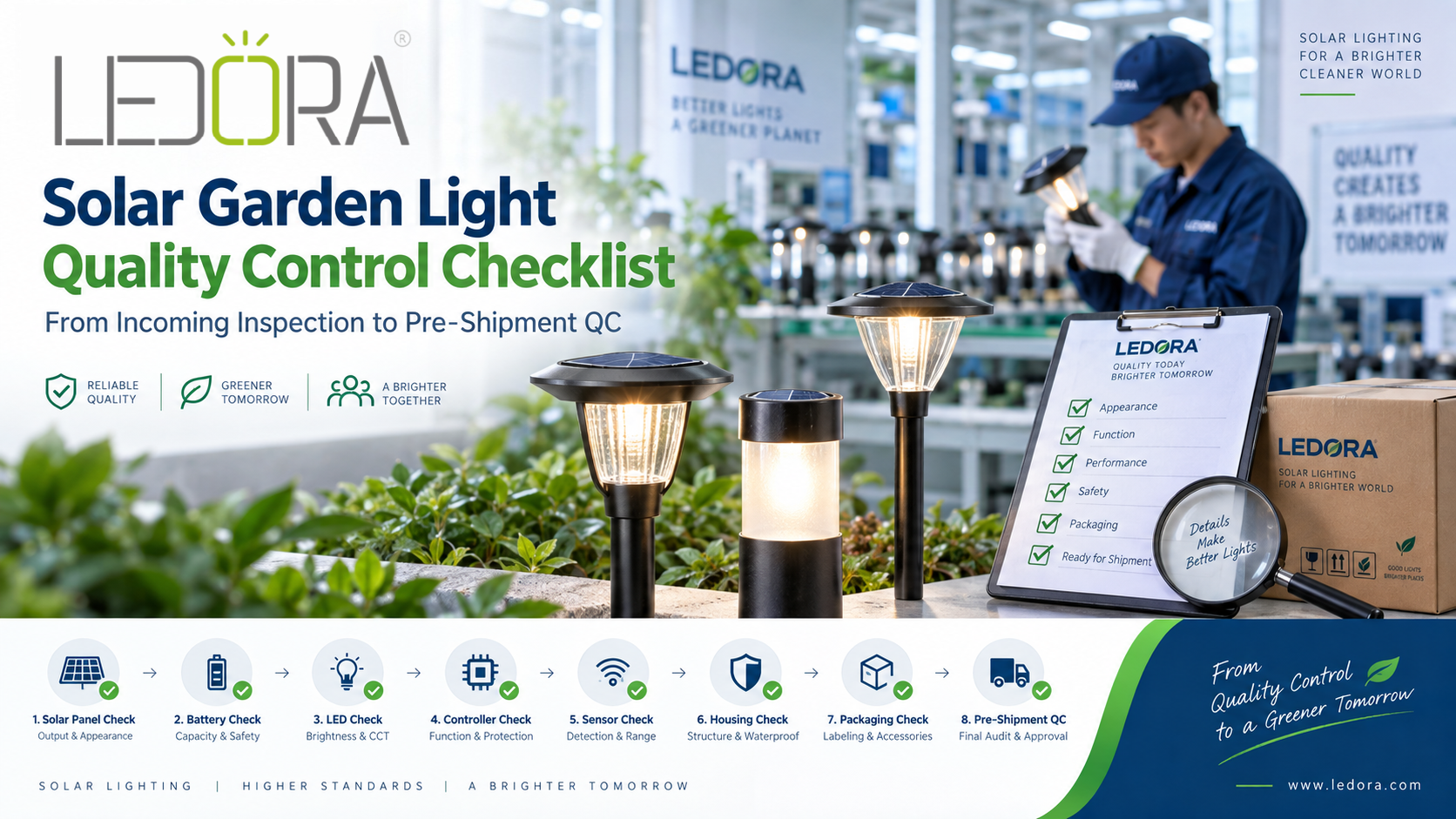
For a broader inspection process, read LEDORA’s Solar Garden Light Quality Control Checklist.

Natural Sunlight Testing vs Solar Simulator Testing
Natural Sunlight Testing
Natural sunlight testing reflects real outdoor use.
However, results may change because of:
- Time of day
- Weather
- Season
- Cloud movement
- Panel angle
- Temperature
- Test location
The test record should include these conditions.
Solar Simulator Testing
A suitable solar simulator can provide more repeatable test conditions.
It can be used to compare:
- Different panel batches
- Approved samples and production panels
- Voltage and current output
- Charging consistency
Photovoltaic current-voltage characteristics can be measured under natural or simulated sunlight using defined procedures. Buyers do not need to perform a full laboratory-standard module test for every small garden light, but the measurement principle shows why repeatable lighting conditions are important.
Best Practical Approach
For wholesale solar garden lights, use both methods where appropriate:
- Controlled testing for component comparison
- Outdoor solar charging for real-use verification
A product should not be approved only because it works for a long time after USB charging.
For additional guidance, read LEDORA’s Solar Garden Light Runtime Guide.
How to Match the System to the Target Market
Entry-Level Decorative Retail
Priorities may include:
- Attractive appearance
- Competitive cost
- Simple dusk-to-dawn operation
- Warm white or colorful light
- Compact packaging
A small panel and Ni-MH battery may be suitable when the LED load is low.
Ecommerce Products
Buyers may prioritize:
- Reliable customer-facing runtime
- Clear installation instructions
- Easy product demonstration
- Consistent multipack performance
- Low complaint rate
Charging conditions and realistic runtime claims should be clearly explained in the product listing.
Retail Chains
Retail programs may require:
- Stable specifications
- Private-label packaging
- Compliance information
- Seasonal delivery planning
- Consistent performance across large quantities
The solar panel and battery should be recorded in the approved specification sheet.
Landscape and Project Buyers
Project customers may prioritize:
- Functional brightness
- Longer service periods
- Consistent lighting
- Better materials
- Stronger outdoor protection
- Replaceable components
- Technical documentation
Higher-output products usually require larger solar panels and lithium battery systems.
For additional market-selection guidance, read LEDORA’s Solar Garden Light Wholesale Buying Guide.
Common Solar Panel and Battery Matching Mistakes
Mistake 1: Comparing Battery Capacity Only by mAh
A 1200mAh battery at 3.7V stores substantially more nominal energy than a 1200mAh battery at 1.2V.
Voltage and capacity must be considered together.
Mistake 2: Requesting the Largest Battery Without Changing the Panel
A larger battery may remain partially charged when the original solar panel is retained.
Mistake 3: Checking Panel Voltage but Ignoring Current
Two 2V panels can provide very different charging performance.
Mistake 4: Using USB Runtime as Proof of Solar Performance
USB charging may fully charge the battery, while outdoor solar charging may only provide part of the required energy.
Mistake 5: Using the Same Panel for Several Brightness Versions
A product offered in low-, medium- and high-brightness versions may require different panel or battery configurations.
Mistake 6: Ignoring Standby and Motion-Sensor Modes
A motion sensor light may achieve long operating time because it does not remain at full brightness continuously.
Mistake 7: Accepting Unclear Units
Solar panel current should normally be stated in mA or A.
Battery capacity is normally stated in mAh or Ah.
A quotation that uses battery-capacity units for a solar panel may contain a specification error and should be clarified before approval.
Mistake 8: Ignoring Production Tolerance
Panels and batteries from different batches may not provide identical performance.
Bulk-production components should be randomly tested against the approved sample.
Solar Panel and Battery Red Flags
Buyers should request clarification when they see:
- Solar panel voltage listed without current or power
- Battery capacity listed without voltage
- Very large battery paired with a very small panel
- Identical panel specification for substantially different LED loads
- Very short charging time with a low-power panel and large battery
- Very long runtime with no brightness or mode information
- Solar runtime tested only through USB charging
- No panel dimensions
- No battery chemistry
- Supplier unwilling to confirm the mass-production battery
- No sample-to-production component comparison
- No panel current test
- No charging record
- No outdoor solar test
These points do not automatically prove that the product is unsuitable.
They indicate that more technical information is required.
OEM Solar Panel and Battery Customization
LEDORA supports OEM and ODM discussions for selected solar garden lighting projects.
Possible adjustments may include:
- Solar panel size
- Solar panel voltage
- Solar panel current
- Solar panel power
- Battery chemistry
- Battery capacity
- LED quantity
- LED power
- Lighting modes
- Motion-sensor settings
- Timer functions
- Housing color
- Logo
- Private-label packaging
- Instruction manuals
The customization process should begin with the target result.
Buyers should define:
- Required brightness
- Expected working time
- Available daily sunlight
- Installation location
- Lighting mode
- Target cost
- Destination market
- Product dimensions
- Packaging limitations
LEDORA can then evaluate whether the existing product configuration is suitable or whether the solar panel, battery, controller and LED load should be adjusted together.

Questions to Ask a Solar Garden Light Supplier
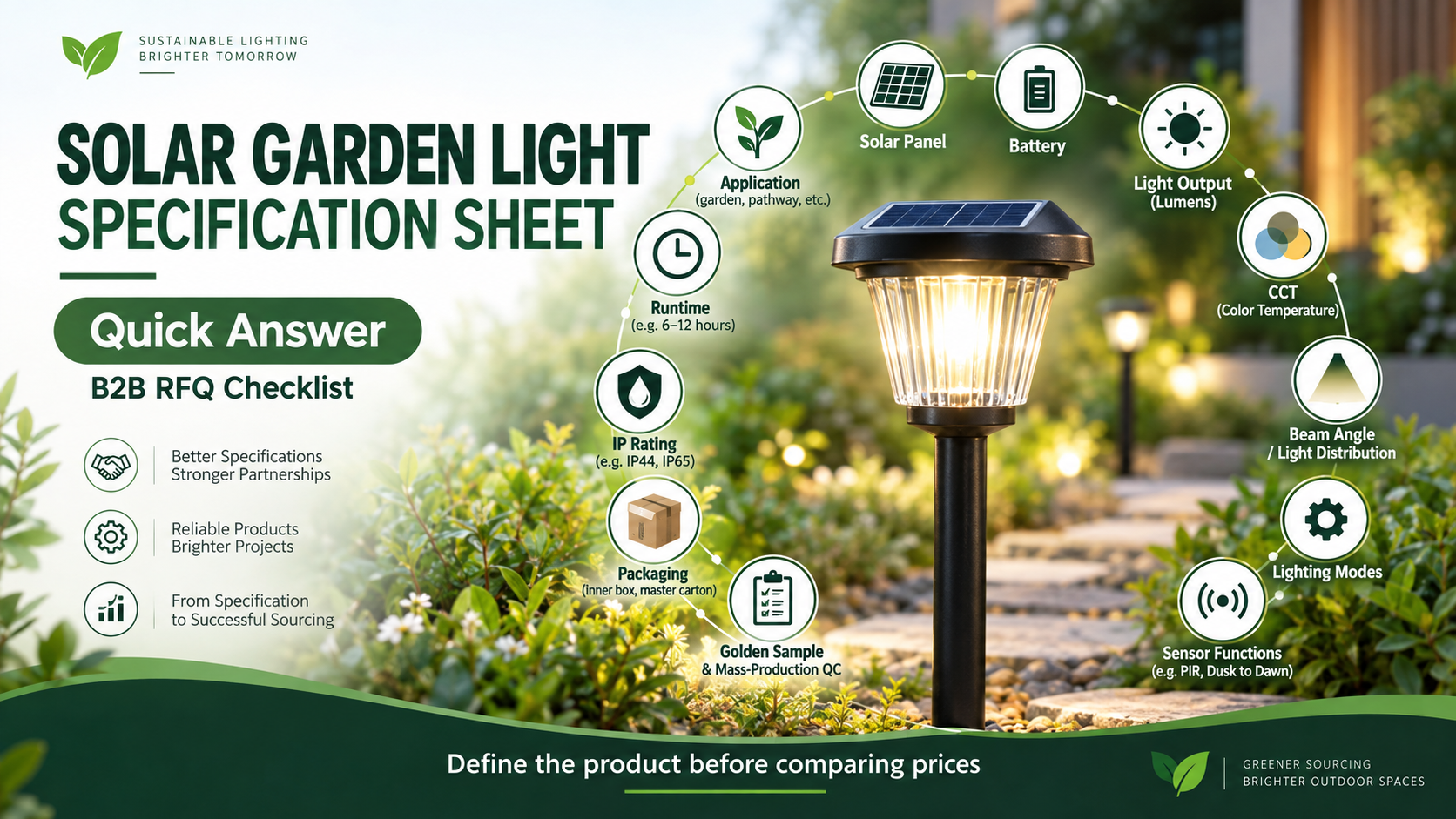
Before approving a sample or placing a bulk order, ask:
- What type of solar panel does the product use?
- What are the panel voltage, current and power?
- What are the exact panel dimensions?
- What battery chemistry is used?
- What are the battery voltage and capacity?
- What is the battery’s approximate watt-hour capacity?
- How long does a full solar charge require?
- Under what conditions was charging time tested?
- Was runtime tested after solar charging or USB charging?
- What LED power and brightness are used?
- Which lighting mode was used for the runtime test?
- Does brightness decrease during the night?
- Can the supplier provide panel voltage and current test records?
- Will mass production use the same panel and battery as the sample?
- Can the panel or battery be customized?
- Will customization affect the housing or waterproof structure?
- Will lithium battery documents need to be updated?
- Can outdoor solar-charging videos or records be provided?
Solar Panel Inspection Checklist
| Inspection Area | What to Verify |
|---|---|
| Panel appearance | No cracks, scratches, delamination or surface contamination |
| Panel dimensions | Match approved drawing and product structure |
| Voltage | Matches approved specification under defined conditions |
| Current | Meets the agreed reference under repeatable lighting |
| Power | Consistent with voltage and current specification |
| Polarity | Positive and negative wiring are correct |
| Cable | Correct length, material and connection |
| Connector | Correct size, fit and waterproof structure |
| Encapsulation | No gaps, bubbles or loose edges |
| Mounting | Correct holes, brackets or adhesive position |
| Charging test | Battery voltage increases as expected |
| Production consistency | Random units match the approved sample |
The checklist should be adapted to the exact product and order requirements.
Frequently Asked Questions
What solar panel size is best for a solar garden light?
There is no universal best size. The panel must be matched with the battery capacity, LED load, target working time, product dimensions and local sunlight conditions.
Is a larger solar panel always better?
No. A larger panel may provide more charging power but can also increase cost, packaging size and installation requirements. The correct panel is the one that supports the required product performance.
Is a larger battery always better?
No. A larger battery cannot provide its full benefit if the solar panel cannot recharge it.
How can buyers compare solar panel power?
Check the panel voltage, current and rated wattage. A basic power calculation is voltage multiplied by current.
Why is panel current important?
Current strongly affects charging speed. Two panels with the same voltage may charge differently if their current outputs are different.
What is the difference between mA and mAh?
mA measures electrical current. mAh measures battery capacity over time. They describe different specifications and should not be used interchangeably.
Can a 2V panel charge a 1.2V battery?
This is a common configuration in small Ni-MH solar lights, but actual suitability depends on the charging circuit, panel current and complete product design.
Can a 5.5V panel charge a 3.7V lithium battery?
This is common in selected lithium-powered solar lights, but the charging and protection circuit must be correctly designed.
Why does a solar light work longer after USB charging?
USB charging may provide a complete battery charge, while one outdoor day may provide only a partial solar charge.
Should solar panel output be tested before bulk production?
Yes. Voltage, current, polarity, dimensions and charging performance should be compared with the approved sample.
Can LEDORA customize solar panel and battery configurations?
Selected configurations can be discussed according to product structure, target performance, order quantity and technical feasibility.
Does changing the battery require a larger solar panel?
Not always, but increasing battery capacity may require more panel power or longer charging time. The complete energy balance should be evaluated.
Final Recommendation
Reliable solar garden light performance depends on a balanced relationship between:
- Solar panel voltage
- Solar panel current
- Solar panel power
- Battery voltage
- Battery capacity
- LED energy consumption
- Controller efficiency
- Lighting mode
- Target runtime
- Available sunlight
For wholesale buyers, the correct approach is not:
Choose the largest battery and the cheapest panel.
The better approach is:
Define the target brightness and runtime, then verify that the panel, battery, controller and LEDs can achieve that result under realistic charging conditions.
A balanced system helps buyers reduce:
- Short runtime
- Incomplete charging
- Weak brightness
- Battery complaints
- Sample-to-production differences
- Unnecessary component cost
- Customer returns
LEDORA supplies solar pathway lights, ground lights, fence lights, decorative garden lights and motion sensor lighting for wholesalers, retailers, ecommerce sellers and private-label brands.
Buyers can review the LEDORA solar garden lights manufacturer and OEM supplier page, explore the complete solar garden light collection or visit the LEDORA official Alibaba supplier page for additional product information.
Request a Solar Panel and Battery Comparison
Contact LEDORA to request:
- Latest solar garden light catalogue
- Solar panel specifications
- Battery specifications
- Product energy comparison
- Sample quotation
- Charging and runtime information
- OEM configuration options
- Private-label packaging
- Model-specific certification information
- Bulk-order pricing
- Estimated production lead time
Contact LEDORA for a Solar Garden Lighting Quotation
Please provide:
- Target product category
- Destination market
- Estimated quantity
- Required brightness
- Expected working time
- Available daily sunlight
- Lighting mode
- Packaging requirements
- Customization requirements
Our team will help you compare suitable solar panel, battery and lighting configurations for your project.