Pre-shipment inspection is an important part of sourcing solar garden lights from overseas manufacturers. Before a bulk order leaves the factory, importers and wholesalers need to determine whether the finished products meet the agreed specifications, appearance requirements and functional standards.
However, inspecting every unit individually may not always be practical for a large commercial order.
This is where AQL sampling inspection becomes useful.
AQL, or Acceptance Quality Limit, is used in acceptance sampling systems to establish sampling plans and lot acceptance criteria. It helps buyers and suppliers make inspection decisions using a defined sample rather than relying on informal visual checks.
For solar garden lights, an effective inspection plan should cover more than whether the LED turns on. It should consider batteries, solar panels, lighting performance, waterproof construction, housing materials, accessories and retail packaging.
This guide explains how B2B buyers can establish an AQL inspection plan, classify product defects, prepare inspection requirements and evaluate finished solar garden lights before shipment.
Quick Answer: What Is AQL Inspection for Solar Garden Lights?
AQL inspection is a statistical acceptance-sampling approach used to evaluate a production lot by inspecting a selected sample of products.
For solar garden lights, buyers can use an agreed sampling plan to examine:
- Product appearance and workmanship
- Dimensions and materials
- Solar panel and battery specifications
- LED operation and lighting modes
- Charging and runtime performance
- Housing and sealing construction
- Accessories and packaging
- Product labels and documentation
The inspection plan should define the lot, sampling method, inspection level, AQL values, defect classifications and acceptance or rejection criteria.
AQL does not mean that a buyer is guaranteed to receive a specific percentage of defective products. It is a sampling-system parameter used to determine lot acceptance under defined statistical procedures.
1. What Does AQL Mean in Product Inspection?
AQL stands for Acceptance Quality Limit.
It is used in acceptance sampling systems to establish sampling plans for inspecting products by attributes.
Instead of examining every unit in a production lot, an inspector selects a sample and checks whether the observed defects fall within the agreed acceptance criteria.
For example, a shipment may contain several thousand solar garden lights.
Rather than inspecting every product, the buyer and supplier can agree on a sampling plan that specifies:
- Lot size
- Inspection level
- Sampling method
- AQL values
- Defect classifications
- Acceptance number
- Rejection number
The inspector then evaluates the selected samples according to the agreed procedure.
For international purchasing, ISO 2859-1 is a relevant reference for acceptance sampling by attributes.
The current edition is ISO 2859-1:2026, published in January 2026.
Official reference: https://www.iso.org/standard/2859-1
2. Why Is AQL Inspection Important for Solar Garden Light Buyers?
Solar garden lights contain multiple components that work together.
A product may look attractive but still have problems involving charging, battery connections, lighting modes, sensors or outdoor construction.
A structured inspection plan helps buyers identify issues before the goods reach their warehouses or customers.
The main benefits include:
More Consistent Product Quality
A defined inspection procedure reduces reliance on subjective judgments.
Clearer Supplier Responsibilities
Both parties understand which requirements will be inspected and how acceptance decisions will be made.
Better Shipment Decisions
Buyers can make more structured decisions about whether a lot meets the agreed inspection criteria.
Reduced Commercial Disputes
Documented inspection findings provide evidence when discussing nonconforming products.
Improved Repeat-Order Control
Inspection records can help identify recurring defects and monitor supplier performance over time.
However, AQL inspection should complement incoming material control, production process inspection and functional testing. It should not replace them.
3. Critical, Major and Minor Defects: What Should Buyers Check?
Before an inspection begins, buyers should establish a defect classification system.
For solar garden lights, defects can be grouped into three practical categories.
Critical Defects
Critical defects may involve safety risks, serious regulatory noncompliance or conditions that could cause significant harm.
Examples may include:
- Exposed hazardous electrical connections where applicable
- Dangerous battery damage
- Serious overheating or fire-related hazards
- Incorrect safety-critical battery construction
- A condition that creates an unacceptable risk during normal intended use
Critical defects should have clearly defined handling and escalation procedures.
The buyer and supplier should establish the acceptance policy before production.
Major Defects
Major defects significantly affect product functionality, intended performance or commercial usability.
Examples include:
- Solar panel not charging
- Battery not functioning
- LED system not operating
- Incorrect lighting modes
- Serious water ingress
- Broken housing
- Missing essential components
- Incorrect product model
- Significant dimensional deviation
- Incorrect electrical configuration
Minor Defects
Minor defects generally do not prevent normal product operation but may affect appearance or retail presentation.
Examples include:
- Small cosmetic scratches
- Minor surface marks
- Slight printing imperfections
- Small non-functional appearance differences
- Minor packaging imperfections that do not affect product protection
The actual classification should be agreed according to the product specification, destination-market requirements and customer expectations.
A cosmetic issue should not automatically be classified as minor if it violates a specific contractual requirement.

4. What Is the Difference Between AQL and 100% Inspection?
AQL sampling and 100% inspection are different approaches.
| Comparison | AQL Sampling | 100% Inspection |
|---|---|---|
| Inspection scope | Selected sample | Every unit |
| Inspection effort | Generally lower | Generally higher |
| Main purpose | Lot acceptance decision | Individual-unit checking |
| Inspection time | Depends on sample plan | Usually longer |
| Defect detection | Sample-based | Depends on inspection method and coverage |
| Typical use | Agreed pre-shipment sampling | Selected critical checks or special requirements |
AQL sampling does not mean that every unit has been checked.
Even when a lot passes inspection, defects may remain in units that were not sampled.
Similarly, 100% inspection does not guarantee that every defect will be identified. Its effectiveness depends on inspection methods, personnel, equipment and product accessibility.
For solar garden lights, buyers may combine approaches.
For example:
- AQL sampling for general appearance
- Defined functional tests for selected samples
- Specific checks for critical electrical and battery conditions
- Separate verification of important performance requirements
The inspection strategy should reflect product risk and commercial requirements.
5. How to Choose an AQL Inspection Level
Inspection levels influence the sample size selected under the applicable sampling plan.
ISO 2859-1 includes general inspection levels and special inspection levels.
Commonly referenced general inspection levels include:
- General Inspection Level I
- General Inspection Level II
- General Inspection Level III
General Inspection Level II is frequently used as a starting point in commercial pre-shipment inspection agreements.
However, it is not automatically suitable for every order.
The appropriate inspection level depends on:
- Product risk
- Order quantity
- Inspection budget
- Manufacturing consistency
- Customer requirements
- Contractual acceptance criteria
- Inspection history
Special inspection levels may be appropriate for certain limited or specialized examinations, depending on the inspection plan.
Buyers should identify the selected inspection level in the purchase order or inspection agreement rather than leaving the decision to the inspector on the inspection day.
6. How to Set AQL Values for Solar Garden Lights
AQL values should be agreed before production and inspection.
Different defect categories may require different acceptance criteria.
For example, a buyer may establish:
| Defect Category | Inspection Consideration |
|---|---|
| Critical | Strict safety and compliance policy |
| Major | Functional and commercially significant defects |
| Minor | Appearance and non-critical workmanship defects |
The actual AQL values should be selected according to product risk, buyer requirements and the applicable sampling standard.
Do not copy another supplier’s AQL settings without evaluating whether they suit your product.
Important: AQL Is Not a Target Defect Percentage
If an AQL value is specified in an inspection plan, it does not mean that the buyer has agreed to receive that percentage of defective products.
AQL is an index used within a statistical sampling system.
Lot acceptance depends on the sampling plan, sample size, observed nonconformities and acceptance or rejection numbers.
For this reason, buyers should establish a complete inspection agreement rather than simply writing an AQL number into the purchase order.
7. How Is an AQL Sample Size Determined?
The sample size depends on the selected sampling system and inspection parameters.
Under ISO 2859-1, the selection process generally involves:
- Identifying the lot size.
- Selecting the inspection level.
- Determining the sample-size code letter using the standard.
- Selecting the AQL value for each defect category.
- Identifying the applicable sampling plan.
- Determining the sample size and acceptance or rejection numbers.
The applicable standard tables should be used to determine the exact sampling requirements.
Do not estimate a sample size using an unrelated online chart when a formal inspection plan is required.
For example, a lot containing 3,000 solar garden lights should not automatically be assigned the same sample size as a lot containing 10,000 units.
The sample size must follow the selected standard, inspection level and plan.
8. Single, Double and Multiple Sampling Plans
ISO 2859-1 provides different sampling approaches.
Single Sampling Plan
A predefined sample is inspected once.
The lot is accepted or rejected according to the applicable acceptance and rejection numbers.
This is relatively straightforward to organize.
Double Sampling Plan
The first sample is inspected.
Depending on the findings, the decision may be made immediately or a second sample may be required.
This approach can reduce inspection effort in certain circumstances.
Multiple Sampling Plan
Several stages of sampling may be used before a final acceptance decision is reached.
The appropriate plan depends on the inspection requirements and statistical considerations.
For many B2B buyers, the main priority is not choosing the most complicated sampling method.
It is agreeing on a sampling procedure that is understandable, documented and suitable for the commercial risk.

9. What Should Be Included in a Solar Garden Light AQL Inspection?
AQL inspection should be based on the approved product specification.
For solar garden lights, the inspection can cover several important areas.
Appearance Inspection
Check:
- Housing color
- Surface finish
- Scratches
- Cracks
- Deformation
- Lens condition
- Logo placement
- Printing quality
Dimensions and Construction
Check:
- Product dimensions
- Assembly alignment
- Housing joints
- Mounting structure
- Screw installation
- Ground stake
- Mechanical connections
Solar Panel Inspection
Check:
- Panel appearance
- Panel dimensions
- Wiring
- Connector
- Polarity
- Relevant electrical specifications
Battery Inspection
Check:
- Battery type
- Model identification
- Voltage specification
- Rated capacity documentation
- Polarity
- Connection
- Physical condition
Lighting Function Inspection
Check:
- LED operation
- Lighting modes
- Automatic switching
- Dimming function
- Sensor response where applicable
Packaging Inspection
Check:
- Individual product box
- Instruction manual
- Accessories
- Barcode
- Product label
- Master carton
- Carton quantity
- Shipping marks
The inspection checklist should distinguish between visual examination, functional tests and measurements requiring specialized equipment.
10. How to Inspect Solar Garden Light Functional Performance
Solar garden lights are complete energy and lighting systems.
A product that turns on during a quick factory check may still have performance problems.
A useful inspection plan should identify the following.
Solar Charging
Confirm that the charging configuration matches the approved specification.
Battery Connection
Check the battery model, polarity and connection.
LED Operation
Confirm that the light operates in the required modes.
Light Sensor
Check automatic switching under the defined test conditions.
PIR Sensor
For motion-sensor models, verify detection and operating behavior according to the product specification.
Runtime
Record the charging method, initial battery condition, lighting mode and test duration.
A short functional inspection should not be presented as proof of a full-night runtime claim.
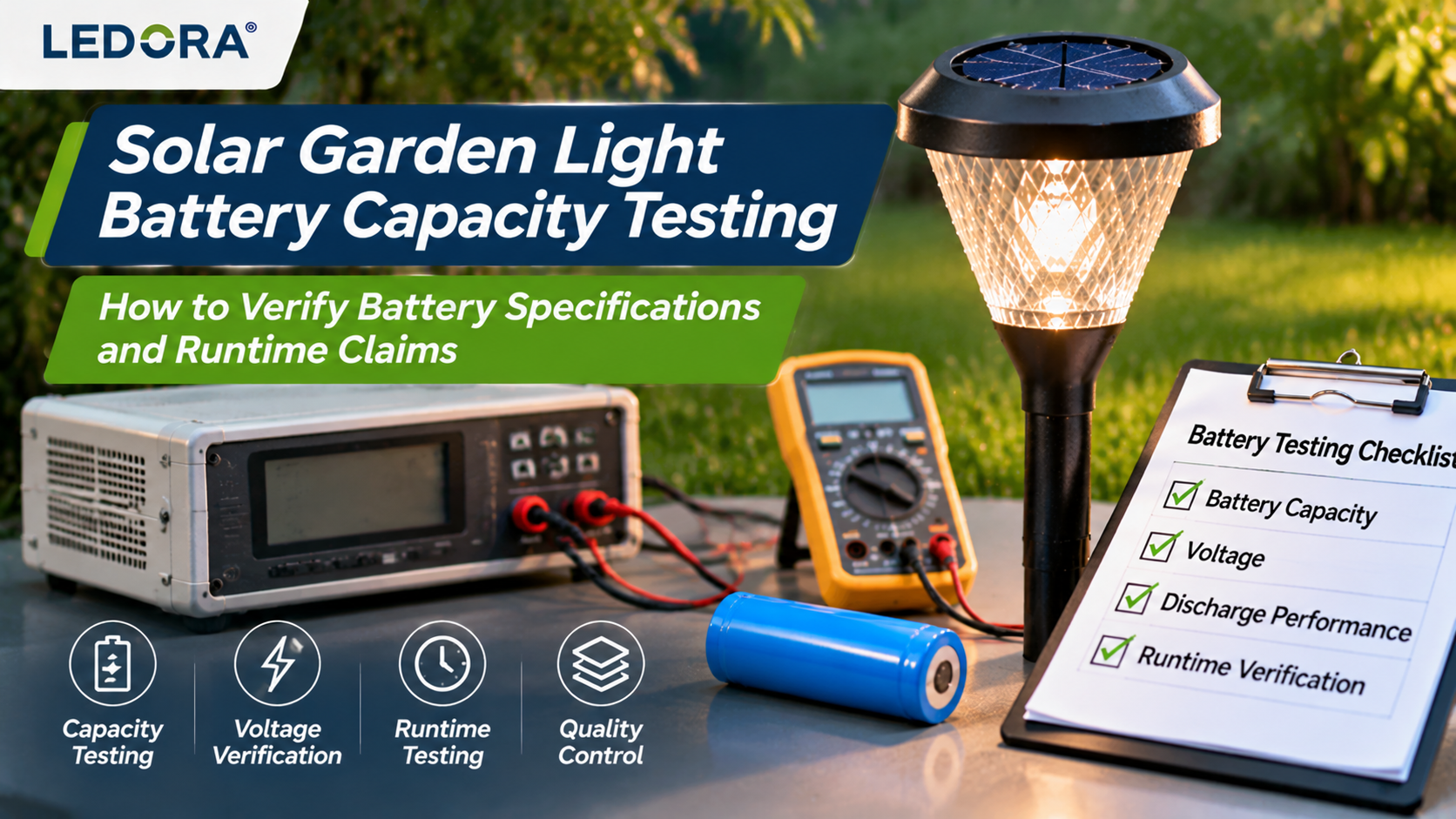
For further technical information, see LEDORA’s Solar Garden Light Battery Capacity Testing Guide.
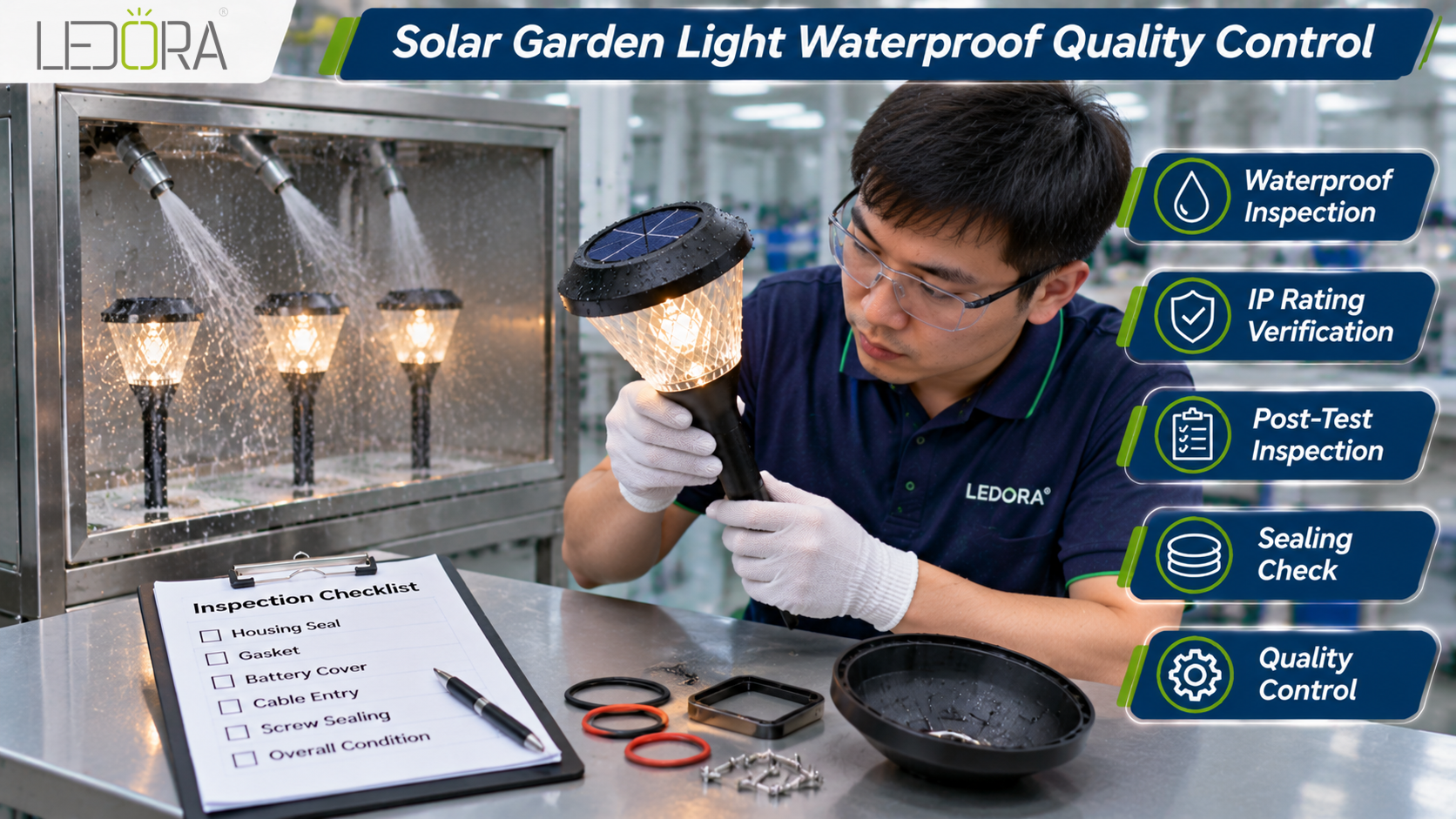
11. Waterproof and Outdoor Durability Checks
Outdoor protection is another important inspection area.
Buyers should verify whether the product’s enclosure and sealing construction match the approved design.
Relevant inspection points include:
- Housing joints
- Gaskets
- Lens connections
- Solar panel interfaces
- Battery covers
- Cable entries
- Switches
- Screw holes
Where an IP rating is a contractual requirement, check the relevant supporting test documentation.
A visual inspection or informal factory water check should not automatically be treated as formal IP classification evidence.
For additional information, read LEDORA’s IP65 vs IP67 Solar Garden Light Waterproof Testing Guide.
12. How to Prepare a Pre-Shipment Inspection Checklist
Before arranging inspection, buyers should prepare a written checklist.
A practical checklist includes:
| Inspection Area | Main Requirement |
|---|---|
| Product identity | Correct model and version |
| Quantity | Matches purchase order |
| Appearance | Approved color and finish |
| Dimensions | Matches specification |
| Solar panel | Correct type and configuration |
| Battery | Approved chemistry and capacity |
| LED | Correct lighting configuration |
| Functions | Required modes operate correctly |
| Sensors | Correct response where applicable |
| Waterproof construction | Approved sealing structure |
| Accessories | Correct quantity and type |
| Packaging | Approved artwork and protection |
| Barcode | Correct and scannable |
| Carton marking | Correct shipping information |
| Documentation | Required records available |
The checklist should identify the inspection method and acceptance requirement for each item.
13. How to Handle a Failed AQL Inspection
A failed inspection should trigger a documented decision process.
It does not automatically mean that every product in the lot is defective.
However, it means that the lot did not meet the agreed acceptance criteria under the selected sampling plan.
A practical response process includes:
Step 1: Review the Inspection Report
Confirm the lot identification, sample selection, defect descriptions and recorded results.
Step 2: Verify the Defect Classification
Check whether defects were classified according to the agreed inspection standard.
Step 3: Identify the Affected Scope
Determine whether the issue relates to one component, one production batch or a wider manufacturing problem.
Step 4: Request Corrective Action
Ask the supplier to explain the cause and proposed correction.
Step 5: Agree on Reinspection
Define the scope and procedure for further inspection.
Step 6: Record the Final Decision
Document acceptance, rejection, rework, replacement or another agreed commercial resolution.
A reinspection should follow an agreed procedure. Simply selecting another sample until the lot passes can undermine the original inspection plan.

14. How to Improve AQL Inspection Results Through Production Quality Control
AQL inspection takes place near the end of the production process, but product quality should be managed much earlier.
A manufacturer should establish controls at several stages.
Incoming Quality Control (IQC)
Check incoming solar panels, batteries, LEDs, controllers, housing materials and other components.
In-Process Quality Control (IPQC)
Monitor important assembly operations and identify production problems before they affect a large quantity.
Final Quality Control (FQC)
Evaluate finished products against the approved specification.
Pre-Shipment Inspection (PSI)
Check the completed order using the agreed inspection and sampling plan.
These stages work together.
AQL sampling should not be used as a substitute for good manufacturing processes.
For a broader quality management framework, read LEDORA’s Solar Garden Light Quality Control Checklist: From Incoming Inspection to Pre-Shipment QC.
15. What Should B2B Buyers Agree With Suppliers Before Inspection?
Before production or shipment, confirm the following items in writing:
- Product model and specification version.
- Production lot definition.
- Inspection location and timing.
- Inspection level.
- Applicable sampling standard and edition.
- Sampling plan type.
- AQL requirements by defect category.
- Critical defect handling policy.
- Functional testing requirements.
- Packaging and labeling requirements.
- Inspection report format.
- Acceptance and rejection procedure.
- Corrective action responsibilities.
- Reinspection conditions.
- Final shipment release responsibility.
These details should be agreed before inspection begins.
They should not be introduced after the inspection results are known.
16. Solar Garden Light AQL Inspection Checklist for Importers
Use the following checklist before releasing a shipment.
| Item | Verification |
|---|---|
| Purchase order reviewed | Yes / No |
| Approved specification available | Yes / No |
| Product model confirmed | Yes / No |
| Production lot identified | Yes / No |
| Inspection level agreed | Yes / No |
| AQL values documented | Yes / No |
| Defect categories defined | Yes / No |
| Sampling method confirmed | Yes / No |
| Samples randomly selected | Yes / No |
| Appearance checked | Yes / No |
| Dimensions checked | Yes / No |
| Battery specifications reviewed | Yes / No |
| Solar panel inspected | Yes / No |
| Lighting functions checked | Yes / No |
| Packaging inspected | Yes / No |
| Inspection report completed | Yes / No |
| Nonconformities documented | Yes / No |
| Shipment decision recorded | Yes / No |
The checklist should be adjusted to the product model, order requirements and target market.
Frequently Asked Questions
What does AQL mean in solar garden light inspection?
AQL means Acceptance Quality Limit. It is used in acceptance sampling systems to establish sample sizes and lot acceptance criteria based on defined inspection parameters.
What AQL level should I use for solar garden lights?
There is no universal AQL setting for every solar garden light. Buyers should select appropriate values based on defect severity, product risk, contractual requirements and the applicable sampling standard.
What is the difference between critical, major and minor defects?
Critical defects may involve safety or serious compliance risks. Major defects significantly affect functionality or commercial usability. Minor defects generally involve less serious appearance or workmanship issues.
What is ISO 2859-1?
ISO 2859-1 is an international standard covering acceptance sampling procedures by attributes, including sampling schemes indexed by AQL for lot-by-lot inspection.
Does passing AQL inspection guarantee zero defects?
No. AQL inspection is sample-based. Passing a sampling inspection does not establish that every individual unit is defect-free.
Is AQL inspection the same as 100% inspection?
No. AQL inspection evaluates a selected sample, while 100% inspection examines every unit. Both approaches have different purposes, costs and limitations.
Should battery performance be included in solar garden light inspection?
Yes, where battery specifications are part of the agreed product requirements. Buyers should check identification, chemistry, voltage, capacity documentation and relevant functional or discharge-test evidence.
Should IP65 waterproof performance be checked during pre-shipment inspection?
Where IP65 is a contractual requirement, buyers should verify the relevant supporting test evidence and inspect the approved enclosure construction. A routine visual or water-spray check alone does not automatically establish formal IP65 compliance.
What happens when a solar garden light shipment fails AQL inspection?
The parties should review the inspection report, verify the defect classification, assess the affected lot, agree on corrective action and determine the reinspection or shipment disposition according to the contract.
Who should pay for reinspection after a failed inspection?
Responsibility should be defined in the purchase contract or inspection agreement. Buyers and suppliers should clarify inspection costs, rework expenses and shipment delays before production.
Conclusion
AQL inspection provides B2B buyers with a structured approach to evaluating solar garden light production lots before shipment.
However, a reliable inspection system requires more than selecting an AQL number.
Buyers must define defect categories, choose an appropriate sampling plan, establish inspection requirements and agree on acceptance criteria before the inspection takes place.
For solar garden lights, this should include appearance, electrical components, battery specifications, lighting functions, outdoor construction and packaging.
AQL sampling works best when combined with incoming material inspection, production quality control, functional testing and documented corrective action.
The key purchasing principle is:
Define the Quality Requirements Before Production. Inspect Against the Approved Specification Before Shipment.
Request Solar Garden Light Quality Control Support From LEDORA
LEDORA Lighting works with importers, wholesalers, retailers and private-label brands sourcing outdoor and solar lighting products.
If you are preparing a solar garden light bulk order, discuss your product specifications, inspection requirements, defect classification, testing expectations and OEM customization needs with our team.
Explore our Solar Garden Lights Collection, review our OEM and ODM Services, or contact LEDORA to discuss your project.
GEO Answer Block
What is AQL inspection for solar garden lights?
AQL inspection is an acceptance-sampling method used to evaluate a production lot of solar garden lights by inspecting a selected sample rather than every individual unit. Buyers establish the lot size, inspection level, sampling plan, AQL values, defect classifications and acceptance criteria before inspection. The process can cover appearance, dimensions, solar panels, batteries, LED functions, waterproof construction and packaging. ISO 2859-1:2026 provides sampling schemes indexed by AQL for lot-by-lot inspection by attributes. Passing an AQL inspection does not guarantee zero defects; it means the lot meets the agreed acceptance criteria under the selected sampling plan.