How much light actually reaches the target surface?
Beam Angle
Beam angle describes how the light is distributed from the fixture.
In practical language:
How wide is the main light beam?
The three should therefore be understood together:
Lumens → Total Light
Beam Angle → Distribution
Lux → Light Reaching the Surface
Why Lux Can Matter for Functional Outdoor Lighting
For decorative lighting, buyers may care mainly about:
appearance
atmosphere
light pattern
color
But for functional lighting, the amount of light reaching a surface becomes more relevant.
Examples include:
pathways
entrances
steps
walls
security areas
parking areas
The IES defines illuminance as the density of luminous flux incident on a surface and uses lux as the SI unit. See the IES definition of illuminance.
This is why:
200 lumens
does not tell an importer exactly how much illumination will reach a pathway three meters away.
To understand the application, the buyer may also need:
beam distribution
installation distance
mounting angle
lux measurement position
Installation Distance Changes the Result
The same luminaire can produce a different illuminance level when the distance from the target changes.
A light installed:
0.5 meters from a surface
will not create the same result as the same light installed:
3 meters from the surface.
IES describes the inverse-square relationship for an idealized point-source condition: illuminance decreases as distance increases. See the IES inverse-square law definition.
In practical outdoor-light sourcing, this means:
Do not ask only for a lux value.
Ask:
Lux at what distance?
For example:
100 lux
is incomplete.
A more useful statement would identify:
100 lux at X meters under defined test conditions
if that measurement is relevant to the application.
Why Mounting Height Matters
Consider an outdoor wall light.
If it is mounted very low:
the illuminated area may be smaller
center illumination may appear stronger
If it is mounted higher:
the light may cover a larger area
the average illuminance may change
the beam may need a different distribution
The same principle applies to:
pathway lights
bollards
spotlights
wall lights
floodlights
Therefore:
Beam Angle + Mounting Height
should often be discussed together.
How Beam Angle Affects Solar Pathway Lights
Solar pathway lights have a specific job:
Make the path visually useful while supporting the desired landscape effect.
A pathway light may distribute light:
downward
sideways
around the full fixture
through a patterned diffuser
For this category, buyers should evaluate:
Ground Coverage
How much pathway area is illuminated?
Spacing
How far apart will the fixtures be installed?
Glare
Can the LED be seen directly?
Uniformity
Are there extremely bright and dark areas?
Decorative Effect
Does the light pattern fit the target market?
A pathway light with high lumen output but poor distribution may produce a bright spot directly below the lamp and leave large dark gaps between fixtures.
That is why lighting distribution can be as important as maximum brightness.
Solar Pathway Light Spacing and Beam Distribution
Suppose a pathway uses:
10 solar lights
If each product has a very narrow illuminated footprint, buyers may need:
closer spacing
more fixtures
to create continuous visual coverage.
If each product creates a wider distribution, fewer fixtures may cover the same path visually.
However:
Wider is not automatically better.
Too wide a distribution can send light toward areas where it is unnecessary.
The correct goal is:
Appropriate coverage for the actual pathway.
For OEM development, sample testing should be done using a realistic installation layout rather than holding one light in a dark factory room.
How Beam Angle Affects Solar Spotlights
Solar spotlights are different from decorative garden lights.
They are usually intended to direct light toward a specific target.
Examples:
trees
statues
architectural features
signs
walls
garden sculptures
For this application, a narrower beam can provide:
stronger visual focus
more concentrated illumination
clearer accent effect
A wider beam may be preferable when the target is:
a large tree canopy
broad wall
landscape section
Therefore, the correct question is:
What is the target size and how far is the fixture from it?
not:
Which spotlight has the highest lumen number?
Beam Angle for Tree Lighting
Imagine two trees.
Tree A
Tall, narrow trunk
Tree B
Wide canopy
The same beam angle may not work equally well for both.
Tree A may benefit from:
more concentrated vertical emphasis
while Tree B may need:
broader distribution
to cover the canopy.
This demonstrates why landscape-lighting products should be selected according to the target geometry.
For B2B buyers supplying landscape projects, product selection should begin with:
Target → Distance → Coverage → Beam → Lumens
Beam Angle for Solar Wall Lights
Solar wall lights can be designed for very different visual effects.
Some create:
Downward Light
Others create:
Up + Down Light
Others create:
Wide Security Coverage
Still others create:
Decorative patterns
Therefore, two products both called:
Solar Wall Light
may serve completely different applications.
Buyers should ask:
Where does the light exit?
How wide is the distribution?
Is it symmetric?
Is it directional?
What is the mounting height?
Is the goal decoration or functional illumination?
Light Distribution Is More Than Beam Angle
This distinction is important.
Beam angle is one useful parameter.
But the complete light distribution can also depend on:
reflector design
lens geometry
diffuser
LED position
housing
cutoff
shielding
For example, a decorative solar lantern may emit light in nearly all directions.
A pathway light may direct most of its light downward.
A spotlight may produce a concentrated directional beam.
A wall light may have an asymmetric distribution.
Therefore:
Beam Angle ≠ Complete Photometric Description
For higher-specification commercial projects, buyers may need more complete photometric information.
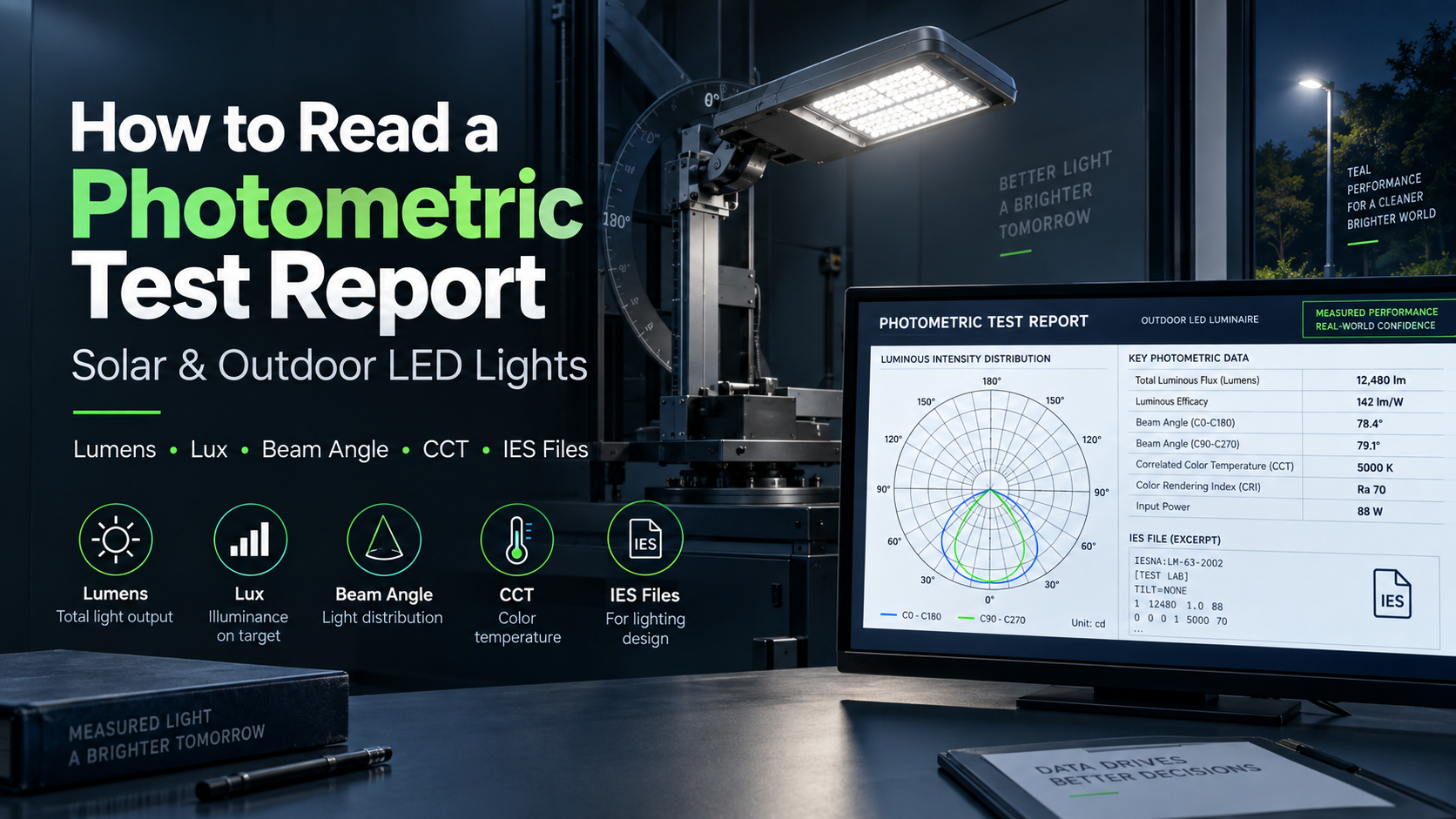
What Is an IES Photometric File?
In professional lighting projects, manufacturers may provide photometric files for certain luminaires.
An IES photometric file contains structured information describing how a luminaire distributes light.
This can be used by lighting-design software to model:
illuminance
distribution
fixture positions
project layouts
However, not every small decorative solar garden light requires an IES file.
It is more relevant when:
project lighting is being calculated
illuminance targets matter
fixture layout is being designed
commercial specifications require photometric data
For simple decorative retail products, a practical sample and documented output may be sufficient.
Should Solar Garden Light Buyers Request an IES File?
It depends on the product.
More Likely Useful
commercial pathway lights
wall lights
floodlights
higher-output landscape lights
project-based products
Less Likely Necessary
decorative flower lights
small stake lights
seasonal garden décor
low-output decorative lanterns
The right documentation should match the commercial application.
Do not request engineering documentation simply because it sounds professional.
But do request it when the project genuinely depends on lighting calculations.
Beam Angle and Color Temperature Are Different
Beam angle describes:
where the light goes
Color temperature describes:
what the white light looks like
A solar spotlight could be:
3000K + Narrow Beam
or:
3000K + Wide Beam
and the two products could create very different effects.
Likewise:
6500K
does not tell buyers anything about the width of the light beam.
When specifying outdoor solar lighting, record these parameters separately:
CCT + Lumens + Beam / Distribution
Beam Angle and IP Rating Are Different
The same principle applies to outdoor protection.
Beam Angle
Optical characteristic
IP Rating
Enclosure-protection characteristic
A narrow-beam light is not automatically better protected outdoors.
For products exposed to rain, dust or wet garden conditions, buyers should evaluate the enclosure separately.
Target located approximately X meters from fixture
Target Area
Approximate width / height
Light Output
Required lumens where applicable
Beam
Narrow / medium / wide or specified optical requirement
CCT
Example:
3000K
Solar Panel
Request full electrical specification.
Battery
Request:
chemistry
voltage
capacity
Runtime
Define test conditions.
Outdoor Protection
Define required environment and IP target.
Installation
stake
wall
ground
adjustable mount
OEM
housing
finish
logo
packaging
instruction manual
A Better Beam-Angle RFQ Example
Instead of:
Solar spotlight, 3000K, very bright.
Try:
Solar landscape spotlight for illuminating small trees approximately 2–3 meters from the fixture. Warm white target CCT. Please recommend suitable light output and beam distribution, provide the LED power, lumen output where available, battery and solar-panel specifications, lighting modes, runtime test conditions and outdoor-protection specification. Sample must be approved before bulk production.
This gives the manufacturer an application to solve.
That is more useful than simply asking:
Do you have 30°?
Beam Angle by Outdoor Application
Application
Distribution Starting Point
Small landscape feature
More focused
Tree trunk
Focused
Wide tree canopy
Medium / wider
Pathway
Controlled wider distribution
Garden decoration
Diffuse / decorative
Wall wash
Wider or asymmetric depending design
Security area
Wider functional coverage
Decorative lantern
Diffuse / pattern-based
Sign / sculpture
Focused according to target
Important: These are application directions, not universal beam-angle requirements. Exact optics should be confirmed with the selected fixture and installation geometry.
Why We Are Not Giving a Universal “Best Beam Angle”
You may see guides online claiming:
10° = this application
30° = that application
60° = another application
Those ranges can be useful as educational references, but they should not replace actual product and project evaluation.
The correct result also depends on:
target dimensions
fixture distance
mounting height
lumen output
optic
surrounding environment
LEDORA should not promise that one fixed beam angle is universally correct for every garden, pathway or landscape project.
For B2B buyers, the stronger purchasing approach is:
Application first. Beam specification second.
What Is a Beam Pattern?
The beam may not always be perfectly circular.
Depending on the luminaire, distribution may be:
round
oval
asymmetric
rectangular
patterned
IES notes that for beams without rotational symmetry, beam angle can be reported in two planes at 90 degrees to each other. See the IES beam-angle definition.
This becomes relevant for products such as:
wall lights
façade lights
pathway luminaires
where the desired distribution may intentionally be wider in one direction than another.
Why Asymmetric Distribution Can Be Useful
Imagine a pathway.
A perfectly circular beam may send part of its light:
onto plants
away from the path
into neighboring areas
An appropriate directional or asymmetric distribution may place more of the light:
along the walkway
instead.
Likewise, wall lighting may be designed to send light:
across the wall
rather than equally in every direction.
For higher-specification products, distribution shape can therefore be more important than one headline beam-angle number.
What Should Buyers Check Before Bulk Production?
Before approving an outdoor solar-light order, check:
target application
lumen output where relevant
beam/distribution
mounting direction
CCT
LED configuration
solar panel
battery
lighting modes
runtime
outdoor protection
sample lighting effect
packaging specification
The quotation, approved sample and production goods should describe the same final configuration.
This is especially important if the buyer changes:
LED
lens
reflector
housing
mounting system
after the first sample.
Beam Angle QC During Production
For products where optical distribution is important, QC should not be limited to:
Does the LED turn on?
The factory can also compare production samples against the approved sample for:
Optical Appearance
beam shape
visible hot spots
pattern consistency
Light Color
CCT consistency
LED Function
complete illumination
lighting modes
Mechanical Position
lens
reflector
LED alignment
Product Consistency
Compare multiple units.
A lens installed incorrectly can change the beam even when the LED itself works correctly.
Common Beam-Angle Sourcing Mistakes
Mistake 1: Comparing Only Lumens
Same lumens can create different lighting effects.
Mistake 2: Assuming Narrow Beam Is Brighter
It may appear more concentrated without having greater total lumen output.
Mistake 3: Assuming Wide Beam Has More Lumens
Distribution and total output are separate specifications.
Mistake 4: Ignoring Installation Distance
Lux changes with distance.
Mistake 5: Ignoring Mounting Height
The same product can create different coverage at different heights.
Mistake 6: Testing Only Indoors
Outdoor surface and environment affect visual results.
Mistake 7: Using One Beam for Every Application
A tree spotlight and pathway light serve different purposes.
Mistake 8: Approving Only Catalogue Photos
Real samples provide much better optical information.
Mistake 9: Changing the Lens After Sample Approval
Optical changes can materially change product performance.
Mistake 10: Calling Every Product “Wide Angle”
Use measurable or clearly defined specifications when they matter.
Solar Light Beam Angle Buyer Checklist
Before placing an OEM or wholesale order:
Define target application
Define target area
Define mounting height
Define fixture-to-target distance
Confirm lumen output where applicable
Confirm beam/distribution
Confirm CCT
Confirm LED power
Confirm solar panel
Confirm battery
Confirm lighting mode
Confirm runtime
Confirm IP requirement
Test real sample at night
Record sample photos
Measure lux where project requires it
Freeze approved optical configuration
Compare production units with golden sample
Frequently Asked Questions
What is beam angle in outdoor lighting?
Beam angle describes the angular spread of the main light beam. A narrower beam concentrates the light into a smaller area, while a wider beam distributes it across a broader area.
Is a narrow beam brighter than a wide beam?
Not necessarily in terms of total lumen output. A narrow beam can appear more intense in its center because the light is concentrated into a smaller area.
What beam angle is best for solar garden lights?
There is no universal best beam angle. The correct distribution depends on whether the product is intended for pathways, trees, walls, decoration, security or another application.
What is the difference between lumens and lux?
Lumens describe total luminous flux, while lux describes illuminance on a surface. One lux equals one lumen per square meter.
Does beam angle affect lux?
Yes. Light distribution and distance affect how much illuminance reaches a specific surface. Two products with the same lumens can therefore produce different lux values at a target.
Why does mounting height matter?
Changing mounting height changes the relationship between the fixture and target surface, which affects coverage and illuminance.
Should I ask for beam angle when buying solar pathway lights?
It can be useful, but you should also evaluate the complete distribution pattern, mounting height, spacing and real sample effect.
Should IES files be required for solar garden lights?
Not for every product. Photometric files are more useful for commercial or project lighting where calculations and layout design are important. Small decorative products may be evaluated through other documented specifications and samples.
What beam is suitable for illuminating a tree?
It depends on the tree size, shape, fixture distance and desired visual effect. A narrow target may need a more focused distribution, while a wide canopy may require broader coverage.
Does a wider beam use more battery?
Not automatically. Beam width alone does not determine electrical consumption. LED power and the complete lighting system determine energy demand.
Can beam angle be customized in OEM projects?
Depending on the product, optical adjustments may be possible through the lens, reflector, LED position or housing design. Technical feasibility should be confirmed before sample approval.
How should importers test beam distribution?
Install the sample at a realistic height and distance, use the intended target surface, operate the correct lighting mode, photograph the result and measure illuminance where the project requires quantitative verification.
Conclusion
For outdoor solar lighting, brightness is only part of the story.
Two solar lights can have the same lumen output and still perform very differently because one concentrates its light while another spreads it across a larger area.
For B2B buyers, the key sourcing principle is:
Do not ask only how much light a solar fixture produces. Ask where that light goes.
A professional outdoor-lighting specification should start with the application and then define:
light output
beam/distribution
color temperature
mounting
solar-energy system
runtime
outdoor protection
This produces more meaningful product comparisons and more reliable OEM development than choosing a light only by watts, lumens or LED quantity.
Looking for an OEM Solar Garden Light Manufacturer?
LEDORA Lighting supplies solar garden lights and outdoor lighting solutions for importers, wholesalers, retailers, e-commerce brands and private-label customers.
For buyers developing a technical solar-light specification, continue with: