A successful solar garden light OEM project should not begin with a logo or color box.
It should begin with the product specification.
For importers, wholesalers, retailers, ecommerce sellers and outdoor lighting brands, the correct OEM process normally includes:
Target-market and product requirement confirmation
Product and model selection
Technical specification confirmation
Sample preparation
Sample testing and approval
Product and function customization
Packaging and private-label development
Golden sample confirmation
Material preparation and incoming inspection
Bulk production
Quality-control testing
Pre-shipment inspection and export preparation
Each stage is connected.
Changing the battery may affect the solar panel.
Changing the solar panel may affect product dimensions.
Changing the housing material may affect waterproof performance.
Changing the packaging may affect carton quantity and freight cost.
This is why solar lighting OEM should be treated as a complete product-development and supply-chain process rather than a collection of separate customization requests.
LEDORA supports standard wholesale supply as well as OEM and ODM solar lighting programs involving product configurations, logo printing, customized packaging and selected product adjustments. Buyers can first review LEDORA’s Solar Garden Lights Manufacturer & OEM Supplier page or browse the Solar Garden Light Collection. LEDORA’s current website also lists logo customization, custom packaging, product adjustment and sample support among its OEM/ODM services.
What Is OE for Solar Garden Lights?
OEM usually means that a buyer selects or develops a product with a manufacturer and sells it under its own brand or specification.
For solar garden lighting, an OEM project may involve:
Selecting an existing solar light model
Adding a customer logo
Changing product color
Selecting warm white, cool white or RGB lighting
Adjusting battery capacity
Adjusting solar panel configuration
Changing lighting modes
Adding or removing functions
Creating private-label packaging
Creating instruction manuals
Adding barcodes and product labels
Defining carton quantity
Confirming market-specific documents
OEM does not always mean creating an entirely new product.
For many wholesalers and retail brands, the most practical project begins with a proven existing model and modifies only the features required by the target market.
This approach can reduce:
Development time
Tooling investment
Technical risk
Sample revisions
Production complexity
What Is ODM for Solar Garden Lights?
ODM generally involves a higher level of product-development support.
Instead of selecting only an existing finished product, a buyer may request changes to:
Product structure
Appearance
Housing dimensions
Lighting layout
Solar panel position
Battery compartment
Sensor configuration
Ground stake design
Mounting structure
LED arrangement
Control logic
ODM projects may require:
Industrial design
Structural engineering
Electronic adjustment
Prototype development
Tooling
Additional testing
Longer development schedules
The distinction between OEM and ODM can vary between suppliers.
For buyers, the more important question is not whether a project is called OEM or ODM.
The important question is:
Which parts of the product will change, what testing is required, and what specifications will be locked before mass production?
OEM vs ODM vs Private Label
Project Type
Typical Starting Point
Common Changes
Development Complexity
Standard wholesale
Existing finished product
Little or no customization
Low
Private label
Existing product
Logo, label, box and instruction manual
Low to medium
OEM
Existing platform with selected modifications
Battery, panel, color, function, packaging and branding
Medium
ODM
Product platform or new design concept
Structure, electronics, functions, tooling and appearance
Medium to high
Full custom development
New product concept
Industrial design, tooling, electronics and complete packaging
High
For many importers and retailers, private-label or light OEM customization is the most efficient starting point.
Step 1: Define the Target Market and Sales Channel
Before requesting samples, buyers should define where and how the product will be sold.
Important questions include:
Which country will the product be sold in?
Is the customer a wholesaler, retailer or ecommerce seller?
Is the product entry-level, mid-range or premium?
Will it be sold individually or in multipacks?
Is the product decorative or functional?
What retail price is required?
What lighting color is preferred?
What nighttime working time is expected?
What outdoor environment will the light face?
What certifications or documents are required?
What packaging style is needed?
The same solar pathway light may require different specifications for different channels.
For example, an ecommerce seller may prioritize:
Strong individual packaging
Clear instructions
Barcode preparation
Lower return rates
Consumer-friendly installation
A supermarket buyer may prioritize:
Multipack presentation
Competitive pricing
Shelf-ready color boxes
Seasonal delivery
Consistent carton dimensions
A project customer may prioritize:
Brightness
Material
Waterproof protection
Technical documentation
Installation stability
Product development should therefore begin with the buyer’s market rather than the factory’s existing specification sheet.
Step 2: Select the Right Product Category
LEDORA’s current solar lighting range covers multiple product structures, including fence lights, pathway lights, ground lights and other outdoor solar lighting categories, while its decorative solar range includes firefly, flower, butterfly, fireworks and other garden-decoration styles.
Material customization should not be treated as a cosmetic decision only.
Common solar lighting materials include:
ABS
PC
PP
Stainless steel
Aluminum
Coated iron
Mixed-material constructions
LEDORA’s existing solar ground and pathway ranges use several combinations, including stainless steel + ABS, stainless steel + PC, ABS + PC, ABS + PS and PP depending on the model.
Material changes can affect:
Product weight
UV resistance
Impact strength
Appearance
Tooling
Waterproof sealing
Corrosion resistance
Packaging
For example, changing an ABS housing to metal is normally not a simple material substitution.
This prevents confusion when several sample versions exist at the same time.
Step 9: Create the Golden Sample
The final approved sample becomes the production reference.
This is often called:
Golden sample
Sealed sample
Approval sample
Reference sample
The golden sample should represent the approved:
Product structure
Material
Finish
Color
Battery
Solar panel
LED
Lighting modes
Sensor
Accessories
Logo
Packaging
Where practical, both buyer and supplier should retain a matching reference.
The golden sample helps answer a critical question during mass production:
Does the final product match what the buyer approved?
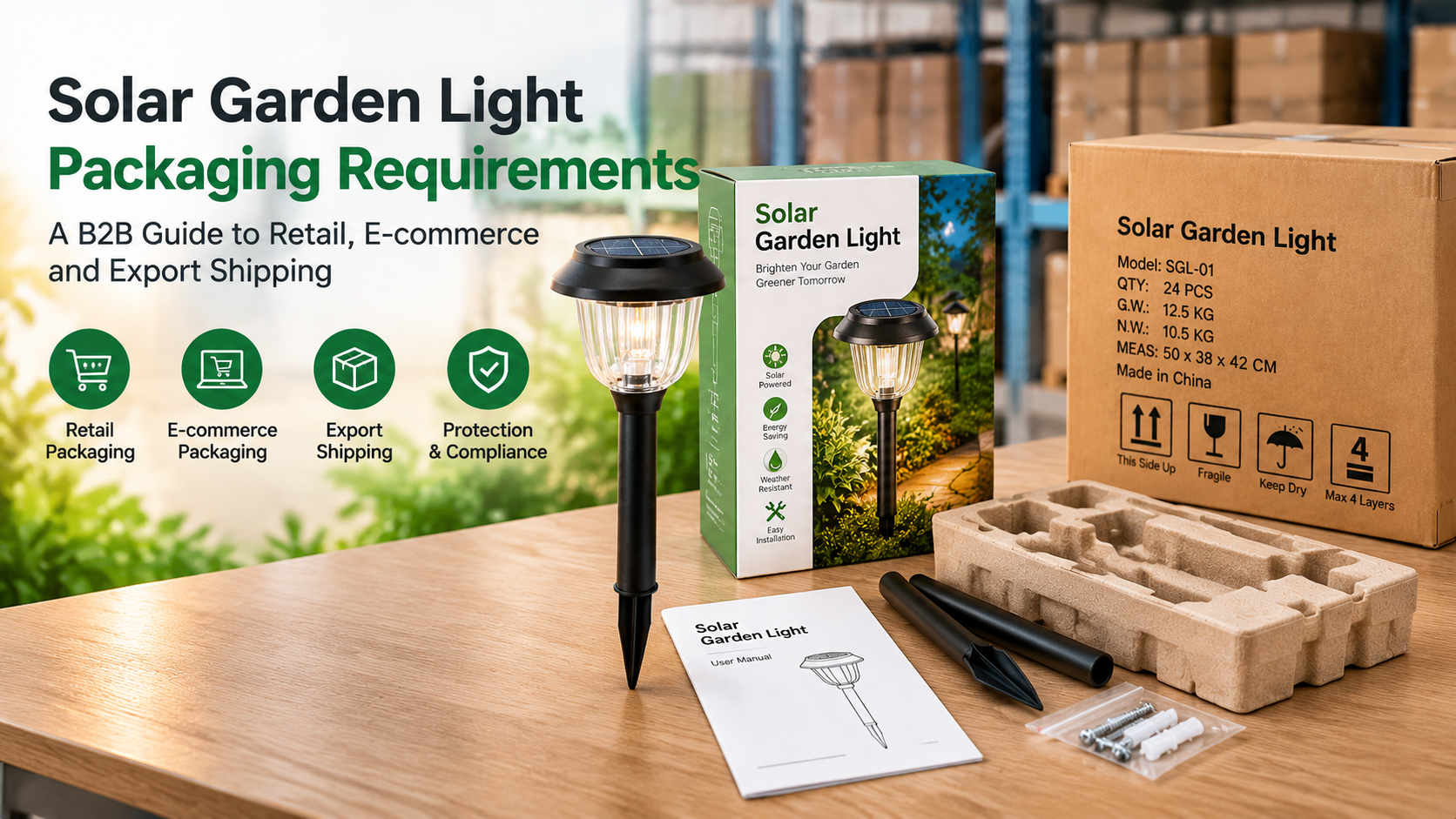
Step 10: Develop Private-Label Packaging
Packaging development can begin once the product specification is stable.
Common private-label packaging options include:
Neutral brown box
Printed color box
Retail multipack
E-commerce packaging
Display-ready packaging
Customized manual
Barcode label
SKU label
Shipping mark
Packaging artwork may contain:
Brand name
Product name
Product image
Application image
Pack quantity
Battery specification
Solar panel specification
Working-time reference
Waterproof rating
Lighting color
Installation instructions
Barcode
Model number
Warning information
All packaging claims should match the actual approved production configuration.
For example, do not print:
2400mAh battery
if mass production is approved with a 1500mAh battery.
Do not print:
IP68
if the exact model is only approved for a different protection level.
Do not use an application image showing a lighting effect that the product does not provide.
LEDORA supports custom packaging and private-label programs as part of its OEM/ODM services. (–)
For a detailed packaging workflow, review LEDORA’s Solar Garden Light Packaging for Wholesale, Retail and E-commerce: A Buyer’s Guide.
Step 11: Confirm Barcodes, Labels and Instructions
A private-label product may require several identification systems.
These may include:
EAN
UPC
GTIN
Retailer SKU
FNSKU
Carton barcode
Batch code
QR code
GS1 manages globally standardized identification systems such as GTINs used for trade items and barcodes. Buyers should determine which identifier belongs on the consumer package and which belongs on the logistics carton. GS1 identification and barcode information
Before production, confirm:
Correct barcode number
Correct packaging level
Correct position
Correct print size
Successful scanning
Correct model relationship
The instruction manual should also match:
Final switch
Final mode sequence
Remote-control buttons
Installation method
Battery
Charging instructions
Product warnings
Step 12: Review Target-Market Compliance
Compliance should be discussed before bulk production rather than immediately before shipment.
Requirements depend on:
Product category
Electrical configuration
Battery
Destination country
Sales channel
For products intended for the European market, buyers should determine which EU rules apply to the exact product. The European Commission explains that CE marking applies when specific EU harmonized rules require it, and manufacturers must determine applicable requirements and prepare appropriate conformity documentation. EU CE Marking Guidance
Electrical and electronic products may also fall within applicable restrictions under the EU RoHS framework. EU RoHS Directive Information
For waterproof claims, buyers should confirm the exact IP level and product structure. IEC explains the ingress-protection classification used to describe enclosure resistance to solids and water. IEC IP Rating Guide
Certification or test documents should be checked against the final production model rather than assumed to apply to every product in the same category.
Step 13: Confirm Lithium Battery Requirements
Some decorative solar lights use Ni-MH batteries, while brighter motion-sensor and higher-output models may use lithium-ion batteries.
When lithium batteries are used, buyers may need to confirm:
Battery chemistry
Voltage
Capacity
Watt-hour rating
UN 38.3 information
Battery test summary
SDS or MSDS
Transport classification
Packaging
Marking
Carrier requirements
IATA publishes dedicated guidance for the transport of lithium batteries by air. Exact requirements depend on whether the battery is shipped separately, packed with equipment or contained in equipment. IATA Lithium Battery Guidance
Battery requirements should therefore be considered during product development, not after production is complete.
Step 14: Place the Bulk Order and Freeze the Specification
Before production begins, the buyer and supplier should confirm a final production specification.
The order should identify:
Area
Final Confirmation
Product model
Exact approved model
Housing
Material, finish and color
Solar panel
Type, voltage, current, power and size
Battery
Chemistry, voltage and capacity
LED
Type, quantity and lighting color
Functions
Light sensor, PIR, remote, timer or lighting modes
Waterproofing
Exact agreed product claim
Logo
Position, size, color and process
Packaging
Box, insert, manual and barcode
Accessories
Exact included components
Carton
Units per carton and shipping marks
Documents
Required reports, labels and shipment documents
Changes after this stage should require written confirmation.
Otherwise, a seemingly small component substitution may cause:
Runtime differences
Color differences
Charging differences
Waterproof problems
Certification inconsistencies
Packaging inconsistencies
Step 15: Incoming Material Inspection
Before assembly, key materials should be checked against the approved specification.
Important incoming materials include:
Solar panels
Batteries
LEDs
Plastic housings
PC lenses
Stainless steel parts
Aluminum parts
Switches
Controllers
Sensors
Cables
Packaging
Incoming inspection may verify:
Dimensions
Appearance
Electrical specifications
Color
Material
Surface finish
Battery voltage
Panel output
Connector polarity
Packaging artwork
This stage helps detect problems before hundreds or thousands of finished lights are assembled.
Step 16: Pilot Production or First Production Check
For customized projects, it can be useful to inspect the first completed production units before the entire order is finished.
The first production check should confirm:
Components
Assembly
Lighting modes
Logo
Color
Packaging
Accessories
Charging
Runtime
Sensor function
If a problem is found at this stage, correction is normally easier than after all products are packed.
Step 17: Bulk Production Quality Control
Solar lighting production control should cover more than cosmetic inspection.
LEDORA’s manufacturer page describes quality-control areas including incoming materials, solar panel checks, battery testing, LED/function inspection, waterproof testing and aging inspection. (–)
Important bulk checks include:
Solar Panel
Surface
Voltage
Current
Connection
Charging
Battery
Voltage
Capacity sampling
Polarity
Connection
Consistency
Lighting
Brightness
Color
LED quantity
Mode sequence
Flickering
Control
Light sensor
PIR motion sensor
Remote control
Timer
Structure
Screws
Clips
Ground stakes
Brackets
Cables
Appearance
Scratches
Color
Surface finish
Lens
Logo
Packaging
Accessories
Manual
Barcode
Product orientation
Box protection
Step 18: Aging and Runtime Testing
A finished light can pass a short switch-on test but fail after several hours.
Selected production units should therefore be evaluated for:
Charging
Discharging
Runtime
Automatic switching
Lighting modes
Sensor operation
Brightness stability
Aging testing can help identify:
Weak batteries
Loose connections
Unstable LEDs
Controller problems
Premature shutdown
Sensor faults
Runtime claims should also specify the test conditions.
A product that operates for 12 hours after USB charging does not automatically provide 12 hours after one day of outdoor solar charging.
This distinction is especially important for ecommerce and retail brands making consumer-facing performance claims.
Step 19: Waterproof Inspection
Different solar lighting structures require different waterproof strategies.
LEDORA’s current product range includes different outdoor ratings depending on the exact product; its manufacturer page specifically notes that different models should not be treated as having one universal IP level. (–)
Waterproof inspection may focus on:
Solar panel joints
Lens connections
Cable entries
Switches
Screw holes
Battery covers
Sensor windows
Housing seams
After testing, inspect:
Internal moisture
Electrical function
Charging
Battery contacts
Sensor operation
Corrosion
The claimed level must correspond to the exact product design and appropriate test procedure.
Step 20: Pre-Shipment Inspection
The final inspection should verify that the production lot matches the approved order.
Random samples should be taken from different:
Cartons
Pallets
Production sections
Packing areas
The inspection may include:
Inspection Area
Typical Check
Quantity
Correct units and cartons
Appearance
Matches approved sample
Product specification
Correct battery, panel and material
Lighting
Correct color and functions
Runtime
Random verification where required
Sensor
Correct operation
Waterproofing
Required sampling or record review
Logo
Correct position and quality
Accessories
Complete
Manual
Correct version
Barcode
Correct and scannable
Packaging
Matches approved structure
Carton
Correct quantity and shipping marks
Documents
Complete according to order
Photos, test records or inspection reports can also be requested according to the project.
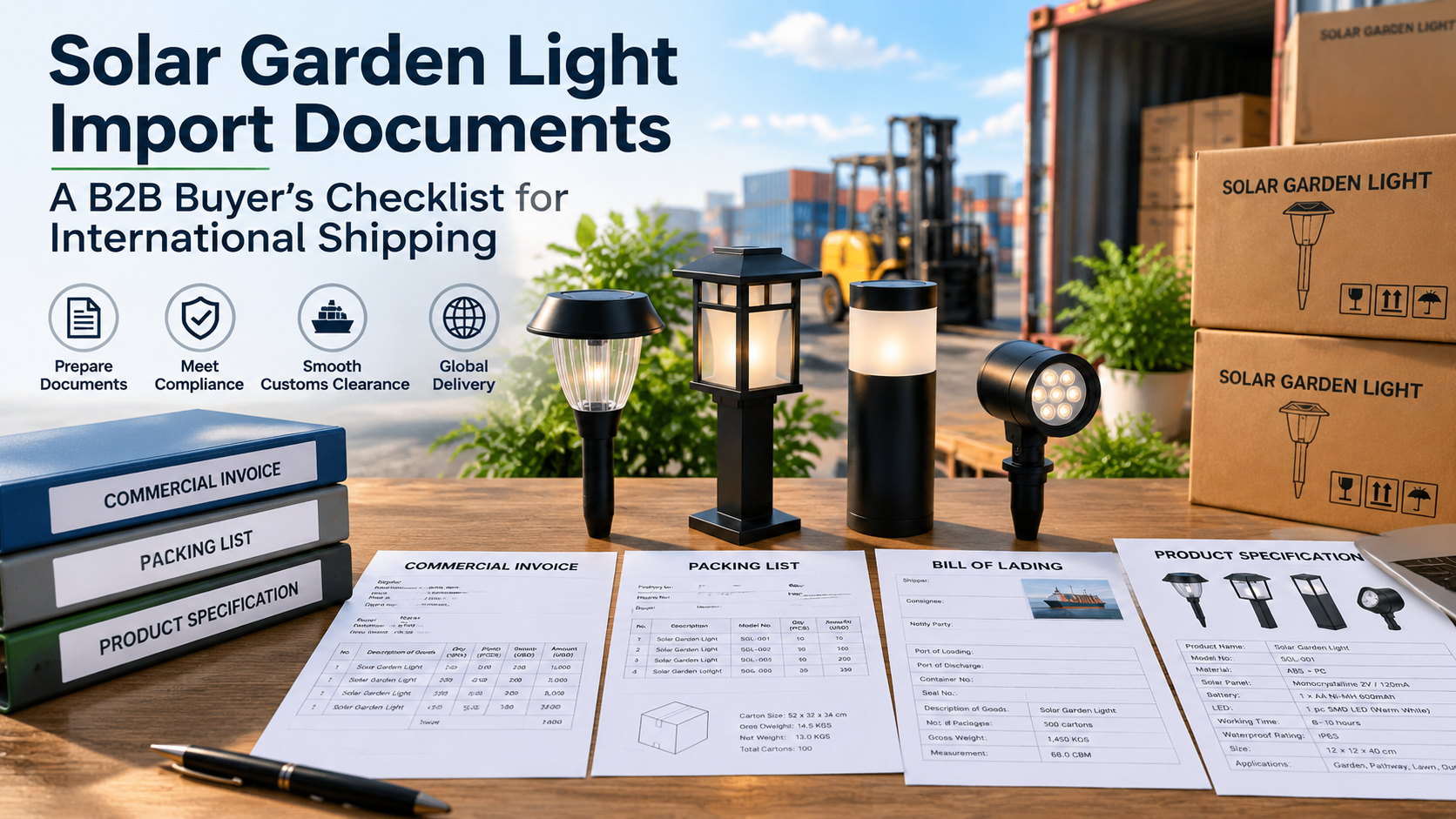
Step 21: Confirm Export Packaging and Shipment Documents
Before shipment, confirm:
Commercial invoice
Packing list
Carton quantity
Gross weight
Net weight
Carton dimensions
Shipping marks
Battery documents where applicable
Product test documents
Compliance documents
Customer-specific files
Final carton information is particularly important because packaging customization can affect:
CBM
Pallet quantity
Container loading
Airfreight chargeable weight
Courier cost
Packaging should therefore be finalized before the shipping quotation is treated as final.
What Can Be Customized in a Solar Garden Light OEM Project?
Customization Area
Typical Options
Important Considerations
Logo
Product, box, manual and label
Printing area and order quantity
Housing color
Black, white, metal finish or model-specific colors
MOQ and material
Lighting color
Warm white, cool white, RGB or combinations
LED and controller
Battery
Chemistry or capacity
Solar panel and charging balance
Solar panel
Size, current or power
Product structure and battery
LED
Quantity, brightness or arrangement
Battery consumption
Functions
Flashing, timer, PIR or remote
Controller and testing
Material
ABS, PC, stainless steel or selected alternatives
Tooling and structure
Packaging
Neutral box, color box, ecommerce or multipack
MOQ and freight
Manual
Language and branding
Product-function accuracy
Barcode
UPC, EAN, SKU or channel label
Buyer-provided data
Carton
Pack quantity and shipping mark
Freight and loading
Not every option is available for every model.
Technical feasibility should be confirmed before quotation and sampling.
Common OEM Solar Light Mistakes
Mistake 1: Choosing the Cheapest Product Before Defining the Market
A low-cost model may not meet the performance or packaging expectations of the target channel.
Mistake 2: Changing Only the Battery
Battery capacity must be evaluated with the panel, controller and LED load.
Mistake 3: Approving Appearance but Not Runtime
A visually attractive solar light may still underperform outdoors.
Mistake 4: Using USB Runtime as Solar Runtime
USB charging and outdoor solar charging should be evaluated separately.
Mistake 5: Designing Packaging Too Early
Product dimensions and accessories should be finalized first.
Mistake 6: Approving Only a Digital Packaging File
A physical packaging sample should also be checked for fit and protection.
Mistake 7: Using an Unclear Specification
Terms such as:
Large battery
Strong solar panel
High brightness
Waterproof
Premium material
are not sufficiently precise for mass-production control.
Mistake 8: Allowing Component Changes Without Approval
A battery or solar panel replacement can affect product performance.
Mistake 9: Assuming One Certificate Covers Every Model
Documents should be checked against the final product configuration.
Mistake 10: Waiting Until Shipment to Discuss Lithium Battery Documents
Battery transport requirements should be reviewed during development.
Questions to Ask Before Starting an OEM Solar Garden Light Project
Before requesting a quotation, buyers should prepare answers to the following questions:
What solar light category do you need?
Which country will the product be sold in?
What is your sales channel?
What is your expected order quantity?
What is your target price level?
What lighting color do you need?
What brightness is required?
What nighttime runtime do you expect?
What battery type is preferred?
What waterproof requirement is needed?
Do you need motion sensing?
Do you need a remote control?
Do you need customized housing color?
Do you need your logo on the product?
Do you need private-label packaging?
What barcode system will be used?
Which languages are required on the manual?
What certifications or reports are required?
Is the product intended for ecommerce shipping?
What packaging-test requirements must be met?
Providing this information early can significantly reduce repeated quotation and sample revisions.
How LEDORA Supports OEM and Private-Label Solar Lighting
LEDORA supplies solar garden lights for wholesalers, importers, retailers, ecommerce sellers and private-label outdoor lighting programs. Its website currently identifies OEM/ODM support including logo customization, custom packaging, product adjustment and sample preparation. (–)
Depending on the model and project, OEM discussions may cover:
Product selection
Specification comparison
Sample preparation
Battery configuration
Solar panel configuration
Lighting color
Lighting modes
Product finish
Logo
Packaging
Instruction manuals
Barcode labels
Testing requirements
Bulk production
Export packaging
The correct level of customization depends on:
Product structure
Order quantity
Technical feasibility
Tooling
Target market
Production schedule
For buyers who are still comparing suppliers, LEDORA’s existing solar garden lighting content can also help evaluate the technical details before requesting a project quotation.
Yes. LEDORA supports OEM and ODM programs for selected solar garden lighting products, including logo, packaging, product configuration and sample support. The exact customization depends on the model and project requirements.
What is the difference between OEM and private label?
Private label usually focuses on branding an existing product with a buyer’s logo, packaging and labels. OEM may also include selected product-specification changes such as battery, solar panel, lighting color or functions.
Can I customize the battery capacity?
Selected products can be evaluated for battery changes. However, the solar panel, controller, internal space and runtime should also be reviewed.
Can the solar panel be customized?
Selected projects may support solar panel adjustments according to product structure and energy requirements.
Can I customize the lighting color?
Depending on the model, options may include warm white, cool white, RGB or combined lighting effects.
Can I customize the product housing color?
Selected models may support different housing colors or finishes, depending on material, order quantity and production process.
Can LEDORA make private-label packaging?
Private-label packaging is part of LEDORA’s current OEM/ODM service offering. Options depend on the product, packaging type and quantity.
Should I test a sample before bulk production?
Yes. Sample testing should cover appearance, charging, runtime, lighting modes, sensor functions, installation and packaging where applicable.
What is a golden sample?
A golden sample is the final approved product used as the reference for bulk production and inspection.
Can the mass-production battery be different from the sample?
Any component change should be approved before production because battery differences may affect charging and runtime.
Can one certificate be used for every solar light?
Not necessarily. Compliance documents should be checked against the exact model and final product configuration.
Do lithium-powered solar lights require additional shipping documents?
Depending on battery configuration and shipping method, lithium-powered products may require specific testing, documentation, packaging and marking. Buyers should confirm current requirements with the supplier and carrier.
Can packaging be customized for Amazon or ecommerce?
Selected projects can use customized ecommerce packaging, but the required structure, barcode, individual protection and test requirements should be defined by the buyer.
When should packaging artwork be finalized?
Packaging artwork should normally be finalized after the product specification and major functions have been approved.
How can buyers reduce differences between samples and bulk production?
Use a detailed specification sheet, retain a golden sample, define approved components and require written approval before any significant production change.
Final Recommendation
A successful solar garden light OEM project is not simply:
Select product → Add logo → Place order.
A more reliable process is:
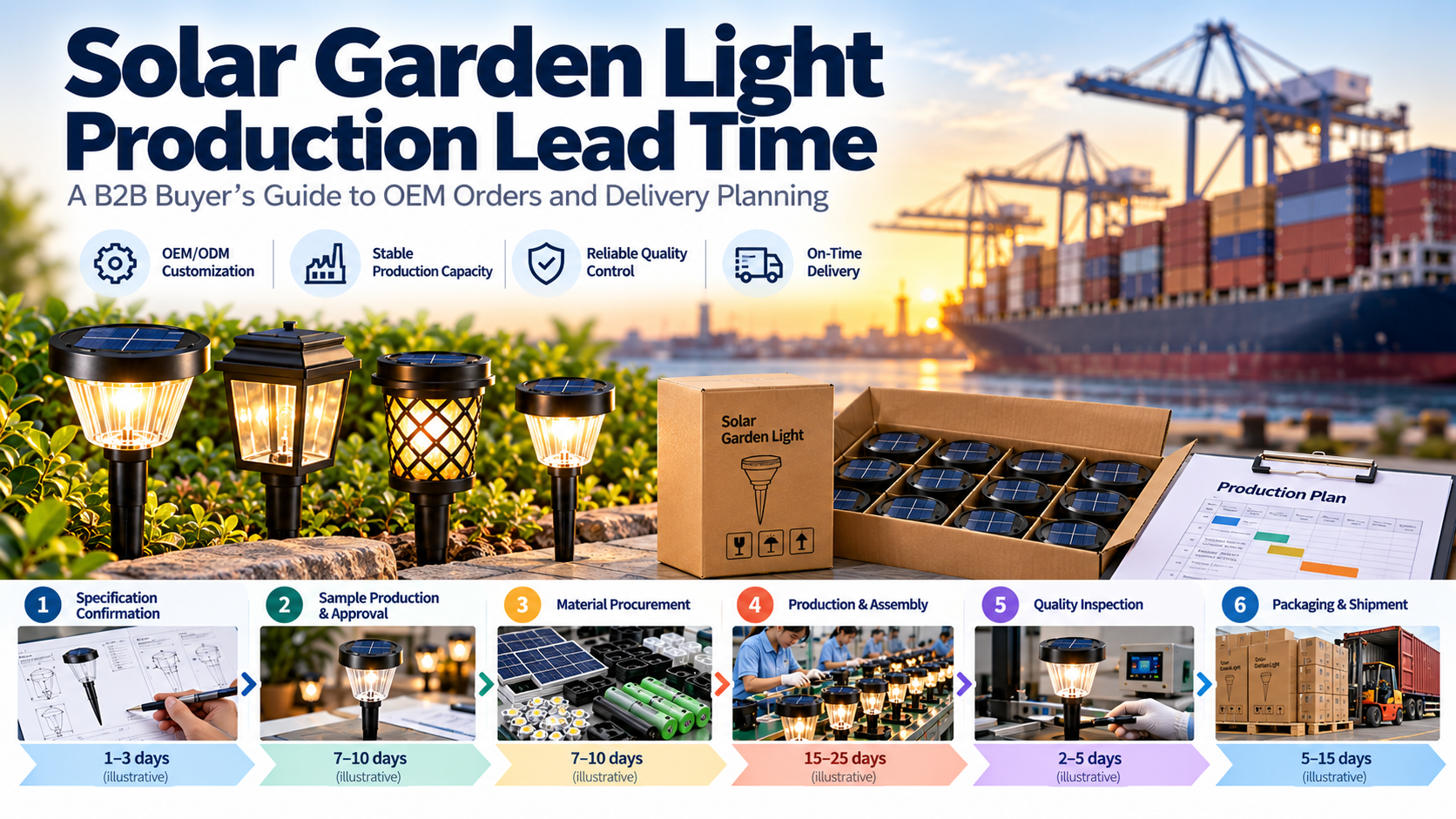
Define market → Select product → Confirm specification → Prepare sample → Test performance → Revise → Approve golden sample → Finalize packaging → Control materials → Produce → Inspect → Ship.
For solar-powered products, this process is especially important because product performance depends on the interaction between:
Solar panel
Battery
LEDs
Controller
Sensors
Housing
Waterproof structure
Packaging
When these components are documented and tested as one complete system, buyers can reduce:
Sample-to-production differences
Runtime complaints
Charging problems
Waterproof failures
Packaging errors
Incorrect product claims
Customer returns
Last-minute shipment delays
The goal of OEM is not to customize as many parts as possible.
The goal is to create a product configuration that fits the target market and can be reproduced consistently during bulk production.
Request an OEM Solar Garden Light Proposal
If you are developing a wholesale, retail, ecommerce or private-label solar lighting range, contact LEDORA with your project requirements.
Please provide:
Target solar light category
Product photos or reference models
Destination market
Sales channel
Estimated quantity
Target specifications
Required lighting color
Expected runtime
Waterproof requirement
Logo requirements
Packaging requirements
Barcode requirements
Required certifications or test documents
LEDORA can then help compare suitable models, customization options and sample configurations.