Photometric Test Reports for Outdoor LED Lights: Quick Answer
A photometric test report provides measured information about how a lighting product performs.
Depending on the test method and equipment, the report may include:
- total luminous flux in lumens
- electrical power in watts
- luminous efficacy in lumens per watt
- luminous intensity distribution
- color temperature
- chromaticity
- color-rendering information
- beam distribution
- photometric data for lighting calculations
For B2B buyers, the most important point is:
Do not treat every number printed in a supplier catalogue as equivalent to laboratory-measured photometric data.
A professional buyer should ask:
What was measured?
Which complete product configuration was tested?
Which method or equipment was used?
Does the bulk-production product match the tested sample?
The U.S. Department of Energy lists ANSI/IES LM-79-2019 as an industry test method covering optical and electrical measurements of solid-state lighting products. DOE — Metrics and Test Methods
NIST also explains that standardized solid-state lighting measurements can include luminous efficacy, chromaticity, color rendering and luminous intensity distribution. NIST — Measurement of Solid-State Lighting Products
For buyers sourcing solar garden lights, this type of measurement becomes especially useful when brightness, beam distribution or color consistency is a critical purchasing specification.
Why Photometric Testing Matters for B2B Buyers
A solar or outdoor LED light can look good in:
- catalogue photos
- showroom samples
- marketing videos
but those materials do not provide a standardized technical comparison.
Imagine two suppliers.
Supplier A
Catalogue says:
Brightness: 500 lm
Supplier B
Catalogue says:
Brightness: 500 lm
At first glance, the products appear equivalent.
But important questions remain:
- Was the value measured or estimated?
- Was it measured for the complete luminaire?
- Was it taken at maximum brightness?
- Was the battery fully charged?
- Was the value measured immediately after startup?
- Which optical configuration was tested?
- Did both products use the same test method?
Without this information, the two numbers may not be directly comparable.
This is why LEDORA’s previous Lumens vs Watts for Solar Garden Lights guide recommends asking how lumen output was obtained when brightness is a critical specification.

What Is Photometry?
Photometry is the measurement of light according to how it is perceived by the human visual system.
For lighting products, photometric measurements can help describe:
- total light output
- direction of light
- illuminance
- efficiency
- optical distribution
For outdoor products, this information can help buyers answer different questions.
Lumens
How much total visible light does the product emit?
Lux
How much light reaches a defined surface?
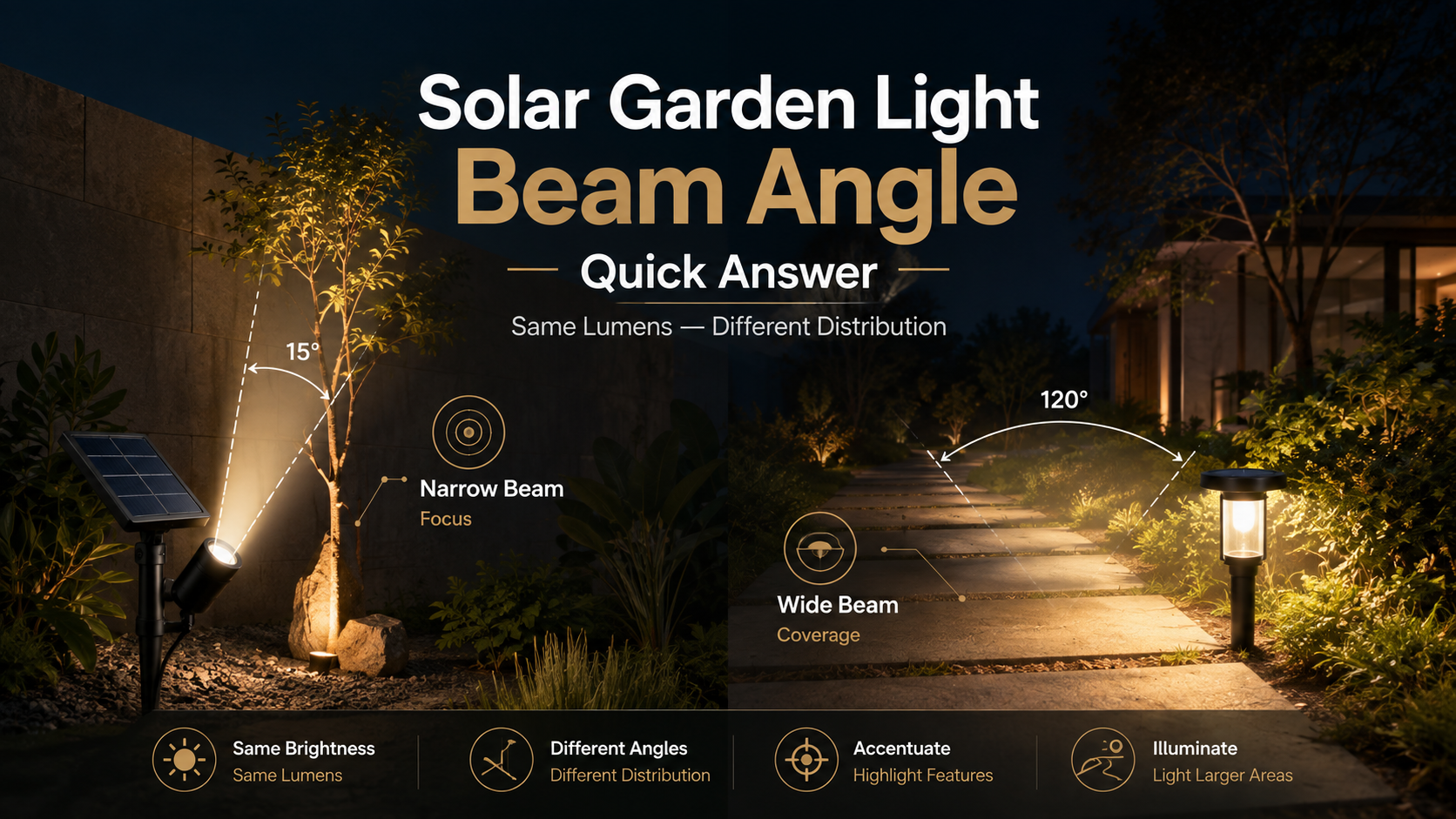
Beam Angle
How widely is the main light distributed?
Luminous Intensity
How much light is emitted in a particular direction?
These measurements are related, but they do not describe the same property.
LEDORA explains this relationship in its Solar Garden Light Beam Angle Guide.
What Is LM-79?
ANSI/IES LM-79 is an industry test method for optical and electrical measurements of solid-state lighting products.
The U.S. Department of Energy currently lists ANSI/IES LM-79-2019 among its core solid-state lighting metrics and test methods. DOE — Metrics and Test Methods
NIST explains that standardized measurements for solid-state lighting can include:
- luminous efficacy
- chromaticity
- color rendering
- luminous intensity distribution
and that the methods include defined operating and measurement conditions. NIST — Measurement of Solid-State Lighting Products
For buyers, a useful way to understand LM-79 is:
It is a controlled method for measuring the performance of a complete solid-state lighting product under defined test conditions.
It is not simply:
“The factory turned the light on and recorded a number.”
What Can an LM-79-Type Report Tell a Buyer?
Depending on the product and report, a buyer may see information such as:
Electrical Measurements
- input voltage
- input current
- input power
Photometric Measurements
- total luminous flux
- luminous efficacy
- luminous intensity distribution
Color Measurements
- chromaticity
- correlated color temperature
- other color characteristics
DOE’s earlier technical explanation of LM-79 describes the method as providing a snapshot of SSL product performance under specified operating conditions. DOE — Understanding LM-79 Reports
For purchasing decisions, however, buyers still need to check that:
the tested product = the product being ordered.
Why the Tested Configuration Matters
Imagine a manufacturer tests:
Model A
with:
- LED type 1
- lens type 1
- 3000K
- battery configuration A
- optical structure A
After the report is issued, the production order changes to:
- LED type 2
- lens type 2
- 6500K
- different operating current
The old photometric result may no longer represent the revised product accurately.
This is why professional buyers should confirm:
- model number
- LED configuration
- driver/controller
- optical components
- CCT
- tested operating mode
before using a report as purchasing evidence.
For OEM programs, these parameters should be locked during the LEDORA Solar Garden Light OEM & ODM Process.

What Is an Integrating Sphere?
An integrating sphere is one type of measurement system used in photometric testing.
IES explains that controlled lighting tests may use an integrating sphere or goniophotometer, depending on the information being measured. IES — Learn About IES Files
NIST also describes sphere photometers and sphere-spectroradiometers as measurement approaches used for solid-state lighting products. NIST — Measurement of Solid-State Lighting Products
For a B2B buyer, an integrating-sphere test can be useful when evaluating measurements such as:
- total luminous flux
- spectral/color characteristics
- electrical-to-light performance
depending on the test setup.
A sphere is particularly useful when the goal is to understand:
How much light the complete product produces overall.
What an Integrating Sphere Does Not Tell You by Itself
A total-lumen measurement does not fully describe:
where the light goes.
For example, two outdoor lights can both produce:
500 lumens
but one may have:
- narrow spotlight distribution
while the other may have:
- wide flood distribution
The total lumen number may be similar while the real-world application is completely different.
Therefore:
Total Lumens ≠ Complete Distribution Data
This is why the buyer may also need goniophotometric measurements when directional performance is important.
What Is a Goniophotometer?
A goniophotometer measures how light is distributed in different directions around a light source or luminaire.
IES defines a goniophotometer as an instrument used to measure directional light-distribution characteristics and record photometric readings at multiple spherical coordinates. IES — LM-75 Goniometer Measurements and Photometric Coordinate Systems
In simpler terms:
An integrating sphere helps answer “How much light?” while a goniophotometer helps answer “Where does the light go?”
For products such as:
- solar spotlights
- wall lights
- pathway lights
- floodlights
- commercial outdoor luminaires
directional light distribution can be critical.

Question: Where does the light go?
Possible outputs:
- intensity by angle
- distribution pattern
- photometric data
- IES data
Bottom:
Total Output + Directional Distribution = Better Product Understanding
Why Beam Angle Is Not Enough for Some Projects
Beam angle is useful, but it is only one simplified description of optical distribution.
Two products may both claim:
60° beam
but still produce different:
- center intensity
- edge distribution
- spill light
- asymmetry
- hot spots
The Illuminating Engineering Society defines beam angle using the directions where intensity drops to 50% of the maximum value. IES — Beam Angle
That means beam angle does not automatically describe every part of the light distribution outside that main beam.
For more detailed project evaluation, buyers may need the complete photometric distribution.
What Is an IES File?
An IES file is a standardized photometric data file used by lighting professionals and lighting-design software.
IES explains that manufacturers commonly obtain photometric data from testing laboratories when:
- developing a new luminaire
- changing LED sources
- evaluating performance
- supporting design or marketing
and that goniophotometric data can be used to generate photometric information describing directional light output. IES — Learn About IES Files
An IES file can allow lighting designers to model:
- fixture position
- illuminance
- distribution
- spacing
- coverage
inside lighting-design software.
Does Every Solar Garden Light Need an IES File?
No.
This is important.
A small decorative solar flower light does not automatically need the same photometric documentation as a commercial pathway luminaire.
An IES File Is More Relevant For:
- commercial pathway lights
- bollards
- wall lights
- floodlights
- spotlights
- project lighting
- products with defined illuminance requirements
An IES File May Be Less Important For:
- decorative solar flowers
- low-output garden ornaments
- seasonal decorative lights
- small lifestyle garden products
Buyers should request documentation that matches the actual application.
Do not add a technical requirement only because it sounds professional.
When Should a B2B Buyer Ask for Photometric Data?
Consider requesting more complete photometric information when:
Brightness Is a Contractual Specification
Example:
Minimum lumen output required
Project Illuminance Matters
Example:
A pathway, entrance or commercial area must achieve a defined lighting result.
Beam Distribution Is Important
Example:
The buyer needs a specific spotlight or wall-light effect.
Several Supplier Products Must Be Compared
Measured data can make comparisons more meaningful.
OEM Changes Affect the Optical System
For example:
- LED changed
- lens changed
- reflector changed
- current changed
- CCT changed
Lumens: What Should Buyers Check in the Report?
Do not look only for:
XXX lm
Check:
- complete product model
- test condition
- operating mode
- measured lumen output
- input power
- CCT
- test date
- laboratory
- sample configuration
For solar products, also confirm whether the test represents:
- full-power operation
- low-power mode
- motion-triggered mode
- another control condition
This matters because the same solar light can operate at different output levels.
Watts and Luminous Efficacy
A photometric report may also include electrical input power.
Luminous efficacy is generally expressed as:
lm/W
The U.S. Department of Energy uses lumens per watt as a measure of light output per unit of electrical power for lighting products. DOE — Exterior Lighting Purchasing Guidance
The simple relationship is:
Luminous Efficacy = Lumens ÷ Watts
However, B2B buyers should be careful when applying mains-powered luminaire efficiency concepts directly to small solar products.
A solar lighting system also includes:
- photovoltaic charging
- battery storage
- controller losses
- variable operating modes
So the complete product’s real outdoor performance must consider more than LED lm/W alone.
LEDORA’s Solar Panel Size and Battery Capacity Matching Guide explains this energy-system relationship in more detail.
Lux: What Should Buyers Ask?
A supplier may say:
Our light produces 100 lux.
That statement is incomplete.
Ask:
100 lux at what distance and at what measurement point?
The actual illuminance depends on:
- distance
- mounting height
- beam distribution
- aiming
- optical design
LEDORA’s Beam Angle & Light Distribution Guide explains why the same lumen output can create different lux values on the target surface.
A better test statement could be:
Measured at X meters from the fixture under defined test conditions.
CCT: What Should Buyers Check?
CCT stands for correlated color temperature and describes the appearance of white light.
For example:
- 2700K
- 3000K
- 4000K
- 6500K
But buyers should not simply confirm that the report says:
3000K
and stop there.
Check whether:
- the tested sample matches the approved LED
- the production batch uses the same configuration
- the target CCT tolerance is appropriate
- multiple units appear visually consistent
LEDORA’s 2700K vs 3000K vs 4000K vs 6500K Outdoor Solar Light Guide explains how CCT should be selected according to outdoor application rather than simply choosing the highest Kelvin value.
CRI and Color Quality
Some photometric or color reports may also include color-rendering information.
CRI and CCT are different.
CCT
Describes:
How warm or cool the white light appears
CRI
Describes a different aspect of color rendering.
DOE’s current list of SSL metrics includes IES TM-30-24 as a method for evaluating light-source color rendition. DOE — Metrics and Test Methods
For decorative garden products, CRI may not always be the top purchasing parameter.
For:
- hospitality
- architecture
- merchandise
- landscape design
- premium outdoor spaces
color quality may become more important.

Bottom:
Do the report and purchase specification match?
What Is the Difference Between a Datasheet and a Test Report?
A product datasheet is typically prepared by the supplier or manufacturer.
It may list:
- model
- dimensions
- power
- lumens
- CCT
- battery
- solar panel
- IP rating
A laboratory test report is different.
It documents:
- the test sample
- test conditions
- measurement method
- measured results
A datasheet can summarize the final specification.
A test report can provide evidence supporting selected performance claims.
For B2B buyers:
Datasheet = Specification communication
Test report = Measurement evidence
The two should agree.
What If the Datasheet and Test Report Do Not Match?
Suppose the catalogue says:
500 lm
but the report says:
420 lm
Do not ignore the difference.
Ask:
- Is the catalogue outdated?
- Was a different model tested?
- Did the LED configuration change?
- Is one value nominal and one measured?
- Is the product operating in another mode?
Likewise, if:
Datasheet: 3000K
but:
Report: 4000K
the discrepancy should be resolved before order approval.
Product information should remain consistent across:
Quotation → Datasheet → Test Report → Golden Sample → PO → Production → Packaging
Can a Factory Test Lumens In-House?
Yes, a manufacturer may use in-house photometric equipment for:
- development
- production comparison
- internal QC
But buyers should distinguish between:
Internal QC Data
Useful for:
- batch comparison
- process control
- engineering development
and:
Independent Laboratory Data
Potentially more appropriate when:
- compliance programs require it
- a retailer requires third-party reports
- project documentation requires it
- performance claims need independent evidence
NIST currently operates an accreditation program for energy-efficient lighting-product laboratories, including LM-79-related proficiency requirements. NIST NVLAP — Energy Efficient Lighting Products
For buyers, the level of testing should match the project requirement.
Should Buyers Require an Accredited Laboratory?
Not every product or purchase requires an accredited laboratory test.
For a small decorative solar-light retail SKU, the commercial requirement may be different from a major commercial outdoor-lighting project.
Consider:
- destination market
- retailer requirement
- tender/project requirement
- claim being made
- certification program
- risk level
If a third-party report is required, buyers should confirm the laboratory’s relevant accreditation and scope rather than assuming that every test lab has identical capabilities.
Photometric Testing vs IP Testing
These tests evaluate different things.
Photometric Testing
Evaluates lighting characteristics such as:
- output
- distribution
- color
IP Testing
Evaluates enclosure protection against defined ingress conditions.
A product can have:
excellent photometric performance
but:
inadequate outdoor protection
or the reverse.
That is why outdoor buyers should evaluate both optical performance and environmental protection.
LEDORA explains enclosure protection in IP44 vs IP65 vs IP67 Outdoor Lights: What B2B Buyers Should Know.
Photometric Testing vs Runtime Testing
Again, these are different.
Photometric testing may tell you:
How much light is produced under defined test conditions.
Runtime testing tells you:
How long the product operates under defined energy conditions.
For solar lighting, these two are connected because:
higher LED consumption → more battery energy required
But they should still be reported separately.
A product can provide:
high initial lumen output
but poor nighttime duration.
For working-time evaluation, see LEDORA’s Solar Garden Light Runtime Guide.
Why Solar Products Need Special Attention
A solar garden light is not simply an LED luminaire.
It is a small energy system:
Solar Panel → Charging Circuit → Battery → Controller → LED
This creates an important sourcing issue.
A photometric test may show the LED output when the battery is fully charged.
But a buyer also needs to know whether the solar panel can recharge the battery sufficiently under realistic conditions.
Therefore, a complete B2B evaluation should include:
- measured light output
- battery system
- solar-panel specification
- runtime
- charging condition
- lighting mode
This is why a photometric report alone cannot prove complete solar-light performance.
Full-Power Output vs Real Nighttime Output
Some solar products use dynamic control.
For example:
First Hours
100% brightness
Later Hours
50% brightness
Motion Mode
20% standby → 100% after detection
In this case, the maximum lumen figure may describe only one operating condition.
The buyer should ask:
At what mode and at what point in the operating cycle was the lumen measurement taken?
This helps prevent a situation where:
Maximum Lumen Claim
is mistaken for:
All-Night Lumen Output
Why a “5000-Lumen Solar Light” Claim Needs Verification
High headline lumen values are common in online lighting marketing.
A professional B2B buyer should not accept or reject such a claim automatically.
Instead ask for:
- measured output
- test report
- complete product model
- LED power
- operating mode
- battery
- solar panel
- runtime
The stronger sourcing question is not:
Is 5000 lumens possible?
It is:
What evidence supports this product’s stated lumen output, and under what conditions was it measured?
This is the same principle LEDORA should use in its own marketing.
Avoid performance numbers that cannot be supported.
How to Compare Two Supplier Reports
When comparing Supplier A and Supplier B:
Step 1 — Match Product Type
Do not compare:
complete luminaire output
with:
bare LED chip data.
Step 2 — Match Operating Conditions
Check:
- voltage
- mode
- temperature where relevant
- product stabilization
Step 3 — Match Metrics
Compare:
- lumens with lumens
- CCT with CCT
- lux at equivalent distance
- beam distribution with beam distribution
Step 4 — Match Configuration
Check:
- LED
- optic
- driver/controller
- housing
Step 5 — Check Laboratory Information
Who performed the test?
Step 6 — Compare to Approved Sample
Does the physical sample match the report?
Red Flags in Photometric Data
B2B buyers should investigate when they see:
No Model Number
The report cannot be clearly connected to the quoted product.
Only a Screenshot
A cropped image may omit important test conditions.
Different Product Photo
The tested configuration may not match the sample.
Unrealistic Precision
Marketing data may present numbers without measurement context.
Test Report Is Very Old
Check whether the product has changed since testing.
Supplier Cannot Explain Test Mode
The salesperson should be able to clarify which product configuration was tested.
Report and Packaging Disagree
Resolve inconsistencies before bulk production.

Bottom:
Verify Before You Compare
What Should Buyers Put in an RFQ?
A stronger outdoor-lighting RFQ could include:
Product
Solar Pathway Light / Wall Light / Spotlight / Garden Light
Application
Describe where it will be installed.
Light Output
Target lumens where applicable.
Illuminance
Target lux and measurement distance if the project requires it.
Beam / Distribution
Specify the application requirement.
CCT
Example:
3000K
Color Quality
Specify if required.
LED Power
Request measured or rated data.
Solar Panel
- voltage
- current
- power
Battery
- chemistry
- voltage
- capacity
Runtime
Define test conditions.
Test Evidence
State whether you require:
- internal test data
- third-party report
- IES file
- project photometric data
Example of a Better RFQ
Instead of:
Need 1000-lumen solar light, please quote.
Write:
We are sourcing a solar pathway light for a commercial landscape project. Please provide the complete product specification including measured lumen output where available, LED power, CCT, beam/light distribution, solar-panel specification, battery specification and runtime test conditions. If photometric test data or an IES file is available for this exact configuration, please provide it together with the model identification. Bulk production should match the approved sample and final specification.
This gives the supplier a clear technical requirement.
Photometric Data for OEM Projects
OEM changes can invalidate earlier performance data when they affect the optical or electrical system.
Examples:
- changing LED supplier
- changing LED quantity
- changing power
- changing lens
- changing reflector
- changing CCT
- changing control mode
If one of these changes occurs, ask:
Does the previous test result still represent the new product?
For significant performance changes, additional testing may be appropriate.
LEDORA’s OEM & ODM Process is built around approving the final configuration before mass production.
What Should LEDORA Photograph for This Article?
Do not use only generic AI laboratory images.
For GEO and EEAT, use real evidence where possible.
Recommended real photographs:
Photo 1
LEDORA product being tested for lumen/CCT output.
Photo 2
Close-up of meter or measurement screen.
Photo 3
Multiple sample units being compared.
Photo 4
Nighttime beam-distribution test.
Photo 5
QC engineer checking specification against approved sample.
If LEDORA does not currently own an integrating sphere or goniophotometer, do not create an image suggesting that the equipment belongs to LEDORA.
Instead use:
“Third-party laboratory photometric testing illustration”
or real supplier/test-lab documentation where usage rights permit.
What Should LEDORA Avoid Claiming?
Avoid writing:
All LEDORA lights are LM-79 certified.
unless that claim is actually supported.
LM-79 is a test method, and product testing/reporting should be described accurately.
Also avoid:
Every product has an IES file.
unless true.
Better language is:
Photometric testing and supporting data can be discussed according to the product and project requirements.
This is more credible for B2B customers and safer for EEAT.
How Photometric Testing Supports Quality Control
Photometric testing can support quality control by creating measurable reference data.
For example:
Approved Sample
500 lm
3000K
Specified beam pattern
Production comparison can then check whether the bulk goods remain consistent with the approved configuration.
However, QC should not rely on only one measurement.
The complete QC system may also include:
- appearance
- electrical function
- solar charging
- battery
- waterproof construction
- aging
- packaging
Photometric performance is one part of product quality.
Golden Sample + Test Report + Production Specification
For an OEM order, the strongest control system is:
Test Report
Golden Sample
Final Specification Sheet
Production QC
Each plays a different role.
Test Report
Measured evidence.
Golden Sample
Physical reference.
Specification Sheet
Commercial and technical definition.
QC
Production consistency.
When all four match, product approval becomes much clearer.
Does an IES File Prove Product Quality?
No.
An IES file provides photometric data.
It does not automatically prove:
- long runtime
- waterproof reliability
- battery quality
- mechanical durability
- packaging quality
- production consistency
This distinction is critical.
A technically detailed IES file should not be used as a substitute for the rest of the product-evaluation process.
Does LM-79 Prove Product Lifetime?
No.
LM-79 primarily describes measured optical/electrical performance under defined conditions.
Long-term light-source maintenance is addressed by different industry methods.
DOE’s current SSL metrics page separately lists:
- LM-79 for optical/electrical measurements
- LM-80 for luminous-flux and color maintenance of LED packages/modules
- TM-21 for long-term projections
See DOE — Metrics and Test Methods.
Therefore:
Initial performance and lifetime performance are not the same question.
B2B Photometric Report Checklist
Before accepting a report:
- Check product model
- Check product photo
- Check tested configuration
- Check report date
- Check laboratory
- Check test method
- Check lumens
- Check input power
- Check lm/W
- Check CCT
- Check distribution
- Check operating mode
- Check whether an IES file is included if needed
- Compare report with datasheet
- Compare report with approved sample
- Confirm production specification
Frequently Asked Questions
What is a photometric test report?
A photometric test report documents measured lighting characteristics under defined test conditions. Depending on the test, it can include lumen output, electrical power, luminous efficacy, color data and light-distribution information.
What is LM-79?
ANSI/IES LM-79 is an industry method for optical and electrical measurements of solid-state lighting products.
What does an integrating sphere measure?
Integrating-sphere systems can be used to evaluate total luminous output and selected color or spectral characteristics, depending on the test setup and instrumentation.
What does a goniophotometer measure?
A goniophotometer measures directional light distribution at different angles around a light source or luminaire.
What is an IES file?
An IES file contains standardized photometric data that lighting-design software can use to model luminaire distribution and project illumination.
Does every solar light need an IES file?
No. It is more relevant for project-oriented or functional luminaires where lighting calculations are important than for simple decorative garden products.
Is a lumen figure enough to compare two lights?
No. Buyers should also consider power, distribution, CCT, test conditions and application.
Is lux the same as lumens?
No. Lumens describe total luminous flux, while lux describes illuminance reaching a surface.
Can two lights with the same lumens perform differently?
Yes. Their beam distribution, optics, installation height and distance can produce very different application results.
Is an LM-79 report a certification?
It is better described as testing performed according to a measurement method rather than treating “LM-79” itself as a blanket product certification.
Can a test report be reused after changing LEDs?
It depends on whether the change affects the measured product configuration. If the LED, driver, optics or operating conditions change materially, buyers should confirm whether the old report still represents the new version.
Should a buyer require third-party photometric testing?
It depends on the project, destination market, retailer requirement and importance of the performance claim.
Conclusion
A professional lighting buyer should not stop at:
“How many lumens?”
The stronger questions are:
How were the lumens measured?
Which product configuration was tested?
How is the light distributed?
What operating mode was used?
Does the report match the product I am buying?
For solar and outdoor LED lighting, the complete evaluation can be summarized as:
Photometric Performance
Solar Energy System
Outdoor Protection
Runtime
Production Consistency
A test report is valuable because it turns part of the product specification from:
marketing language
into:
measurable technical evidence.
For importers, wholesalers, retailers and project buyers, the most important sourcing principle is:
Do not ask only for a number. Ask for the measurement behind the number.
Looking for an OEM Solar & Outdoor Lighting Manufacturer?
LEDORA Lighting supplies solar garden lights and outdoor lighting products for importers, wholesalers, retailers, e-commerce brands and OEM/ODM buyers.
To build a complete technical specification, continue with:
Lumens vs Watts for Solar Garden Lights
2700K vs 3000K vs 4000K vs 6500K Outdoor Solar Lights
Solar Garden Light Beam Angle & Light Distribution Guide
Solar Panel Size & Battery Capacity Matching Guide
IP44 vs IP65 vs IP67 Outdoor Lights Guide
Solar Garden Light OEM & ODM Process
When requesting a quotation, send LEDORA:
Target Market + Application + Product Model + Lumens + CCT + Beam Requirement + Battery + Solar Panel + Runtime + IP Requirement + Test Requirement + Quantity + Packaging
Request Wholesale Pricing
Send your target product and quantity for a wholesale quotation.
Request Photometric / Technical Information
Tell us which performance data your project requires.
Discuss an OEM / ODM Project
Send your target market, application and technical specification for product evaluation.