PIR motion sensor and dusk-to-dawn controls solve different outdoor-lighting problems.
Dusk-to-dawn control automatically turns a solar light on when ambient light falls below a defined level and allows it to operate according to its programmed nighttime mode.
PIR motion sensing detects changes associated with movement within the sensor’s detection area and can trigger a lighting response, such as changing from standby brightness to high brightness.
For B2B buyers, the better choice depends on the application:
Garden Decoration → Dusk-to-Dawn
Pathway → Dusk-to-Dawn or Sensor + Low Brightness
Entrance → PIR Motion Sensor
Security Area → PIR Motion Sensor
Decorative Solar Light → Dusk-to-Dawn
Wall / Garage / Gate → PIR or Hybrid Control
The most important sourcing principle is:
Do not compare solar lights only by battery capacity and maximum lumens. Compare the control strategy that determines when and how those lumens are actually used.
A well-designed control system can reduce unnecessary high-output operation and help the available solar and battery energy support the intended nighttime application.
What Is a Dusk-to-Dawn Solar Light?
A dusk-to-dawn solar light uses ambient-light sensing to determine when daytime changes to nighttime.
During daylight:
Solar Panel → Charges Battery
When ambient light becomes sufficiently low:
Light Sensor / Control Circuit → Activates Night Mode
The Illuminating Engineering Society defines a photocontrol as a photoelectric switch that controls lighting according to daylight illuminance.
In solar garden lighting, this principle is commonly used to automate nighttime operation.
The user does not need to manually switch the product on every evening.
How Dusk-to-Dawn Solar Lights Work
A simplified operating cycle is:
Daytime
Solar panel receives sunlight.
↓
Battery stores energy.
↓
Ambient light decreases around dusk.
↓
Controller recognizes nighttime conditions.
↓
LED lighting mode starts.
↓
Ambient light increases the following morning.
↓
Lighting stops and charging resumes.
The exact switching threshold and control logic depend on the product design.
For buyers, “automatic on at night” should therefore be understood as a control function, not as proof that the product will maintain maximum brightness throughout the entire night.

What Is a PIR Motion Sensor?
PIR stands for:
Passive Infrared
A PIR sensor is commonly used in outdoor lighting to detect changes in infrared radiation associated with movement within its detection area.
In a solar motion-sensor light, the controller can use this detection event to change the lighting state.
For example:
No Motion
Low brightness or off
↓
Motion Detected
High brightness
↓
Preset Delay
↓
Return to standby or low brightness
This is very different from a simple dusk-to-dawn product that operates continuously according to a fixed nighttime program.
PIR Sensor Does Not Mean the Light Is Always Off
This is an important B2B distinction.
A PIR product can use several control strategies.
Mode 1 — Motion Only
No movement:
Light Off
Movement detected:
High Brightness
After the preset delay:
Light Off
Mode 2 — Dim + Motion
No movement:
Low Brightness
Movement detected:
High Brightness
After the preset delay:
Return to Low Brightness
Mode 3 — Continuous Night Lighting
The light operates at a defined brightness after dark, with the exact behavior depending on the controller.
Therefore:
“PIR sensor” alone does not define the complete lighting mode.
Buyers should request the exact operating sequence.
Real LEDORA Motion-Sensor Product Example
LEDORA currently lists solar motion-sensor products with multiple lighting modes.
For example, this LEDORA 102-LED Solar Motion Sensor Security Light includes three described operating strategies:
Security Mode
Motion triggers the light.
Permanent Night Mode
The light operates through the night according to its programmed mode.
Smart Brightness Control
The light remains at lower output and becomes brighter when motion is detected.
This illustrates why importers should compare:
Mode Logic
rather than simply checking:
PIR: Yes / No
PIR Motion Sensor vs Dusk-to-Dawn: Main Difference
| Feature | PIR Motion Sensor | Dusk-to-Dawn |
|---|---|---|
| Main Trigger | Movement | Ambient light |
| Typical Purpose | Functional / security | Automatic nighttime lighting |
| High Output | Often event-based | Depends on programmed mode |
| Standby Mode | Common | Product-dependent |
| Energy Strategy | Reduce unnecessary high output | Automatic night operation |
| Common Applications | Entrance, wall, garage, security | Garden, pathway, decoration |
| Important Buyer Parameter | Detection + delay + modes | Nighttime mode + runtime |
The two technologies are not necessarily competitors.
Many outdoor solar products combine them.
What Is a Hybrid Solar Lighting Control?
A hybrid product can use both:
Light Sensor + PIR Sensor
The light sensor first determines:
Is it dark enough for nighttime operation?
Then the PIR sensor determines:
Is motion present?
A simplified control sequence can be:
Daylight
Light Off / Battery Charging
↓
Night Detected
Standby Mode Activated
↓
No Motion
Low Brightness
↓
Motion Detected
High Brightness
↓
Delay Ends
Return to Low Brightness
This type of control is common in functional solar wall and security lighting because it combines automatic nighttime operation with event-based brightness control.

Why Control Mode Matters for Solar Lighting
A solar light has a limited daily energy budget.
The basic system is:
Available Sunlight → Solar Panel → Battery → Controller → LED
The controller determines how the stored battery energy is used during the night.
Imagine two products using similar:
- solar panels
- batteries
- LEDs
Product A operates at high brightness continuously.
Product B uses low brightness and activates high brightness only when movement occurs.
Their nighttime energy consumption can be very different.
This is why LEDORA’s Solar Panel Size and Battery Capacity Matching Guide recommends evaluating the solar panel, battery, LED load, lighting mode and target runtime as one complete system.
Motion Sensor vs Continuous Lighting: Which Uses Less Energy?
A motion-controlled strategy can reduce energy consumption when the light spends substantial time:
- off
- at reduced brightness
- in low-power standby
and only increases output when needed.
However, buyers should not assume that every PIR product automatically has excellent runtime.
Actual energy use depends on:
- standby power
- standby brightness
- high-light power
- number of activations
- duration of each activation
- controller efficiency
- sensor power consumption
Therefore:
PIR = Potential Energy Management
not:
PIR = Guaranteed Long Runtime
Why “12 Hours Runtime” Can Be Misleading on Sensor Lights
Suppose a solar motion-sensor light is advertised as:
Working Time: 12 Hours
That could mean several different things.
Scenario A
12 hours at full brightness.
Scenario B
12 hours at low brightness.
Scenario C
12 hours in sensor standby with occasional high-output activation.
Scenario D
12 hours under a programmed dimming curve.
These are not equivalent performance claims.
LEDORA’s Solar Garden Light Runtime Guide explains why B2B buyers should ask which lighting mode was used when a runtime figure was measured.
The stronger question is:
Under what charging condition, brightness level and sensor mode was the stated runtime tested?
Detection Distance: What Should Buyers Know?
A motion-sensor specification may include a stated:
Detection Distance
For example:
X meters or X feet.
However, the practical detection result can depend on:
- sensor design
- mounting height
- sensor angle
- direction of movement
- ambient conditions
- surrounding obstacles
Therefore, buyers should not approve a motion-sensor light using only one catalogue distance.
Test the exact sample in the intended installation environment.
Detection Angle: Wider Is Not Always Better
A supplier may advertise:
Wide Detection Angle
That sounds attractive.
But a wider detection zone is not automatically better for every application.
Imagine a light installed beside:
- a road
- moving trees
- a neighboring walkway
- a busy public area
An unnecessarily broad detection area can increase unwanted activations.
The correct sensor field should match:
Where motion should be detected
rather than:
The widest angle available
This is the same application-first principle used when choosing solar light beam angle and light distribution.

Detection Direction Matters
PIR detection can behave differently depending on how a person moves relative to the sensor.
For practical sample testing, do not perform only one approach test.
Test movement:
- across the sensor zone
- toward the sensor
- from different sides
- at the expected installation distance
Record whether the product activates consistently.
For commercial buyers, this is especially important when the light will be installed at:
- entrances
- garages
- pathways
- gates
- warehouses
- exterior walls
Mounting Height Matters
Sensor performance should be evaluated at the intended installation height.
A sample held by hand at waist height does not necessarily represent performance after wall installation.
For example:
Factory Test
Sensor placed 1 meter above the floor.
Actual Installation
Product mounted 2.5 meters above the ground.
The detection geometry is different.
Therefore, sample approval should record:
Mounting Height + Sensor Angle + Detection Distance
What Is High-Light Duration?
After motion is detected, many solar sensor lights remain at high brightness for a defined period.
This is the:
High-Light Duration
or delay period.
For example, the control sequence may be:
Motion detected
↓
100% brightness
↓
X seconds
↓
Return to standby
The exact duration should be confirmed for the product.
A longer high-light duration can improve convenience in some applications but also increases energy consumption.
A shorter duration may save energy but may not suit every user scenario.
Why High-Light Duration Is a B2B Specification
Imagine a warehouse entrance.
The buyer wants enough time for:
- a person to approach
- open a door
- unload an item
A very short activation may be inconvenient.
Now imagine a residential pathway where people pass occasionally.
An excessively long high-output period may waste stored battery energy.
Therefore, buyers should specify:
What should happen after motion is detected?
not merely:
Does it have PIR?
Motion Sensor Sensitivity
Some products allow fixed or adjustable sensitivity.
If sensitivity is too low:
- people may enter the target area before activation
- smaller movements may not trigger the light
If sensitivity is too high:
- unwanted activations may increase
Outdoor environments can be more challenging than controlled indoor environments because they may include:
- animals
- moving vegetation
- weather
- temperature changes
- passing vehicles
IES guidance for outdoor lighting notes that motion detection can face false-trigger challenges from factors such as animals and moving vegetation.
For B2B sourcing, real outdoor testing is therefore more valuable than relying only on the sensor component datasheet.
PIR Sensor vs Photocell: They Are Not the Same
These two components serve different functions.
PIR Sensor
Detects movement-related infrared changes.
Photocontrol / Light Sensor
Responds to ambient daylight level.
The Illuminating Engineering Society defines a photocontrol as a photoelectric switch that controls lighting according to daylight illuminance.
Therefore:
PIR answers:
“Is movement detected?”
Light sensor answers:
“Is it day or night?”
A solar motion light often uses both.
Why a Solar Light May Not Turn On Indoors
This is a common customer-service problem.
A buyer receives a sample.
They turn on the switch in a bright office.
The solar light does not illuminate.
They conclude:
The product is defective.
But the light sensor may be detecting sufficient ambient light and keeping nighttime mode disabled.
This should be explained clearly in:
- sample instructions
- product manuals
- retail packaging
- e-commerce listings
LEDORA’s Solar Garden Light Packaging Guide recommends explaining light-sensor operation and motion-sensor modes in the instruction manual to reduce avoidable customer complaints.
How to Test the Light Sensor
A simple functional check can include:
- Turn the product on.
- Ensure the battery has sufficient charge.
- Cover the solar panel or light-sensing area appropriately.
- Allow the controller to recognize darkness.
- Check whether nighttime mode activates.
- Expose the sensor to sufficient light again.
- Confirm that the product returns to daytime behavior.
The exact procedure depends on product design.
For bulk QC, the factory should use a consistent test procedure rather than relying on subjective judgment.
How to Test a PIR Motion Sensor Sample
Step 1 — Fully Prepare the Sample
Confirm:
- battery charge
- switch position
- correct mode
Step 2 — Install at Realistic Height
Use the expected installation position.
Step 3 — Define the Test Area
Mark:
- distance
- angle
- walking path
Step 4 — Test Multiple Directions
Approach:
- from the side
- from the front
- from different positions
Step 5 — Measure Activation
Record whether the light activates reliably.
Step 6 — Record High-Light Duration
Measure how long the product remains at high output.
Step 7 — Test Return Mode
Does it:
- turn off?
- dim?
- remain on?
Step 8 — Repeat
Do not approve based on one activation.

PIR Sensor for Solar Wall Lights
PIR control is especially useful for functional wall-light applications such as:
- garage entrances
- gates
- doors
- driveways
- side passages
- exterior walls
- security areas
LEDORA currently lists a 4-head solar motion sensor flood light with adjustable heads and several operating modes.
Products in this category demonstrate why buyers need to evaluate three systems together:
Optics + Sensor + Energy System
The light may need:
- wide illumination
- reliable detection
- sufficient high-output brightness
- enough stored battery energy
A strong sensor with a poorly matched battery does not create a good product.
PIR Sensor for Pathway Lights
Pathway products may use sensor control when the goal is:
Low Energy Standby + Functional Light When People Approach
This can be useful for:
- residential pathways
- hotel paths
- entrances
- garden steps
But sensor operation is not necessary for every pathway product.
Decorative pathways may instead prioritize:
- continuous low-level lighting
- atmosphere
- visual guidance
The control mode should match the purpose.
Dusk-to-Dawn for Decorative Solar Garden Lights
Decorative products often use simpler automatic nighttime control.
Examples include:
- solar flowers
- decorative lanterns
- ground lights
- garden ornaments
- decorative pathway stakes
The user typically expects:
Charge During Day → Turn On at Night
For these products, adding a PIR sensor may create unnecessary:
- cost
- complexity
- packaging explanation
- failure points
The better product is not always the product with more functions.
PIR vs Dusk-to-Dawn for Security Lighting
Security-oriented products have different priorities.
The buyer may want:
- higher brightness when movement occurs
- broader detection
- adjustable light heads
- fast response
- reduced energy use during inactive periods
For these applications, PIR or another appropriate motion-detection strategy may be more suitable than simple continuous decorative lighting.
But the exact sensor specification still needs to be tested.
Motion Sensor vs Timer
A timer responds to:
Time
A motion sensor responds to:
Detected movement
A dusk-to-dawn sensor responds to:
Ambient light
These three control concepts should not be confused.
A more advanced outdoor product may combine them.
For example:
Dusk
Light activates.
↓
First 4 Hours
Medium brightness.
↓
Later Night
Low brightness.
↓
Motion
High brightness.
This type of programming can balance:
- user experience
- security
- energy use
- runtime
Why Outdoor Lighting Controls Matter Beyond Battery Runtime
Controls can also reduce unnecessary outdoor lighting.
DarkSky International’s Five Principles for Responsible Outdoor Lighting recommends that outdoor lighting should be used only when needed and identifies controls such as:
- timers
- motion detectors
as tools for dimming or turning lighting off when it is not required.
For B2B buyers, this adds another product-selection question:
Does the control strategy provide light only when the application needs it?
This is particularly relevant for:
- hospitality
- residential areas
- landscape projects
- environmentally sensitive projects
Control Mode and Color Temperature Should Be Evaluated Separately
Control mode determines:
When and how the light operates
Color temperature determines:
How the white light appears
A PIR security light can be:
- 3000K
- 4000K
- 6500K
depending on the target application.
Likewise, a dusk-to-dawn garden light can use different CCTs.
LEDORA’s 2700K vs 3000K vs 4000K vs 6500K Outdoor Solar Light Guide explains why Kelvin should be selected according to application rather than treating higher CCT as better performance.
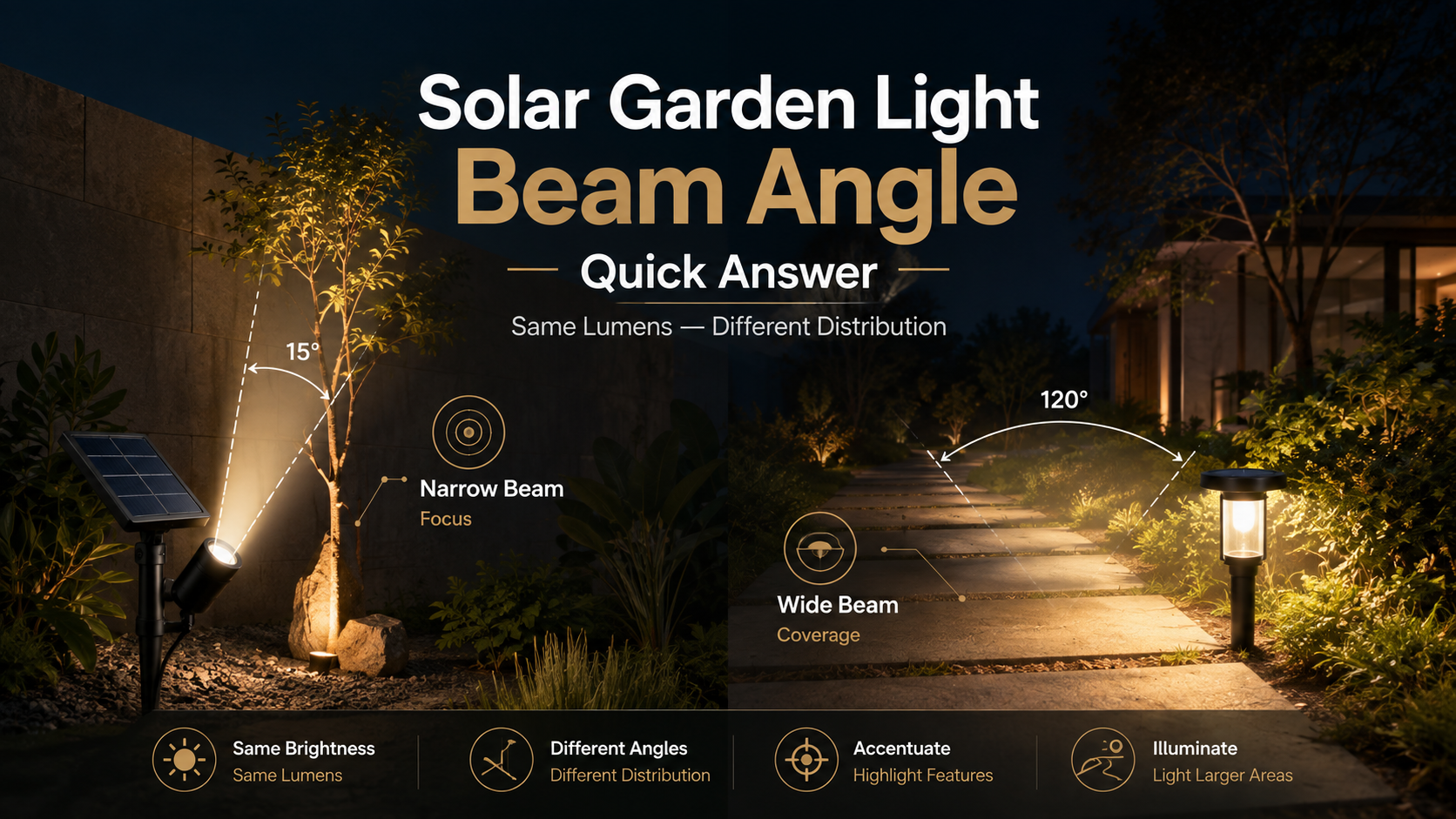
Control Mode and Beam Angle Should Be Evaluated Together
Consider a solar security light.
A wide sensor detection area does not guarantee appropriate illumination.
The product also needs to send light toward the target.
Therefore:
Detection Zone
and
Lighting Distribution
should be evaluated separately.
A person may trigger the sensor from one direction while the light beam points somewhere else.
For functional outdoor projects, buyers should combine:
Sensor Coverage + Beam Distribution + Mounting Position
LEDORA explains optical distribution in its Solar Garden Light Beam Angle Guide.
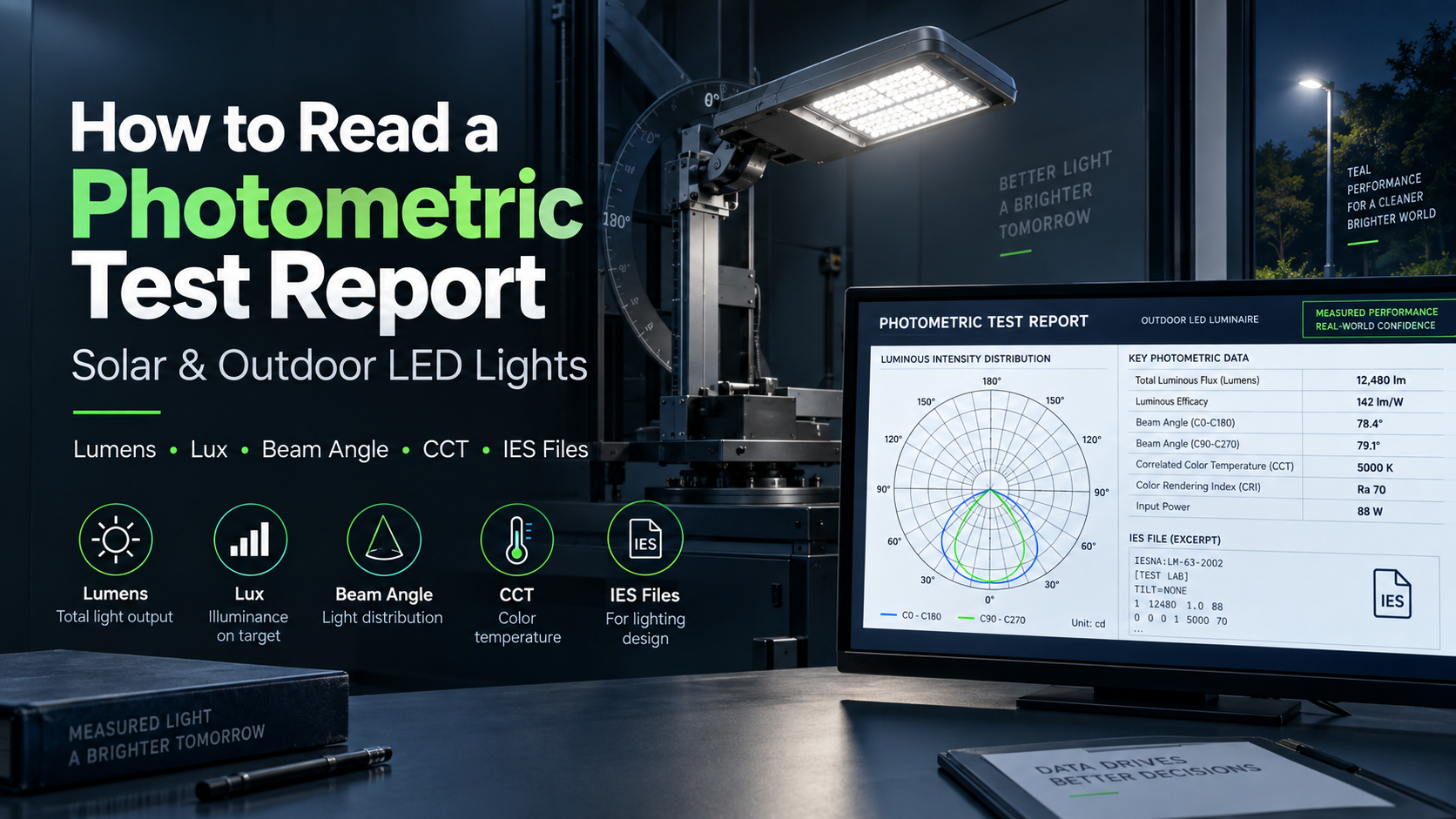
Control Mode and Photometric Data
Suppose a photometric report states:
500 lm
But the solar light has:
- low mode
- medium mode
- high mode
- PIR high mode
The buyer needs to know:
Which mode produced the 500-lumen measurement?
LEDORA’s Photometric Test Report Guide explains why test data should be connected to the exact:
- product configuration
- operating mode
- optical system
This becomes especially important for sensor-controlled products.
What Should Buyers Specify in an OEM RFQ?
Do not write only:
PIR Solar Light Required
A better specification includes:
Product Type
Solar Wall Light / Pathway Light / Floodlight / Security Light
Application
Entrance / Garage / Garden / Pathway / Commercial Exterior
Day/Night Control
Automatic light sensor required?
Motion Sensor
PIR or other required sensor type.
Detection Requirement
State the intended detection area rather than only requesting “long distance.”
Lighting Modes
Define the required operating sequence.
Standby Brightness
Off or reduced output?
High-Light Brightness
Define target output where relevant.
High-Light Duration
How long should high output remain after activation?
CCT
Example:
3000K / 4000K / 6500K
Solar Panel
Request:
- voltage
- current
- power
Battery
Request:
- chemistry
- voltage
- capacity
Runtime
Define the operating mode used for testing.
Outdoor Requirement
Define target IP rating and installation environment.
OEM Requirements
- housing
- color
- logo
- packaging
- manual
- barcode
Example of a Better PIR Solar Light RFQ
Instead of:
Need solar wall light with motion sensor. Please quote.
Use:
We are sourcing a solar wall light for residential entrances. The product should operate automatically after dark and use a PIR motion sensor to increase brightness when movement is detected. Please provide the detection angle and distance, recommended mounting height, standby brightness, high-light output, high-light duration, solar-panel specification, battery chemistry/voltage/capacity, lighting modes, runtime test conditions, IP rating and OEM packaging options. The final control sequence must be confirmed during sample approval.
This gives the supplier a real application to solve.
OEM Customization for Sensor Lights
LEDORA’s Solar Garden Light OEM & ODM Process already identifies solar motion-sensor products as a category where customization may include:
- battery capacity
- solar panel
- PIR sensor
- lighting modes
- high-light duration
- housing color
- mounting accessories
This is important because these specifications interact.
Changing:
High-Light Duration
can affect:
Energy Consumption
which can affect:
Runtime
which may require reviewing:
Battery + Solar Panel
OEM customization should therefore be treated as a system change rather than a list of independent features.

How to Approve a Golden Sample
Before bulk production, record the final control behavior.
The golden sample should confirm:
Daylight Behavior
Does the light remain off while charging?
Night Activation
Does nighttime mode start correctly?
Sensor Response
Does motion trigger the expected lighting change?
Detection Area
Does it match the intended installation?
High-Light Duration
Is the timing correct?
Return Mode
Does the light return to:
- off
- low brightness
- medium brightness
as specified?
Runtime
Does the complete control strategy meet the target operating time?
The quotation, specification sheet, manual and final production should describe the same mode sequence.
Sensor-Light QC Before Shipment
Bulk inspection should not check only:
LED On / Off
For sensor products, include:
Day/Night Sensor Test
Verify automatic switching.
PIR Trigger Test
Confirm motion activation.
Mode Test
Cycle through all available modes.
High-Light Duration
Confirm timing against the approved specification.
Standby Mode
Check low-light or off behavior.
Multiple-Unit Comparison
Make sure units behave consistently.
Battery and Charging
Confirm the energy system.
Outdoor Construction
Inspect sealing and assembly.
Packaging
Check that the instruction manual explains the correct mode sequence.
Common PIR Solar Light Sourcing Mistakes
Mistake 1 — Asking Only “Does It Have PIR?”
PIR does not define the complete control sequence.
Mistake 2 — Comparing Runtime Without Comparing Modes
12 hours of standby is not the same as 12 hours at maximum brightness.
Mistake 3 — Choosing the Widest Detection Angle
The detection zone should match the application.
Mistake 4 — Ignoring Mounting Height
Sensor behavior can change with installation geometry.
Mistake 5 — Ignoring High-Light Duration
Longer high-output periods consume more battery energy.
Mistake 6 — Testing Only Once
Sensor performance should be tested repeatedly.
Mistake 7 — Testing Only Indoors
Outdoor conditions can affect real application performance.
Mistake 8 — Changing the Controller After Sample Approval
The lighting sequence may change even when the housing looks identical.
Mistake 9 — Ignoring the Manual
Consumers need to understand the mode sequence.
Mistake 10 — Assuming More Modes Mean a Better Product
More modes can also create more complexity.
PIR Motion Sensor vs Dusk-to-Dawn Application Guide
| Application | Starting Control Strategy |
|---|---|
| Decorative Solar Garden Light | Dusk-to-Dawn |
| Solar Flower Light | Dusk-to-Dawn |
| Decorative Pathway Light | Dusk-to-Dawn |
| Functional Pathway Light | Dusk-to-Dawn / Hybrid |
| Residential Entrance | PIR / Hybrid |
| Garage | PIR / Hybrid |
| Gate | PIR / Hybrid |
| Security Wall Light | PIR / Hybrid |
| Hotel Landscape | Application-dependent |
| Commercial Exterior | Project-dependent |
These are application starting points, not universal requirements.
Final control selection should depend on:
Purpose + Required Brightness + Traffic + Runtime + Solar Energy Budget
B2B Sensor-Light Sample Approval Checklist
Before approving a solar motion-sensor product:
- Confirm product application
- Confirm light-sensor operation
- Confirm PIR operation
- Confirm detection area
- Confirm mounting height
- Confirm lighting modes
- Confirm standby brightness
- Confirm high brightness
- Confirm high-light duration
- Confirm return mode
- Confirm CCT
- Confirm beam distribution
- Confirm solar panel
- Confirm battery
- Confirm runtime test mode
- Confirm IP requirement
- Repeat sensor tests
- Approve golden sample
- Verify manual
- Verify packaging
- Recheck bulk-production samples
Frequently Asked Questions
What is the difference between PIR and dusk-to-dawn solar lights?
A dusk-to-dawn control responds primarily to ambient light level, while a PIR motion sensor responds to movement-related infrared changes within its detection area. Many solar security lights combine both functions.
Does a PIR solar light work during the day?
The exact logic depends on the product, but many outdoor solar sensor lights use a light sensor to prevent normal lighting operation during daylight while the solar panel charges the battery.
Is PIR better than dusk-to-dawn?
Neither is universally better. PIR is useful when lighting should respond to movement, while dusk-to-dawn control is useful when automatic nighttime lighting is required.
Do motion sensor lights save battery power?
They can reduce energy consumption when high brightness is used only during motion events, but actual battery use depends on standby power, brightness, activation frequency and high-light duration.
What is a hybrid solar sensor light?
A hybrid design can combine ambient-light sensing with motion detection. The light activates nighttime control after dark and then changes brightness when movement is detected.
What should buyers check in a PIR sensor specification?
Check the intended detection area, mounting height, lighting modes, standby state, high-light duration and real sample performance.
Is a wider PIR detection angle always better?
No. Excessively wide detection may create unwanted activations depending on the installation environment.
Why does my solar light not turn on in a bright room?
The ambient-light sensor may detect daytime conditions and prevent nighttime mode from activating.
Does PIR affect solar-light runtime?
Yes, indirectly. The controller determines how often and how long the LED operates at high brightness, which affects battery energy consumption.
What is high-light duration?
It is the period during which the product remains at increased brightness after a motion event.
Should motion-sensor lights be tested outdoors?
Yes. Realistic mounting height, detection geometry and environmental conditions provide more useful information than a simple tabletop test.
Can PIR settings be customized for OEM orders?
Depending on the product platform and controller, areas such as sensor type, lighting modes, high-light duration, battery, panel and related functions may be customizable. The final specification should be confirmed before production.
Conclusion
The difference between a basic solar light and a well-designed solar lighting system is not only:
Panel + Battery + LED
The controller matters too.
For functional outdoor products, the complete system becomes:
Solar Panel → Battery → Controller → Light Sensor → Motion Sensor → LED Output
Dusk-to-dawn control answers:
When should nighttime lighting begin?
PIR control answers:
When should the lighting respond to movement?
For B2B buyers, the most important principle is:
Do not buy a motion-sensor solar light based only on “PIR: Yes.” Define exactly how the product should behave before approving the sample.
A professional specification should connect:
Detection + Lighting Mode + Brightness + Duration + Battery + Solar Panel + Runtime
When these parameters are designed and tested together, the product is more likely to perform consistently in its intended outdoor application.
Looking for OEM Solar Motion Sensor & Outdoor Lighting?
LEDORA Lighting supplies solar garden lights and solar outdoor lighting products for importers, wholesalers, retailers, e-commerce brands and OEM/ODM buyers.
For technical sourcing, continue with:
Solar Panel Size & Battery Capacity Matching Guide
How Long Do Solar Garden Lights Stay On at Night?
Solar Garden Light Beam Angle & Light Distribution Guide
2700K vs 3000K vs 4000K vs 6500K Outdoor Solar Lights
How to Read a Photometric Test Report for Outdoor LED Lights
Solar Garden Light OEM & ODM Process
For sensor-light examples, review:
102-LED Solar Motion Sensor Security Light
4-Head Solar Motion Sensor Flood Light
For authoritative lighting-control references:
IES — Occupancy Sensor Definition
DarkSky — Five Principles for Responsible Outdoor Lighting
When requesting an OEM quotation, send LEDORA:
Target Market + Application + Detection Requirement + Mounting Height + Lighting Modes + Standby Brightness + High-Light Brightness + High-Light Duration + CCT + Solar Panel + Battery + Runtime + IP Requirement + Quantity + Packaging