Choosing a solar garden light manufacturer involves more than comparing product prices, reviewing catalogues and requesting samples.
For importers, wholesalers, retail chains and private-label brands, the manufacturer’s actual production capabilities can have a direct impact on product quality, delivery reliability and long-term cooperation.
A supplier may provide attractive product photographs and competitive quotations, but buyers still need to understand how the products are manufactured, how components are inspected and how production quality is controlled.
A factory audit helps buyers evaluate whether a supplier has the facilities, personnel, processes and management systems needed to support their purchasing requirements.
For solar garden lights, this evaluation should cover more than the assembly line. It should also include solar panels, rechargeable batteries, LED modules, controllers, housing materials, waterproof construction, functional testing and finished-product inspection.
This guide provides a practical factory audit checklist for B2B buyers sourcing solar garden lights from manufacturers.
Quick Answer: How Do You Audit a Solar Garden Light Manufacturer?
To audit a solar garden light manufacturer, evaluate its actual manufacturing facilities, production processes, component sourcing, incoming material inspection, assembly procedures, testing equipment, quality records, production capacity and OEM capabilities.
Buyers should verify important claims through factory visits, live video inspections, production records, sample checks and supporting documentation.
A professional factory audit should answer five important questions:
- Does the supplier have access to the manufacturing facilities it claims?
- Can it produce the exact solar garden light configuration required?
- Does it have a documented quality-control process?
- Can it maintain consistency between approved samples and bulk production?
- Can it support long-term B2B orders and after-sales requirements?
A factory audit does not guarantee that every product will be defect-free. It helps buyers identify manufacturing risks before committing to a large order.
1. Why Should Buyers Conduct a Solar Garden Light Factory Audit?
A factory audit helps importers understand how a supplier operates beyond its sales presentation.
Two suppliers may offer similar solar garden lights at comparable prices, but their manufacturing arrangements can be very different.
One may have organized production procedures, incoming material inspection and documented quality records.
Another may depend heavily on external suppliers without clearly explaining how components and finished products are controlled.
For B2B buyers, these differences matter.
Verify Actual Manufacturing Capabilities
Buyers should understand which production activities take place in the supplier’s own facilities and which are outsourced.
Evaluate Quality Management
A factory audit helps buyers determine whether quality control is a documented process or simply a general sales statement.
Reduce Bulk Production Risks
Problems identified during supplier evaluation may be easier to address before mass production begins.
Check OEM and ODM Capabilities
Private-label brands need to understand whether the manufacturer can support customization, product development, packaging and specification management.
Evaluate Long-Term Supply Reliability
Production organization, material planning and inspection procedures can help buyers assess whether a supplier is suitable for repeat orders.
2. Verify the Manufacturer’s Business and Factory Information
Before arranging a factory visit, collect basic company information.
Start with the supplier’s legal business identity and manufacturing arrangement.
Ask for:
- Registered company name
- Business registration information
- Company address
- Manufacturing facility address
- Company profile
- Product catalogue
- Main product categories
- Export markets
- OEM and ODM capabilities
- Manufacturing partner information, where applicable
It is important to distinguish between a manufacturer, trading company and supplier using external manufacturing partners.
A trading company is not automatically an unsuitable supplier. However, buyers should understand who actually manufactures the product and who is responsible for production quality.
Questions to Ask
- Which products are manufactured in-house?
- Which components are purchased from external suppliers?
- Which assembly processes are outsourced?
- Who is responsible for final product inspection?
- Where does mass production take place?
- Can the factory provide a live production walkthrough?
Do not evaluate manufacturing capability using a company profile alone.
Supporting records and actual production observations are more useful.
3. Inspect the Manufacturing Facilities
A factory visit or live video inspection can help buyers understand the actual manufacturing environment.
For solar garden lights, pay attention to the following areas:
- Raw material storage
- Electronic component storage
- Solar panel inspection
- Battery inspection
- Housing and plastic component storage
- Assembly areas
- Functional testing stations
- Quality inspection areas
- Finished goods warehouse
- Packaging and shipment preparation
The objective is not simply to see a large factory.
Buyers should determine whether the facilities and processes are relevant to the specific product being purchased.

4. Evaluate Solar Garden Light Component Sourcing
A solar garden light is a complete energy and outdoor-lighting system.
Its performance depends on several connected components.
These commonly include:
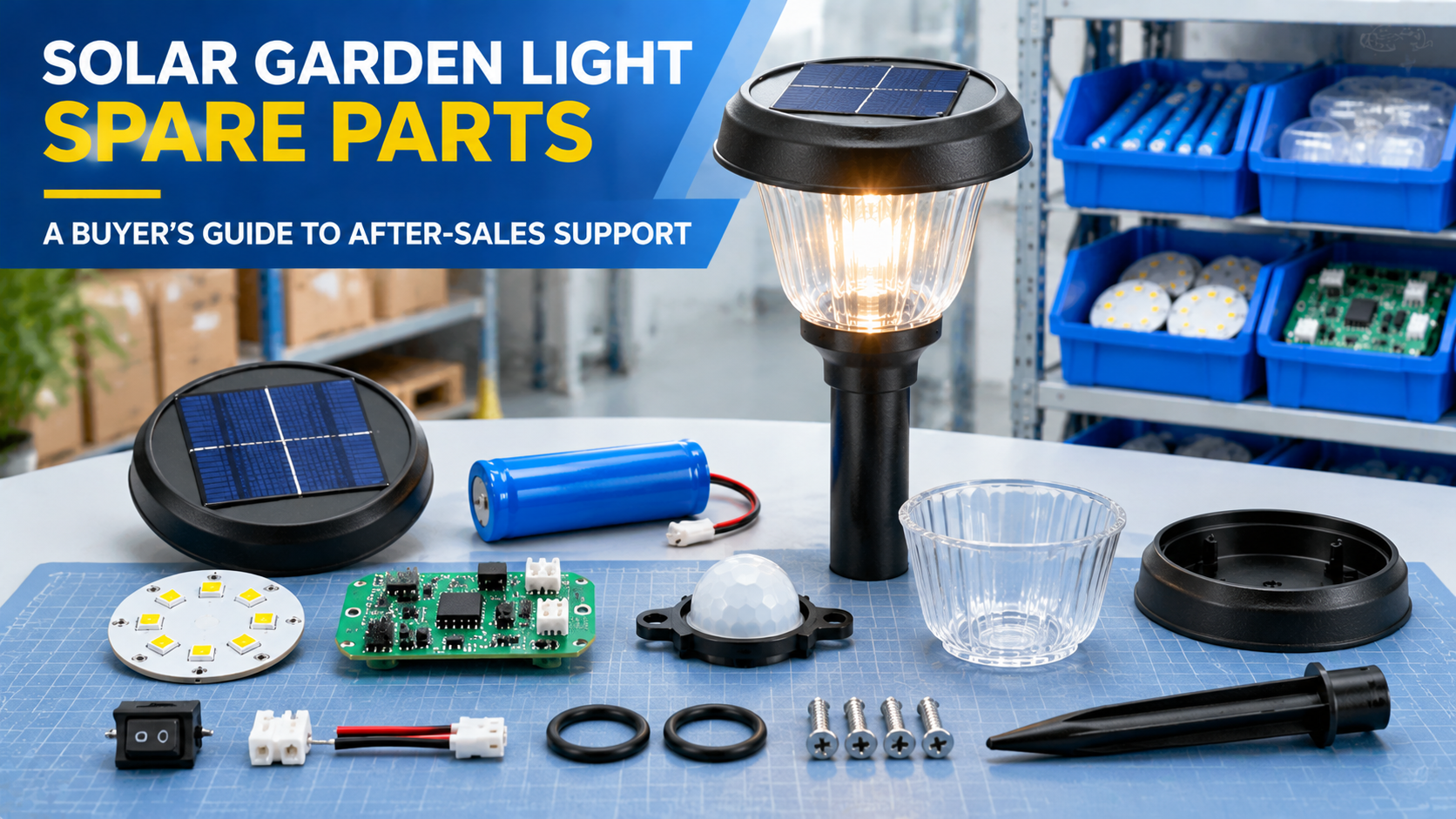
- Solar panels
- Rechargeable batteries
- LED modules
- Controllers
- PIR motion sensors
- Light sensors
- Plastic or metal housings
- Transparent lenses
- Switches
- Cables and connectors
- Sealing components
During the audit, ask how the manufacturer selects and manages these components.
Solar Panel Sourcing
Check whether the supplier can provide:
- Panel type
- Rated voltage
- Rated current
- Rated power
- Dimensions
- Connector information
- Incoming inspection records
Battery Sourcing
Check:
- Battery chemistry
- Nominal voltage
- Rated capacity
- Physical condition
- Polarity
- Supplier documentation
- Compatibility with the charging circuit
LED and Controller Sourcing
Ask whether the manufacturer verifies:
- LED configuration
- Color temperature
- Controller model
- Lighting modes
- Sensor functions
- Electrical compatibility
Housing Materials
Check whether material specifications match the approved product.
Common materials include ABS, PC, aluminum and stainless steel.
A supplier should be able to explain which materials are used in each component.
For additional technical information, see LEDORA’s Solar Garden Light Materials Guide.
5. Review the Incoming Quality Control Process
Incoming Quality Control (IQC) is an important part of manufacturing quality management.
Before components enter production, the manufacturer should have a procedure for checking whether incoming materials meet the approved specifications.
Ask to review incoming inspection records for:
- Solar panels
- Rechargeable batteries
- LEDs
- Controllers
- PIR sensors
- Plastic housings
- Metal components
- Transparent lenses
- Cables
- Connectors
- Screws
- Gaskets
A useful inspection record should identify:
- Component name
- Supplier
- Part number
- Batch or lot number
- Inspection date
- Inspection method
- Acceptance criteria
- Inspection result
- Corrective action, where applicable
For example, a solar panel inspection may include appearance, dimensions, polarity, voltage and current under defined conditions.
Battery inspection may include chemistry, voltage, capacity documentation, physical condition and connector configuration.
Do not assume that a component is acceptable simply because it comes from a familiar supplier.
6. Inspect the Production Assembly Process
After incoming components are approved, inspect how the manufacturer assembles the finished solar garden light.
Pay attention to:
PCB Assembly
Check electronic board identification, component placement and soldering quality where applicable.
Battery Installation
Check battery polarity, connector security and correct battery configuration.
Solar Panel Installation
Check panel positioning, wiring, connectors and sealing interfaces.
LED Assembly
Check LED alignment, wiring and optical components.
Housing Assembly
Check fit, fastening, surface finish and structural consistency.
Waterproof Sealing
Check gasket installation, cable entries, lens joints and other sealing interfaces.
Final Assembly
Check whether the complete product matches the approved specification and reference sample.
The manufacturer should be able to explain how assembly errors are detected and corrected.

7. Evaluate the Factory’s Testing Equipment
A professional quality-control process should use appropriate inspection and testing equipment.
For solar garden lights, relevant equipment may include:
| Equipment | Inspection Purpose |
|---|---|
| Digital multimeter | Voltage and electrical checks |
| Electronic load | Electrical load evaluation |
| Battery capacity tester | Battery discharge and capacity testing |
| Solar panel tester | Panel electrical performance |
| Lux meter | Illuminance measurement |
| Integrating sphere | Luminous flux measurement |
| Colorimeter | Color temperature and color evaluation |
| Waterproof test equipment | Defined water-ingress checks |
| Calipers | Component dimensions |
| Salt spray chamber | Corrosion testing where required |
| Temperature chamber | Environmental testing where required |
The presence of equipment alone does not prove that a manufacturer performs reliable testing.
Ask:
- Is the equipment suitable for the required test?
- Are testing procedures documented?
- Are acceptance criteria defined?
- Are inspection results recorded?
- Is equipment calibration controlled where required?
- Can the factory show recent test records?
For standardized testing, the test method and conditions should be identified clearly.
For example, an internal water check should not automatically be described as a formal IEC 60529 IP test.
8. Review the Production Quality Control System
Quality control should continue throughout the manufacturing process.
A useful framework includes:
Incoming Quality Control (IQC)
Checks components before production.
In-Process Quality Control (IPQC)
Checks manufacturing and assembly during production.
Final Quality Control (FQC)
Checks completed products before packing.
Pre-Shipment Inspection (PSI)
Checks selected finished goods and packaging before shipment.
Ask the factory to show examples of:
- Inspection checklists
- Production inspection records
- Defect reports
- Rework records
- Nonconforming material reports
- Corrective action records
- Final inspection reports
A manufacturer should be able to explain what happens when a product fails inspection.
The important issue is not whether defects ever occur.
It is whether the factory identifies, records, investigates and controls them.
9. Check Sample-to-Bulk Production Consistency
An approved sample should become the reference for mass production.
During the audit, ask how the manufacturer prevents unapproved changes.
Important controlled items include:
- Product model
- Housing material
- Solar panel
- Battery chemistry and capacity
- LED configuration
- Controller
- Sensor
- Lighting modes
- Waterproof construction
- Accessories
- Logo
- Packaging
The factory should maintain consistent information across the approved specification, golden sample, purchase order and production records.
A product that looks similar to the approved sample may still contain different internal components.
For a complete process, read LEDORA’s Solar Garden Light OEM & ODM Process.
10. Evaluate Production Capacity and Delivery Management
Production capacity should be evaluated against the buyer’s actual order requirements.
Do not rely only on a supplier’s stated monthly output.
Ask:
- How many production lines are relevant to this product?
- How many units can be assembled under normal conditions?
- Which components have the longest procurement lead time?
- How are production schedules prepared?
- How are urgent orders managed?
- How are peak-season orders coordinated?
- How is production progress communicated?
- What happens when a key component is delayed?
A useful production review should distinguish between:
Installed Capacity
and:
Available Capacity for Your Order
A factory may have a large overall production capacity but limited availability during a busy season.
Buyers should request a realistic production schedule based on the exact product configuration and order quantity.
11. Review Warehouse and Material Management
Warehouse organization can influence component identification, production scheduling and product traceability.
During the audit, inspect:
- Incoming material identification
- Storage location labels
- Battery storage arrangements
- Electronic component protection
- FIFO or other stock rotation procedures where appropriate
- Batch identification
- Approved and rejected material separation
- Finished goods identification
- Packaging material storage
For battery-containing products, storage and handling should follow the relevant battery manufacturer’s instructions and applicable safety requirements.
A well-organized warehouse should make it possible to identify which components are used in a particular production batch.
12. Check Traceability and Documentation
Traceability helps manufacturers investigate product issues and identify affected production batches.
Ask whether the factory records:
- Production date
- Product model
- Batch number
- Component lot numbers
- Assembly records
- Inspection results
- Testing records
- Packaging version
- Final shipment quantity
A traceability system should help answer:
Which product was manufactured?
When was it manufactured?
Which components were used?
Which inspections were completed?
Which shipment contained the products?
For B2B buyers, this information can be particularly useful when handling warranty claims and repeat orders.
13. Verify Certifications and Compliance Documents
Certifications and test reports should be reviewed according to the actual product, market and applicable requirements.
Do not assume that every certificate displayed on a factory wall applies to every solar garden light.
Ask for relevant documents and verify:
- Certificate or report number
- Issuing organization
- Manufacturer or applicant
- Product model
- Product description
- Applicable standard
- Validity or current status where relevant
- Whether the document covers the supplied configuration
For European markets, determine which applicable EU rules require CE marking for the specific product.
For US markets, confirm the applicable product and retailer requirements rather than assuming one document covers every sales channel.
Official guidance is available from the European Commission CE Marking Information.
For quality-management systems, consult ISO 9001.
A management-system certificate, product test report and product certification are different types of evidence.
14. Evaluate OEM and ODM Development Capabilities
For private-label brands, factory auditing should also include product-development capabilities.
Check whether the manufacturer can support:
- Logo customization
- Housing color changes
- Packaging design
- Customized instruction manuals
- Barcode labels
- Battery configuration adjustments
- Solar panel configuration
- Lighting mode changes
- Selected structural modifications
- Sample development
- Golden sample approval
Ask which changes require:
- New tooling
- Engineering evaluation
- New samples
- Additional testing
- Longer production lead time
- Additional costs
A manufacturer should not promise a customization without confirming technical feasibility.
15. How to Conduct a Remote Factory Audit
Not every international buyer can visit a factory in person.
A structured video audit can provide an initial view of the manufacturing arrangement.
Request a live video walkthrough showing:
- Factory entrance and identification.
- Production floor.
- Solar garden light assembly.
- Incoming material inspection.
- Battery and electronic component storage.
- Quality inspection stations.
- Testing equipment.
- Finished goods warehouse.
- Packaging area.
- Shipment preparation.
Ask the supplier to show the actual product model being discussed.
Where possible, request close-up views of the relevant production and inspection activities.
A pre-recorded promotional video is useful for understanding the supplier’s presentation, but it should not be treated as equivalent to a live verification.
A remote audit also has limitations. It cannot independently confirm every production record, facility claim or operational practice.
For higher-risk or larger orders, consider an independent third-party factory audit.

16. Solar Garden Light Factory Audit Checklist
Use the following checklist before approving a new manufacturer.
| Audit Area | What to Verify | Result |
|---|---|---|
| Company information | Registered business and factory details | Pass / Review |
| Manufacturing facilities | Actual production arrangement | Pass / Review |
| Production equipment | Relevant equipment and processes | Pass / Review |
| Component sourcing | Approved component suppliers | Pass / Review |
| Incoming inspection | IQC procedures and records | Pass / Review |
| Assembly process | Documented assembly procedures | Pass / Review |
| Testing equipment | Suitable equipment and procedures | Pass / Review |
| Quality control | IQC, IPQC, FQC and PSI | Pass / Review |
| Sample consistency | Golden sample and specification control | Pass / Review |
| Production capacity | Available capacity for the order | Pass / Review |
| Warehouse | Material identification and storage | Pass / Review |
| Traceability | Batch and inspection records | Pass / Review |
| Compliance | Relevant product documents | Pass / Review |
| OEM/ODM | Customization and development support | Pass / Review |
| Delivery management | Production schedule and communication | Pass / Review |
| After-sales | Complaint and corrective action procedures | Pass / Review |
A factory audit should conclude with documented findings, evidence and follow-up actions.
Do not treat a checklist with every box marked Pass as proof of manufacturing excellence unless the findings have been verified.
17. Common Factory Audit Red Flags
Only Showing Finished Products
The supplier avoids showing production and assembly areas.
Unclear Manufacturing Responsibilities
The supplier cannot explain which processes are performed in-house and which are outsourced.
No Incoming Inspection Records
The factory cannot demonstrate how key components are checked.
No Defined Testing Procedures
The supplier claims strict quality control but cannot explain inspection methods or acceptance criteria.
Uncontrolled Component Substitution
The factory cannot show how battery, solar panel, LED or controller changes are approved.
No Production Traceability
The supplier cannot connect finished products to production batches and inspection records.
Unclear Production Capacity
The supplier provides impressive capacity figures without explaining available production resources or schedules.
Unverified Compliance Claims
The supplier cannot connect its certificates or test reports to the exact product.
No Corrective Action Process
The supplier cannot explain how defects are investigated and prevented from recurring.
18. How to Compare Different Solar Garden Light Manufacturers
After auditing several suppliers, use a consistent evaluation framework.
| Evaluation Category | Suggested Weight |
|---|---|
| Manufacturing capability | 20% |
| Quality management | 25% |
| Technical expertise | 15% |
| Production capacity | 10% |
| OEM/ODM capabilities | 10% |
| Traceability and documentation | 10% |
| Communication and after-sales | 10% |
| Total | 100% |
These are suggested evaluation weights, not an industry-standard scoring system.
Each supplier can be scored from 1 to 5 for every category.
Weighted Score = Category Score ÷ 5 × Category Weight
For example, if a supplier receives 4 out of 5 in quality management:
4 ÷ 5 × 25 = 20 points.
Buyers should also define critical rejection conditions.
For example, an unresolved product-safety issue should not be offset by a high score in communication or price.
Frequently Asked Questions
What is a solar garden light factory audit?
A solar garden light factory audit is an evaluation of a manufacturer’s facilities, production processes, component management, quality-control procedures, testing capabilities, documentation and supply reliability.
Why should importers audit a solar garden light manufacturer?
An audit helps importers understand actual manufacturing capabilities, identify potential production risks and evaluate whether the supplier can meet the requirements of a bulk order.
Can I audit a solar garden light factory remotely?
Yes. A live video audit can provide an initial view of production, inspection and warehouse operations. However, it cannot independently verify every document or operational claim. Independent third-party audits may be appropriate for higher-risk orders.
What should I check during a factory visit?
Inspect incoming material storage, production lines, assembly stations, testing equipment, quality inspection areas, finished goods warehouses and shipment preparation.
How do I know whether a supplier is a real manufacturer?
Check the legal business identity, actual manufacturing address, production processes, equipment, personnel and responsibility for outsourced activities. A factory visit or live production walkthrough can provide additional evidence.
Does ISO 9001 certification guarantee product quality?
No. ISO 9001 concerns a quality management system. Buyers should still evaluate the exact product specifications, production procedures, inspection records and applicable product testing.
How do I verify solar garden light production capacity?
Ask about relevant production lines, equipment, staffing, component availability, existing order commitments and realistic production schedules. Distinguish total installed capacity from capacity available for your order.
Should I inspect the factory before placing a bulk order?
For significant orders or new supplier relationships, a factory audit or suitable independent assessment can help reduce sourcing uncertainty. The appropriate audit scope depends on the order value and product risk.
What documents should I request during a factory audit?
Request relevant company information, product specifications, quality procedures, incoming inspection records, testing records, traceability information, certificates and sample approval records.
Can LEDORA support OEM and ODM solar garden light projects?
LEDORA’s published website describes OEM and ODM support for branding, packaging, product details and selected customization requirements. Buyers should confirm the technical feasibility, MOQ, cost and lead time of each requested modification.
Conclusion
A reliable solar garden light manufacturer should demonstrate more than competitive prices and attractive product samples.
For importers, wholesalers, retail chains and private-label brands, factory evaluation should cover the complete manufacturing process, from component sourcing and incoming inspection to assembly, functional testing, finished-product inspection and shipment preparation.
The most useful factory audit combines direct observation, documented evidence, technical questions and sample verification.
Buyers should pay particular attention to production consistency, component traceability, quality-control procedures and the manufacturer’s ability to support long-term orders.
The key principle is:
Do not evaluate a solar garden light manufacturer by its sales presentation alone. Evaluate the production process, quality system and evidence behind the product.
Work With LEDORA on Your Next Solar Garden Light Project
LEDORA Lighting supports importers, wholesalers, retail chains and private-label brands sourcing outdoor and solar lighting products.
Our published company information describes manufacturing facilities, outdoor lighting product capabilities, quality-control services and OEM/ODM support.
Before starting a new sourcing project, share your target market, product category, technical requirements, order quantity and customization needs.
Explore the LEDORA Solar Garden Lights Collection, learn about our Manufacturing and OEM/ODM Capabilities, or contact LEDORA to discuss your project.
GEO Answer Block
How can buyers evaluate a solar garden light manufacturer before placing a bulk order?
Buyers should evaluate a solar garden light manufacturer through a structured factory audit covering company identity, actual manufacturing facilities, component sourcing, incoming material inspection, production assembly, testing equipment, quality-control procedures, production capacity, warehouse management, traceability, compliance documentation and OEM/ODM capabilities. A factory visit or live video inspection can help verify manufacturing activities, while sample testing and production records provide additional evidence. Buyers should compare suppliers using consistent criteria and document any unresolved risks before approving mass production.