How Do You Verify an IP65 Claim on a Solar Light?
An IP65 claim should be verified by more than the word “waterproof” on a quotation or product page.
Under the IEC IP classification system:
6 refers to the solid-particle protection level.
5 refers to the water-ingress protection level.
For IP65, the enclosure is classified as:
Dust-tight + protected against water jets
under the applicable IEC 60529 test classification.
For B2B buyers, however, the important question is not simply:
“Does the supplier say IP65?”
The stronger questions are:
Which exact product was tested?
Which parts of the product are covered?
Does the report match the current product structure?
Were the cable entries, switches, battery compartment and joints included?
Does bulk production use the same sealing design as the tested sample?
IEC 60529 is the international standard covering degrees of protection provided by electrical equipment enclosures under the IP Code. IEC 60529 — Degrees of Protection Provided by Enclosures
Intertek also explains that IP testing under IEC 60529 is used to evaluate an enclosure’s resistance to dust and moisture. Intertek — IP Testing per IEC 60529
For importers sourcing solar garden lights, the correct approach is:
IP Rating + Test Evidence + Product Structure + Sample Inspection + Production Consistency
Why “Waterproof Solar Light” Is Not a Complete Specification
The term:
Waterproof
is widely used in product marketing.
But it does not tell the buyer:
- which IP level applies
- what test was performed
- which enclosure was tested
- whether connectors were included
- whether the battery compartment was included
- whether the solar-panel connection was included
- whether the product has changed since testing
This is why a professional RFQ should avoid asking only:
“Is it waterproof?”
Instead ask:
What IP rating does the exact product have, and what evidence supports that rating?
LEDORA explains the differences between the major outdoor IP levels in its existing IP44 vs IP65 vs IP67 Outdoor Lights guide. IP44 vs IP65 vs IP67 Outdoor Lights: What B2B Buyers Should Know
That article helps buyers choose an appropriate rating.
This guide focuses on the next question:
How do you verify that the claimed rating belongs to the product you are buying?

What Does IP65 Actually Mean?
IP ratings contain two characteristic numerals.
In:
IP65
the first numeral is:
6
and the second numeral is:
5
Intertek’s IEC 60529 guidance describes:
IP6X → Dust-tight
and:
IPX5 → Protected against water jets
Intertek — IEC 60529 IP Rating Table
Therefore:
IP65 = Dust-tight enclosure + protection against the applicable water-jet test
This does not mean:
- permanent underwater operation
- unlimited water pressure
- every component can be submerged
- every installation environment is acceptable
IP ratings describe defined test classifications.
They are not unlimited guarantees against every possible real-world condition.
IP65 Is Not the Same as IP67
This is an important distinction for solar-light buyers.
IP65
Dust-tight + water-jet protection
IP67
Dust-tight + protection against the effects of temporary immersion
These levels evaluate different water-exposure conditions.
A buyer should not say:
“IP67 is always better, so I want IP67 for every product.”
The correct level should match the actual application.
For example:
A solar wall light exposed to rain has a different installation condition from a solar ground light located near wet soil or accumulated water.
LEDORA’s IP comparison guide explains this application-based approach in more detail. LEDORA IP44 vs IP65 vs IP67 Guide
What Should an IP65 Test Report Show?
When a supplier provides an IP report, do not check only the final result.
Review whether the report can be clearly connected to your product.
A useful review should include:
- report number
- test laboratory
- test date
- applicant
- manufacturer where stated
- model number
- product description
- product photographs
- tested IP level
- applied test standard
- test conclusion
The critical question is:
Can you trace the report to the exact product you are ordering?
A report with a valid-looking logo but an unrelated model number is not useful evidence for your purchase.
Check the Product Model First
Suppose your quotation says:
Model: SL-2026A
But the IP report shows:
Model: SL-2019
Ask:
- Are they the same enclosure?
- Was the model name changed only for commercial reasons?
- Are the seals identical?
- Is the switch identical?
- Is the battery cover identical?
- Is the lens structure identical?
- Has the housing mold changed?
Do not assume that two visually similar lights have identical ingress protection.
The model relationship should be documented.

Check the Product Photograph in the Report
Photographs are extremely useful.
Compare the report image with your current sample.
Look at:
- housing shape
- lens
- switch
- screws
- cable entry
- sensor window
- solar-panel connection
- battery cover
- mounting structure
If the product shown in the report looks different, ask why.
A cosmetic change may be harmless.
A structural change may not be.
The key issue is whether the change affects the enclosure.
Why Structural Changes Can Affect IP Performance
Water does not care about marketing model names.
It enters through physical openings.
Common ingress-risk points include:
- housing seams
- cable entries
- switches
- charging ports
- battery covers
- sensor windows
- screw holes
- lens joints
- solar-panel connections
- connectors
If one of these areas changes, the waterproof structure may also change.
That means an old test report may no longer represent a significantly modified product.
Solar Lights Have More Water-Entry Points Than They Appear To
A basic solar light is a system made of multiple components.
A typical product may include:
Solar Panel
↓
Cable / Connection
↓
Housing
↓
Battery
↓
Controller
↓
LED
↓
Switch / Sensor
Each interface can create a sealing challenge.
For this reason, buyers should inspect the complete product instead of looking only at the visible lamp housing.
Solar Panel Sealing
The solar panel is directly exposed to weather.
Inspect:
- panel edge sealing
- rear housing
- cable outlet
- panel-to-housing joint
- adhesive or sealant application
- cracks
- cable strain relief
If the solar panel is remote rather than integrated, inspect the cable and connector system separately.
Housing Seam
Many solar lights use two or more housing pieces.
Where those pieces meet, the design may use:
- gasket
- O-ring
- adhesive
- ultrasonic welding
- mechanical compression
- another sealing method
Inspect whether the seam is:
- even
- compressed correctly
- free from gaps
- free from contamination
A gasket cannot work properly if it is:
- twisted
- missing
- cut
- poorly seated
Lens Joint
The transparent optical section is another important interface.
Possible issues include:
- uneven glue
- incomplete seal
- poor fit
- cracked plastic
- deformation
- gaps after assembly
For outdoor lighting, optical appearance and waterproof construction should both be checked.
Battery Compartment
Some solar lights contain replaceable rechargeable batteries.
Others use enclosed battery systems.
If a battery cover is accessible, check:
- cover fit
- gasket
- screws
- latch
- sealing surface
A battery compartment may become a water-entry point if it is opened and closed incorrectly.
For retail products, the manual should clearly explain battery-access procedures where relevant.
Switches and Buttons
A physical switch creates another enclosure interface.
Check whether the product uses:
- covered push button
- rubber membrane
- recessed switch
- sealed mechanical interface
A switch may function perfectly during a dry indoor test but still become a weak point under outdoor exposure if the sealing design is poor.
PIR Sensor Windows
Motion-sensor lights introduce another component:
PIR Sensor Window
This area must allow detection while remaining properly integrated into the enclosure.
LEDORA’s recent PIR Motion Sensor vs Dusk-to-Dawn Solar Lights guide explains why sensor behavior, mounting position and lighting modes should be tested separately from basic waterproof performance. PIR Motion Sensor vs Dusk-to-Dawn Solar Lights
For sensor models, buyers should evaluate:
Waterproof Structure + Sensor Function
after relevant environmental testing.

What Happens During IP Testing?
IP testing evaluates an enclosure according to defined conditions associated with the target IP classification.
Intertek explains that IEC 60529 testing evaluates protection against:
- solid foreign objects
- dust
- water
depending on the requested IP level. Intertek — Ingress Protection Testing
UL Solutions likewise describes IP water and dust testing as evaluating liquid ingress and solid-particle protection according to standards including IEC/EN 60529. UL Solutions — Environmental Simulation and IP Testing
For IP65, the classification combines the applicable:
IP6X solid-particle requirement
and:
IPX5 water requirement
What Should Happen After the Water Test?
This is where buyers often stop too early.
They see water sprayed onto a sample and assume:
“The test is finished.”
But post-test inspection matters.
After an outdoor-light water test, evaluate:
- water inside the housing
- condensation where relevant
- battery contacts
- PCB area
- LED operation
- sensor operation
- switch operation
- charging function
- visible corrosion
- seal movement
The product should also be assessed according to the applicable acceptance criteria of the relevant test method.
Why “The Light Still Turns On” Is Not Enough
Imagine a solar light after a water test.
The LED still illuminates.
But inside the housing there is moisture around:
- battery terminal
- PCB
- connector
The product may appear functional immediately.
That does not mean the result should automatically be treated as acceptable.
Moisture can later contribute to:
- corrosion
- electrical instability
- battery-contact problems
- intermittent operation
Therefore:
Function after spraying is not the same as verified ingress protection.
Factory Waterproof Test vs Standard IP Test
These should not automatically be treated as equivalent.
Factory Waterproof Check
A manufacturer may perform an internal water test for:
- production QC
- process monitoring
- leak detection
- sample comparison
This can be valuable.
Standard IP Test
A formal IP test follows the applicable requirements of a defined standard such as IEC 60529.
This may be required when:
- a customer specifically requests test evidence
- a retailer requires documentation
- a project specification calls for it
- the IP claim needs formal verification
For B2B buyers:
Factory QC and third-party testing can complement each other.
One should not automatically be represented as the other.
Should Every Production Unit Be Sent to a Laboratory?
No.
That would usually be commercially impractical.
A more realistic quality system is:
Product Design
↓
Representative Sample Testing
↓
Golden Sample Approval
↓
Controlled Production Process
↓
Production Waterproof Checks
↓
Pre-Shipment Inspection
The goal is to keep bulk production consistent with the approved and tested construction.
Why the Golden Sample Matters
Suppose the IP-tested sample uses:
- gasket A
- screw A
- housing A
- cable gland A
- adhesive A
But mass production uses:
- thinner gasket B
- different screw pressure
- modified housing
- cheaper cable gland
- less adhesive
Even if the outside appearance remains similar, sealing performance may change.
This is why the approved golden sample is important.
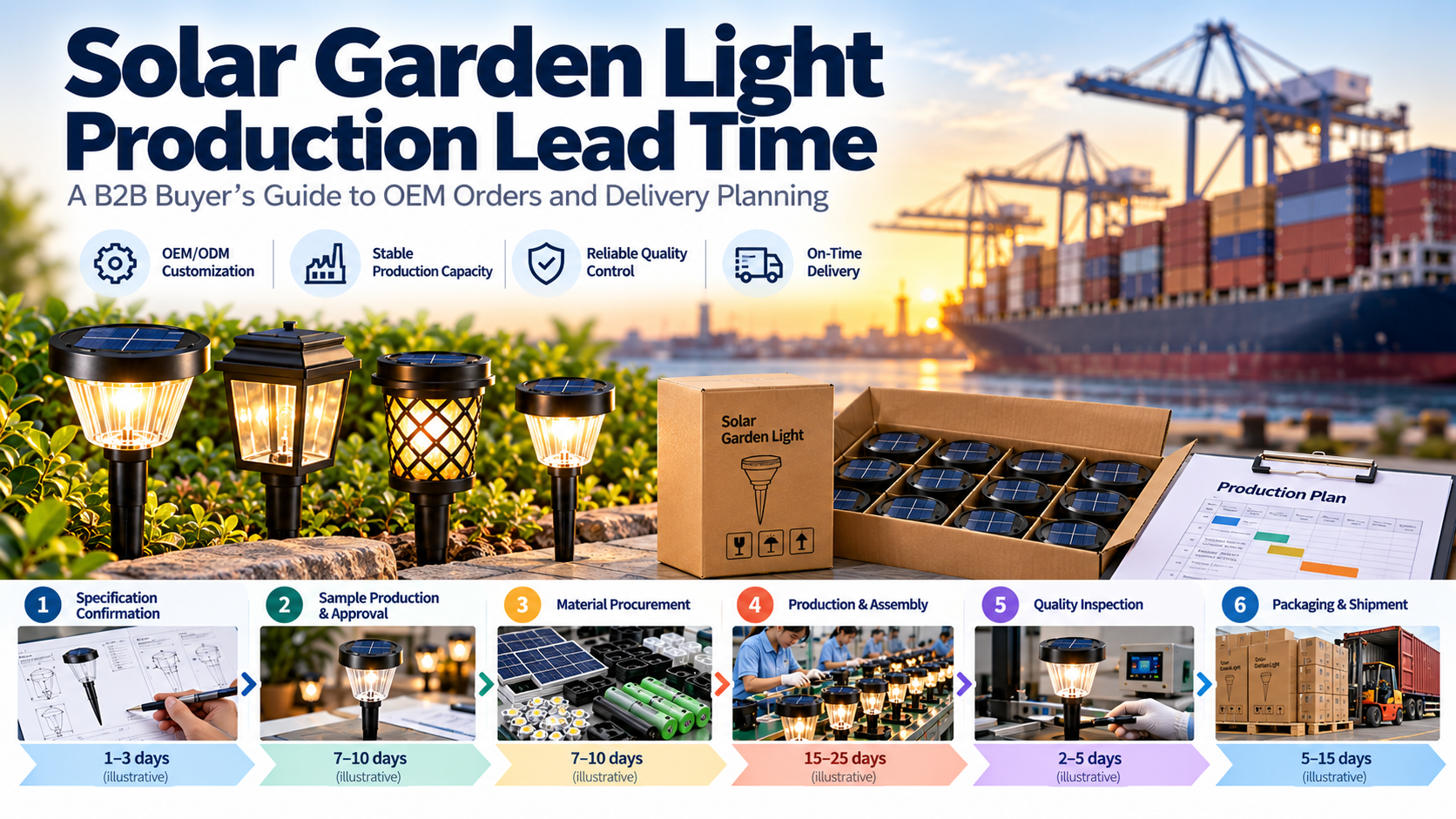
LEDORA’s Solar Garden Light OEM & ODM Process includes waterproof inspection and emphasizes confirming the final product structure before bulk production. Solar Garden Light OEM & ODM Process

What Should Buyers Check During Sample Approval?
Before approving a solar outdoor light, inspect:
Housing
- cracks
- deformation
- gaps
- joint fit
Gaskets
- size
- placement
- compression
- damage
Solar Panel
- edge seal
- cable entry
- rear joint
Lens
- adhesive
- joint
- fit
Switch
- sealing
- movement
- cover
Battery Compartment
- gasket
- screw fit
- cover compression
Cable Entry
- gland
- strain relief
- sealant
Sensor
- window installation
- housing joint
Do not approve waterproof performance only from exterior appearance.
What Is a Waterproof Structure BOM?
For OEM projects, sealing-related components should be controlled as part of the product specification and BOM.
A waterproof-related BOM may include:
- gasket material
- gasket dimensions
- O-ring
- adhesive
- sealant
- cable gland
- screw
- housing component
- switch boot
- connector
If critical sealing components change, review whether the change affects the approved construction.
Silicone Sealant Is Not a Substitute for Good Design
Applying more glue is not automatically a professional waterproof strategy.
Excess sealant can create:
- inconsistent assembly
- cosmetic defects
- contamination
- difficult rework
- unreliable compression
The enclosure should be designed so that sealing is:
- repeatable
- controlled
- inspectable
A factory should not rely only on an operator adding “more glue” to compensate for poor component fit.
Waterproofing and Material Selection
Housing material can affect outdoor durability, but material and IP rating are not the same specification.
For example:
- ABS
- PC
- stainless steel
- aluminum
can all be used in outdoor products depending on design.
A stainless-steel product is not automatically IP65.
A plastic product is not automatically less waterproof.
The actual ingress protection depends on:
Enclosure Design + Joints + Seals + Assembly + Testing
LEDORA discusses outdoor material selection separately in its materials guide. ABS vs PC vs Stainless Steel vs Aluminum for Solar Garden Lights
Waterproofing and Outdoor Aging Are Different
IP testing evaluates ingress protection under defined conditions.
It does not automatically answer every long-term outdoor durability question.
A product may also need to withstand:
- UV exposure
- heat
- cold
- temperature cycling
- corrosion
- repeated rain
- mechanical stress
Therefore:
IP65 ≠ Complete Outdoor Lifetime Test
Professional buyers should separate:
Ingress Protection
from:
Long-Term Outdoor Durability
IP65 Does Not Tell You Battery Quality
A solar light may be IP65 but contain a poor battery.
Likewise, a product may have a good battery but poor sealing.
These are different quality dimensions.
For solar lighting, buyers should evaluate:
IP Protection
Battery System
Solar Panel
LED Load
Runtime
LEDORA explains the energy-system relationship in its Solar Panel Size and Battery Capacity Matching Guide. Solar Panel Size and Battery Capacity Matching Guide
IP65 Does Not Guarantee All-Night Runtime
This is another common misunderstanding.
Waterproofing tells you about enclosure protection.
Runtime depends on:
- available sunlight
- solar-panel output
- battery energy
- LED consumption
- lighting mode
- controller
- weather
Therefore:
IP Rating and Runtime should be evaluated separately.
LEDORA’s runtime guide explains why working-hour claims should always include charging and operating conditions. How Long Do Solar Garden Lights Stay On at Night?
Waterproofing and Cloudy Weather
Rainy and cloudy environments create two different issues.
Issue 1 — Water Exposure
Can the enclosure resist the intended environmental exposure?
Issue 2 — Reduced Solar Charging
Is enough solar energy available to recharge the battery?
Even a properly protected solar light may deliver shorter runtime if several days of poor solar input reduce stored energy.
LEDORA explains this distinction in its winter and cloudy-weather guide. Why Do Solar Garden Lights Perform Worse on Cloudy Days and in Winter?
IP65 Solar Light QC Before Shipment
For a bulk order, waterproof-related QC can include several levels.
Visual Inspection
Check:
- gaps
- seals
- screws
- cracks
- cable entries
- switch covers
- panel joints
Functional Inspection
Check:
- charging
- LED
- sensor
- controller
- switch
Production Water Check
Where appropriate, use the defined factory QC procedure for selected samples.
Post-Test Inspection
Check for:
- moisture
- water droplets
- abnormal function
- corrosion signs
- loose seals
Packaging Inspection
Ensure that packaging does not deform or damage waterproof-related parts during transport.
Why Packaging Can Affect Waterproof Performance
This is easy to overlook.
Suppose a solar wall light passes its waterproof test.
During transportation:
- housing becomes deformed
- solar-panel cable is crushed
- connector is damaged
- switch cover is torn
The waterproof construction may no longer be the same.
This is why packaging and product protection should be considered together.
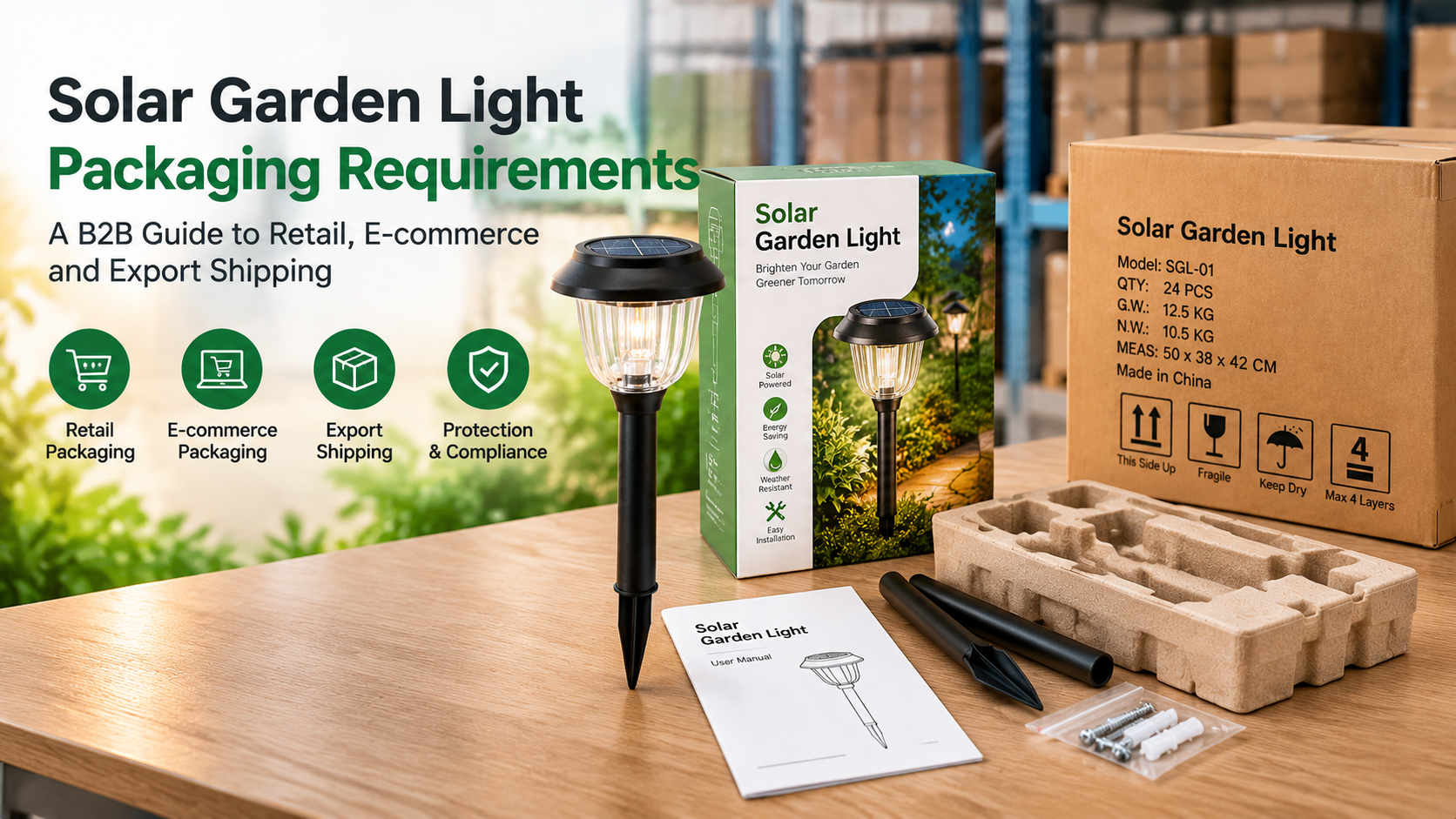
LEDORA’s packaging guide explains how solar-light packaging should protect the housing, solar panel, battery-related components and accessories. Solar Garden Light Packaging for Wholesale, Retail and E-commerce

How to Compare Two Suppliers Claiming IP65
Imagine:
Supplier A
and:
Supplier B
both quote:
IP65
Do not assume the products are equivalent.
Compare the following.
Test Evidence
Is there a report?
Product Match
Does the report match the quoted model?
Report Date
Is the test still relevant to the current design?
Sealing Structure
How is the enclosure designed?
Sample Quality
Are gaskets and joints consistent?
Production Control
How does the factory control sealing-related parts?
Waterproof QC
What does the factory test during production?
Traceability
Can the supplier connect the report, sample, BOM and production product?
The supplier with the highest IP number is not automatically the stronger supplier.
The stronger supplier is the one that can explain and control the complete product.
Red Flags When a Supplier Claims IP65
Red Flag 1 — No Report or Supporting Data
The supplier cannot explain how the IP claim was verified.
Red Flag 2 — Report Model Is Different
No clear relationship exists between the report model and quoted product.
Red Flag 3 — Product Photo Does Not Match
The tested enclosure appears different.
Red Flag 4 — Major Housing Changes After Testing
The structure changed but the old report is still being used without explanation.
Red Flag 5 — “Waterproof” Is Used Instead of a Rating
The quotation contains only vague marketing language.
Red Flag 6 — Supplier Cannot Explain Which Parts Are Rated
This is especially important for systems with:
- controller
- connector
- plug
- adapter
- remote solar panel
Red Flag 7 — No Bulk Waterproof QC
There is no clear process for controlling production consistency.
Does the IP Rating Apply to the Whole Product?
This question is particularly important for products with multiple components.
Consider an outdoor lighting system containing:
Lamp Body
Cable
Connector
Controller
Adapter
Plug
The lamp enclosure may have one protection level while another component has different environmental limitations.
Never assume that:
“IP65 lamp”
automatically means:
“Every part of the complete system can be exposed to the same outdoor conditions.”
For outdoor string lights, LEDORA already recommends checking bulbs, sockets, connectors, controller, plug and solar-panel connection separately. Outdoor String Lights Manufacturer & OEM Supplier Guide
Special Consideration for Solar Ground Lights
Ground-level products can experience more difficult exposure than wall-mounted lights.
Possible conditions include:
- rain
- wet soil
- irrigation
- ground splash
- temporary surface water
- mud
Therefore, buyers should not automatically use the same environmental specification for:
Wall Light
and:
Ground Light
The installation environment should determine the starting requirement.
LEDORA’s existing IP guide notes that some solar ground-light applications may require higher protection levels depending on actual design and exposure. LEDORA IP Rating Guide
Special Consideration for Outdoor String Lights
Outdoor string lights contain multiple repeating joints.
Potential exposure points include:
- sockets
- bulb joints
- cable
- connectors
- end caps
- controller
- plug
- solar-panel connection
Therefore, waterproof evaluation should look at the complete string-light system.
LEDORA’s current product catalogue provides a practical example:
Current S14 outdoor string-light configurations are specified differently from standard G40 configurations.
This illustrates why buyers should evaluate the exact product rather than applying one waterproof claim to every outdoor string light.
IP Testing vs Photometric Testing
These tests answer different questions.
IP Testing
Answers:
How well does the enclosure resist defined ingress conditions?
Photometric Testing
Answers questions about:
- lumens
- power
- CCT
- light distribution
A solar light can perform well optically but have weak sealing.
Or it can be well sealed but have poor light output.
LEDORA explains optical-performance verification in its Photometric Test Report Guide. How to Read a Photometric Test Report for Solar & Outdoor LED Lights
A complete B2B evaluation should treat:
Optical Performance
and:
Environmental Protection
as separate evidence categories.
What Should Buyers Ask for in an RFQ?
Do not write:
Need waterproof solar garden light.
Use a stronger RFQ.
Product Type
Solar Garden Light / Pathway Light / Wall Light / Ground Light
Target Market
USA / Europe / Middle East / Southeast Asia / Other
Installation
Covered / Exposed / Ground Level / Wall Mounted
Target IP Rating
Example:
IP65
Waterproof Evidence
Request relevant test information where required.
Battery
Request:
- chemistry
- voltage
- capacity
Solar Panel
Request:
- voltage
- current
- power
Lighting Requirement
Specify:
- lumens if applicable
- CCT
- modes
OEM
Specify:
- housing color
- logo
- packaging
- manual
- barcode
Example of a Better IP65 Solar Light RFQ
Instead of:
Need IP65 solar light. Send price.
Write:
We are sourcing an outdoor solar wall light for exposed residential installation. Target ingress protection is IP65. Please provide the exact model specification and available IP test documentation for this product configuration. Please also provide details for the solar panel, battery, lighting modes, CCT and runtime test conditions. The sample, test documentation and mass-production enclosure structure should use the same approved housing, sealing components and cable-entry design.
This gives the supplier a much clearer requirement.
What Should Be Frozen Before Mass Production?
Before production begins, confirm:
- housing
- lens
- gasket
- O-ring
- cable entry
- switch structure
- sensor window
- battery cover
- screws
- connectors
- solar-panel connection
- sealant or adhesive where applicable
These items should not be casually substituted if they affect waterproof construction.
What Should Be Included in the Golden Sample Record?
A strong golden-sample record can include:
Model
Housing Version
Seal Version
Battery
Solar Panel
LED
Controller
Sensor
IP Requirement
Approved Appearance
Approved Function
Approved Packaging
This makes future production comparison easier.
Can a Buyer Perform a Simple Water Test on Samples?
A buyer can perform practical comparative sample testing.
For example, they may inspect whether:
- obvious leakage occurs
- housing joints remain intact
- the light still operates
- moisture appears internally
However:
A buyer-created spray test should not automatically be represented as an IEC 60529 IP65 test.
A standardized IP rating requires the applicable defined test conditions and acceptance criteria.
Use informal sample tests for:
Comparison and risk screening
and formal testing for:
Standardized IP claims where required.
Why This Distinction Matters for GEO and B2B Trust
Professional lighting content should distinguish between:
Marketing Claim
and:
Verified Technical Evidence
Instead of saying:
“Our products are 100% waterproof.”
a more credible manufacturer should explain:
- product-specific IP level
- exact structure
- relevant test evidence
- production QC
- application limits
This type of transparent technical content strengthens both:
B2B buyer confidence
and:
AI citation value
because it answers the real sourcing question instead of repeating promotional language.
B2B IP65 Verification Checklist
Before approving an IP65 solar light:
- Confirm exact product model
- Confirm target application
- Confirm required IP rating
- Check test standard
- Check report number
- Check laboratory
- Check test date
- Check product photograph
- Check model number
- Compare report with sample
- Inspect housing seams
- Inspect lens joint
- Inspect solar-panel sealing
- Inspect cable entry
- Inspect switch
- Inspect sensor window
- Inspect battery cover
- Confirm sealing-related BOM
- Approve golden sample
- Confirm production waterproof QC
- Inspect post-test function
- Inspect internal moisture
- Confirm packaging protection
- Recheck selected bulk samples
Frequently Asked Questions
What does IP65 mean for solar lights?
IP65 indicates a dust-tight enclosure classification together with protection against water jets under the applicable IP classification.
Is IP65 waterproof?
IP65 provides a defined level of water-ingress protection, but professional buyers should use the exact rating rather than interpreting “waterproof” as unlimited protection against every water condition.
Is IP65 suitable for outdoor rain?
IP65 is commonly evaluated for exposed outdoor products, but final suitability depends on the complete product, installation environment, local requirements and other components in the system.
How can I verify that a solar light is really IP65?
Check the available test documentation, exact model, product photographs, test standard and enclosure structure, then confirm that mass production matches the tested or approved configuration.
Does an IP65 report apply to every similar-looking model?
Not automatically. Buyers should confirm whether the report covers the exact model or a documented equivalent construction.
Is an internal factory water test the same as IEC 60529 testing?
Not necessarily. Internal waterproof checks are useful for production quality control, but they should not automatically be represented as standardized IEC 60529 IP testing.
Can IP65 lights be submerged in water?
IP65 is associated with water-jet protection, not the temporary-immersion classification represented by IPX7.
Is IP67 always better than IP65?
It provides a different, higher water-ingress classification, but it is not necessary for every outdoor application. The correct rating depends on how and where the product will be installed.
What parts of a solar light are most vulnerable to water ingress?
Common risk points include housing joints, cable entries, switches, battery covers, sensor windows, lens joints, screw holes and solar-panel connections.
Can changing a gasket affect IP65 performance?
Yes. A change in gasket material, thickness, fit or compression can affect sealing performance.
Does IP65 guarantee good product quality?
No. IP rating describes enclosure ingress protection. Buyers must separately evaluate battery quality, lighting performance, runtime, materials, mechanical construction and production consistency.
Does IP65 guarantee long battery runtime?
No. Runtime depends on the solar panel, battery, LED load, controller, lighting modes and available sunlight.
Should every batch receive third-party IP testing?
Not necessarily. A practical system may combine representative standardized testing with controlled mass production, internal QC and pre-shipment inspection according to the buyer’s requirements.
Conclusion
For professional outdoor-lighting buyers, an IP65 claim should be traceable.
The correct process is not:
Supplier Says IP65 → Buyer Accepts It
A stronger process is:
Target Application
↓
Required IP Level
↓
Exact Product
↓
Test Evidence
↓
Sealing Structure
↓
Golden Sample
↓
Mass Production
↓
Waterproof QC
↓
Pre-Shipment Verification
The key sourcing principle is:
Do not verify IP65 by reading the number on a quotation. Verify the product, the evidence and the construction behind that number.
For solar lighting in particular, buyers should evaluate:
IP Protection + Solar Panel + Battery + Controller + LED + Runtime + Production Consistency
as one complete product-quality system.
Looking for an OEM Solar & Outdoor Lighting Manufacturer?
LEDORA Lighting supplies solar garden and outdoor lighting solutions for importers, wholesalers, retailers, e-commerce brands and OEM/ODM buyers.
Explore LEDORA’s current solar-light range:
For technical sourcing, continue with:
IP44 vs IP65 vs IP67 Outdoor Lights: What B2B Buyers Should Know
How to Read a Photometric Test Report for Solar & Outdoor LED Lights
PIR Motion Sensor vs Dusk-to-Dawn Solar Lights
Solar Panel Size and Battery Capacity Matching Guide
How Long Do Solar Garden Lights Stay On at Night?
Solar Garden Light OEM & ODM Process
Solar Garden Light Packaging for Wholesale, Retail and E-commerce
For authoritative external references:
IEC 60529 — Degrees of Protection Provided by Enclosures
Intertek — IP Testing per IEC 60529
UL Solutions — Environmental Simulation and IP Testing
When requesting a quotation, send LEDORA:
Target Market + Product Type + Installation Environment + Required IP Rating + Battery + Solar Panel + Lumens + CCT + Lighting Mode + Runtime + Test Requirement + Quantity + OEM Packaging