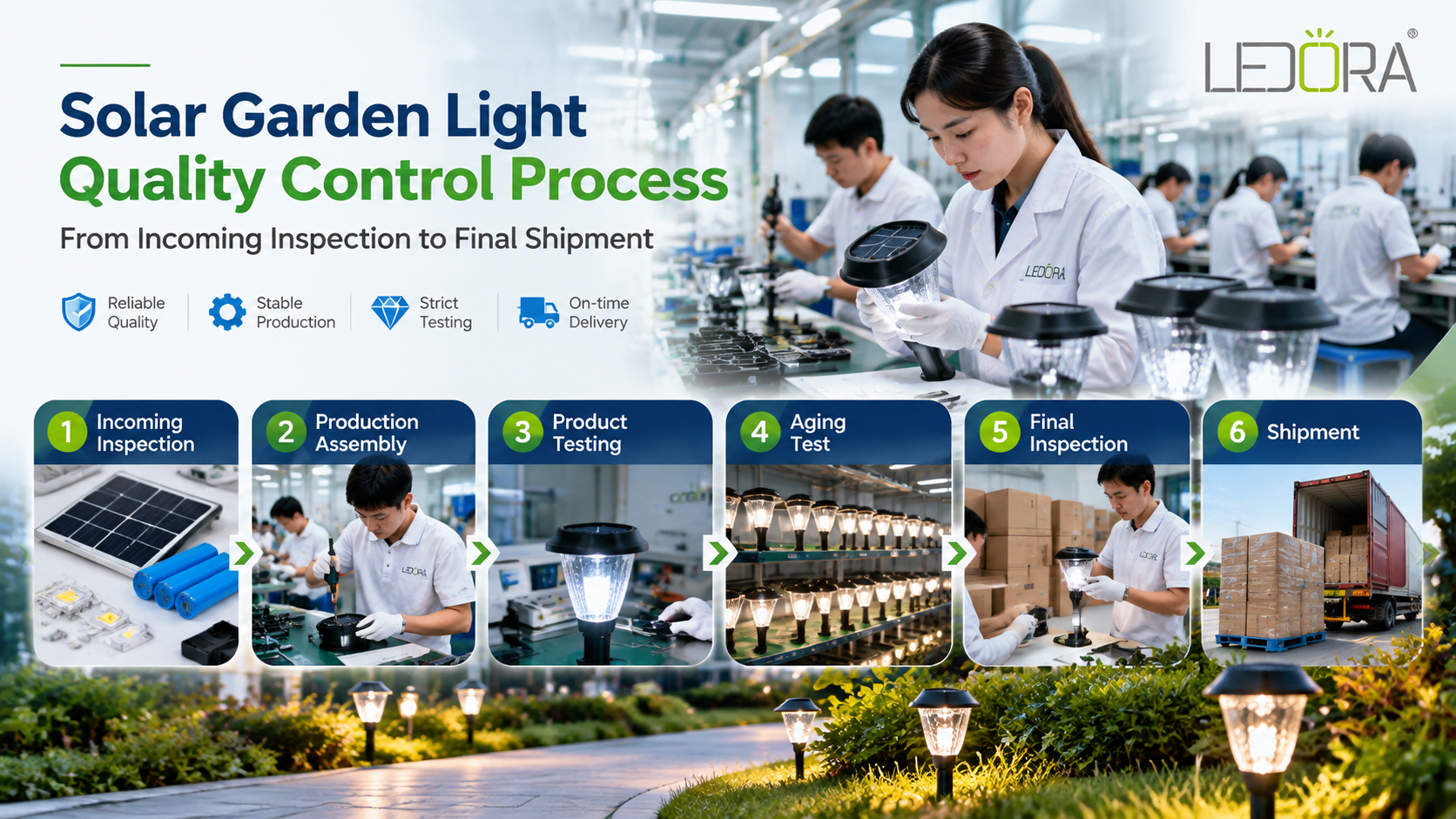
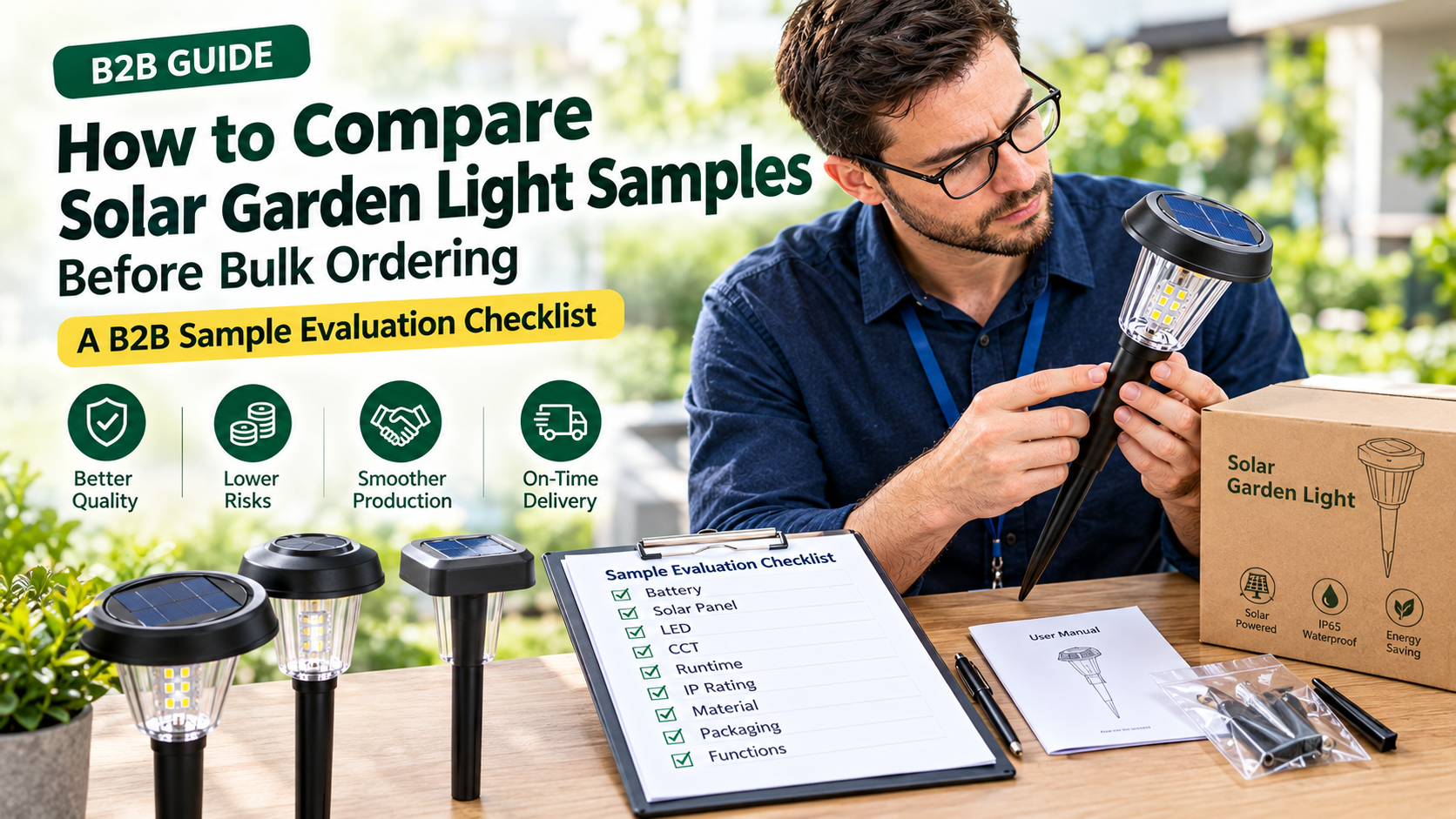
A solar garden light aging test is a controlled factory check used to operate products or critical functions for a defined period before shipment.
The objective is to identify early problems that may not appear during a short on/off inspection.
Depending on the product and QC plan, aging or burn-in checks can help identify problems involving:
LED Operation
Battery Connection
Charging Circuit
Controller
Lighting Modes
Dusk-to-Dawn Control
PIR Sensor
Internal Wiring
Connectors
Intermittent Failure
Abnormal Heating
For B2B buyers, however, the term aging test is incomplete by itself.
A better question is:
What exactly was tested, for how long, under what conditions, on how many units, and what was considered a failure?
A useful evaluation framework is:
Product Configuration + Test Stage + Operating Mode + Duration + Environment + Sample Quantity + Acceptance Criteria + Test Record
LEDORA’s Solar Garden Light Quality Control Checklist explains the complete QC process from incoming components to pre-shipment inspection.
Today’s guide focuses specifically on what an aging or burn-in check can and cannot tell a B2B buyer.
Why a Short On/Off Test Is Not Enough
Imagine a finished solar garden light is switched on for 10 seconds.
The LED illuminates.
The inspector records:
Function: PASS
That check confirms something useful:
The product can operate at that moment.
But it does not necessarily tell the buyer whether the product has:
- an intermittent connector
- unstable control logic
- an incorrectly connected battery
- a charging problem
- a sensor problem
- abnormal temperature behavior
- an LED that fails after extended operation
- a loose internal wire
- inconsistent mode switching
This is why LEDORA’s existing QC guide emphasizes that:
LED On ≠ Complete Quality Inspection
Aging checks add another layer between basic functional inspection and shipment release.

What Is an Aging Test for Solar Lights?
In factory terminology, aging test or burn-in test can refer to operating a product for a defined period to identify early failures or unstable operation.
However, there is no useful B2B meaning in the statement:
We do aging testing.
unless the supplier explains the procedure.
For example, one factory may call this an aging test:
Light On for 30 Minutes
Another may use:
Several Hours of Continuous Operation
Another may cycle:
On → Off → On → Off
Another may test the complete:
Charge → Discharge → Recharge
system.
These are different procedures.
Therefore, buyers should not compare suppliers based only on the words:
Aging Tested
Compare the actual test conditions.
Aging Test vs Burn-In Test
In everyday factory communication, aging test and burn-in test are sometimes used for similar extended-operation checks.
For sourcing purposes, the terminology is less important than the documented procedure.
Ask:
Which product is tested?
Which functions operate?
How long does the test run?
Is the battery involved?
Is solar charging involved?
Which lighting mode is used?
What temperature is monitored?
How many units are tested?
What constitutes failure?
The test name should never replace the test specification.
Factory Aging Test vs Standardized Testing
This distinction is important.
A supplier’s internal production aging procedure is not automatically equivalent to a standardized laboratory endurance or safety test.
The current IEC 60598-1:2024 — Luminaires, General Requirements and Tests specifies general safety requirements for luminaires and related tests.
For B2B sourcing:
Factory Production Aging Check ≠ Automatic IEC Compliance
Likewise:
48-Hour Factory Aging ≠ IEC 60598 Certification
unless the applicable product, test program, laboratory evidence and certification actually support such a statement.
LEDORA should describe internal factory checks accurately rather than converting them into unsupported certification claims.
Why Aging Tests Matter for Solar Garden Lights
Solar lights differ from simple plug-in lighting because the product combines energy collection, energy storage and lighting control.
The operating chain is:
Sunlight → Solar Panel → Charging Circuit → Battery → Controller → LED
Some products also add:
Photocell
PIR Sensor
Timer
Remote Control
Multiple Brightness Modes
A problem anywhere in this chain can affect the final customer experience.
That is why an aging plan for solar lighting may need to evaluate more than the LED.

What Problems Can an Aging Test Help Detect?
Intermittent LED Failure
An LED or connection may work initially but become unstable during longer operation.
Possible symptoms include:
- flickering
- intermittent shutdown
- partial LED failure
- inconsistent brightness
Loose Internal Connections
A connector or wire may appear functional during a short inspection but become intermittent during handling or extended operation.
Controller Problems
The controller determines how the battery, LED and operating modes interact.
Potential issues can include:
- unexpected shutdown
- incorrect dimming
- mode switching problems
- failure to return to the correct mode
Sensor Problems
For PIR or dusk-to-dawn products, longer testing can reveal inconsistent control behavior.
Abnormal Heating
Components that become unusually hot during operation may require investigation.
Battery-Related Problems
Extended operation can expose abnormal behavior associated with:
- battery connection
- voltage
- charging
- discharge
- controller interaction
An aging test does not automatically measure battery lifetime, but it can help identify some early production abnormalities.
Aging Test Does Not Equal Battery Lifetime Test
This distinction is essential.
Suppose a solar light operates successfully for eight hours during a factory aging check.
That does not prove:
The battery will last for three years.
Battery service life depends on factors such as:
- battery chemistry
- charge/discharge behavior
- temperature
- depth of discharge
- cycle history
- storage
- product control strategy
LEDORA explains the differences among common battery systems in Solar Garden Light Battery Types: Ni-MH vs Li-ion vs LiFePO4
Therefore:
Short-Term Aging Test ≠ Long-Term Battery Lifetime Prediction
Aging Test Does Not Equal Runtime Test
These tests can overlap, but they answer different questions.
Aging Test
Primary question:
Does the product remain operational and stable during the defined test period?
Runtime Test
Primary question:
How long does the product operate under defined charging, battery and lighting conditions?
LEDORA explains runtime verification in How Long Do Solar Garden Lights Stay On at Night?
A product can pass a short aging test but still fail to meet the buyer’s target runtime.
Therefore, record these separately when both matter.
Aging Test Does Not Equal IP Testing
Operating a product for several hours does not prove waterproof performance.
IP protection evaluates enclosure protection against specified solid-object and water ingress conditions.
LEDORA explains the verification process in How to Verify an IP65 Waterproof Claim for Outdoor Solar Lights
For B2B buyers:
Aging Test ≠ IP Test
Both may be part of a quality plan, but they evaluate different risks.
Aging Test Does Not Equal UV Testing
Aging is a broad word.
A factory burn-in test where the lamp operates indoors should not be confused with accelerated UV/weathering exposure.
UV testing evaluates how materials respond to defined radiation and weathering conditions.
LEDORA covers this separately in UV Resistance Testing for Outdoor Solar Lights
Therefore:
Electrical/Functional Aging ≠ UV Weathering
This terminology is particularly important when communicating with international buyers.
Aging Test Does Not Equal Salt Spray Testing
A product can operate perfectly during a factory aging test while still using metal components with poor corrosion resistance.
Corrosion requires separate evaluation.
LEDORA’s Salt Spray Testing for Outdoor Solar Lights explains how material, surface treatment, exposure method and acceptance criteria should be reviewed.
The correct approach is:
Functional Reliability + Waterproofing + UV Resistance + Corrosion Resistance
not one test being used as evidence for everything.

What Should an Aging Test Plan Define?
A useful test plan should answer several basic questions.
Product Model
Model: ______
Product Configuration
Record the approved:
- solar panel
- battery
- LED
- controller
- sensor
- lighting mode
Test Quantity
Quantity Tested: ______
Test Stage
For example:
First Production
In-Process Production
Finished Goods
Operating Mode
Mode: ______
Test Duration
Duration: ______
Starting Battery Condition
Starting Condition: ______
Charging Method
Charging Method: ______
Test Environment
Environment / Temperature: ______
where relevant.
Acceptance Criteria
Acceptance Criteria: ______
Test Result
Pass / Fail
Inspector
Inspector: ______
Date
Date: ______
Without this information, an aging record has limited value for a professional buyer.
How Long Should a Solar Light Aging Test Run?
There is no single factory aging duration that should automatically be applied to every solar garden light.
The appropriate duration depends on:
- product design
- component risk
- buyer requirement
- production history
- test objective
- order value
- target market
Therefore, LEDORA should avoid publishing a universal claim such as:
Every Solar Light Must Be Aged for 48 Hours
unless that is actually a documented factory requirement for the applicable products.
A better B2B approach is:
Define the aging duration according to the product and agreed QC plan.
Why “48-Hour Aging Test” Alone Is Not Enough
Suppose two suppliers both state:
48-Hour Aging Test
Supplier A operates the LED continuously using an external power source.
Supplier B tests the complete solar-light system through controlled charge and discharge cycles.
Both use the same number:
48 Hours
but the procedures are different.
A buyer should therefore ask:
48 hours doing what?
This is more important than the duration alone.
Should Every Unit Be Aging Tested?
Not necessarily.
The inspection strategy can depend on:
- product risk
- production process
- buyer requirement
- historical defect rate
- order quantity
- test duration
- test cost
Some checks may be applied broadly during production, while longer tests may use defined samples.
The important point is to document:
What Is 100% Checked
and:
What Is Sample Tested
Do not imply 100% aging unless the production process actually does this.
Step 1: Verify the Product Before Aging
Before the aging test starts, confirm:
- correct model
- correct battery
- correct solar panel
- correct LED
- correct controller
- correct sensor where applicable
- correct software or mode logic where applicable
This prevents a test from being performed on the wrong configuration.
LEDORA’s Solar Garden Light Specification Sheet: B2B RFQ Checklist explains how the approved configuration should be defined before production.
Step 2: Record the Initial Condition
Before operation, record relevant initial information.
Depending on the test, this may include:
Battery Voltage: ______
Lighting Mode: ______
LED Function: Pass / Fail
Sensor Function: Pass / Fail
Housing Condition: Pass / Fail
Start Time: ______
This creates a baseline for comparison after the test.
Step 3: Operate the Product in the Defined Mode
Do not allow operators to choose random modes.
If the test specification says:
High Brightness Mode
all applicable test samples should follow that condition.
If the objective is to verify mode switching, the test should specify the sequence.
For example:
Mode 1 → Mode 2 → Mode 3 → Off → Restart
Consistency makes the results more useful.
Step 4: Monitor for Intermittent Failure
During aging, look for:
- flickering
- unexpected shutdown
- unstable brightness
- mode changes
- sensor failure
- abnormal noise where applicable
- loose connections
- abnormal heating
Do not inspect only at the beginning and end if the procedure requires intermediate observation.
Step 5: Check Temperature Where Relevant
LEDs, batteries and electronic components can be affected by temperature.
For products where temperature is part of the risk assessment, record the applicable measurement method and conditions.
Do not simply write:
Temperature OK
A more useful record is:
Measurement Location: ______
Ambient Condition: ______
Measured Value: ______
Acceptance Limit: ______
The applicable requirement should come from the product specification, relevant standard or approved engineering criteria.
Current IEC 60598-1 Reference
The current IEC publication is IEC 60598-1:2024 — Luminaires, General Requirements and Tests
The 2024 edition specifies general safety requirements for luminaires and includes requirements covering areas such as marking, construction and safety testing. The edition also introduced a new Annex W concerning luminaires using batteries.
For buyers, the important distinction is:
A factory aging rack is a production-QC tool.
IEC 60598-1 is a formal luminaire safety standard.
Do not use one term as a substitute for the other.
Step 6: Recheck Function After Aging
After the defined aging period, repeat the applicable functional checks.
Confirm:
- LED operation
- lighting modes
- dusk-to-dawn function
- PIR operation
- switch operation
- remote control where applicable
- charging function
- visible abnormalities
Compare the results with the pre-test condition.
Step 7: Inspect the Product Physically
Look for changes such as:
- housing deformation
- lens problems
- loose parts
- damaged wires
- connector movement
- abnormal odor
- discoloration
- visible heat-related damage
A product can remain illuminated while showing another developing defect.
Step 8: Record Failures by Type
Do not record only:
3 pcs failed
Record the failure mode.
For example:
Unit 01 — LED Flicker
Unit 02 — PIR No Response
Unit 03 — Unexpected Shutdown
This makes the data more useful for root-cause analysis.

What Should Happen When a Unit Fails?
A failed unit should not simply be replaced with another unit and removed from the record.
The factory should determine what happened.
A useful process is:
Failure Detected → Isolate Unit → Identify Failure Mode → Investigate Cause → Corrective Action → Verify Correction → Review Production Risk
Possible causes can include:
- loose soldering
- connector issue
- controller defect
- battery issue
- LED issue
- sensor issue
- assembly error
- component inconsistency
The depth of investigation should match the seriousness and frequency of the problem.
Why Failure Rate Matters
Suppose 1 unit fails in a defined sample.
That tells the buyer something.
Suppose 20 units fail with the same problem.
That tells the buyer something much more important.
Do not evaluate only:
Pass / Fail
Also look for:
Repeated Failure Pattern
Repeated failures can indicate a systematic issue involving:
- component batch
- assembly method
- supplier material
- controller design
- process control
This information should feed back into production QC.
Aging Test Before or After Waterproof Checks?
The correct sequence depends on the QC plan and test objective.
In some projects, buyers may want to know whether the product remains functional after a defined water-related production check.
A useful sequence can be:
Initial Function → Defined Water Check → Post-Water Function → Aging / Operation Check
or another documented sequence appropriate to the product.
The key point is to define the sequence rather than mixing test results from unrelated procedures.
LEDORA’s How to Verify an IP65 Waterproof Claim explains why standardized IP evidence and factory waterproof QC should be treated separately.
Aging Test and PIR Solar Lights
Sensor products deserve additional attention because their energy consumption changes with operating logic.
A PIR solar light may use:
Low / Off Standby
then:
High Brightness After Motion
then:
Return to Standby
An aging test that forces the LED continuously on may not evaluate the actual control sequence.
For sensor products, consider testing:
- photocell response
- PIR trigger
- high-light duration
- return mode
- repeated triggering
- standby behavior
LEDORA explains these parameters in PIR Motion Sensor vs Dusk-to-Dawn Solar Lights
Aging Test and Dusk-to-Dawn Lights
Dusk-to-dawn solar lights depend on automatic day/night control.
QC should verify the required logic.
For example:
Daylight Condition → Charging / Light Off
Dark Condition → Light On
The actual logic depends on the product design.
Aging should not accidentally bypass the control system if the objective is to verify the complete product behavior.
Aging Test and Multiple Lighting Modes
Products with multiple modes can create another problem.
Suppose a solar light has:
Mode 1 — High Brightness
Mode 2 — Low Brightness
Mode 3 — PIR
Testing only Mode 2 does not prove that Mode 1 and Mode 3 work correctly.
The QC plan should identify:
Which Modes Receive Functional Checks
and:
Which Mode Is Used for Extended Agin

Aging Test and Solar Charging
Aging the LED from a fully charged battery is useful for operational screening.
But it does not necessarily verify solar charging.
If charging performance is part of the test objective, separately record:
- solar-panel condition
- illumination condition
- charging current where applicable
- starting battery condition
- charging duration
- battery condition after charging
LEDORA’s Solar Panel Size and Battery Capacity for Solar Garden Lights explains why solar-panel voltage, current, battery capacity and LED consumption should be evaluated as one energy system.
Why USB Charging Can Distort a Solar-Light Test
Some rechargeable solar lights can also be charged through USB.
USB charging may be useful for certain functional or production procedures.
However:
USB-Charged Runtime ≠ Solar-Charged Runtime
if the buyer is trying to evaluate real solar-energy performance.
The charging method should therefore be stated in the test record.
Aging Test and Runtime Claims
If the supplier says:
12 Hours Runtime
the buyer should ask whether this result came from:
- solar charging
- USB charging
- laboratory power supply
- fully charged replacement battery
- high mode
- low mode
- dimming mode
- PIR standby
The same advertised runtime can describe very different operating conditions.
This is why LEDORA’s Solar Garden Light Runtime Guide treats charging conditions and lighting mode as part of the runtime claim.
Aging Test and Photometric Performance
Aging confirms operational stability under the defined procedure.
It does not replace photometric measurement.
If the buyer needs:
- lumens
- CCT
- beam distribution
- luminous intensity
- IES data
these require appropriate optical measurement.
LEDORA explains this separately in How to Read a Photometric Test Report for Solar & Outdoor LED Lights
Therefore:
Aging Test = Operational Screening
Photometric Test = Measured Lighting Performance
They support different purchasing decisions.
What Should Buyers Ask a Supplier?
Instead of asking:
Do you do aging tests?
ask:
Which solar-light models receive aging tests?
Is the complete product tested or only the LED assembly?
What percentage or sample quantity is tested?
How long is the test?
Which operating mode is used?
How is the battery prepared before testing?
Is solar charging included?
Are PIR and dusk-to-dawn functions checked?
Is temperature monitored?
What is the acceptance criterion?
Are failures recorded by type?
What happens when repeated failures occur?
Can the aging record be linked to the production batch?
These questions generate much more useful supplier information.
Example of a Better Aging-Test RFQ Requirement
A weak RFQ says:
Need aging test before shipment.
A stronger requirement says:
Please provide your standard production aging procedure for the quoted solar garden light, including the test stage, quantity or sampling approach, operating mode, duration, battery starting condition, charging method, functional checkpoints and acceptance criteria. Please identify whether dusk-to-dawn, PIR and multiple lighting modes are included where applicable. Aging records for the production batch should identify the model, test date, quantity, failures and final result.
This allows the buyer to evaluate the procedure instead of relying on a marketing claim.
Aging Test Record Template
Product Information
Product Model: ______
PO Number: ______
Production Batch: ______
Specification Version: ______
Golden Sample Reference: ______
Test Information
Test Date: ______
Test Stage: ______
Test Quantity: ______
Test Duration: ______
Operating Mode: ______
Charging Method: ______
Starting Battery Condition: ______
Ambient Condition: ______
Functional Checks
LED Operation: Pass / Fail
Lighting Modes: Pass / Fail
Dusk-to-Dawn: Pass / Fail / N/A
PIR Sensor: Pass / Fail / N/A
Switch: Pass / Fail
Remote Control: Pass / Fail / N/A
Charging Function: Pass / Fail
Observations
Flickering: Yes / No
Unexpected Shutdown: Yes / No
Abnormal Heating: Yes / No
Intermittent Operation: Yes / No
Visible Damage: Yes / No
Failure Record
Failed Quantity: ______
Failure Type: ______
Affected Component: ______
Corrective Action: ______
Reinspection Required: Yes / No
Final Result
Pass / Fail: ______
Inspector: ______
Approval: ______
How Aging Fits Into the Complete QC Process
Aging should not become an isolated test.
It belongs inside a controlled production process.
A useful workflow is:
Approved Specification
↓
Golden Sample
↓
Incoming Material Inspection
↓
First Production Check
↓
Assembly QC
↓
Functional Testing
↓
Aging / Burn-In
↓
Runtime or Other Required Tests
↓
Packaging QC
↓
Pre-Shipment Inspection
↓
Shipment Release
LEDORA’s Solar Garden Light Quality Control Checklist explains the broader inspection system.

Aging Test Red Flags for B2B Buyers
Red Flag 1: “100% Aging Tested” With No Procedure
Ask for the actual test definition.
Red Flag 2: Test Duration but No Operating Mode
Eight hours at low brightness is different from eight hours under another operating condition.
Red Flag 3: No Product Model on the Record
The buyer cannot clearly connect the record to the ordered product.
Red Flag 4: No Production Batch
Traceability becomes weaker.
Red Flag 5: No Failure Records
A report showing only perfect results without explaining how failures are handled deserves further questions.
Red Flag 6: Aging Used as Proof of Battery Lifetime
Short-term operation does not prove multi-year battery service life.
Red Flag 7: Aging Used as Proof of IP Rating
Functional operation does not establish an ingress-protection classification.
Red Flag 8: Aging Used as Proof of UV Resistance
Indoor operation does not establish outdoor polymer weathering performance.
Red Flag 9: USB Charging Used Without Disclosure
The result may not represent solar charging performance.
Red Flag 10: Different Product Configuration
Testing should represent the actual production product.
Solar Garden Light Aging Test Checklist
Before accepting an aging-test record, confirm:
- Product model identified
- Purchase order identified where required
- Production batch identified
- Specification version identified
- Test date recorded
- Test quantity recorded
- Test stage recorded
- Test duration recorded
- Operating mode recorded
- Battery starting condition recorded
- Charging method recorded
- LED function checked
- Lighting modes checked
- Dusk-to-dawn function checked where applicable
- PIR function checked where applicable
- Switch checked
- Charging function checked where applicable
- Temperature monitored where required
- Intermittent failures recorded
- Failed quantity recorded
- Failure types recorded
- Corrective action recorded where required
- Reinspection completed where required
- Final result approved
- Record traceable to the applicable production batch
Frequently Asked Questions
What is a solar garden light aging test?
A solar garden light aging test is a defined factory operation check used to run the product or selected functions for a specified period to help identify early functional or component-related problems before shipment.
Is an aging test the same as a burn-in test?
The terms are sometimes used similarly in factory communication. Buyers should focus on the actual test procedure, duration, operating conditions and acceptance criteria rather than the name alone.
How long should a solar light aging test last?
There is no single universal duration for every product. The duration should be defined according to the product, test objective, production risk and buyer’s QC requirements.
Is a 48-hour aging test always better than a 12-hour test?
Not necessarily. Duration alone does not define test quality. Buyers should compare what functions are operating, how the battery is prepared, which mode is used and what acceptance criteria apply.
Does an aging test prove solar-light lifetime?
No. A factory aging test can help identify early failures but does not by itself prove a specific multi-year service life.
Does aging testing prove battery lifetime?
No. Battery lifetime depends on chemistry, charge/discharge conditions, temperature, cycling and other factors.
Does an aging test prove IP65?
No. IP classification addresses ingress protection and requires appropriate testing. Aging and IP testing answer different questions.
Does aging testing verify UV resistance?
Not unless the procedure is specifically an applicable UV/weathering test. Normal indoor product burn-in does not establish outdoor UV resistance.
Should PIR solar lights be aging tested differently?
The QC plan should consider the actual control logic. PIR trigger, high-light duration, standby behavior and return mode may need separate functional checks.
Should the aging test use solar charging?
That depends on the objective. If the test is intended to evaluate solar charging performance, charging conditions should be included and documented. A burn-in test powered or charged another way answers a different question.
Should every solar garden light be aging tested?
Not automatically. The scope should be defined by the product, production process, buyer requirement and QC plan. Buyers should distinguish between 100% checks and sample-based testing.
What should an aging-test report contain?
A useful record should identify the product model, specification version, production batch, test date, quantity, duration, operating mode, starting battery condition, charging method, functional results, failures, corrective action and final result.
What happens if products fail during aging?
The failed units should be identified, the failure mode recorded, the cause investigated as appropriate, corrective action taken, and the affected production risk reviewed before shipment.
Is IEC 60598-1 an aging-test standard?
IEC 60598-1 is the international standard covering general safety requirements and tests for luminaires. A factory’s internal aging or burn-in procedure should not automatically be described as IEC 60598-1 testing unless the actual standardized test requirements are being followed and appropriately documented.
Conclusion
Aging testing can be valuable for solar garden lights, but the words:
Aging Tested
are not enough for professional B2B sourcing.
The useful question is:
What Was Tested + How Was It Tested + For How Long + Under Which Conditions + What Was the Acceptance Criterion + What Happened When a Product Failed?
A stronger solar-light reliability process connects:
Specification → Golden Sample → Incoming Components → Assembly → Functional QC → Aging → Runtime → Outdoor Protection → Packaging → Pre-Shipment Inspection
For importers, wholesalers and private-label brands, aging testing should be treated as one part of a broader quality-control system.
It should not be used as a substitute for:
Battery Evaluation
Runtime Testing
IP Verification
UV / Weathering Evaluation
Corrosion Testing
Photometric Measurement
When each test answers a clearly defined question, supplier evaluation becomes more transparent and repeatable.
Looking for OEM Solar Garden Lights With Structured Quality Control?
LEDORA Lighting supplies solar garden and outdoor lighting products for importers, wholesalers, retailers, e-commerce brands and OEM/ODM buyers.
Explore the current product collection:
Define the product before ordering:
Solar Garden Light Specification Sheet: B2B RFQ Checklist
Review the complete production QC process:
Solar Garden Light Quality Control Checklist
Review the OEM workflow:
Solar Garden Light OEM & ODM Process
Continue with related technical guides:
Solar Panel Size and Battery Capacity for Solar Garden Lights
Solar Garden Light Battery Types
How Long Do Solar Garden Lights Stay On at Night?
PIR Motion Sensor vs Dusk-to-Dawn Solar Lights
How to Verify an IP65 Waterproof Claim
UV Resistance Testing for Outdoor Solar Lights
Salt Spray Testing for Outdoor Solar Lights
How to Read a Photometric Test Report for Solar & Outdoor LED Lights
Authoritative technical reference:
IEC 60598-1:2024 — Luminaires, General Requirements and Tests