A solar garden light quotation is only useful when buyers understand exactly what is included in the price.
For importers, wholesalers, retail chains, e-commerce brands and private-label companies, requesting a quotation involves more than sending a product photo and asking for the lowest price.
Two solar garden lights may look nearly identical but use different solar panels, batteries, LEDs, housing materials, lighting modes and packaging.
These differences can affect performance, durability, production cost and customer satisfaction.
A well-prepared Request for Quotation (RFQ) helps buyers compare suppliers on a consistent basis and reduces misunderstandings before sample approval and bulk production.
This guide explains how to prepare a solar garden light RFQ, what information to request from manufacturers and how to evaluate quotations for wholesale and OEM projects.
Quick Answer: What Should a Solar Garden Light RFQ Include?
A solar garden light RFQ should identify the product application, destination market, expected order quantity, solar panel specifications, battery requirements, LED performance, lighting modes, housing materials, outdoor protection, customization, packaging, testing requirements, delivery terms and quotation validity.
Buyers should also request clear information about MOQ, sample costs, tooling charges, production lead times and any deviations from the requested specifications.

Why a Detailed RFQ Matters for Solar Garden Light Buyers
An RFQ establishes the technical and commercial basis for supplier quotations.
Without clear requirements, different manufacturers may quote different product configurations.
For example, Supplier A may quote a solar pathway light with a smaller battery and basic packaging.
Supplier B may quote a similar-looking product with a different battery chemistry, upgraded housing material and retail-ready packaging.
Comparing only the unit price would not provide a meaningful result.
A detailed RFQ helps buyers:
- Receive more comparable quotations.
- Identify technical differences before ordering.
- Understand which customization options affect cost.
- Clarify MOQ and production requirements.
- Reduce unnecessary sample revisions.
- Establish a foundation for production and inspection.
A complete RFQ does not need to be complicated. It needs to be specific enough for the supplier to understand the intended product.
Step 1: Define the Product Application and Target Market
Before discussing technical details, explain where and how the solar garden light will be used.
Product Application
Different outdoor lighting applications have different requirements.
| Product Type | Typical Application | Main RFQ Considerations |
|---|---|---|
| Solar pathway lights | Walkways and garden borders | Light distribution, installation, runtime |
| Solar decorative stake lights | Gardens and seasonal displays | Appearance, color, materials |
| Solar fence lights | Fences, decks and boundaries | Mounting, dimensions, weather exposure |
| Solar ground lights | Landscaping and accent lighting | Installation conditions, enclosure protection |
| Solar wall lights | Entrances and outdoor walls | Mounting, lighting modes, brightness |
| Solar motion-sensor lights | Access areas and outdoor security applications | Detection behavior, operating modes |
Buyers can review LEDORA’s Solar Garden Lights Product Collection when selecting suitable product categories.
Destination Market
Specify the intended sales market, such as the United States, European Union, United Kingdom, Southeast Asia or Middle East.
Market information helps suppliers discuss appropriate labeling, instructions, packaging, environmental conditions and applicable product requirements.
A supplier should not assume that one configuration is suitable for every market.
Sales Channel
State whether the product will be sold through:
- Retail chains
- Garden centers
- Wholesale distributors
- Online marketplaces
- Private-label e-commerce brands
- Landscaping and hospitality projects
The sales channel can influence packaging, labeling, product assortment and order quantities.
Step 2: Provide Complete Technical Specifications
A useful quotation should describe the complete solar lighting system.
Solar Panel Requirements
Request information about:
- Solar panel type
- Rated voltage
- Rated power or current, where applicable
- Panel dimensions
- Charging configuration
The solar panel must be considered together with the battery and electrical load.
A larger panel does not automatically guarantee better performance if the complete system is poorly matched.
For more technical guidance, read Solar Panel Size and Battery Capacity for Solar Garden Lights.
Battery Requirements
Include:
- Battery chemistry
- Nominal voltage
- Rated capacity
- Battery configuration
- Replaceability requirements, if applicable
Different battery types may involve different charging, operating and cost considerations.
Read LEDORA’s Solar Garden Light Battery Types Guide for additional background.
LED and Lighting Performance
Specify:
- Required brightness or lighting effect
- LED power
- Color temperature
- Beam or light distribution requirements
- Operating modes
- Automatic on/off behavior
- Sensor requirements, if applicable
For functional lighting applications, request appropriate photometric information rather than relying only on LED wattage.
Related guide: How to Read a Photometric Test Report for Solar and Outdoor LED Lights.
Charging and Runtime Requirements
Avoid requesting only a generic claim such as “10 hours runtime.”
Instead, specify:
- Target operating duration
- Brightness setting or operating mode
- Charging conditions
- Test environment
- Acceptance criteria
Runtime should be evaluated under defined conditions.
Read How Long Do Solar Garden Lights Stay On at Night?.

Step 3: Define Housing Materials and Outdoor Protection
The housing material and enclosure design can affect appearance, durability, cost and suitability for the intended environment.
Common material choices include ABS, PC, stainless steel and aluminum.
Each material has different properties, and performance also depends on its grade, construction, finish and application.
Buyers should specify:
- Housing material
- Lens or diffuser material
- Color and finish
- Product dimensions
- Mounting method
- Fastener requirements
- Target ingress-protection rating
- Environmental exposure conditions
For material selection, see ABS vs PC vs Stainless Steel vs Aluminum for Solar Garden Lights.
Waterproof Requirements
An IP rating should be associated with a defined product configuration and applicable test method.
Buyers should not assume that a waterproof claim also establishes UV resistance, corrosion resistance or temperature durability.
Read How to Verify an IP65 Waterproof Claim for Outdoor Solar Lights.
For the underlying IP Code reference, consult the official IEC 60529 publication.
Step 4: Define OEM and Private-Label Requirements
For OEM projects, customization requirements should be included in the initial RFQ whenever possible.
Branding and Appearance
Possible customization includes:
- Product logo
- Housing color
- Surface finish
- Packaging artwork
- Instruction manuals
- Labels
Functional Customization
Depending on the product design and technical feasibility, buyers may request changes to:
- Lighting modes
- Color temperature
- Battery configuration
- Solar panel configuration
- Sensors
- Mounting accessories
Not every change can be made without affecting cost, tooling, testing or lead time.
A supplier should identify which requirements are standard options and which require engineering review.
For a complete project workflow, read Solar Garden Light OEM & ODM Process: From Sample Approval to Bulk Production.
Step 5: Specify Packaging Before Comparing Prices
Packaging is often overlooked during the first quotation stage.
However, packaging requirements can significantly affect the final unit cost and shipment configuration.
Buyers should clarify:
- Individual color box or plain box
- Retail multipack requirements
- Private-label artwork
- Barcode and product labels
- Instruction manual languages
- Installation accessories
- Inner protective materials
- Master-carton quantity
- Carton dimensions and weight
- Shipping marks
For e-commerce orders, transit protection and package dimensions deserve particular attention.
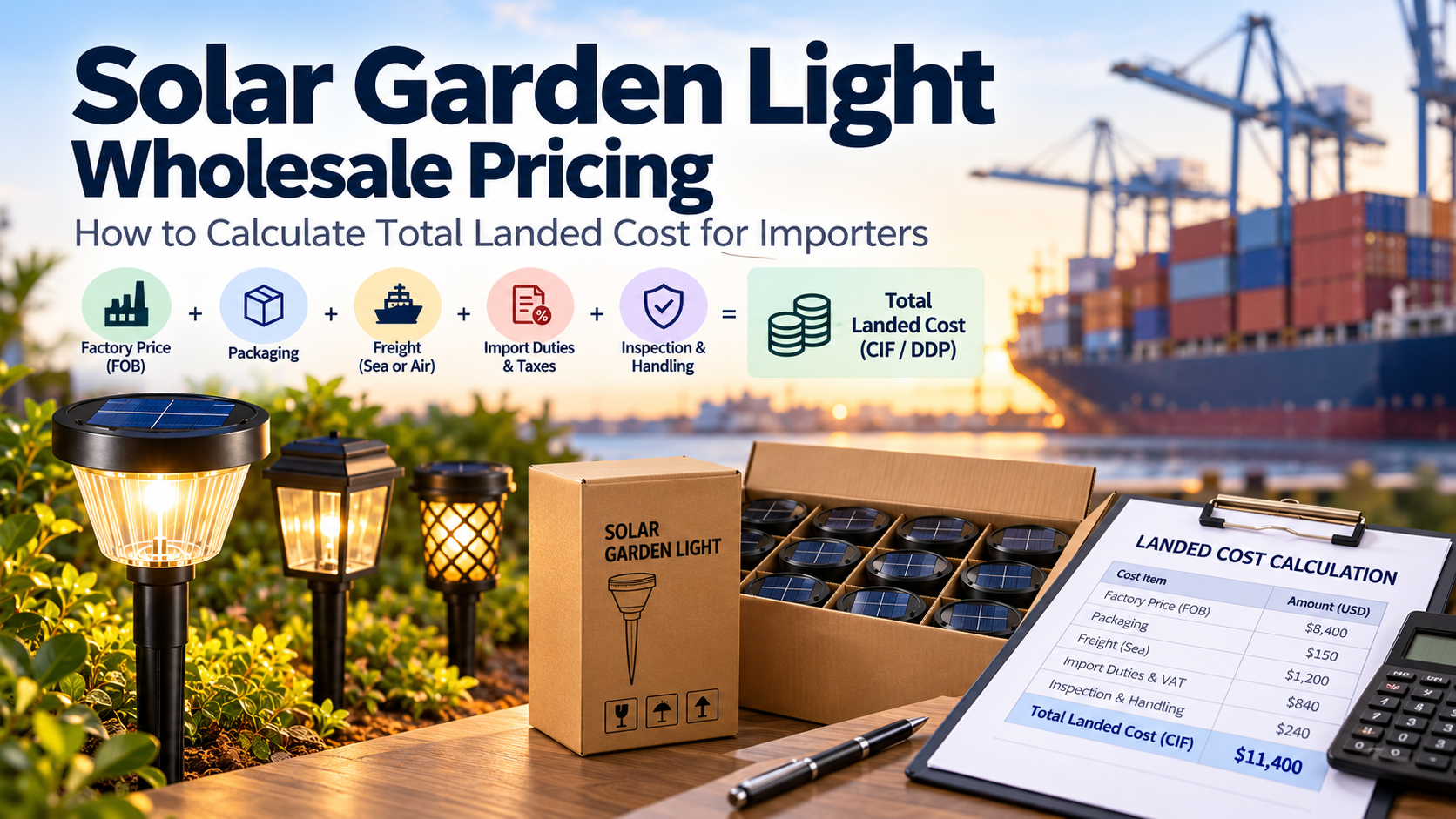
A supplier quotation should clearly state whether packaging costs are included.
Read Solar Garden Light Packaging for Wholesale, Retail and E-Commerce.

Step 6: Request Clear MOQ, Price and Lead-Time Information
A useful quotation should separate technical requirements from commercial terms.
Minimum Order Quantity
Ask for MOQ by:
- Product model
- Color
- Battery configuration
- Packaging version
- Logo customization
A supplier may have different minimum quantities for standard products and customized versions.
Price Structure
Ask whether the quotation includes:
- Product
- Packaging
- Accessories
- Branding
- Tooling or setup charges
- Testing costs
- Other agreed services
Delivery Terms
Specify the requested Incoterm and named place, such as FOB with the agreed port or another suitable delivery arrangement.
Buyers should confirm exactly which costs and responsibilities are included.
Production Lead Time
Clarify the starting point for the quoted lead time.
For example, does production begin after:
- Deposit confirmation?
- Final specification approval?
- Sample approval?
- Packaging artwork approval?
- Material availability confirmation?
Lead time should be linked to clearly defined conditions.
Step 7: Request Sample and Quality-Control Information
Before confirming bulk production, buyers should understand how samples will be evaluated and approved.
A quotation should clarify:
- Sample price
- Sample preparation time
- Sample shipping arrangement
- Technical configuration
- Sample revision procedure
- Approval requirements
The final approved sample should be linked to a written specification.
See How to Compare Solar Garden Light Samples Before Bulk Ordering.
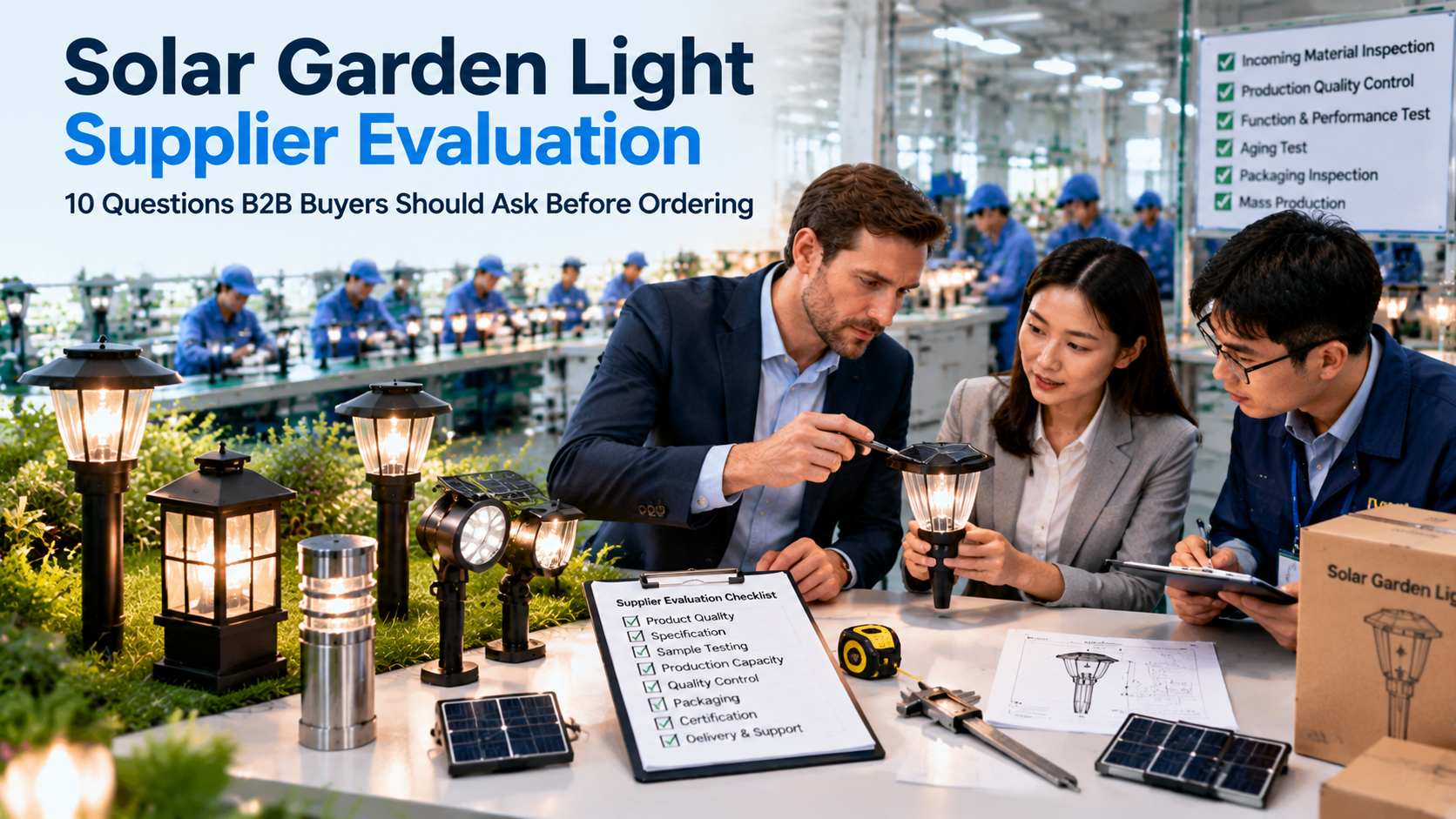
Quality-Control Requirements
Buyers should also discuss:
- Incoming material inspection
- In-process inspection
- Functional testing
- Charging and runtime verification
- Defined aging or operating checks
- Packaging inspection
- Pre-shipment inspection
For detailed inspection planning, read Solar Garden Light Quality Control Checklist.
For lot-by-lot acceptance sampling, the official ISO 2859-1:2026 standard provides a reference for sampling procedures indexed by acceptance quality limit (AQL).
AQL sampling does not replace product qualification or process control.

Step 8: Compare Quotations Using the Same Requirements
When quotations arrive, compare suppliers using a consistent evaluation table.
| Comparison Item | Supplier A | Supplier B |
|---|---|---|
| Product model | Confirm | Confirm |
| Solar panel | Record specification | Record specification |
| Battery | Record specification | Record specification |
| LED performance | Record specification | Record specification |
| Housing material | Record specification | Record specification |
| Packaging | Confirm included items | Confirm included items |
| MOQ | Record quantity | Record quantity |
| Unit price | Record currency and basis | Record currency and basis |
| Sample cost | Record amount | Record amount |
| Tooling charges | Record amount | Record amount |
| Lead time | Record conditions | Record conditions |
| Delivery terms | Confirm Incoterm and place | Confirm Incoterm and place |
| Testing documents | Record available evidence | Record available evidence |
| Specification deviations | List all deviations | List all deviations |
The objective is not simply to identify the lowest quotation.
It is to determine which supplier offers the most suitable product and commercial arrangement for the project.
Step 9: Watch for Common Solar Lighting RFQ Mistakes
Requesting a Price Without a Specification
A product photo is not a complete technical requirement.
Comparing Different Battery Configurations
Different batteries can affect cost, charging behavior and runtime.
Ignoring Packaging Costs
A quotation for bulk-packed products may not be comparable with one including individual retail packaging.
Accepting Unclear Runtime Claims
A runtime claim should identify the relevant charging and operating conditions.
Failing to Confirm Component Changes
Changes to solar panels, batteries, controllers or housings may affect the approved product.
Overlooking Quotation Validity
Currency, component prices and production conditions may change. Buyers should confirm the quotation validity period.
Step 10: Prepare a Complete Solar Garden Light RFQ Checklist
Use the following checklist before sending your inquiry.
| RFQ Requirement | Information to Confirm |
|---|---|
| Buyer details | Company and contact |
| Destination market | Country or region |
| Sales channel | Retail, wholesale, e-commerce or project |
| Product type | Pathway, decorative, wall, fence or ground |
| Quantity | Trial order and estimated annual demand |
| Solar panel | Type, voltage, power or current |
| Battery | Chemistry, voltage, capacity |
| LED | Brightness, power, CCT and modes |
| Runtime | Target duration and test conditions |
| Housing | Material, color, dimensions |
| Outdoor protection | IP and environmental requirements |
| Customization | Logo, packaging, functions |
| Packaging | Unit box, carton, labeling |
| Documentation | Applicable test and market requirements |
| Sample | Quantity, cost and approval process |
| QC | Inspection and acceptance criteria |
| MOQ | By model and customization |
| Price | Currency and included costs |
| Delivery | Incoterm, named place and lead time |
| Quotation validity | Expiration date |

Frequently Asked Questions
What is a solar garden light RFQ?
A solar garden light RFQ is a Request for Quotation that describes the buyer’s technical, commercial and packaging requirements so manufacturers can prepare comparable offers.
What information should I send to a solar garden light manufacturer for a quotation?
Provide the product type, destination market, quantity, solar panel and battery requirements, lighting performance, runtime conditions, housing materials, IP requirement, customization, packaging and delivery terms.
Why do two suppliers quote different prices for similar solar garden lights?
Differences may result from battery chemistry, solar panel specifications, LED performance, materials, manufacturing processes, packaging, MOQ or commercial terms. Buyers should align specifications before comparing prices.
What is the MOQ for OEM solar garden lights?
There is no universal MOQ. Minimum order quantities depend on the product model, customization, packaging, components and manufacturing requirements. Buyers should request the MOQ for each proposed configuration.
Should I request a sample before placing a bulk order?
Yes. A sample allows buyers to evaluate the product against the specification. The final approved sample should be linked to the production requirements.
Does a supplier quotation include testing and certification costs?
Not necessarily. Buyers should ask which testing, documentation and third-party services are included, and which require separate charges.
How can I reduce quotation differences between suppliers?
Send the same version-controlled specification to every supplier, request a list of deviations and compare prices using identical quantities, packaging and delivery terms.
Conclusion
A well-prepared solar garden light RFQ helps buyers move beyond price-only sourcing decisions.
By defining technical specifications, customization, packaging, testing requirements and commercial terms before requesting quotations, importers and brands can make more meaningful supplier comparisons.
The quotation should become part of a consistent purchasing process in which the approved specification, sample, purchase order and production requirements all describe the same product.
Request a Solar Garden Light Wholesale or OEM Quotation
LEDORA Lighting supports importers, wholesalers, retailers, e-commerce brands and outdoor lighting companies with solar garden lighting sourcing and OEM/ODM projects.
To request a quotation, share your destination market, target product, estimated quantity, technical requirements, customization needs, packaging expectations and preferred delivery terms.
Explore the LEDORA Solar Garden Lights Collection, review our OEM & ODM Services, or contact LEDORA to discuss your project.
Email: andrea@ledora-led.com