Outdoor Solar Light Color Temperature: Quick Answer
Color temperature describes the visual appearance of white light and is measured in Kelvin (K).
In general:
- 2700K = warm, yellow-white appearance
- 3000K = warm white
- 4000K = neutral to cooler white
- 5000K–6500K = cool or daylight-like white
Lower Kelvin values appear warmer, while higher Kelvin values appear cooler or more blue-white.
However, a higher color temperature does not automatically mean a brighter or higher-quality light.
For outdoor solar lighting, buyers should choose color temperature according to:
Application + Desired Atmosphere + Light Output + Optical Distribution + Target Market
For example, a decorative solar garden light may work well in warm white, while a functional wall or security light may use a cooler white depending on the project.
Color temperature should also be evaluated separately from brightness. If you are comparing brightness specifications, read LEDORA’s Lumens vs Watts for Solar Garden Lights.
What Is Color Temperature?
Color temperature, more precisely correlated color temperature or CCT, describes the apparent color of white light.
It is expressed in Kelvin:
K = Kelvin
The U.S. Department of Energy describes low CCT values such as 1800–2700K as warm in appearance and higher values around 4500–6500K as cool.
A key sourcing point is:
Higher Kelvin does not mean better lighting performance.
CCT tells you how the light appears.
It does not directly tell you:
- lumen output
- power consumption
- runtime
- solar-panel efficiency
- battery capacity
- waterproof performance
These must be evaluated separately.

2700K: Warm and Relaxed Outdoor Lighting
2700K produces a warm appearance that is often associated with:
- traditional incandescent-style light
- warm decorative lighting
- hospitality environments
- relaxed residential spaces
For outdoor applications, 2700K can work particularly well for:
- patios
- gardens
- restaurant terraces
- hotel outdoor areas
- decorative pathways
- pergolas
- landscape accents
The visual goal is usually:
Atmosphere rather than maximum visual whiteness.
For decorative outdoor spaces, this warmer appearance can help create a softer transition between indoor hospitality lighting and exterior environments.
When Should B2B Buyers Consider 2700K?
Consider 2700K when the target product is positioned around:
Hospitality
- restaurants
- cafés
- hotels
- resorts
Residential Outdoor Living
- garden
- patio
- balcony
- pergola
Decorative Retail
- lifestyle garden products
- premium decorative lights
- warm ambient lighting
Landscape Atmosphere
- low-level pathway lighting
- accent lighting
- decorative installations
If your buyer is selling an emotional or lifestyle product, warmer CCT can be more important than simply increasing the lumen number.
3000K: One of the Most Versatile Outdoor Choices
3000K still appears warm, but usually looks slightly cleaner and less yellow than 2700K.
This makes it useful for a wide range of outdoor applications.
Typical examples include:
- solar pathway lights
- garden lights
- patio lighting
- outdoor wall lights
- restaurant lighting
- hotel landscaping
- decorative string lights
For many B2B buyers, 3000K provides a useful balance between:
Warm Atmosphere + Functional Visibility
DarkSky International recommends warmer-colored lighting where possible and currently uses 3000K or lower in several of its outdoor-lighting guidelines. See DarkSky’s responsible outdoor lighting guidance.
That does not mean every outdoor product worldwide must use 3000K.
It means buyers should understand that outdoor light color can affect more than product appearance.

2700K vs 3000K: What Is the Difference?
Both are warm color temperatures.
The difference is relatively subtle compared with the difference between 3000K and 6500K.
2700K
Typically appears:
- warmer
- softer
- more yellow or amber
3000K
Typically appears:
- warm white
- slightly cleaner
- less yellow
For an OEM buyer, the right choice depends on the product positioning.
If the product is intended to imitate a warm decorative incandescent appearance:
2700K may be appropriate.
If the buyer wants warm outdoor lighting with slightly more neutral visual appearance:
3000K may be a better starting point.
4000K: Neutral White for More Functional Outdoor Lighting
4000K typically appears more neutral or cool compared with 2700K and 3000K.
It may be suitable when buyers prioritize:
- clearer visual definition
- functional exterior lighting
- modern appearance
Potential applications include:
- outdoor wall lights
- entrances
- modern pathways
- utility areas
- selected landscape applications
- commercial outdoor spaces
However, the correct CCT still depends on project requirements.
A hotel garden designed around warm ambient lighting may prefer 2700K or 3000K.
A modern functional entrance may use 4000K.
There is no universal “best Kelvin.”
3000K vs 4000K for Outdoor Lighting
This is a common sourcing decision.
Choose 3000K When:
The project prioritizes:
- warm atmosphere
- hospitality
- decorative appearance
- garden relaxation
- residential outdoor living
Consider 4000K When:
The project prioritizes:
- clearer neutral appearance
- functional lighting
- modern commercial environments
- utility-oriented visibility
The difference should be evaluated using actual samples.
Do not approve a color temperature only from:
- catalogue photos
- Photoshop images
- computer screens
Camera white balance and display settings can make the same light appear different online.
6500K: Cool White and Daylight-Like Appearance
6500K is much cooler in appearance.
It can appear:
- blue-white
- crisp
- daylight-like
Possible applications may include selected:
- security lights
- functional wall lights
- utility lighting
- market-specific outdoor products
However, 6500K is generally very different visually from warm decorative garden lighting.
A 6500K pathway light installed beside a 2700K patio may look inconsistent even if both products have acceptable brightness.
For this reason, buyers should not choose a CCT only because:
“Cooler looks brighter.”
Perceived appearance and measured luminous flux are different concepts.
LEDORA explains the distinction between brightness and power in its Lumens vs Watts for Solar Garden Lights guide.
Does Higher Kelvin Mean Brighter?
No.
This is one of the most common misunderstandings.
Color temperature and brightness describe different characteristics.
CCT / Kelvin
Answers:
What color does the white light appear?
Lumens
Answers:
How much visible light is emitted?
Therefore:
6500K ≠ automatically more lumens
and:
2700K ≠ automatically dim.
A well-designed 3000K luminaire may produce more measured light than a lower-output 6500K product.
When comparing solar lighting, specify:
CCT + Lumens + LED Power
rather than using Kelvin as a brightness specification.
Does Higher Kelvin Use More Power?
Not necessarily.
A higher CCT alone does not tell the buyer the electrical consumption of the complete light.
Power consumption depends on factors such as:
- LED specification
- LED quantity
- operating current
- driver/control system
- brightness mode
Therefore, do not assume:
6500K uses more power than 3000K
only because the color looks cooler.
The actual electrical specification must be compared.
Color Temperature and Solar-Light Runtime
CCT itself should not be treated as a runtime specification.
For solar products, nighttime performance is mainly affected by the complete energy system:
Solar Panel → Battery → Controller → LED Load → Lighting Mode
If an OEM change in LED package, power or output accompanies a color-temperature change, then the energy system may need to be reviewed.
That is why LEDORA recommends evaluating the complete configuration in its Solar Panel Size and Battery Capacity for Solar Garden Lights: A Buyer’s Matching Guide.
Color Temperature vs CRI: They Are Not the Same
B2B buyers should also distinguish between:
CCT
and
CRI.
CCT describes the appearance of the white light.
CRI, or color rendering index, relates to how colors appear under the light compared with a reference source.
A product can have:
3000K
but different color-rendering characteristics from another 3000K product.
Therefore:
Same CCT does not automatically mean identical lighting quality.
For projects where the appearance of:
- plants
- food
- architecture
- merchandise
- decorative surfaces
is particularly important, buyers may also want to review color-rendering requirements.
Why Two 3000K Lights Can Look Different
This is another common procurement issue.
Buyer A orders:
3000K Solar Pathway Light
from Supplier A.
Then Buyer A adds another 3000K product from Supplier B.
After installation:
The colors do not look identical.
Why?
Because nominal CCT does not guarantee that two independent products will appear exactly the same.
The U.S. Department of Energy notes that products with the same stated CCT can still appear visually different because CCT is a simplified metric with manufacturing tolerances. See DOE LED and Controls Guidance.
For B2B programs, this makes sample comparison and production consistency important.
Why CCT Consistency Matters for Wholesale Orders
Imagine a retail multipack containing four solar pathway lights.
Three appear warm white.
One appears noticeably cooler.
Even if every light technically functions, the consumer may still view the set as defective.
The same issue becomes more obvious in:
- pathway sets
- hotel landscaping
- restaurant installations
- resort gardens
- synchronized decorative displays
Therefore, buyers should consider not only:
Target CCT
but also:
Batch-to-Batch Color Consistency
This should be evaluated during sample approval and quality control.
Should Buyers Specify Kelvin Instead of “Warm White”?
Yes, when color consistency matters.
An RFQ that says:
Light Color: Warm White
is less precise than:
Target CCT: 3000K
However, even Kelvin alone may not define every aspect of color quality.
For larger or higher-specification projects, buyers may need:
- target CCT
- acceptable tolerance
- CRI requirement
- approved visual sample
The appropriate level of specification depends on the product and project.
Warm White Is Not a Universal Number
This is important.
Different suppliers, marketplaces or product categories may use the phrase:
Warm White
for somewhat different color-temperature ranges.
Therefore, if a buyer requires visual consistency across several products, do not rely only on:
- Warm White
- Natural White
- Daylight
- Cool White
Ask for the numeric CCT.
For example:
3000K
is more useful for technical communication than simply:
Warm White.
How to Choose CCT for Solar Garden Lights
Start with the application.
Decorative Garden Lights
Consider:
2700K–3000K
when the goal is warm atmosphere.
Examples:
- decorative flowers
- garden lanterns
- patio décor
- hanging solar lights
Pathway Lights
Depending on the project:
2700K–4000K
may be considered.
The key is whether the buyer wants:
- decorative warmth
- balanced visibility
- modern neutral appearance
Solar Wall Lights
Possible choices can include:
- 3000K
- 4000K
- cooler white configurations
depending on whether the product is decorative or functional.
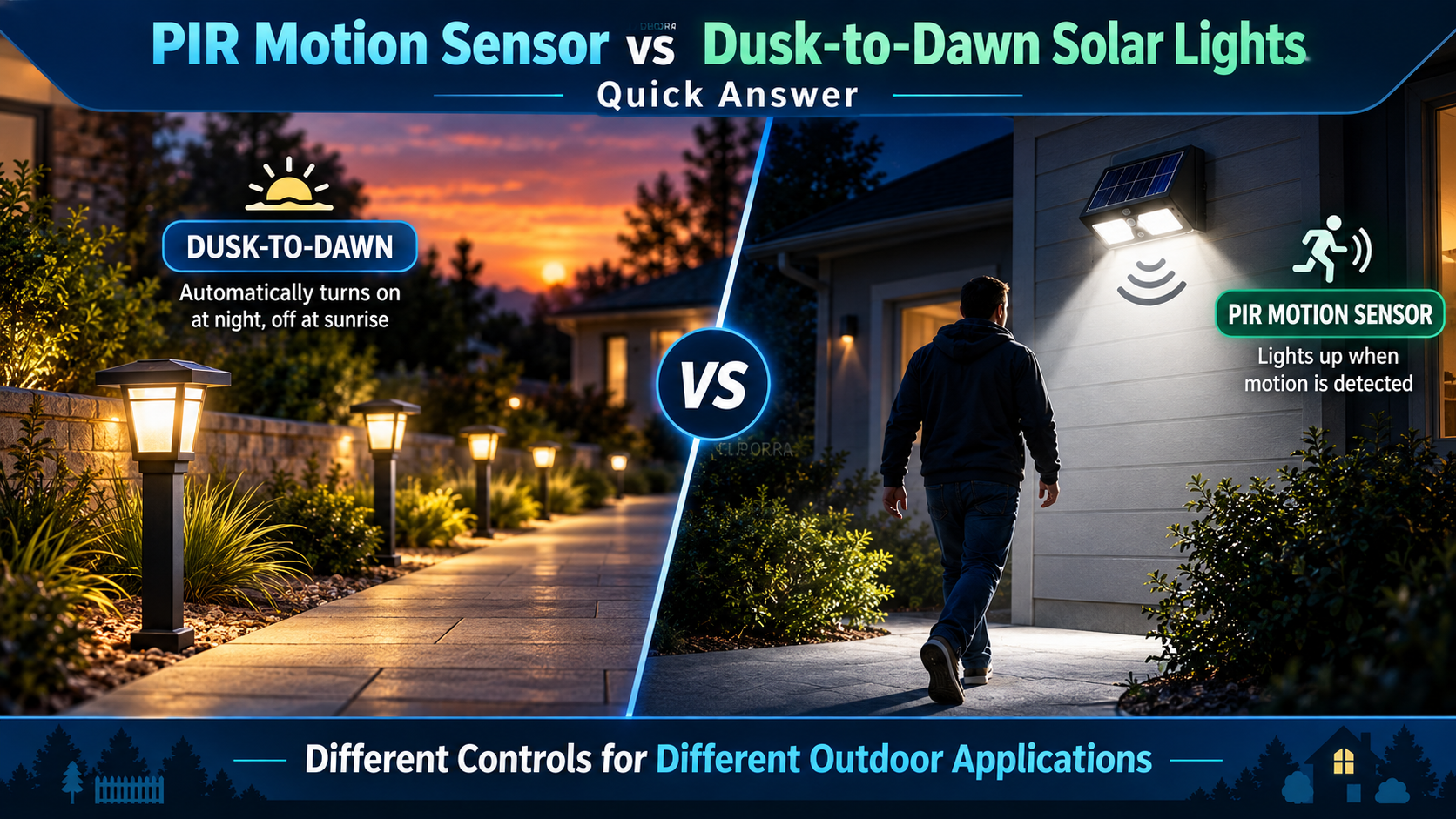
Security / Motion-Sensor Lights
Functional products may use neutral or cooler white options depending on target-market preference and project requirements.
The exact choice should be confirmed with the product sample.

Color Temperature for Restaurants and Hospitality
Hospitality lighting is often selected to create:
- comfort
- warmth
- intimacy
- attractive food presentation
- outdoor atmosphere
For this reason, warm color temperatures are commonly considered for:
- restaurant patios
- cafés
- hotel gardens
- resort walkways
- terrace dining
LEDORA’s outdoor string-light range also uses warm-white configurations for decorative hospitality applications. Buyers sourcing this type of project can review the LEDORA Outdoor String Lights Manufacturer & OEM Supplier Guide.
For a coordinated hospitality project, matching the visual appearance of:
String Lights + Pathway Lights + Wall Lights + Garden Lights
can produce a more consistent design than selecting each product independently.
Color Temperature for Pathways
Pathway lighting needs to balance:
- visibility
- glare control
- atmosphere
- landscape appearance
A brighter, cooler product is not automatically better.
Excessive brightness or poorly directed light can make an outdoor environment uncomfortable even when the fixture produces more lumens.
DarkSky’s outdoor-lighting principles encourage using light:
- only where needed
- no brighter than necessary
- directed appropriately
- warmer where possible
See DarkSky Responsible Outdoor Lighting.
Therefore, pathway-light sourcing should evaluate:
CCT + Lumens + Distribution + Installation Height
not CCT alone.
What About Outdoor Light Pollution?
Color temperature is relevant to responsible outdoor-lighting design.
DarkSky International notes that outdoor lighting with higher blue-light content can contribute more strongly to certain forms of light pollution and recommends warmer outdoor lighting where practical.
Its current position supports outdoor lighting at 3000K or lower for its approved-lighting framework. See DarkSky’s outdoor lighting position.
For B2B buyers, this does not mean:
Every solar garden light everywhere must be 3000K.
Instead, it means projects involving:
- resorts
- parks
- environmentally sensitive locations
- hospitality developments
- dark-sky-conscious communities
may have additional requirements that should be identified before product selection.
CCT Should Be Checked Together With Light Direction
Responsible outdoor lighting is not only about Kelvin.
A 2700K product can still create poor outdoor lighting if it:
- produces unnecessary uplight
- causes glare
- lights neighboring properties
- is much brighter than required
Similarly, a carefully designed luminaire considers:
Light Output + Direction + Timing + CCT
DarkSky and the Illuminating Engineering Society promote principles that include using light only when and where needed and selecting warmer light where possible.
For B2B projects, buyers should therefore avoid reducing outdoor-lighting quality to:
“We use 3000K, so the product is automatically good.”
The whole application matters.
Color Temperature and IP Rating Are Different Specifications
Another common mistake is mixing optical and environmental specifications.
CCT
Describes:
Light appearance
IP Rating
Describes:
Protection provided by the enclosure against specified ingress conditions
A 3000K product is not automatically better protected outdoors than a 6500K product.
For outdoor-enclosure selection, read LEDORA’s IP44 vs IP65 vs IP67 Outdoor Lights: What B2B Buyers Should Know.
The two specifications should be listed independently in the RFQ.
Color Temperature and Material Are Different Decisions
Housing material also does not determine CCT.
Solar garden-light products may use materials such as:
- ABS
- PC
- stainless steel
- aluminum
The correct material depends on:
- structure
- application
- cost
- appearance
- outdoor requirements
while CCT relates to the emitted light.
Buyers evaluating housing construction can also read LEDORA’s ABS vs PC vs Stainless Steel vs Aluminum for Solar Garden Lights.
Should a Buyer Offer Multiple CCT Options?
For some product lines, yes.
For example, a brand may offer:
SKU A
3000K Warm White
SKU B
6500K Cool White
This allows the same basic product platform to address different market preferences.
However, more SKU options also create additional complexity:
- packaging
- labels
- barcode management
- inventory
- production planning
- warehouse picking
Do not add multiple color temperatures only because customization is technically possible.
The product range should match actual market demand.
What Is CCT Selectable Lighting?
Some products can provide more than one white-light color temperature.
For example:
Warm → Neutral → Cool
The U.S. Department of Energy’s explanation of color-tunable LED products describes LED systems that can mix or switch between warmer and cooler white-light sources.
For outdoor solar products, selectable CCT can provide additional flexibility, but it also creates more things to verify:
- switching method
- mode sequence
- memory function
- brightness at each CCT
- power consumption
- runtime
- packaging instructions
More functions can improve product positioning only when they are reliable and easy for consumers to understand.
Does Changing CCT Affect Solar-Light Runtime?
Not necessarily by itself.
But if changing CCT also means changing:
- LED package
- number of LEDs
- operating current
- brightness level
then electrical consumption may change.
For an OEM project, do not assume:
“We only changed warm white to cool white.”
Confirm whether the final LED system still matches:
- battery
- solar panel
- controller
- target runtime
LEDORA’s Solar Panel and Battery Matching Guide explains why solar lights should be evaluated as complete energy systems.
What Should Importers Put in the RFQ?
Do not write only:
Light Color: White
A stronger RFQ could specify:
Product
Solar Pathway Light
Target Market
USA / EU / UK / Middle East / other
Application
Garden / Pathway / Hotel / Residential / Commercial
Target CCT
Example:
3000K
Lumen Output
Specify where commercially relevant.
LED Power
Specify or request factory recommendation.
CRI
Specify when color rendering is important.
Solar Panel
- type
- voltage
- power
Battery
- chemistry
- voltage
- capacity
Lighting Mode
- constant
- dimming
- timer
- sensor
Runtime
State test conditions.
Outdoor Requirement
Specify required installation environment.
OEM
- housing
- logo
- packaging
- manual
- labeling
What Should Buyers Check During Sample Approval?
A color-temperature sample should be evaluated under realistic viewing conditions.
Check:
- actual light color
- visual consistency between units
- brightness
- color rendering where relevant
- lighting mode
- solar charging
- runtime
- product appearance
- packaging description
- label and specification consistency
If several models will be installed together, evaluate them together.
For example:
Pathway Light + Wall Light + String Light
If one is 2700K, one visually appears 3500K and another is 6500K, the project may look inconsistent even though each product works independently.
Golden Sample Control for CCT
For OEM orders, the approved sample should become a reference for mass production.
LEDORA’s Solar Garden Light OEM & ODM Process explains the importance of technical specification confirmation, sample testing and golden-sample approval before bulk production.
For CCT-sensitive projects, the final specification should align across:
Quotation → Approved Sample → PO → Production → Packaging → Website Listing
Do not allow:
- quotation: 3000K
- package: Warm White
- website: 2700K
- production: visually cooler batch
without reviewing the discrepancy.
Why Website, Packaging and Product Specifications Must Match
This is important for retailers and e-commerce brands.
Suppose the product box says:
3000K Warm White
but the online listing says:
6500K Daylight
Even if the physical product is good, consumers may complain because their expectation was created by the listing.
Therefore, buyers should control:
- product specification
- instruction manual
- retail box
- Amazon/e-commerce listing
- website
- carton SKU label
as one product-information system.
LEDORA discusses this same consistency principle in its Solar Garden Light Packaging Guide.
Common Color Temperature Sourcing Mistakes
Mistake 1: Assuming Higher Kelvin Means Brighter
It does not.
Use lumens for light output.
Mistake 2: Writing Only “Warm White”
Use numeric CCT when consistency matters.
Mistake 3: Approving from a Photo
Camera settings can distort light color.
Mistake 4: Mixing Different CCTs in One Project
The result may look inconsistent.
Mistake 5: Ignoring the Application
Security lighting and decorative garden lighting may require different visual characteristics.
Mistake 6: Ignoring Batch Consistency
A multipack should not contain visibly different light colors.
Mistake 7: Treating CCT as the Only Outdoor-Lighting Quality Metric
Also evaluate:
- lumens
- distribution
- glare
- controls
- IP requirement
- battery
- solar panel
- runtime
2700K vs 3000K vs 4000K vs 6500K Comparison
| CCT | General Appearance | Common Starting Applications |
|---|---|---|
| 2700K | Very warm | Decorative garden, patio, hospitality |
| 3000K | Warm white | Garden, pathway, restaurant, hotel |
| 4000K | Neutral white | Modern pathway, entrance, functional exterior |
| 6500K | Cool/daylight-like | Selected utility or security applications |
Important: These are application starting points, not universal rules. Final selection should be based on the target market, project requirement and approved sample.
Outdoor Solar Light Color Temperature Buyer Checklist
Before approving an order:
- Define the application
- Define target market
- Choose target CCT
- Confirm lumen output where relevant
- Confirm LED power
- Confirm CRI if required
- Compare actual samples
- Check CCT consistency between units
- Confirm lighting modes
- Confirm solar-panel specification
- Confirm battery specification
- Verify runtime
- Verify outdoor/IP requirement
- Check packaging CCT description
- Freeze golden sample before production
Frequently Asked Questions
What does 3000K mean in outdoor lighting?
3000K describes a warm-white correlated color temperature. It tells buyers the general visual appearance of the white light rather than its brightness.
Is 2700K or 3000K better for a garden?
Both can work well. 2700K generally appears warmer, while 3000K is still warm but slightly more neutral. The choice depends on the desired atmosphere.
Is 3000K good for outdoor pathway lights?
3000K can be suitable for many decorative and hospitality-oriented pathway applications. Actual project requirements should also consider lumens, light distribution and installation conditions.
Is 4000K too bright for outdoor lighting?
4000K describes color temperature, not brightness. A 4000K light can have low or high lumen output depending on the product.
Is 6500K brighter than 3000K?
Not necessarily. Kelvin describes light appearance, while lumens describe light output.
What color temperature is best for restaurants?
Warm color temperatures such as 2700K or 3000K are commonly considered for hospitality applications where atmosphere is important, but the final choice depends on the lighting design.
What color temperature is best for solar garden lights?
There is no universal value. Decorative garden products often use warm white, while functional outdoor products may use neutral or cooler options depending on their application.
Should I specify “warm white” or Kelvin in an RFQ?
Use a Kelvin value when consistency is important. “Warm white” can be interpreted differently across suppliers.
Can two 3000K lights look different?
Yes. Products with the same nominal CCT can still show visual differences because of LED characteristics and manufacturing tolerances.
Does color temperature affect solar-light battery life?
CCT alone is not a battery-runtime specification. However, if different LED configurations consume different amounts of power, the complete solar-panel, battery and LED system should be reviewed.
What CCT is recommended for dark-sky-conscious outdoor lighting?
DarkSky International generally promotes warmer outdoor lighting and uses 3000K or lower in several of its current program guidelines. Specific project requirements should always be checked separately.
Conclusion
Color temperature is not simply a choice between:
Yellow Light vs White Light.
For professional buyers, it is part of the overall lighting experience.
The basic comparison is:
2700K → Warmer
3000K → Warm White
4000K → Neutral White
6500K → Cooler / Daylight-Like
But the correct outdoor-lighting specification should consider:
CCT + Lumens + Distribution + Application + Solar Energy System + Runtime
The most important B2B sourcing principle is:
Do not choose the highest Kelvin number. Choose the color temperature that matches the application and target market.
For importers, wholesalers, retailers and private-label brands, specifying numeric CCT and approving real samples can reduce color inconsistency and create a more professional outdoor-lighting range.
Looking for an OEM Solar Garden Light Manufacturer?
LEDORA Lighting supplies solar garden lights and outdoor lighting products for importers, wholesalers, retailers, e-commerce brands and OEM/ODM customers.
Before developing a custom solar-light program, buyers can continue with:
Lumens vs Watts for Solar Garden Lights
Solar Panel Size & Battery Capacity Matching Guide
Solar Garden Light Runtime Guide
Solar Garden Lights in Winter & Cloudy Weather
Solar Garden Light OEM & ODM Process
When requesting an OEM quotation, send LEDORA:
Target Market + Application + CCT + Target Lumens + Solar Panel + Battery + Runtime + IP Requirement + Quantity + Packaging Requirement