Do Solar Garden Lights Work on Cloudy Days and in Winter?
Yes, solar garden lights can still operate during cloudy weather and winter, but their nighttime performance may be different from what users see after a clear summer day.
The reason is simple:
A solar light can only store the energy that its solar panel is able to collect.
Cloud cover can reduce the solar radiation reaching a photovoltaic panel, while seasonal changes affect both available daylight and the angle at which sunlight reaches the surface.
The U.S. Department of Energy explains that clouds affect solar-panel electricity production and that solar radiation varies with time of day, season and atmospheric conditions.
For a solar garden light, this creates a simple energy chain:
Available Sunlight → Solar Panel Output → Battery Charge → LED Energy Consumption → Nighttime Runtime
Therefore, when importers evaluate solar garden lights, they should not treat a quoted runtime as a fixed number that will occur under every weather condition.
A more professional question is:
Under what charging, weather and operating conditions was the stated runtime measured?
Why Weather Changes Solar Garden Light Performance
A solar garden light is a small standalone photovoltaic energy system.
During the day:
Sunlight → Solar Panel → Charging Circuit → Battery
At night:
Battery → Controller → LED
The product therefore has two sides that must remain in balance:
Energy In
Determined mainly by:
- available solar radiation
- panel size
- panel efficiency
- panel orientation
- shading
- charging time
Energy Out
Determined mainly by:
- LED power
- brightness level
- number of LEDs
- lighting mode
- controller consumption
- operating time
When daytime energy input falls but nighttime energy demand remains unchanged, the battery may reach the evening with less stored energy.
That can result in:
- shorter runtime
- reduced brightness on some designs
- earlier shutoff
- different performance from one season to another
LEDORA explains this system relationship in its Solar Panel Size and Battery Capacity for Solar Garden Lights: A Buyer’s Matching Guide.

What Happens to Solar Lights on Cloudy Days?
Cloudy does not mean zero solar radiation.
Solar panels can still receive solar energy under many cloudy conditions because sunlight includes both direct and diffuse radiation.
However, the amount available to the panel can be significantly different from a clear day.
The U.S. Department of Energy’s Solar Radiation Basics explains that sunlight can be absorbed, scattered and reflected by water vapor, clouds, dust and other atmospheric components.
The Department of Energy also notes in its discussion of solar energy on cloudy days that clouds can hamper solar-panel electricity production.
For a small solar garden light, lower daytime energy production means the rechargeable battery may not return to the same state of charge that it would reach after strong direct sunlight.
Does a Solar Garden Light Still Charge When It Is Cloudy?
It may still charge, but charging performance depends on the amount of usable solar radiation reaching the panel.
There is a major difference between:
Light cloud
and
Heavy overcast conditions.
There is also a difference between:
- one cloudy afternoon
- several consecutive cloudy days
- a shaded garden
- a clear winter day
- a clear summer day
This is why professional solar-light specifications should avoid vague statements such as:
“Works perfectly in all weather.”
A more useful specification identifies:
- solar-panel specification
- battery specification
- charging conditions
- working-time test conditions
- lighting mode
Why Several Cloudy Days Matter More Than One Cloudy Day
One cloudy day may reduce the amount of energy stored in the battery.
But consecutive low-sunlight days can create a more difficult condition.
Consider this simplified example:
Day 1
Battery starts relatively full.
Cloudy weather provides partial recharge.
The light operates at night.
Day 2
The battery begins the day at a lower state of charge.
Another cloudy day provides another partial recharge.
The light operates again.
Day 3
Available stored energy may be lower again if daytime charging has repeatedly failed to replace the energy consumed at night.
This is why buyers should be careful with claims such as:
“12 hours every night.”
That statement is incomplete without charging and operating conditions.
For a detailed explanation of working-time claims, read LEDORA’s How Long Do Solar Garden Lights Stay On at Night? A Buyer’s Runtime Guide.
Why Solar Garden Lights Can Perform Differently in Winter
Winter creates several potential changes to the solar-energy equation.
1. Shorter Daylight Periods
In many markets, winter days are shorter than summer days.
This can reduce the amount of time available for solar charging.
2. Lower Solar Angle
The sun is lower in the sky during winter at many locations.
The U.S. Department of Energy explains that the sun’s rays are more slanted during the shorter winter days and provides Denver as an example where June receives substantially more solar energy than December.
3. More Cloudy Weather in Some Markets
Local climate can create extended periods of low solar input.
4. Temperature Changes
Battery behavior is also affected by operating temperature.
Different battery chemistries do not behave identically under all environmental conditions.
5. Snow, Dirt or Debris
If the panel surface is physically covered, less solar radiation can reach the photovoltaic cells.
For larger PV systems, NREL research has documented performance losses when snow prevents solar radiation from reaching photovoltaic cells.
The same physical principle matters for a small solar-light panel: the active panel surface needs access to light.

Does Cold Weather Stop Solar Panels From Working?
No.
Buyers should distinguish between:
solar-panel energy production
and
battery performance.
A photovoltaic panel does not require hot weather in order to generate electricity.
What it requires is solar radiation.
In fact, photovoltaic system performance cannot be explained simply by air temperature.
The Department of Energy notes that real photovoltaic output depends on actual sunlight intensity and environmental conditions rather than only the standard laboratory rating.
See the DOE resource: Optimizing Solar Photovoltaic Performance for Longevity.
For solar garden lights, however, cold-weather evaluation must also include the rechargeable battery and electronics.
Battery Chemistry Matters in Cold and Variable Weather
Solar garden lights can use different rechargeable battery chemistries.
LEDORA’s current solar-light content discusses:
- Ni-MH
- lithium-ion
- LiFePO4 in selected systems
These battery types should not be assumed to perform identically under every temperature and charging condition.
Buyers should confirm:
- battery chemistry
- nominal voltage
- capacity
- target operating temperature
- charging circuit
- solar-panel specification
- LED load
LEDORA’s new Solar Garden Light Battery Types: Ni-MH vs Li-ion vs LiFePO4 Guide explains these differences from a B2B sourcing perspective.
For a more focused comparison between two common battery families, see Ni-MH vs Lithium Batteries in Solar Garden Lights.
Why a Bigger Battery Does Not Automatically Solve Winter Performance
A common OEM request is:
“Our customers complain about short winter runtime. Please double the battery capacity.”
This may or may not solve the real problem.
Suppose the original system uses:
Solar Panel A + Battery A + LED Load A
If the buyer changes only:
Battery A → Much Larger Battery B
but keeps the same solar panel, the system may simply have a larger battery that still cannot receive enough daily energy under low-sunlight conditions.
The correct question is:
Can the available solar panel recharge the selected battery sufficiently under the target conditions?
That is why battery capacity and panel output should be evaluated together.
Read: Solar Panel Size and Battery Capacity for Solar Garden Lights.
Why a Larger Solar Panel Can Help — But Is Not the Only Answer
Increasing solar-panel capability may improve available charging energy under suitable conditions.
But bigger is not automatically better.
A larger panel can affect:
- product dimensions
- appearance
- housing design
- cost
- packaging size
- shipping volume
- mounting structure
For a small decorative flower light, an oversized panel may make little commercial sense.
For a brighter pathway or wall light, additional panel capacity may be more valuable.
The correct product design balances:
Performance + Appearance + Cost + Packaging + Target Market
rather than maximizing one specification.
Solar Panel Placement Can Be More Important Than Buyers Expect
Even a well-designed solar light can perform poorly if the panel is installed in a bad location.
Common problems include:
- under trees
- beside tall walls
- below roof overhangs
- under dense vegetation
- behind garden furniture
- in shadow for most of the day
A solar garden light should be positioned so its panel receives suitable sunlight according to the product instructions.
This is particularly important for products where the solar panel is integrated into the top of the lamp.
The best-looking position in a garden is not always the best charging position.
What Is Partial Shading?
Partial shading occurs when only part of the panel receives unobstructed sunlight.
Examples include:
- tree branches
- leaves
- fences
- railings
- roof edges
- nearby decorative objects
For small garden lights, this can easily happen without the consumer realizing it.
An end customer may then conclude:
“The battery is bad.”
when the actual problem is:
“The panel is not receiving enough usable solar energy.”
This is why installation guidance is part of product quality.

Keep the Solar Panel Surface Clean
Outdoor solar panels naturally collect:
- dust
- pollen
- leaves
- bird residue
- water marks
- dirt
If contamination blocks light from reaching the panel, charging performance can be affected.
Consumers should follow the manufacturer’s cleaning and maintenance instructions.
For B2B buyers, the instruction manual should explain:
- panel placement
- first-use charging
- cleaning
- switch position
- seasonal performance
- troubleshooting
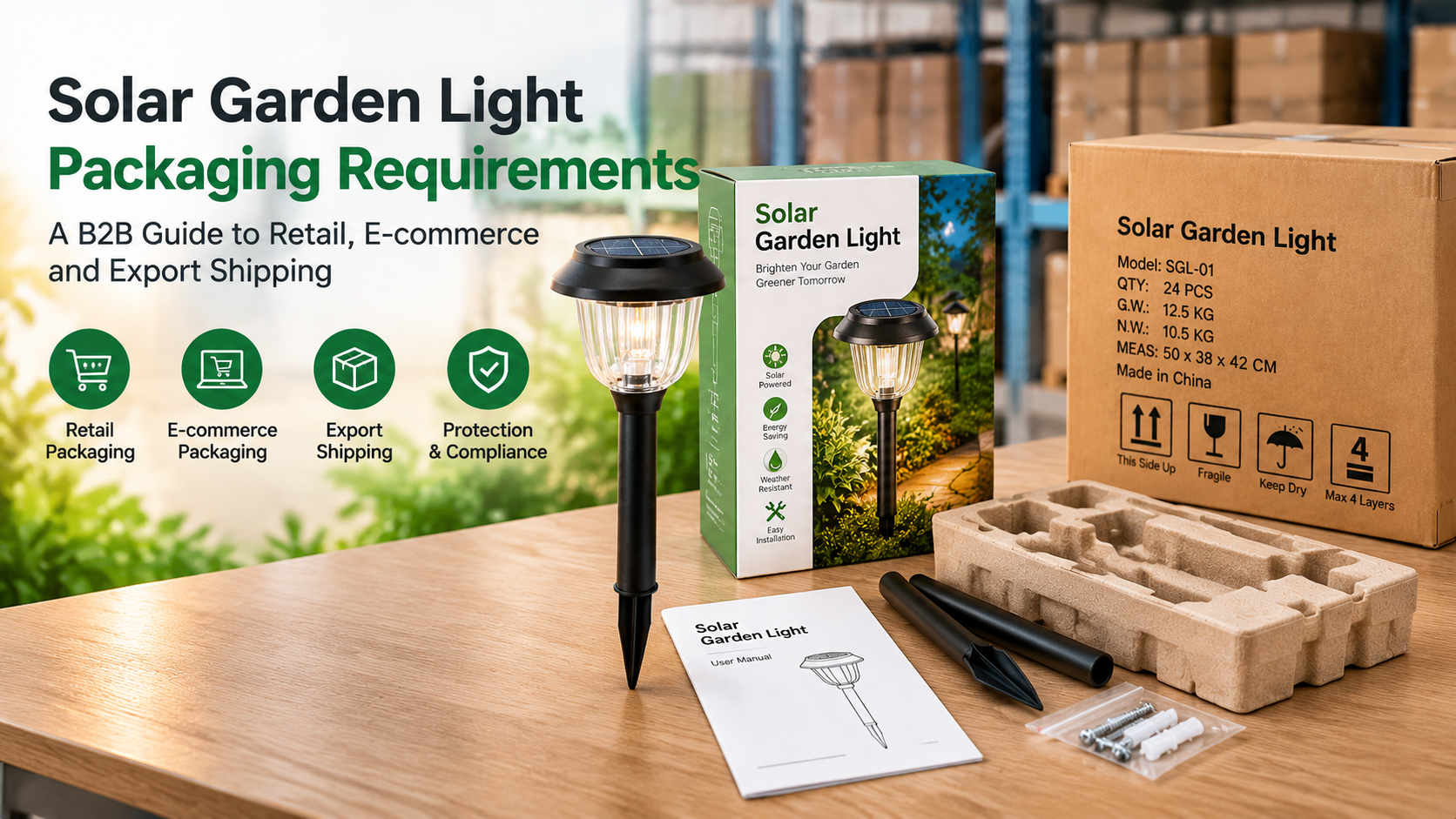
LEDORA’s Solar Garden Light Packaging for Wholesale, Retail and E-commerce explains why these instructions should be included in the final consumer package.
Don’t Forget the ON/OFF Switch
This sounds simple, but it can become a real customer-service issue.
Some solar lights must be switched to the ON position before normal charging and automatic operation.
If the customer removes the product from the box, places it outdoors but leaves the switch off, the product may appear defective.
Good product documentation should clearly explain:
- Remove protective packaging or panel film if applicable.
- Switch the product on as instructed.
- Position the solar panel correctly.
- Allow appropriate charging.
- Test the automatic light sensor correctly.
Clear instructions can reduce unnecessary returns.
Why Solar Lights May Not Turn On During the Day
Many solar garden lights use a light sensor or solar-panel voltage logic to control automatic operation.
During bright conditions, the product may remain off because it interprets the environment as daytime.
At night or in sufficiently dark conditions, it can switch on automatically.
Therefore, a buyer or consumer testing a solar light under bright indoor lighting may incorrectly assume:
“The product does not work.”
Testing should follow the actual product instructions.
Why Runtime Claims Need Test Conditions
Imagine three suppliers offering a solar garden light.
Supplier A
Claims:
12 Hours
Supplier B
Claims:
10 Hours
Supplier C
Claims:
8 Hours
At first glance, Supplier A looks best.
But the numbers cannot be compared properly until the buyer asks:
- How long was the product charged?
- Under what solar conditions?
- Was the battery fully charged before testing?
- What lighting mode was used?
- Was brightness constant?
- What was the ambient temperature?
- Was the test based on solar charging or laboratory/USB charging?
Without this information:
12 hours vs 10 hours vs 8 hours
may not be a meaningful comparison.
LEDORA’s Solar Garden Light Runtime Guide provides a more detailed framework for evaluating these claims.
Solar Charging vs USB Charging: Don’t Confuse the Two
Some rechargeable outdoor lights support both:
- solar charging
- USB charging
A product tested after a complete USB charge may achieve a different result from the same product after a cloudy day of solar charging.
Therefore, marketing materials should not present a USB laboratory runtime as if it automatically represents real-world solar performance.
B2B buyers should ask:
Was this runtime measured after solar charging or external charging?
This one question can make supplier comparisons much more accurate.
How Should Importers Evaluate Solar Lights for Northern Markets?
For buyers selling into markets with:
- shorter winter days
- frequent cloud cover
- long periods of rain
- high latitude
the product should be evaluated according to the actual market rather than only under ideal factory conditions.
Discuss:
Solar Panel
- type
- size
- rated output
Battery
- chemistry
- voltage
- capacity
LED
- power
- quantity
- brightness modes
Control Strategy
- dusk-to-dawn
- timer
- motion sensor
- reduced-brightness mode
Target Runtime
Define realistic performance expectations.
Consumer Instructions
Explain weather-dependent performance clearly.
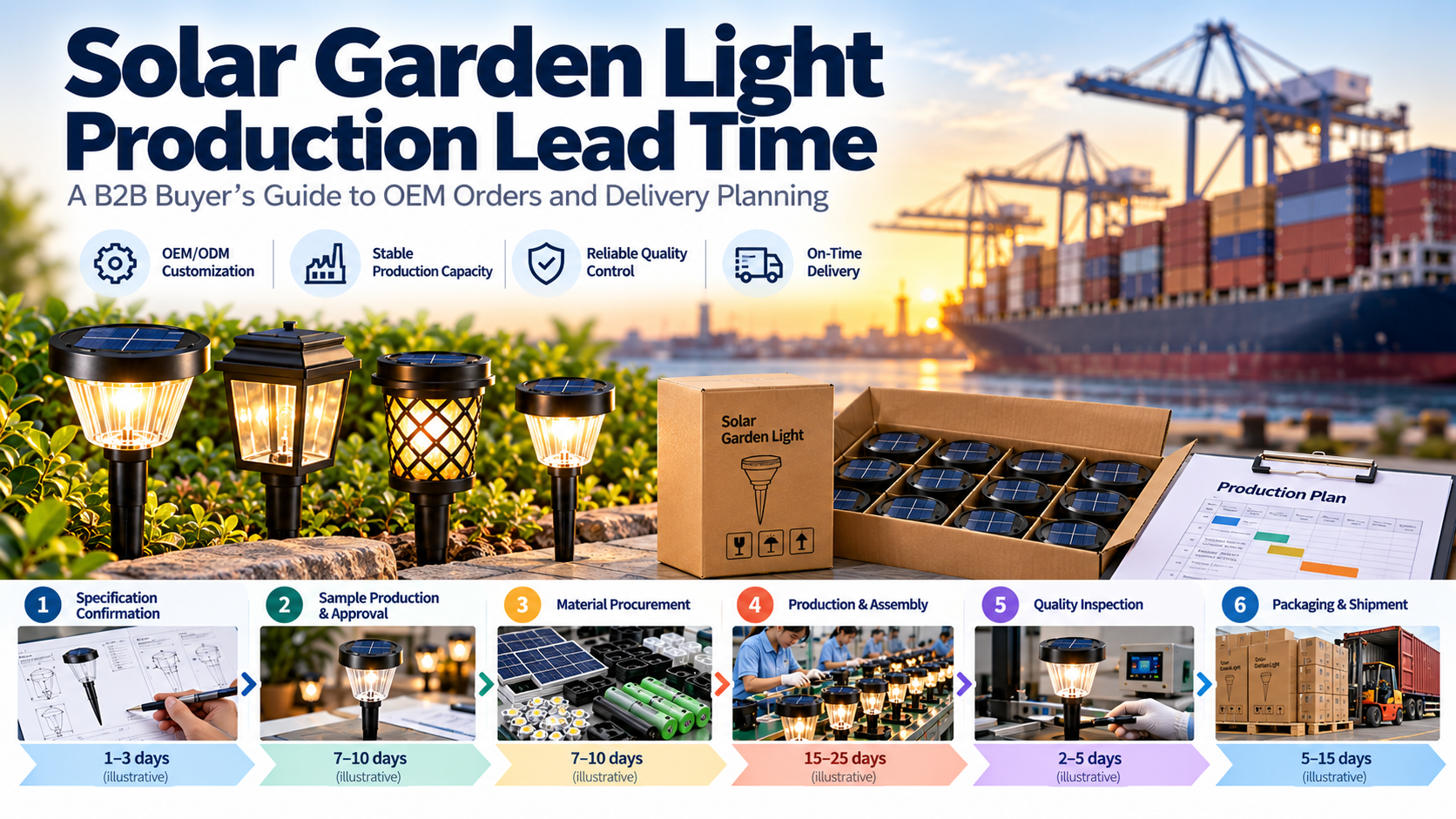
For OEM projects, these requirements should be frozen before mass production. See LEDORA’s Solar Garden Light OEM & ODM Process: From Sample Approval to Bulk Production.
How Should Importers Evaluate Solar Lights for Hot, Sunny Markets?
High solar availability does not mean product design can ignore the environment.
Buyers should still consider:
- battery operating conditions
- housing temperature
- UV exposure
- material aging
- waterproof structure
- panel construction
A solar light designed for one climate should not automatically be assumed to perform identically in every global market.
For wholesalers selling into several regions, the target market should be part of the product-development specification.
Solar Garden Light Winter Performance Checklist for B2B Buyers
Before approving a solar-light program, confirm:
- Target country and climate
- Solar-panel type
- Solar-panel voltage
- Solar-panel power/current
- Battery chemistry
- Battery voltage
- Battery capacity
- LED power
- Lighting modes
- Charging-time test conditions
- Runtime test conditions
- Low-light expectations
- Operating-temperature requirements
- Consumer installation instructions
- Panel cleaning instructions
- First-use instructions
- Product QC procedure

Should Buyers Test Solar Garden Lights Outdoors?
For meaningful real-world evaluation, outdoor testing can provide useful information beyond a short indoor function check.
Depending on the project, buyers may evaluate:
- charging under natural sunlight
- automatic dusk activation
- nighttime runtime
- lighting-mode behavior
- performance over several days
- cloudy-day behavior
- installation angle
- product sealing and outdoor construction
However, outdoor testing should record environmental conditions.
Otherwise, one day’s result may be difficult to compare with another.
How Should OEM Buyers Specify Cloudy-Weather Performance?
Avoid an unrealistic RFQ such as:
“Must work 12 hours every night in any weather.”
Instead, define the product system and test conditions.
A better RFQ includes:
Target Market: Northern Europe
Product: Solar Pathway Light
Panel: To be confirmed based on energy requirement
Battery: Chemistry + voltage + capacity
LED: Power + operating mode
Runtime Target: Defined under agreed charging conditions
Installation: Open outdoor area
Control: Dusk-to-dawn / timer / sensor
Weather Expectation: Seasonal performance to be evaluated during sample stage
This gives the manufacturer a technical requirement that can actually be discussed and tested.
What Should Buyers Check During Sample Approval?
Before approving bulk production, evaluate:
- Solar-panel specification
- Battery specification
- LED power
- Charging function
- Automatic light-control function
- Lighting modes
- Runtime under defined conditions
- Housing construction
- Waterproof requirement
- Product instructions
For a broader sourcing framework, read How to Choose Solar Garden Lights for Wholesale Orders.
Common Reasons Solar Garden Lights Have Short Runtime
If a solar garden light runs for fewer hours than expected, possible causes include:
Insufficient Daytime Solar Energy
Clouds, winter conditions or shading may reduce charging input.
Poor Panel Placement
The panel may spend much of the day in shade.
Dirty Panel Surface
Dirt or debris can reduce available light reaching the panel.
Battery State of Charge
The battery may not have received sufficient energy during the day.
Battery Aging or Quality
Battery condition can influence usable stored energy.
High LED Consumption
High-brightness modes consume more energy.
Incorrect Product Setup
Switch position or operating mode may be incorrect.
System Mismatch
The solar panel, battery and LED load may not be appropriately balanced.
A good diagnosis therefore looks at the complete system rather than replacing the battery immediately.
What Should a Solar Lighting Manufacturer Provide?
For serious B2B sourcing, an outdoor lighting manufacturer should be able to discuss more than product appearance.
Buyers should request information about:
- solar-panel specification
- battery chemistry and capacity
- LED load
- lighting modes
- working-time test
- charging conditions
- waterproof construction
- materials
- packaging
- OEM options
- QC process
LEDORA supports importers, wholesalers, retailers and private-label brands with solar garden lighting development, sample evaluation, OEM/ODM customization and bulk-production support.
Frequently Asked Questions
Do solar garden lights work on cloudy days?
Yes, they can still operate under cloudy conditions, but reduced solar radiation can result in less charging energy being stored during the day. Actual nighttime performance depends on the product and weather conditions.
Do solar lights charge when there is no direct sunlight?
Solar panels can receive diffuse solar radiation even when direct sunlight is reduced. However, charging performance can be lower than under strong clear-sky conditions.
Why do my solar lights stay on for fewer hours in winter?
Possible reasons include shorter daylight periods, lower seasonal solar input, cloud cover, battery behavior at different temperatures and installation conditions.
Do solar lights need direct sunlight?
For best charging performance, the solar panel should receive suitable solar exposure according to the manufacturer’s instructions. Prolonged shade can reduce available charging energy.
Does cold weather stop solar lights from working?
Cold weather does not mean a photovoltaic panel cannot generate electricity. However, the complete solar light also contains a rechargeable battery and electronics whose performance can be influenced by environmental conditions.
Will a bigger battery improve winter runtime?
Not automatically. The solar panel must still be able to provide enough charging energy. Battery capacity, panel output and LED consumption should be evaluated together.
Will a bigger solar panel make a solar garden light better?
A larger or more capable panel may provide more charging potential, but it can also increase product size and cost. The correct panel should match the battery, LED load, product design and target market.
How long should solar garden lights stay on?
There is no universal runtime. LEDORA’s Solar Garden Light Runtime Guide explains why charging conditions, battery, LED load, lighting mode and weather all affect working time.
Should importers test solar lights during cloudy weather?
For markets where low-light conditions are commercially important, buyers should discuss appropriate testing and performance expectations during product development and sample approval.
How can customers improve solar garden light charging?
Follow the product instructions, place the panel where it can receive suitable sunlight, avoid unnecessary shading, keep the panel surface clean and ensure the product is switched and configured correctly.
Conclusion
Solar garden lights do not have one fixed runtime for every day of the year.
Their real-world performance depends on a changing energy balance:
Sunlight → Solar Panel → Battery → LED → Runtime
Cloud cover can reduce the solar radiation available for charging, while winter can bring shorter daylight periods and different solar angles.
That does not mean solar garden lights “do not work in winter.”
It means professional buyers should evaluate them as complete energy systems rather than expecting one advertised runtime to apply under every condition.
For importers and private-label brands, the most important questions are:
- What solar input was used during testing?
- What battery system is installed?
- How much energy does the LED consume?
- Which lighting mode was tested?
- What market and climate is the product designed for?
The most important sourcing principle is:
Don’t ask only how many hours a solar light works. Ask under what charging, weather and operating conditions that runtime was achieved.
Looking for a Solar Garden Light Manufacturer?
LEDORA Lighting supplies solar garden lights for importers, wholesalers, retailers, e-commerce sellers and private-label outdoor brands.
For buyers developing a new solar lighting program, we recommend reviewing:
- Solar Panel Size & Battery Capacity Matching Guide
- Solar Garden Light Battery Types Guide
- Solar Garden Light Runtime Guide
- Solar Garden Light OEM & ODM Process
- Solar Garden Light Packaging Guide
When requesting a quotation, send LEDORA:
Target Market + Product Type + Solar Panel Requirement + Battery Requirement + LED/Runtime Requirement + Quantity + Packaging Requirement