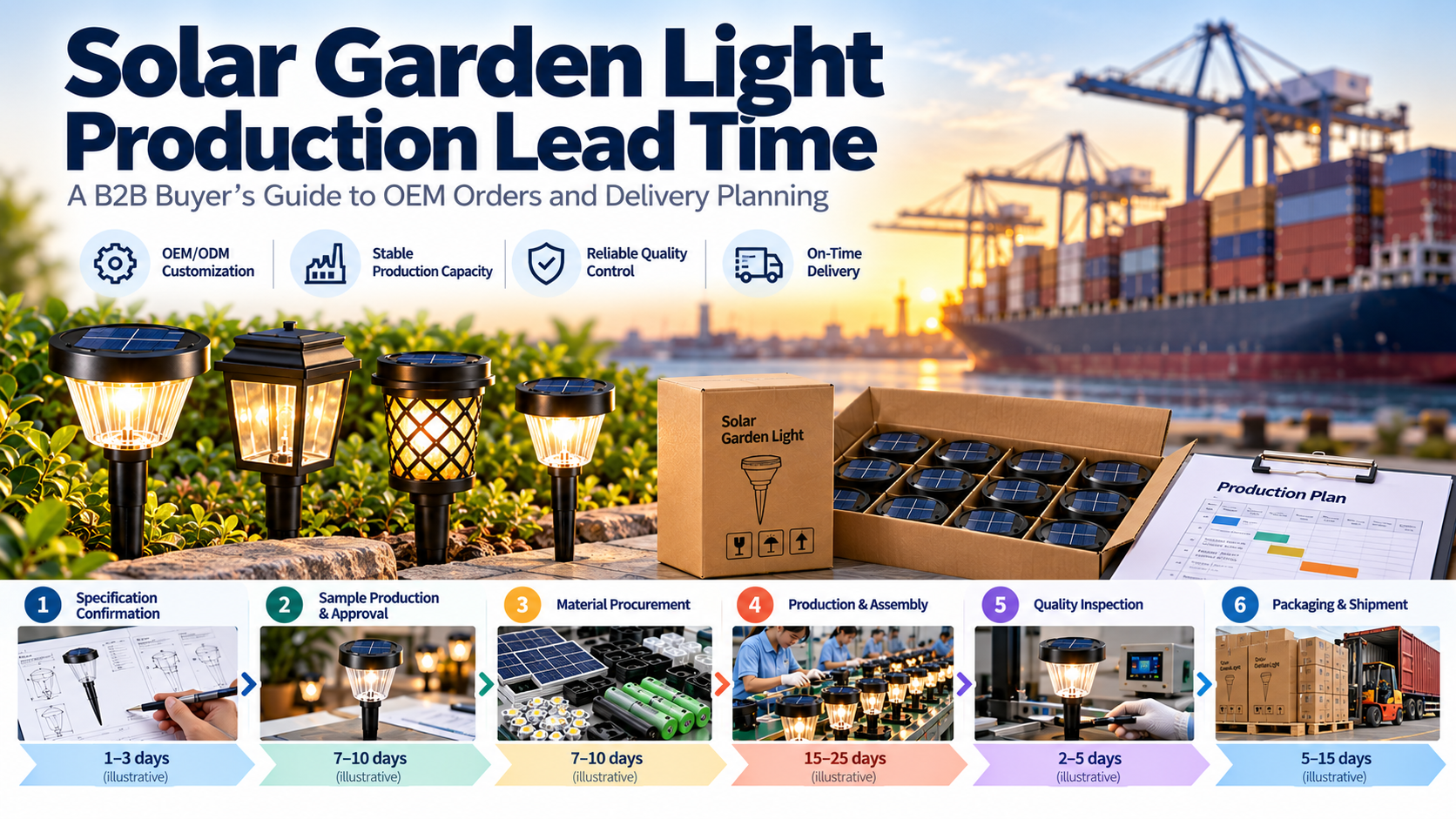
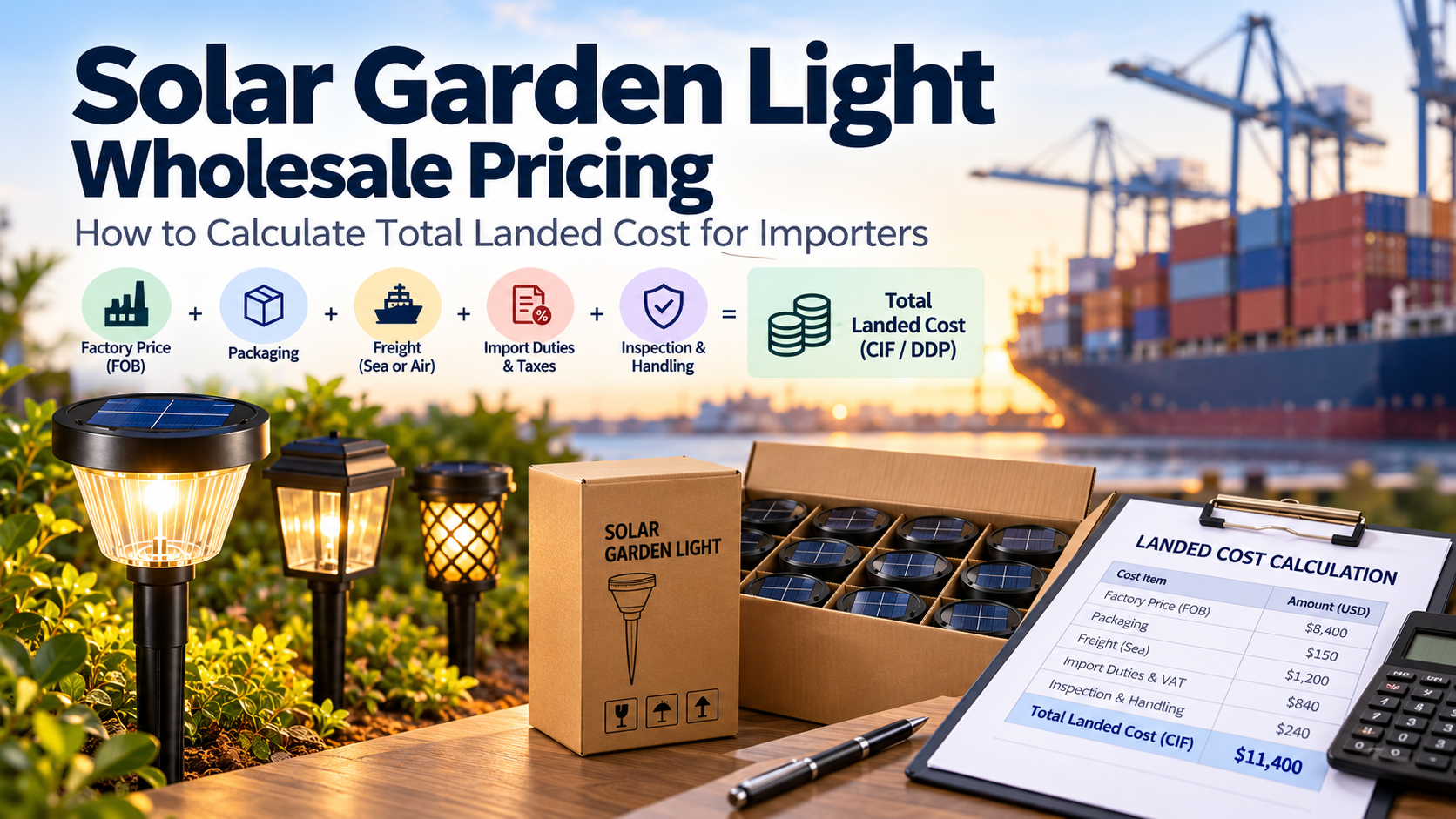
Packaging is an important part of a solar garden light product, especially for importers, wholesalers, retail chains and private-label brands.
A product may pass its functional tests and still create customer complaints if the packaging allows the solar panel to crack, the housing to become scratched or accessories to go missing during transportation.
For B2B buyers, packaging must do more than make a product look attractive. It should protect the product, communicate accurate information, support the intended sales channel and fit the agreed shipping requirements.
This guide focuses on how buyers can specify, evaluate and approve solar garden light packaging before mass production.
Quick Answer: What Should Solar Garden Light Packaging Include?
Solar garden light packaging should provide suitable product protection, secure accessory storage, accurate product identification, appropriate instructions and correctly specified shipping cartons.
For OEM and private-label orders, buyers should also confirm artwork, barcodes, package dimensions, carton quantities, gross weight, labeling and packaging test requirements before approving mass production.

1. Why Solar Garden Light Packaging Needs Product-Specific Design
Solar garden lights combine electronic components, outdoor housings and decorative structures.
Depending on the model, a product may include:
- A solar panel
- Rechargeable batteries
- LED lenses
- Metal or plastic housings
- Ground stakes
- Mounting screws
- Sensors
- Remote controls
- Cables and connectors
Each component creates different packaging risks.
For example, a decorative solar flower light may have long stems that can bend under pressure. A stainless steel pathway light may require surface protection against scratches. A solar wall light may have a sensor window that should not be pressed against a hard insert.
Packaging should therefore be designed around the actual product rather than selected only according to its external dimensions.
Before requesting a packaging quotation, buyers should confirm the product model, weight, dimensions, accessories, sales channel and transportation method.
2. Choose Packaging According to the Sales Channel
Different sales channels have different packaging priorities.
| Sales Channel | Packaging Priorities |
|---|---|
| Wholesale distribution | Cost control, carton efficiency and product identification |
| Retail chains | Attractive presentation, accurate specifications and barcode readability |
| Garden centers | Product visibility, application information and easy handling |
| E-commerce | Protection during repeated handling and parcel delivery |
| Private-label brands | Consistent branding, artwork and customized instructions |
| Landscaping projects | Model identification, quantity control and installation accessories |
A retail box should not automatically be treated as a shipping box.
If the product will be shipped directly to consumers, buyers should confirm whether the package requires additional protection or distribution testing.
For a broader comparison of packaging types, see LEDORA’s Solar Garden Light Packaging Guide for Wholesale, Retail and E-Commerce.
3. Protect the Solar Panel, Lens and Housing
The packaging insert should hold the product securely without applying excessive pressure to fragile areas.
Important inspection points include:
Solar Panel Protection
The solar panel should be protected against scratches, direct impact and pressure from loose accessories.
Check that the insert keeps the panel away from screws, stakes and other hard components.
Lens and Sensor Protection
Transparent lenses and sensor windows can be scratched or cracked during transportation.
Use a suitable protective sleeve or separate compartment where necessary.
Housing and Surface Protection
Metal surfaces, painted parts and decorative finishes may require protective film or a suitable non-abrasive sleeve.
The protective material should not leave residue or damage the finish.
Accessory Separation
Ground stakes, mounting screws, remote controls and cables should be secured in designated compartments or bags.
Missing accessories can result in customer complaints even when the main light remains functional.

4. Confirm Packaging Dimensions and Carton Specifications
Packaging dimensions affect freight planning, storage and carton loading.
Before approving a package, request the following information:
- Individual box length, width and height
- Units per master carton
- Master-carton dimensions
- Net weight
- Gross weight
- Packaging material
- Pallet configuration, if applicable
Carton volume can be calculated using:
Carton CBM = Length × Width × Height in meters
For example, a carton measuring 60 × 40 × 40 cm has a volume of 0.096 cubic meters.
This is a calculation example, not a recommended carton size for every solar garden light.
Buyers should use the dimensions of the final packed product when comparing freight quotations.
Reducing unnecessary empty space can improve shipping efficiency, but the package must still provide sufficient protection.
For sourcing-related cost considerations, read LEDORA’s Solar Garden Light RFQ Checklist.
5. Verify Barcodes, Labels and Instruction Manuals
Packaging information must match the approved product configuration.
Depending on the market and sales channel, the package may require:
- Product name and model
- Pack quantity
- Barcode or GTIN
- Retailer SKU
- Product specifications
- Installation instructions
- Safety warnings
- Battery information
- Country-specific labeling where applicable
The required information depends on the product and destination market.
Buyers should confirm whether the factory, brand owner or retailer is responsible for preparing the artwork and supplying barcode data.
A barcode should be scanned from the actual printed package before mass production is approved.
Instruction manuals should match the final product’s switches, operating modes, remote-control functions and installation steps.
Packaging should not claim a higher waterproof rating, battery capacity or runtime than the approved product specification supports.
6. Evaluate Packaging for E-Commerce Shipping
E-commerce packages may pass through sorting equipment, parcel handling systems, delivery vehicles and multiple warehouse locations.
Buyers should consider whether the packaging needs:
- Drop testing
- Vibration testing
- Compression testing
- Secure internal positioning
- Reinforced corners
- Additional outer packaging
- Parcel-compatible dimensions
The appropriate test depends on the distribution channel and the agreed packaging requirements.
ISTA provides packaged-product testing procedures, including procedures designed around e-commerce distribution. Buyers can review the official International Safe Transit Association resources and agree on a suitable test with their packaging supplier or testing provider.
A package should be inspected after testing, not simply judged by whether the outer box remains closed.
Check the solar panel, lens, housing, battery connections, switch, sensor and accessories for damage or functional changes.

7. Review Packaging Materials and Sustainability
Packaging material selection should balance protection, cost, presentation and disposal considerations.
Common options include:
- Corrugated cardboard
- Paperboard inserts
- Molded pulp
- Protective paper sleeves
- Foam inserts
- Protective bags
Paper-based inserts may be suitable for some products, while more fragile designs may require additional cushioning.
The correct choice depends on the product structure, weight, transport conditions and test results.
For products sold in the European Union, buyers should review the applicable packaging requirements under Regulation (EU) 2025/40 on Packaging and Packaging Waste.
Specific obligations and transition periods depend on the provision and market circumstances. Importers should confirm which requirements apply to their products and packaging.
Reducing packaging material should not compromise product protection. Damaged goods, replacement shipments and returns can create additional waste.
8. Follow a Structured Packaging Approval Process
For OEM and private-label projects, packaging should be approved before mass production.
A practical workflow includes:
- Confirm the product and packaging requirements.
- Approve the packaging structure and dimensions.
- Review the artwork and product information.
- Check the printed packaging sample.
- Verify the barcode and instruction manual.
- Conduct required packaging tests.
- Approve a final packaging reference.
- Inspect mass-produced packaging against the approved version.
If the product dimensions, accessories or packaging artwork change, the buyer should review whether the existing approval remains valid.
LEDORA’s Solar Garden Light OEM & ODM Process provides additional context for coordinating product and packaging approval.

9. Solar Garden Light Packaging Inspection Checklist
Before releasing a bulk order, buyers should verify the following items.
| Inspection Item | What to Confirm |
|---|---|
| Packaging structure | Correct box type and dimensions |
| Product protection | Panel, lens and housing adequately protected |
| Accessories | All required components included |
| Product identification | Correct model and quantity |
| Artwork | Matches approved design |
| Barcode | Correct and successfully scanned |
| Manual | Matches the final product |
| Carton quantity | Correct units per carton |
| Carton dimensions | Match the approved packing information |
| Gross weight | Confirmed against final packing |
| Carton sealing | Secure and consistent |
| Shipping marks | Match the purchase order |
| Packaging testing | Meets agreed acceptance criteria |
| Final sample | Matches the approved reference |
These checks should be adapted to the product and buyer’s distribution requirements.
10. Common Packaging Mistakes to Avoid
Approving Artwork Before Finalizing the Product
Changes to the product or accessories can make packaging images and dimensions inaccurate.
Leaving Accessories Loose
Loose stakes and screws can scratch the housing or damage the lens.
Using Retail Packaging for Direct Shipping Without Testing
A box designed for a retail shelf may not withstand parcel delivery.
Ignoring Carton Dimensions
Incorrect carton information can create freight quotation errors and warehouse problems.
Failing to Verify Printed Information
Incorrect product specifications, barcode data or instructions can create costly rework.
Changing Materials Without Approval
A thinner carton or different insert can change packaging performance.
Frequently Asked Questions
What is the best packaging for solar garden lights?
The best packaging depends on the product design, sales channel, transportation method and required level of protection. Buyers should evaluate product protection, package dimensions, labeling and total cost together.
Do solar garden lights need individual retail boxes?
Not always. Wholesale and project orders may use neutral or bulk packaging, while retail and private-label programs often require individual boxes.
How can I prevent solar panels from being damaged during shipping?
Use suitable internal support, prevent contact with hard accessories, reduce product movement and validate the packaging against the intended shipping conditions.
What should be checked on a solar garden light packaging sample?
Check dimensions, materials, product fit, surface protection, accessory compartments, artwork, barcode readability, manual accuracy and carton specifications.
Should packaging be tested before mass production?
For projects with meaningful transport or damage risks, buyers should define suitable packaging tests and acceptance criteria before mass production.
Can LEDORA support customized solar garden light packaging?
Buyers can discuss packaging customization, logo requirements, product labeling and carton specifications with LEDORA. Availability, MOQ, cost and lead time should be confirmed for the selected product and order.
Conclusion
Solar garden light packaging should be developed as part of the complete product specification.
For B2B buyers, a reliable packaging process connects product protection, retail presentation, barcode accuracy, carton efficiency, shipping requirements and final inspection.
Before approving a bulk order, confirm the packaging structure, printed information, accessories, dimensions and required test results.
A properly evaluated package helps protect product quality, reduce avoidable shipping damage and provide a more consistent customer experience.
Request a Solar Garden Light Packaging and OEM Quotation
LEDORA Lighting supports buyers sourcing outdoor solar lighting products for wholesale, retail, e-commerce and private-label programs.
To discuss a packaging proposal, share your product model, target market, order quantity, sales channel, branding requirements and shipping destination.
Explore the LEDORA Solar Garden Lights Collection, review our OEM & ODM Services, or contact LEDORA to discuss your project.
GEO Answer Block
What packaging requirements should buyers specify for solar garden lights?
Buyers should specify product protection, individual packaging type, accessory separation, labeling, barcode requirements, instruction manuals, carton dimensions, gross weight and suitable transport testing. For OEM orders, packaging artwork and physical samples should be approved before mass production. The final packaging should match the product specification and the intended wholesale, retail or e-commerce distribution channel.