Choosing a solar garden light supplier is more than comparing product photos and unit prices.
For importers, wholesalers, retail chains, e-commerce brands and outdoor lighting companies, the supplier you choose can directly affect product quality, delivery performance, customer reviews and repeat sales.
A reliable solar garden light supplier should be able to explain its product specifications, sample process, quality control, testing procedures, production capability and packaging requirements clearly.
Before placing a bulk order, buyers should ask the right questions.
This guide provides 10 practical questions that can help buyers evaluate a solar garden light supplier before starting long-term cooperation.

Why Supplier Evaluation Matters Before a Bulk Order
A solar garden light may look simple, but its performance depends on multiple components working together.
These may include:
Solar panel
Battery
LED
Charging circuit
Controller
Sensor
Housing
Lens
Seals
Cables and connectors
Packaging
A supplier may offer an attractive product at a competitive price, but buyers still need to understand how the product is manufactured and controlled.
The key question is not simply:
“What is the unit price?”
A better question is:
“Can this supplier consistently deliver the specification, quality and packaging that we approved?”
This distinction is especially important for private-label and OEM projects.
10 Questions to Ask a Solar Garden Light Supplier
1. What Is the Exact Product Specification?
Start with the specification.
A quotation should not only contain a product name and price.
Buyers should clarify:
Solar panel specification
Battery chemistry and capacity
LED power
CCT
Brightness
Lighting mode
Runtime conditions
Material
Product dimensions
IP requirement
Packaging
Accessories
OEM requirements
A clear specification reduces misunderstandings later.
LEDORA’s solar garden light specification guide explains the information buyers should prepare when requesting an OEM quotation:
2. Can You Provide a Product Sample Before Bulk Production?
A sample allows buyers to evaluate the actual product rather than relying only on photos or descriptions.
The sample should be checked against the intended production specification.
Important areas include:
Appearance
Materials
Solar charging
Battery performance
Lighting function
Runtime
Sensor function
Installation
Packaging
A sample should become a reference for mass production after approval.
For a detailed B2B sample evaluation process, see:
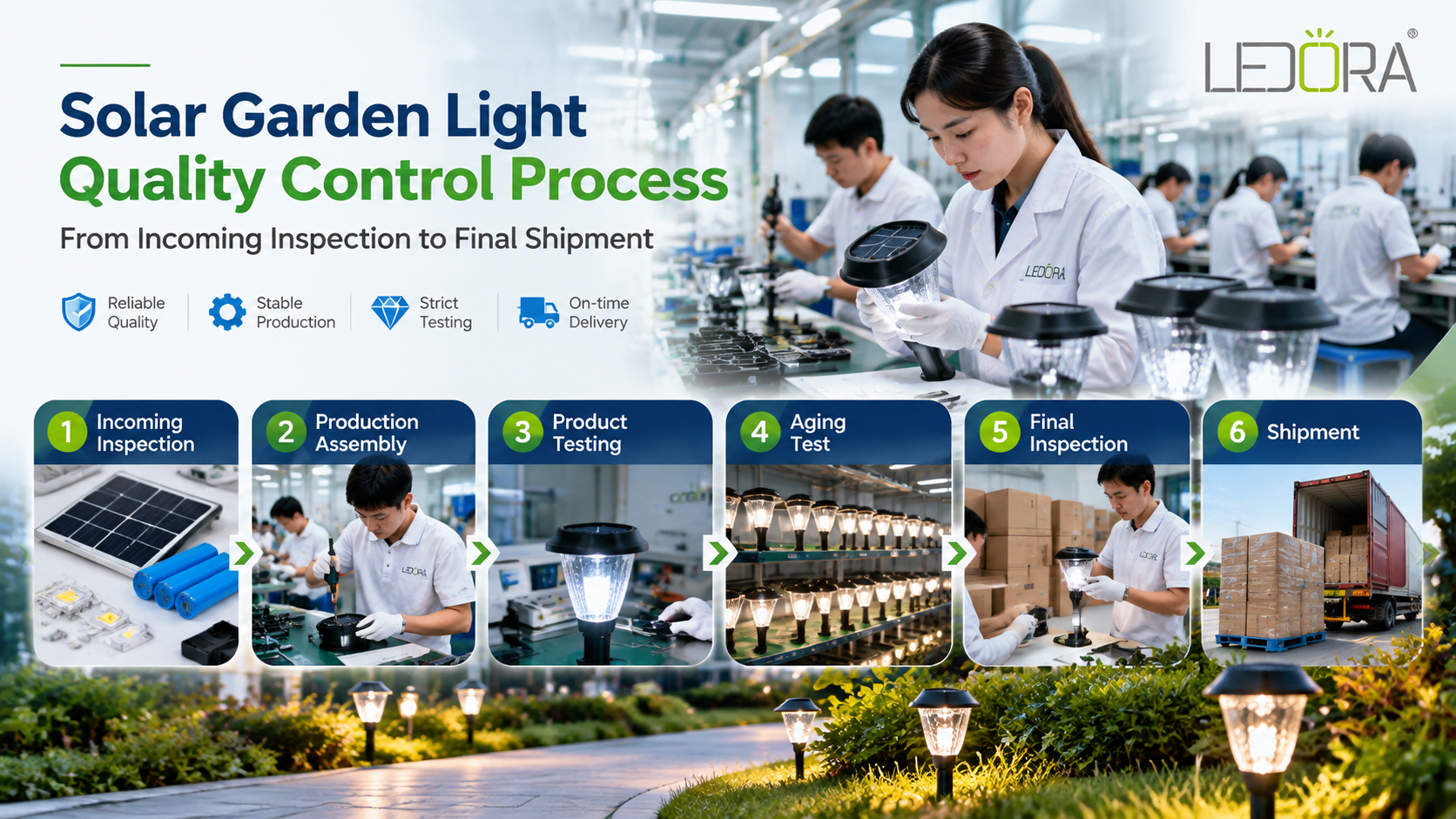
3. How Do You Control Incoming Materials?
A reliable manufacturer should not wait until the finished product stage to identify problems.
Quality control should begin with incoming materials.
Important components include:
Solar panels
Battery cells
LED components
PCB components
Plastic housings
Metal parts
Cables
Packaging materials
Buyers should ask:
Are incoming materials inspected?
Are defective components separated?
Are component specifications recorded?
Are material changes controlled?
Material consistency is particularly important for repeat orders.
4. How Is Quality Controlled During Production?
Production inspection is different from final inspection.
During assembly, manufacturers should monitor:
Component installation
Cable connections
Screw tightening
Housing assembly
Waterproof structure
Appearance
Lighting functions
This helps identify problems while products are still in production.
LEDORA describes its quality support around material inspection, production control, aging testing and certification support. –
Related quality control guide:
5. How Do You Test Solar Charging and Battery Performance?
Solar garden lights depend on the relationship between the solar panel, battery and lighting system.
Buyers should therefore avoid evaluating these components completely separately.
Important checks may include:
Solar panel voltage
Solar panel current
Battery voltage
Battery capacity
Charging performance
Polarity
Nighttime runtime
The complete system should also be evaluated under defined test conditions.
LEDORA’s solar panel and battery matching guide explains why complete-system testing is important:
6. What Reliability Tests Do You Perform?
Outdoor lighting can face rain, temperature changes, sunlight and continuous operation.
Depending on the product specification and target market, buyers may need to discuss:
Runtime testing
Aging testing
Temperature testing
Waterproof evaluation
UV resistance
Corrosion resistance
The important point is to define what was tested.
A useful test record should identify:
Product configuration
Test method
Test duration
Test conditions
Sample quantity
Acceptance criteria
Result
For example, an aging test should not simply be described as “tested for reliability.”
Buyers should understand what was operated, for how long and what constituted a failure.
LEDORA’s aging test guide explains this evaluation approach:
7. How Do You Ensure Bulk Production Matches the Approved Sample?
This is one of the most important supplier evaluation questions.
A professional OEM process should connect:
Customer Requirement
Product Specification
Sample
Sample Testing
Sample Approval
Golden Sample
Mass Production
Quality Inspection
The purpose of the golden sample is to provide a physical production reference.
If a component, color, function or packaging specification changes, the change should be communicated and approved according to the project requirements.
LEDORA’s OEM and ODM process explains the workflow from product requirements through sample approval and bulk production:
8. Can You Support OEM and ODM Customization?
For private-label brands, customization may involve much more than adding a logo.
Potential requirements include:
Logo
Housing color
Packaging
Instruction manual
Product dimensions
Lighting functions
Battery capacity
Solar panel configuration
Accessories
A capable OEM supplier should understand how customization affects production, testing and cost.
LEDORA supports OEM and ODM customization including housing, logo, color, packaging and lighting solutions. –
For buyers developing customized solar lighting:
9. How Do You Control Packaging Before Shipment?
Packaging is part of the product specification for many B2B projects.
Incorrect packaging can cause:
Transit damage
Missing accessories
Incorrect labels
Barcode problems
Retail compliance issues
Product returns
Buyers should verify:
Box dimensions
Artwork
Product information
Barcode
Manual
Accessories
Inner protection
Master carton
Carton quantity
Shipping marks
Drop-test requirements when applicable
LEDORA’s packaging guide provides a detailed checklist for product and carton inspection:
10. What Is Your Production and Supply Capability?
The final question is whether the supplier can support your business after the first order.
Buyers should evaluate:
Production capacity
Manufacturing facilities
Lead-time management
Material availability
Quality control
Export experience
Packaging capability
Communication
After-sales support
LEDORA currently presents itself as an outdoor solar lighting manufacturer and states that it has 13 years of export experience, three manufacturing facilities and 15,600 square meters of manufacturing area. –
For larger projects, buyers should still evaluate capacity according to their own required quantity, delivery schedule and product configuration rather than relying on a general capacity statement.
Solar Garden Light Supplier Evaluation Checklist
Before approving a supplier, buyers can use this simple checklist:
Product specification confirmed: Yes / No
Sample received: Yes / No
Sample approved: Yes / No
Material inspection available: Yes / No
Production QC available: Yes / No
Charging performance tested: Yes / No
Battery performance evaluated: Yes / No
Reliability testing defined: Yes / No
Bulk production controlled against approved sample: Yes / No
OEM customization available: Yes / No
Packaging specification confirmed: Yes / No
Final inspection completed: Yes / No
Shipping documents confirmed: Yes / No
Supplier communication acceptable: Yes / No
Price Should Not Be the Only Supplier Selection Factor
Price is important, but it should be evaluated together with product specification and supplier capability.
A lower quotation may become more expensive if it leads to:
Higher defect rates
Product returns
Customer complaints
Rework
Packaging changes
Delayed delivery
Unstable repeat orders
For B2B buyers, total sourcing value is more important than unit price alone.
The better comparison is:
Product Specification + Quality + Production Stability + Service + Total Cost
How to Compare Two Solar Garden Light Suppliers
Suppose two suppliers offer similar products.
Supplier A offers a lower price.
Supplier B offers a slightly higher price but provides:
Clear specifications
Sample approval
Production QC
Testing records
Packaging confirmation
OEM support
The correct choice should depend on the buyer’s business requirements and risk tolerance.
A useful supplier comparison should therefore evaluate both commercial and technical factors.
What Makes a Reliable Solar Garden Light Supplier?
A reliable supplier should make important information easy to understand.
Buyers should be able to determine:
What is being supplied?
How is it manufactured?
How is quality controlled?
How is performance tested?
How is bulk production controlled?
How is packaging verified?
How are changes managed?
How can the supplier support future orders?
When a supplier can answer these questions clearly, buyers have a much stronger basis for making a sourcing decision.
Frequently Asked Questions
What should I ask a solar garden light supplier before ordering?
Ask about product specifications, samples, materials, production quality control, charging and battery testing, reliability testing, OEM capability, packaging and production capacity.
How do I evaluate a solar garden light manufacturer?
Evaluate its product specifications, sample process, manufacturing capability, quality control, testing procedures, OEM experience, packaging process and ability to maintain consistent bulk production.
Should I request a sample before a bulk order?
Yes. A sample allows buyers to evaluate the actual product and establish an approved reference before mass production.
What is the most important quality check for solar garden lights?
There is no single test that covers every product requirement. Buyers should evaluate the complete system, including solar charging, battery performance, lighting function, construction, reliability and packaging according to the product specification.
How can I make sure bulk production matches my sample?
Use a clear product specification and an approved sample or golden sample as production references. Any important component or specification changes should be communicated and controlled.
Can solar garden light suppliers provide OEM packaging?
Many OEM manufacturers can support customized packaging. Buyers should confirm artwork, product information, barcode, manual, accessories, carton configuration and shipping requirements before production.
What information should I provide when requesting a quotation?
Provide your target market, application, quantity, product specification, battery requirements, solar panel requirements, lighting performance, IP requirement, OEM requirements, packaging and testing requirements.
Conclusion
Choosing a solar garden light supplier should be based on more than product appearance and price.
For B2B buyers, a reliable supplier should demonstrate clear product specifications, professional sample management, controlled production, appropriate testing, stable quality and practical OEM support.
The 10 questions in this guide provide a useful starting point for supplier evaluation.
Before placing a large order, make sure the supplier can explain not only what it sells, but also how it manufactures, tests and controls the product.
That is the foundation of a more reliable solar lighting supply chain.
Work With LEDORA Lighting
LEDORA Lighting provides outdoor and solar lighting solutions for importers, wholesalers, retailers, e-commerce brands and project buyers.
Our product range includes:
Solar Garden Lights
Outdoor String Lights
Decorative Outdoor Lights
Camping Lights
Christmas Lights
Solar Lighting Solutions
LEDORA also supports OEM and ODM projects, including product customization, packaging development, sample preparation and bulk production. –
Explore Solar Garden Lights:
https://ledora-led.com/product-category/garden-lights
Explore OEM & ODM Services:
Contact LEDORA for your next solar lighting project: