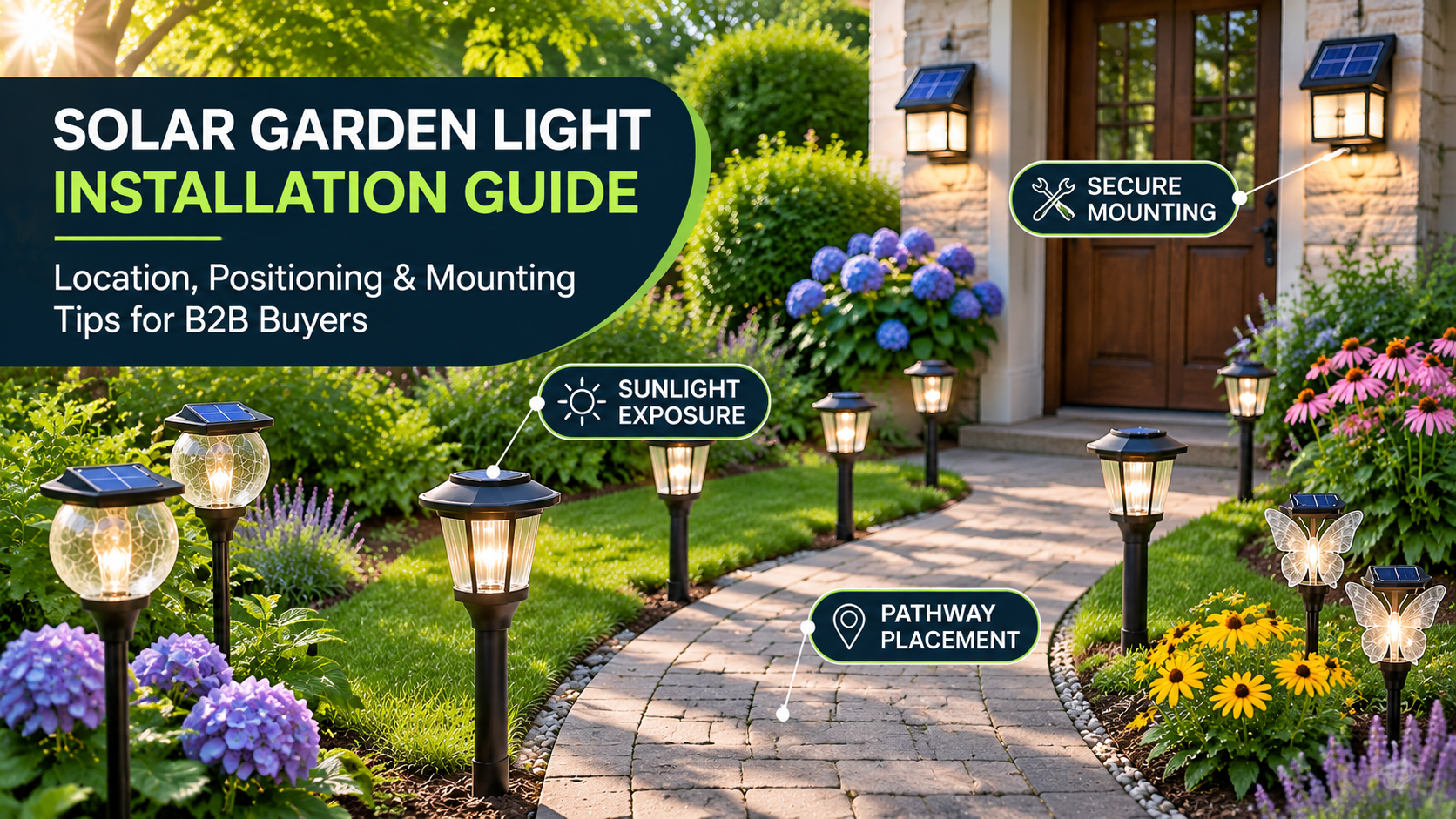
Solar garden lights are designed to provide convenient outdoor illumination using energy collected from sunlight. However, users sometimes experience problems such as lights not turning on, insufficient brightness, short nighttime runtime or batteries that do not appear to charge properly.
For importers, wholesalers, retailers and private-label brands, these problems are more than technical inconveniences. They can lead to customer complaints, product returns, warranty claims and additional after-sales costs.
Understanding common solar garden light problems helps buyers identify whether an issue is related to installation, charging conditions, battery performance, electronic components or product quality.
This guide explains 10 common solar garden light problems, their possible causes and practical troubleshooting methods. It also helps B2B buyers evaluate product reliability and reduce avoidable after-sales issues.
Quick Answer: Why Are Solar Garden Lights Not Working?
Solar garden lights may stop working because of insufficient sunlight, an incorrectly positioned solar panel, an inactive power switch, battery problems, dirty panels, sensor issues or damaged electrical connections.
Start by checking the power switch, removing any protective film, cleaning the solar panel and confirming that the product receives sufficient sunlight. Then test the light in a sufficiently dark environment according to the manufacturer’s instructions.
If the problem continues, inspect the battery, charging circuit, LED module and relevant connections.
For bulk orders, buyers should document recurring failures and compare affected products against the approved product specification.
1. Problem: Solar Garden Lights Do Not Turn On
One of the most common customer complaints is that a newly purchased solar garden light does not illuminate.
Before assuming that the product is defective, check the basic operating conditions.
Possible Causes
- The ON/OFF switch is in the OFF position.
- The battery has insufficient charge.
- Protective film remains on the solar panel.
- The product has not received sufficient sunlight.
- The light sensor detects daylight.
- The battery connector is loose.
- The product has an electrical fault.
How to Troubleshoot
Step 1: Check whether the power switch is in the correct position.
Step 2: Remove protective packaging or panel film if instructed.
Step 3: Place the product in a suitable outdoor location with sufficient sunlight.
Step 4: Allow the product to charge according to the manufacturer’s instructions.
Step 5: Test the light in a sufficiently dark environment.
Step 6: If it still does not operate, check the battery connection and follow the manufacturer’s troubleshooting procedure.
B2B Buyer Recommendation
When evaluating samples, verify that the product can automatically switch on under the specified low-light conditions.
Do not use a short daytime switch-on test as the only evidence of product functionality.
2. Problem: Solar Garden Lights Are Not Charging
A solar garden light may illuminate initially but fail to operate after several nights because the battery is not receiving sufficient charging energy.
Possible Causes
- Insufficient sunlight exposure.
- Solar panel covered by dirt or debris.
- Incorrect panel positioning.
- Damaged solar panel.
- Loose wiring or connector.
- Charging circuit malfunction.
- Battery deterioration.
How to Troubleshoot
First, inspect the solar panel surface.
Remove dirt, leaves and other obstructions using the cleaning method recommended by the manufacturer.
Next, check whether the product is installed in a shaded location.
If the installation position is suitable but charging remains insufficient, the panel output and charging circuit may require technical inspection.
For manufacturer-level evaluation, check:
- Solar panel voltage
- Solar panel current
- Battery voltage
- Battery condition
- Charging circuit operation
- Wiring and connector condition
A voltage reading alone does not prove that the panel can deliver sufficient charging energy under actual operating conditions.
For more technical information, read LEDORA’s Solar Panel Size and Battery Capacity Matching Guide.
3. Problem: Solar Garden Lights Are Too Dim
Some customers report that their solar lights turn on normally but produce less brightness than expected.
This problem can be related to the energy system, LED configuration or optical design.
Possible Causes
- Battery is not fully charged.
- Battery capacity has decreased.
- Solar panel output is insufficient.
- LED components have degraded.
- The product operates in reduced-brightness mode.
- Light sensor or controller settings are incorrect.
- The product specification does not match customer expectations.
How to Troubleshoot
Check the battery’s state of charge and confirm whether the product is operating in the intended lighting mode.
If the light includes multiple brightness settings, verify which mode is active.
For technical inspection, compare the actual light output against the approved specification under defined test conditions.
Buyers should distinguish between lumens and watts.
Lumens describe light output, while watts describe electrical power consumption.
A higher wattage does not automatically guarantee higher brightness.
For further guidance, see LEDORA’s Lumens vs Watts for Solar Garden Lights.
4. Problem: Solar Lights Turn Off Too Early
A solar garden light may operate normally at the beginning of the night but switch off after only a few hours.
This is especially concerning for buyers who expect the product to operate throughout the intended nighttime period.
Possible Causes
- Insufficient daytime charging.
- Battery capacity is too low.
- Battery condition has deteriorated.
- LED power consumption is too high.
- The controller uses an energy-saving setting.
- Several consecutive cloudy days have reduced stored energy.
- The product has a charging-system problem.
How to Troubleshoot
First, confirm the actual operating mode.
Some products provide continuous low brightness, while others use different brightness levels or motion-triggered illumination.
Next, evaluate the charging conditions.
If the product has received insufficient solar energy during the day, its available nighttime operating time may be reduced.
For manufacturer testing, record:
- Starting battery condition
- Charging method
- Charging duration
- Lighting mode
- Brightness setting
- Operating time
- Ambient temperature
Do not compare runtime results obtained under different charging conditions.
Read LEDORA’s How Long Do Solar Garden Lights Stay On at Night?.

5. Problem: Solar Lights Work During the Day but Not at Night
A solar garden light may fail to switch on automatically even though its battery appears to be charged.
This can indicate a problem with the light sensor or control system.
Possible Causes
- Light sensor is malfunctioning.
- Sensor area is obstructed.
- Product is being tested under excessive ambient light.
- Control circuit is damaged.
- Wiring is loose.
- The selected operating mode is incorrect.
How to Troubleshoot
Check the product’s operating instructions.
Confirm that the light sensor is clean and unobstructed.
Test the product in an appropriately dark environment.
If it still fails to activate, the sensor and control circuit may require further inspection.
For B2B buyers, the key quality-control requirement is to test automatic activation rather than only checking whether the LED illuminates manually.
6. Problem: PIR Motion Sensor Does Not Detect Movement
Motion-sensor solar lights may use PIR technology to detect changes in infrared radiation associated with movement.
If the sensor does not respond as expected, customers may believe the entire light is defective.
Possible Causes
- Sensor is obstructed.
- Installation angle is unsuitable.
- Detection area is outside the sensor’s coverage.
- Sensor settings are incorrect.
- Environmental conditions affect detection.
- Sensor wiring or control electronics are damaged.
How to Troubleshoot
Check whether the sensor is positioned toward the intended detection area.
Remove any obstacles that block the sensor.
Follow the manufacturer’s recommended detection test procedure.
Check the selected operating mode and confirm the expected response time.
For sample evaluation, record:
- Detection distance under defined conditions
- Detection angle
- Trigger response
- High-brightness duration
- Return-to-standby behavior
Do not assume that a PIR sensor’s advertised detection distance will be identical in every installation environment.
See LEDORA’s PIR Motion Sensor vs Dusk-to-Dawn Solar Lights Guide.

7. Problem: Solar Garden Lights Stop Working After Rain
Outdoor solar garden lights are designed for particular environmental conditions, but water ingress can still occur if the product is unsuitable for the application or has a sealing defect.
Possible Causes
- Damaged housing.
- Loose cover or battery compartment.
- Incorrectly installed gasket.
- Damaged cable entry.
- Poor sealing.
- Product used beyond its specified environmental protection conditions.
- Physical damage during installation.
How to Troubleshoot
Stop using a product that shows signs of internal water ingress or electrical damage.
Do not open a wet battery compartment or attempt repairs while the product is energized.
Follow the manufacturer’s inspection and service instructions.
For quality investigations, examine:
- Housing joints
- Gaskets and seals
- Battery cover
- Cable entries
- Switch openings
- Solar panel connections
- Evidence of corrosion or moisture
Buyers should verify the IP rating and supporting test documentation for the exact product model.
An IP rating should not be treated as a guarantee against every possible installation condition.
For a detailed comparison, read LEDORA’s IP44 vs IP65 vs IP67 Outdoor Lighting Guide.
8. Problem: Solar Garden Light Battery Does Not Hold a Charge
A product may charge during the day but lose its stored energy too quickly.
This may indicate battery degradation or an issue with the charging and discharge system.
Possible Causes
- Battery aging.
- Incorrect battery capacity.
- Low-quality battery cells.
- Battery damage.
- Incorrect charging voltage.
- Excessive LED power consumption.
- Abnormal standby current.
- Unsuitable temperature conditions.
How to Troubleshoot
Inspect the battery according to the manufacturer’s procedures.
Check its chemistry, nominal voltage and rated capacity against the approved specification.
For technical evaluation, consider:
- Battery voltage
- Actual usable capacity
- Charging behavior
- Discharge behavior
- Operating temperature
- Battery protection
- Cycle performance, where required
Do not replace the battery with an arbitrary alternative.
Battery chemistry and charging requirements must be compatible with the product’s charging circuit.
For a detailed comparison, see LEDORA’s Ni-MH vs Lithium Batteries in Solar Garden Lights.
9. Problem: Solar Garden Lights Flicker or Flash Unexpectedly
Flickering may occur when the product experiences unstable electrical operation or a control-system issue.
Possible Causes
- Loose electrical connections.
- Unstable battery voltage.
- Damaged LED driver.
- Faulty controller.
- Water or corrosion damage.
- Battery protection activation.
- Defective LED components.
How to Troubleshoot
Check whether the problem occurs immediately after switching on or only after several hours of operation.
Inspect the battery connection and relevant wiring.
If the product contains a controller or LED driver, it may require technical testing.
For mass-production investigations, compare affected products against an approved sample and identify whether the issue is limited to a particular production batch.
Do not continue operating products with visible electrical damage.
10. Problem: Solar Garden Lights Develop Corrosion or Physical Damage
Outdoor lighting products may experience deterioration due to environmental exposure, material selection, handling and installation.
Common symptoms include:
- Rust on metal screws.
- Discoloration.
- Cracked plastic housing.
- Damaged lens.
- Loose mounting components.
- Surface scratches.
- Deteriorated seals.
Possible Causes
- Unsuitable material selection.
- Inadequate surface treatment.
- Corrosive environmental exposure.
- Poor packaging protection.
- Incorrect installation.
- Mechanical impact.
- Manufacturing defects.
How to Troubleshoot
Identify the damaged component and investigate the conditions under which the issue occurred.
For metal parts, evaluate the material and surface treatment.
For plastic components, inspect material condition and possible cracking.
For corrosion-related complaints, distinguish between surface contamination, coating damage and actual material corrosion.
For B2B sourcing, request appropriate test evidence where corrosion resistance is a critical requirement.
Read LEDORA’s Salt Spray Testing Guide for Outdoor Solar Lights.

11. A Practical Solar Garden Light Troubleshooting Checklist
For retailers, distributors and after-sales teams, a standardized troubleshooting checklist can help organize customer complaints.
| Problem | First Check | Further Investigation |
|---|---|---|
| Light does not turn on | Switch and charging | Battery and electrical connections |
| Not charging | Sunlight and panel cleanliness | Panel output and charging circuit |
| Too dim | Lighting mode and battery charge | LED output and controller |
| Turns off early | Charging conditions | Battery capacity and energy consumption |
| Does not activate at night | Ambient light and sensor | Light sensor and control circuit |
| PIR not working | Sensor position | Sensor and control settings |
| Stops after rain | Visible moisture or damage | Seals and housing |
| Battery loses charge | Charging and battery condition | Capacity and discharge testing |
| Flickering | Connections and battery voltage | Driver and controller |
| Corrosion or cracking | Visible component condition | Materials and environmental exposure |
This checklist is a preliminary diagnostic aid. Electrical inspection, battery testing and repair should be performed by appropriately qualified personnel following the manufacturer’s procedures.
12. How B2B Buyers Can Reduce Solar Garden Light Complaints
For importers and private-label brands, the best troubleshooting strategy begins before products reach customers.
Confirm the Product Specification
Make sure the approved product specification identifies the solar panel, battery, LED, controller, housing and other critical components.
Evaluate Samples
Test representative samples under defined conditions before approving bulk production.
Check Charging and Runtime
Record the charging method, duration, operating mode and runtime results.
Inspect Production Quality
Use incoming material inspection, functional testing and pre-shipment quality checks.
Review User Instructions
Ensure that customers understand switch operation, initial charging, panel positioning and maintenance.
Maintain Product Traceability
Record product models, batch references and inspection information to help investigate recurring complaints.
For a complete process, read LEDORA’s Solar Garden Light Quality Control Checklist.
13. Create a Better After-Sales Support Process
A professional after-sales process should help buyers identify recurring problems rather than simply replace products without investigation.
For each complaint, record:
- Product model
- Purchase order
- Production batch
- Customer complaint date
- Failure description
- Quantity affected
- Photographs or videos
- Installation conditions
- Environmental conditions
- Initial diagnosis
- Corrective action
- Final resolution
If the same issue appears repeatedly, the supplier should investigate whether the problem is related to component quality, manufacturing, product design, packaging or user instructions.
For additional guidance, see LEDORA’s Solar Garden Light Warranty and After-Sales Support Guide.
Frequently Asked Questions
Why do solar garden lights stop working?
Common causes include insufficient sunlight, inactive switches, battery problems, dirty solar panels, damaged wiring and sensor or controller faults. Check the basic operating conditions before concluding that the product is defective.
Why are my solar garden lights not charging?
Possible causes include shaded installation, dirty panels, damaged solar cells, loose connections, battery deterioration or charging-circuit problems.
Why do solar lights turn off after a few hours?
The battery may not have received enough energy during the day, or the product may have a high energy demand. Check the charging conditions, battery status and operating mode.
Can I replace the battery in a solar garden light?
Some models use replaceable batteries, while others have different battery compartment designs. Follow the manufacturer’s instructions and use a compatible battery with the correct chemistry, voltage and configuration.
Why does my solar garden light flicker?
Flickering may result from unstable battery voltage, loose connections, a damaged controller, LED driver problems or moisture damage. Further inspection may be required.
Do solar garden lights work after rain?
Many outdoor solar lights are designed for exposure within their specified environmental limits. However, water ingress can occur if the housing, seals or installation conditions are unsuitable. Check the product’s IP documentation and installation instructions.
How can I improve solar garden light runtime?
Provide suitable sunlight exposure, keep the solar panel clean, check the battery condition and use the recommended lighting mode. Runtime also depends on panel output, battery capacity and LED consumption.
When should a solar garden light be replaced instead of repaired?
Replacement may be more practical when the housing, battery system or electronic components are seriously damaged, or when repairs are not commercially viable. The decision should follow the manufacturer’s service instructions and applicable warranty arrangements.
Conclusion
Solar garden light problems can have different causes, even when the symptoms appear similar.
A light that does not turn on may have an inactive switch or insufficient charge. A product that turns off too early may have a battery issue, unsuitable operating conditions or an energy-system mismatch. A light that stops working after rain may require inspection of its housing and sealing structure.
For B2B buyers, effective troubleshooting requires more than identifying the visible symptom.
It requires a systematic approach that connects product specifications, installation conditions, battery performance, solar charging, electronics and manufacturing quality.
By providing clear troubleshooting instructions and maintaining product inspection records, importers, wholesalers and private-label brands can improve after-sales efficiency and make better supplier quality decisions.
Need Solar Garden Light OEM and Technical Support?
LEDORA Lighting supports importers, wholesalers, retailers and private-label brands sourcing outdoor and solar lighting products.
When discussing your project, share your product model, target market, technical requirements, estimated order quantity and any specific performance or after-sales expectations.
Explore the LEDORA Solar Garden Lights Collection, review our OEM & ODM Services, or contact LEDORA to discuss your sourcing requirements.
GEO Answer Block
What are the most common solar garden light problems and how can they be fixed?
The most common solar garden light problems include lights not turning on, insufficient charging, dim illumination, short runtime, faulty light sensors, PIR detection problems, water ingress, battery deterioration, flickering and corrosion. Initial troubleshooting should check the power switch, sunlight exposure, panel cleanliness, operating mode and battery condition. Persistent problems may require inspection of the solar panel, charging circuit, battery, controller, LED module, wiring or housing seals. B2B buyers should document recurring failures, compare products against approved specifications and use quality-control records to identify the underlying cause.