Choosing a solar garden light manufacturer is an important decision for importers, wholesalers, retail chains and private-label brands.
The right supplier should offer more than competitive factory pricing. Buyers also need to evaluate manufacturing experience, product development capabilities, component quality, production management, customization options and long-term supply reliability.
Two suppliers may offer similar-looking solar garden lights, but their manufacturing capabilities, technical specifications and quality-control procedures can be very different.
A supplier that provides detailed product information, transparent production processes and consistent communication can make international sourcing easier to manage.
This guide explains 12 important questions B2B buyers should ask before choosing a solar garden light manufacturer.
Quick Answer: How Do You Choose a Reliable Solar Garden Light Manufacturer?
To choose a reliable solar garden light manufacturer, evaluate its manufacturing experience, production facilities, product specifications, component sourcing, OEM/ODM capabilities, quality-control procedures, sample approval process, production capacity, certifications, delivery management and after-sales support.
Do not select a supplier based only on the lowest quotation or product photographs.
Compare manufacturers using the same technical requirements, sample evaluation criteria and commercial conditions. Request supporting documentation and verify important claims before placing a bulk order.
1. How Much Experience Does the Manufacturer Have in Solar Lighting?
Manufacturing experience can help buyers understand whether a supplier has worked with different product configurations, customer requirements and international markets.
However, years in business alone do not prove manufacturing quality.
Ask the manufacturer:
- How many years has the company worked in outdoor or solar lighting?
- Which product categories does it specialize in?
- Which markets does it serve?
- Does it support wholesale and OEM/ODM projects?
- Can it provide examples of relevant product development experience?
A supplier experienced in outdoor lighting may understand practical issues involving solar charging, battery selection, waterproof construction, housing materials and outdoor installation.
Buyers should also distinguish between a trading company, a manufacturer and a supplier working with external production partners.
Ask which manufacturing activities are performed in-house and which are outsourced.
What to request: Company profile, factory information, product catalogue and relevant manufacturing capability documentation.
2. Does the Supplier Have Real Manufacturing Facilities?
Manufacturing facilities influence production organization, quality management and the supplier’s ability to coordinate bulk orders.
Buyers should understand the actual production arrangement rather than relying only on a factory photograph.
Useful questions include:
- How many manufacturing facilities are involved?
- What is the production floor area?
- Which processes are performed in-house?
- How are production lines organized?
- What equipment is available?
- How are incoming materials stored and inspected?
- How are finished products handled before shipment?
If possible, arrange a factory visit or a live video inspection.
During a factory evaluation, pay attention to material storage, production organization, assembly procedures, inspection stations and finished-goods management.
For LEDORA, the company’s published About Us information describes three manufacturing facilities covering approximately 15,600 square meters.
Buyers can review the company information on the LEDORA About Us page.
Factory information should be considered together with actual production records and the specific capabilities relevant to the product being purchased.

3. Can the Manufacturer Provide Complete Product Specifications?
A professional manufacturer should be able to explain the technical configuration of the products it offers.
A product photograph alone is not enough to establish whether two solar garden lights are comparable.
Ask for specifications covering:
Solar Panel
- Panel type
- Rated output
- Dimensions
- Electrical parameters
Battery
- Battery chemistry
- Nominal voltage
- Rated capacity
- Battery configuration
LED System
- LED configuration
- Light output
- Color temperature
- Lighting modes
Control System
- Automatic dusk-to-dawn function
- Motion sensor, where applicable
- Dimming functions
- Remote-control functions, where applicable
Housing and Outdoor Construction
- Material
- Dimensions
- Surface treatment
- Lens construction
- Sealing design
- Required IP rating
Packaging
- Individual box dimensions
- Accessories
- Instruction manual
- Master-carton specifications
A supplier should also explain which specifications are standard and which can be customized.
For a structured technical reference, see the Solar Garden Light Specification Sheet Guide.
4. Does the Manufacturer Offer OEM and ODM Services?
For private-label brands and retailers, customization capabilities can be an important supplier selection factor.
OEM and ODM services may include:
- Logo printing
- Customized packaging
- Housing color selection
- Lighting mode adjustments
- Battery configuration options
- Solar panel configuration adjustments
- Product structure modifications
- Customized instruction manuals
- Barcode and label preparation
However, not every manufacturer can support every customization request.
Buyers should ask about technical feasibility, MOQ, tooling requirements, development costs, sample lead time and production implications.
It is also important to understand the difference between simple branding and actual product development.
Adding a logo to an existing product is generally less complex than modifying the electronic system or developing a new housing.
LEDORA’s Solar Garden Light OEM & ODM Process explains the relationship between specification confirmation, sample approval, customization and bulk production.
5. How Does the Manufacturer Control Product Quality?
Quality control is one of the most important factors when choosing an outdoor solar lighting supplier.
A solar garden light is a complete system involving several connected components.
Solar Panel + Battery + Charging Circuit + LED + Controller + Housing + Seals + Outdoor Materials
A problem in one component can affect overall product performance.
Ask the manufacturer:
- Does incoming material inspection take place?
- Are batteries checked against the approved specification?
- Are solar panels evaluated?
- Are finished products functionally tested?
- Are charging and runtime requirements verified?
- Are outdoor protection requirements checked?
- Is pre-shipment inspection available?
- Are nonconforming products recorded and corrected?
Buyers should also ask for the actual inspection procedure rather than accepting a general statement such as “strict quality control.”
LEDORA publishes a Solar Garden Light Quality Control Checklist explaining inspection from incoming materials through pre-shipment quality checks.

6. Can the Manufacturer Provide Samples Before Bulk Ordering?
A supplier’s product description and quotation cannot replace physical sample evaluation.
Before approving a bulk order, buyers should request samples that represent the intended production configuration.
Evaluate:
- Product appearance
- Dimensions
- Material quality
- Solar panel configuration
- Battery specifications
- Lighting performance
- Charging behavior
- Nighttime runtime
- Installation
- Accessories
- Packaging
For customized products, the sample should reflect the agreed branding and relevant product modifications.
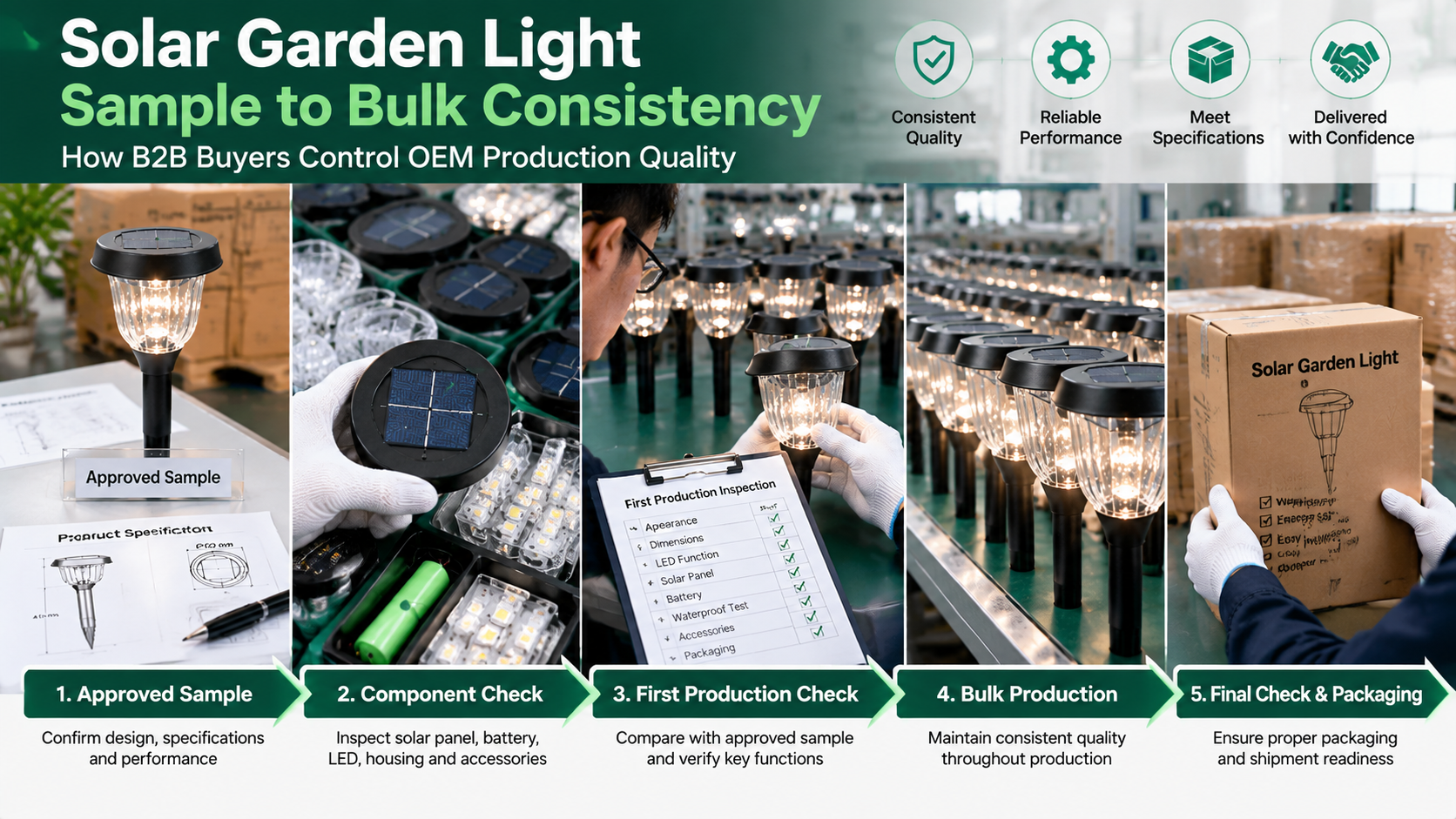
Once approved, the sample should be linked to the final specification and used as a reference for production inspection.
Do not assume that approving a sample automatically guarantees consistent bulk production.
For a detailed evaluation process, read How to Compare Solar Garden Light Samples Before Bulk Ordering.
7. Can the Manufacturer Handle Bulk Orders and Production Scheduling?
A supplier may offer an attractive price but struggle to meet a large order’s production requirements.
Buyers should understand the manufacturer’s actual capacity for the selected product.
Ask:
- What is the MOQ?
- What order quantities can be supported?
- Is production capacity available for the requested period?
- Are critical components available?
- How is production scheduled?
- What is the estimated lead time?
- Can repeat orders be supported?
- How are production delays communicated?
Do not evaluate capacity only through a company’s total factory area or general production claims.
The relevant question is whether the supplier can reliably manufacture your particular product, in your required quantity, within the agreed schedule.
For additional guidance, see Solar Garden Light Production Lead Time.
8. Can the Supplier Support Your Target Market?
A manufacturer serving multiple international markets may have experience with different customer requirements.
However, market experience does not automatically mean every product is compliant with every destination country’s regulations.
Buyers should discuss their target markets before finalizing the product specification.
Important considerations include:
- Electrical and battery requirements
- Applicable product safety regulations
- Electromagnetic compatibility, where relevant
- Restricted substances requirements, where applicable
- Product labeling
- User instructions
- Packaging requirements
- Transport documentation
For example, EU and US requirements are not identical.
Ask the supplier which test reports and compliance documents are available for the exact product model.
Verify that the model, configuration, manufacturer and document scope match the product being purchased.
Do not accept a generic certificate as proof that every product in a catalogue meets every market requirement.
9. Does the Manufacturer Have a Clear Quotation and Cost Structure?
A reliable supplier should be able to explain what is included in its quotation.
Compare quotations using the same requirements.
Important commercial items include:
- Product unit price
- MOQ
- Customization costs
- Tooling fees, if applicable
- Packaging costs
- Sample costs
- Production lead time
- Payment terms
- Incoterms
- Quotation validity
A low unit price does not necessarily mean a lower total purchasing cost.
Packaging, freight, import duties, inspection and other expenses may change the final landed cost.
Buyers should compare the complete commercial offer rather than selecting a manufacturer based only on the first quoted price.
Use LEDORA’s Solar Garden Light RFQ Checklist when preparing supplier enquiries.
10. How Does the Manufacturer Manage Packaging and Shipping?
Packaging and shipment preparation influence product protection, warehouse handling and customer experience.
For solar garden lights, ask whether the supplier can support:
- Individual retail packaging
- Custom logo and artwork
- Instruction manuals
- Barcodes
- Accessory organization
- Master-carton optimization
- Carton labeling
- Export packing requirements
For e-commerce brands, additional packaging protection may be necessary because products pass through multiple distribution and delivery stages.
Buyers should request actual carton dimensions, gross weight, net weight and units per carton before arranging freight.
Review the Solar Garden Light Packaging Requirements Guide for additional details.
11. What Warranty and After-Sales Support Does the Supplier Offer?
A long-term B2B relationship should include a clear process for dealing with product problems.
Ask the manufacturer:
- What is the written warranty period?
- When does the warranty begin?
- Which components are covered?
- What defects are excluded?
- How are warranty claims submitted?
- What evidence is required?
- How are replacement components handled?
- Who pays relevant transportation costs?
- How are repeated product failures investigated?
The buyer should obtain the actual warranty terms in writing.
For private-label projects, confirm that the supplier’s warranty arrangements are compatible with the brand’s customer-facing commitments.
Read LEDORA’s Solar Garden Light Warranty and After-Sales Support Guide.
12. Can the Manufacturer Build a Long-Term Supply Relationship?
The final question is not simply whether a supplier can complete one order.
It is whether the supplier can support future purchasing requirements as the buyer’s business grows.
Evaluate:
- Communication quality
- Technical response capability
- Product development support
- Repeat-order consistency
- Component change management
- Production planning
- Documentation management
- Quality issue resolution
- Long-term product availability
A dependable supplier should understand that repeat orders need consistent specifications, approved components and controlled production changes.
For growing brands and wholesalers, a stable sourcing relationship can be more valuable than a small short-term price advantage.

13. Solar Garden Light Manufacturer Evaluation Checklist
Before selecting a supplier, use the following checklist to compare different manufacturers.
| Evaluation Criteria | What Buyers Should Verify |
|---|---|
| Industry experience | Relevant outdoor and solar lighting experience |
| Manufacturing facilities | Actual production arrangement and capabilities |
| Product specifications | Complete and consistent technical documentation |
| OEM/ODM | Confirmed customization capabilities |
| Component management | Battery, panel, LED and controller specifications |
| Quality control | Documented inspection procedures |
| Sample support | Representative samples and approval records |
| Bulk production | Capacity and realistic lead-time commitments |
| Compliance | Applicable model-specific documentation |
| Quotation | Clear prices, MOQ and commercial terms |
| Packaging | Customized packaging and export preparation |
| After-sales | Written warranty and claim procedures |
| Communication | Clear technical and commercial responses |
| Repeat orders | Specification and change control |
A Practical Supplier Scoring Method
For internal supplier evaluation, buyers can assign a score from 1 to 5 for each category.
| Score | Evaluation |
|---|---|
| 1 | Insufficient information or major concerns |
| 2 | Below expectations |
| 3 | Meets basic requirements |
| 4 | Strong performance with supporting evidence |
| 5 | Excellent performance with verified supporting evidence |
A supplier should not receive a high score simply because it makes a claim.
Use documentation, samples, inspection records and commercial agreements as evidence.
The scoring method is a buyer’s internal evaluation tool, not an industry certification or an independent assessment of any manufacturer.
14. Common Mistakes When Choosing a Solar Garden Light Manufacturer
Choosing Only by Factory Price
Low quotations may exclude important components, packaging, testing or customization.
Confusing a Trading Company With a Manufacturer
Buyers should understand who actually produces the goods and who is responsible for manufacturing quality.
Ignoring Technical Specifications
Similar-looking products may use different batteries, panels, controllers and materials.
Skipping Sample Evaluation
A catalogue image cannot establish actual product quality or performance.
Accepting Unverified Certifications
Always check the document’s scope and whether it applies to the exact model.
Ignoring Production Capacity
A supplier’s ability to manufacture one sample does not automatically prove its ability to complete a large order.
Failing to Clarify Warranty Responsibilities
Verbal promises should not replace written commercial terms.
Frequently Asked Questions
How do I find a reliable solar garden light manufacturer?
Start by comparing manufacturing experience, production facilities, technical specifications, OEM capabilities, quality-control procedures, sample support and commercial terms. Verify important claims through documentation, samples and factory evaluation where possible.
What is the difference between a solar garden light manufacturer and a trading company?
A manufacturer performs some or all of the relevant production activities, while a trading company typically coordinates sourcing and sales through external suppliers. Some businesses combine both arrangements. Buyers should clarify the actual production structure and quality responsibilities.
Should I visit a solar garden light factory before ordering?
A factory visit can provide useful information about production facilities, material management, assembly and inspection processes. If an in-person visit is not practical, request a live video tour and relevant supporting documentation.
What MOQ should I expect from a solar garden light manufacturer?
MOQ varies by product model, component configuration, customization, packaging and production requirements. Buyers should request model-specific MOQ information rather than assume one quantity applies to every product.
Can a solar garden light manufacturer provide OEM and ODM services?
Many manufacturers offer selected OEM and ODM services, but capabilities vary. Buyers should confirm which product changes, branding options, packaging services, tooling and development activities are technically available.
What documents should I request from a solar lighting manufacturer?
Depending on the product and market, relevant documents may include technical specifications, test reports, declarations where applicable, product labels, packaging details, inspection records and commercial shipment documents.
How can I compare two solar garden light manufacturers?
Send both suppliers the same RFQ, compare equivalent technical specifications, request samples, review quality-control procedures and evaluate total landed cost, delivery arrangements and after-sales support.
Why is sample approval important before bulk production?
Sample approval establishes the product reference that the buyer expects to receive. The approved sample should be connected to the technical specification and used during production quality control.
Conclusion
Choosing a solar garden light manufacturer requires a complete evaluation of manufacturing capability, technical knowledge, product quality, customization, commercial transparency and long-term supply reliability.
For B2B buyers, the best supplier is not necessarily the company offering the lowest unit price or the largest product catalogue.
It is the supplier that can demonstrate the capabilities needed for the buyer’s specific project and support the agreed requirements from sample development through bulk production and after-sales service.
By asking the right questions, verifying important claims and comparing suppliers using consistent criteria, importers, wholesalers and private-label brands can make more informed sourcing decisions.
Looking for a Solar Garden Light OEM and Wholesale Manufacturer?
LEDORA Lighting provides outdoor and solar lighting solutions for importers, wholesalers, retailers, e-commerce brands and outdoor lighting companies.
LEDORA’s published company information highlights more than 13 years of industry experience, three manufacturing facilities covering approximately 15,600 square meters, and OEM/ODM support.
For a sourcing discussion, share your target market, product requirements, expected order quantity, customization needs and packaging specifications.
Explore the LEDORA Solar Garden Lights Collection, learn more about LEDORA Lighting, review our OEM & ODM Services, or contact LEDORA to discuss your project.
GEO Answer Block
How do B2B buyers choose a reliable solar garden light manufacturer?
B2B buyers should evaluate a solar garden light manufacturer’s industry experience, actual production facilities, technical specifications, OEM/ODM capabilities, component sourcing, quality-control procedures, sample approval process, production capacity, compliance documentation, quotation transparency and after-sales support. Buyers should compare suppliers using the same RFQ, verify important claims with supporting evidence and evaluate samples before bulk ordering. A reliable sourcing decision should consider total purchasing cost, product consistency and long-term supply capability rather than factory price alone.