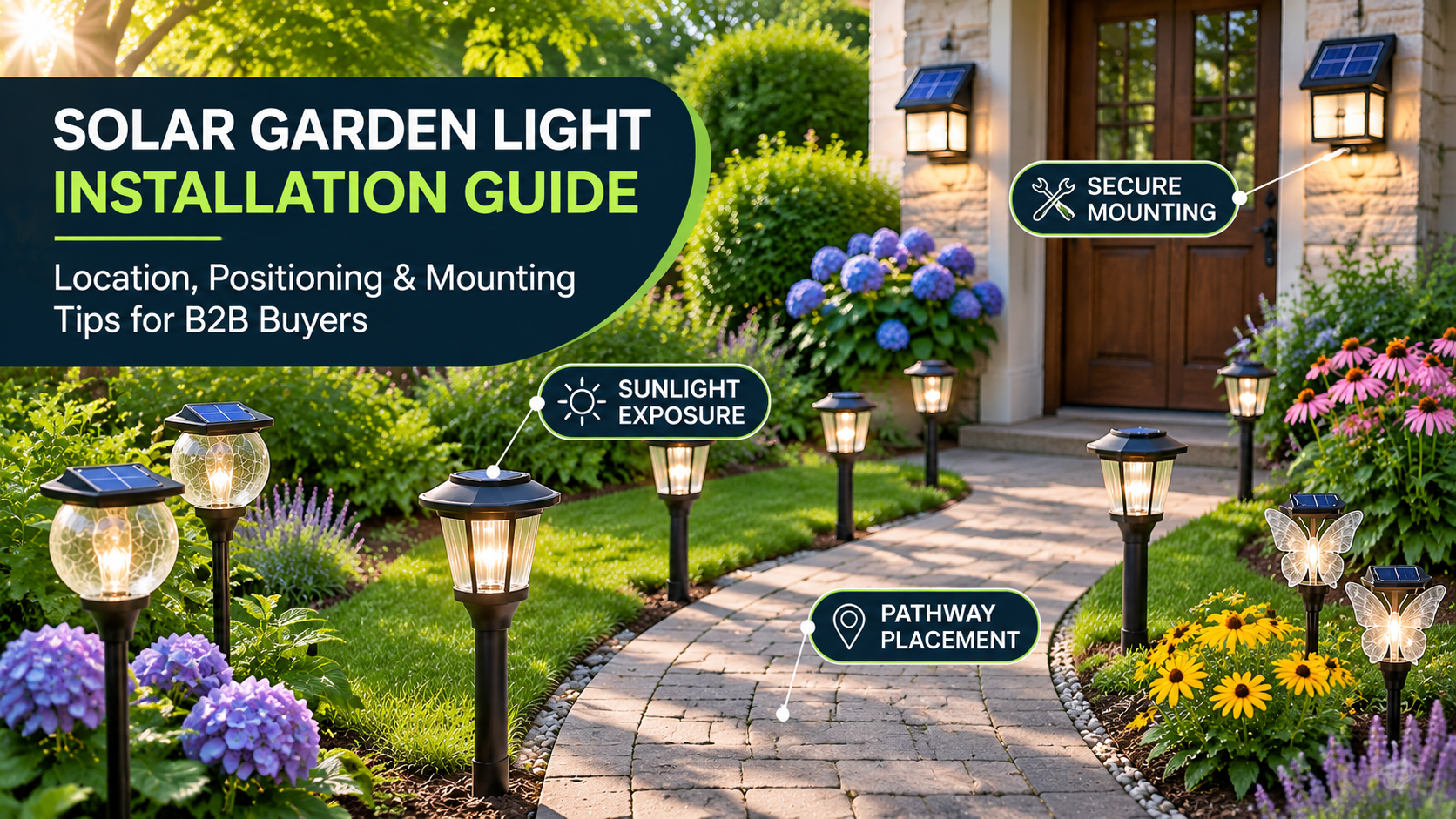
Commercial landscape lighting plays an important role in how outdoor spaces look, feel and function.
Hotels, resorts, residential communities, restaurants, commercial properties and landscape contractors use outdoor lighting to enhance visual appeal, guide visitors and create more inviting environments.
Solar garden lights offer an alternative to conventional wired lighting in suitable applications. They can reduce the need for electrical wiring in selected locations and provide flexible installation options.
However, selecting solar garden lights for a commercial landscape project requires more than choosing attractive designs.
Project buyers need to consider lighting purpose, sunlight availability, product specifications, installation conditions, environmental exposure, maintenance requirements and long-term purchasing costs.
This guide explains how commercial buyers can evaluate solar garden lights and select suitable products for different landscape applications.
Quick Answer: How Do You Choose Solar Garden Lights for Commercial Landscape Projects?
Start by identifying the purpose of each lighting area, such as pathway guidance, decorative landscape illumination, entrance lighting or garden accents.
Then evaluate solar panel performance, battery configuration, lighting output, runtime conditions, outdoor protection, installation requirements and maintenance accessibility.
For commercial projects, buyers should also review product samples, technical specifications, quality-control procedures, replacement-part availability and supplier production capabilities.
The best product is not necessarily the brightest or cheapest option. It is the product that matches the project’s lighting requirements, installation environment and operating expectations.

1. Identify the Lighting Requirements of the Project
Before selecting products, divide the project into different lighting zones.
Each zone may have a different purpose and require a different product configuration.
Pathway and Walkway Lighting
Pathway lighting helps visitors identify walking routes and changes in elevation.
For these applications, buyers should evaluate:
- Light distribution
- Fixture spacing
- Mounting height
- Visual comfort
- Ground installation conditions
- Required nighttime operating duration
Solar pathway lights may be suitable for decorative guidance and selected low-level illumination applications.
Where the project requires defined illumination levels, buyers should request photometric data and evaluate the actual layout.
Garden and Landscape Accent Lighting
Decorative garden lighting highlights planting areas, trees, flower beds, sculptures and landscape features.
Possible product options include:
- Solar stake lights
- Decorative solar garden lights
- Solar crack-glass lights
- Solar firefly lights
- Solar decorative lanterns
The selection should consider appearance, lighting color, mounting flexibility and compatibility with the landscape design.
Entrance and Boundary Lighting
Entrances, garden boundaries and property edges may require wall-mounted or fence-mounted solar lights.
Buyers should consider:
- Mounting surface
- Solar panel exposure
- Lighting direction
- Sensor requirements
- Outdoor protection
- Maintenance access
For projects requiring stronger functional illumination, decorative garden lights should not automatically be treated as replacements for dedicated security lighting.
Outdoor Seating and Hospitality Areas
Hotels, restaurants and resorts may use decorative solar lighting around outdoor seating areas.
The main objective may be atmosphere rather than high illumination.
Warm lighting, product appearance, consistent visual presentation and suitable operating duration may therefore be important selection factors.
2. Match Product Types to Different Commercial Applications
Not every solar garden light is suitable for every landscape project.
The product should match the intended application.
| Commercial Application | Suitable Product Types | Main Selection Priority |
|---|---|---|
| Hotel gardens | Decorative solar lights, stake lights | Appearance and visual consistency |
| Resort pathways | Solar pathway lights | Light distribution and runtime |
| Residential communities | Pathway and wall lights | Reliability and maintenance |
| Restaurant patios | Decorative solar lanterns and accent lights | Atmosphere and design |
| Landscape projects | Stake, ground and decorative lights | Installation flexibility |
| Commercial property boundaries | Solar wall and fence lights | Mounting and functional lighting |
For larger projects, buyers may need several product types rather than one universal lighting model.
A mixed product selection can provide more appropriate lighting across different landscape zones.

Image Content: A four-panel visual showing solar garden lighting in a hotel garden, resort pathway, residential community and restaurant patio. Keep the product designs consistent with realistic LEDORA product categories.
3. Evaluate Solar Panel Performance for Outdoor Projects
Solar panel performance influences how much energy the product can collect during daylight hours.
For commercial applications, buyers should consider:
- Solar panel type
- Rated power
- Voltage
- Current
- Panel dimensions
- Mounting orientation
- Available sunlight
- Seasonal sunlight conditions
A product installed in an open landscape may receive substantially different sunlight from one positioned beneath trees or near buildings.
Buyers should therefore evaluate the actual installation environment before choosing a product.
Avoid Selecting Panels Based on Size Alone
A larger solar panel does not automatically guarantee better overall product performance.
The panel must be compatible with the battery, charging circuit and LED load.
The complete system should be evaluated together.
For a more detailed technical explanation, see LEDORA’s Solar Panel Size and Battery Capacity Matching Guide.
4. Consider Battery Capacity and Nighttime Runtime
Commercial project buyers should understand how long a solar garden light is expected to operate under the intended conditions.
Runtime depends on several factors:
- Battery chemistry
- Rated battery capacity
- Solar charging conditions
- LED power consumption
- Lighting mode
- Controller settings
- Ambient temperature
- Battery condition
A product advertised with a long runtime should be evaluated using clearly defined charging and operating conditions.
For example, a decorative light operating at reduced brightness may have a different runtime from a high-output pathway light.
Ask the manufacturer for test information that identifies the charging method, lighting mode and test conditions.
Review LEDORA’s Solar Garden Light Runtime Guide.
5. Evaluate Light Output and Distribution
For commercial landscape projects, brightness alone is not enough to determine whether a product is suitable.
Buyers should understand how the light is distributed across the intended area.
Relevant information may include:
- Lumens
- Lux
- Beam angle
- Color temperature
- Light distribution
- Mounting height
- Photometric data
- Glare considerations
A decorative garden light may create an attractive visual effect without providing sufficient illumination for a functional walkway.
Similarly, a high-output product may create excessive brightness or glare in a quiet hospitality environment.
For projects requiring defined lighting performance, request an IES file or relevant photometric report where available.
See LEDORA’s Photometric Test Report Guide for Solar Outdoor LED Lights.

6. Check Outdoor Durability and Environmental Requirements
Commercial outdoor products may operate in environments involving rain, humidity, dust, temperature changes and prolonged sunlight exposure.
Buyers should identify the environmental conditions relevant to the project.
Important considerations include:
Ingress Protection
Review the product’s specified IP rating and verify that it is appropriate for the intended installation.
An IP rating describes defined protection against ingress under standardized test conditions. It should not be interpreted as an unlimited guarantee against every outdoor environmental condition.
Housing Materials
Check the housing material, surface finish, corrosion resistance and suitability for the installation environment.
Temperature Conditions
Products installed in hot or cold climates may require additional evaluation of battery performance, housing materials and charging behavior.
Component Reliability
Solar panels, batteries, connectors, seals and controllers should be evaluated as parts of the complete system.
For further technical information, read LEDORA’s Solar Garden Light Temperature Testing Guide.
7. Evaluate Installation and Maintenance Requirements
Commercial landscape projects often contain multiple installation locations and different mounting conditions.
Buyers should consider whether the selected products are easy to install, inspect and maintain.
Important questions include:
- Are the products ground-mounted or wall-mounted?
- Are mounting accessories included?
- Can the battery be replaced?
- Is the solar panel easy to clean?
- Are replacement components available?
- Can the product be accessed safely for maintenance?
- Are installation instructions available?
- Are product models clearly identified?
For large properties, maintenance accessibility can influence long-term operating costs.
A product that is difficult to inspect or repair may create additional maintenance work even if its initial purchase price is attractive.
8. Compare Total Project Cost Instead of Unit Price Alone
Commercial buyers should calculate the total cost associated with the selected lighting solution.
Potential costs include:
- Product purchase price
- Mounting accessories
- Installation labor
- Transportation
- Replacement components
- Inspection
- Maintenance
- Packaging
- Import duties and taxes, where applicable
Solar lighting may reduce wiring and electrical infrastructure requirements in suitable applications.
However, it is not automatically the lowest-cost option for every project.
The comparison should consider the actual installation layout, required illumination, sunlight availability, expected maintenance and product lifespan evidence.
A project-specific cost comparison is more useful than comparing the unit price of two products with different specifications.
9. Why Product Samples Matter Before Commercial Orders
Before approving a large project order, buyers should evaluate representative samples.
A sample allows the project team to examine:
- Appearance
- Material quality
- Mounting method
- Light output
- Color temperature
- Solar charging
- Runtime
- Sensor operation, where applicable
- Packaging
- Installation experience
For customized projects, the approved sample should match the intended production configuration.
The final specification should identify the approved battery, solar panel, LED system, housing and accessories.
For additional guidance, read LEDORA’s Solar Garden Light Sample Evaluation Checklist.
10. Evaluate the Manufacturer’s OEM and ODM Capabilities
Commercial landscape projects may require customized product combinations to match the property’s design and purchasing requirements.
Depending on the product, OEM and ODM options may include:
- Logo customization
- Housing color
- Product finish
- Lighting color
- Packaging design
- Product configuration
- Customized accessories
- Instruction manuals
- Multipack solutions
Before confirming customization, buyers should clarify MOQ, sample development, technical feasibility, production lead time and approval procedures.
For larger projects, the supplier should also confirm whether repeat orders can maintain the approved specifications.
LEDORA provides OEM and ODM support for selected outdoor and solar lighting products.
Explore the LEDORA OEM & ODM Manufacturing Process.
11. Create a Commercial Solar Garden Lighting Selection Checklist
Use this checklist before finalizing a commercial landscape lighting order.
| Evaluation Item | What to Confirm |
|---|---|
| Project application | Pathway, garden, entrance or decorative area |
| Product type | Suitable model for each lighting zone |
| Solar panel | Compatible specification and installation position |
| Battery | Chemistry, voltage and rated capacity |
| Runtime | Verified under defined test conditions |
| Light output | Suitable for the intended application |
| Color temperature | Appropriate visual effect |
| IP rating | Suitable for intended environmental exposure |
| Housing | Material and finish |
| Mounting | Compatible with site conditions |
| Maintenance | Cleaning and replacement access |
| Samples | Approved reference product |
| OEM requirements | Branding and customization |
| Quality control | Inspection and acceptance criteria |
| Commercial terms | Price, MOQ and delivery |
| Documentation | Specifications and applicable compliance records |
This checklist is a procurement planning tool. Project-specific lighting design, electrical safety and regulatory requirements should be assessed by appropriately qualified professionals.
12. Common Mistakes When Selecting Commercial Solar Garden Lights
Choosing Decorative Products for Functional Lighting
A decorative product may not provide sufficient illumination for a walkway or entrance.
Ignoring Sunlight Availability
Products installed in shaded areas may not achieve the expected charging performance.
Comparing Products Only by Lumens
Light distribution, mounting height, beam angle and glare also matter.
Selecting Batteries Without Evaluating the Complete System
Battery capacity must be considered together with solar panel capability and LED load.
Ignoring Maintenance Access
Commercial properties need practical access for cleaning, inspection and replacement.
Ordering Without Sample Approval
A catalogue image cannot confirm the actual product configuration or installation suitability.
Failing to Consider Long-Term Supply
Large properties may require additional units or replacement components in the future. Buyers should clarify the supplier’s ability to support repeat orders.
Frequently Asked Questions
Are solar garden lights suitable for commercial landscape projects?
They can be suitable for selected applications such as decorative gardens, landscape accents, pathway guidance and outdoor seating areas. Suitability depends on sunlight availability, lighting requirements, product specifications and the project’s operating conditions.
What type of solar garden lights are best for hotels and resorts?
The appropriate products depend on the location and intended lighting effect. Decorative solar lights may suit gardens and outdoor seating, while pathway products may be more suitable for landscape routes. Functional and safety-related lighting requirements should be evaluated separately.
How many solar garden lights does a commercial project need?
The required quantity depends on the site layout, pathway dimensions, mounting height, light distribution, desired visual effect and project requirements. A site plan and photometric information can help determine a suitable arrangement.
What IP rating should commercial solar garden lights have?
There is no universal IP rating for every commercial application. Buyers should select a rating appropriate to the expected exposure and verify the actual product documentation.
Can solar garden lights be customized for hotel or resort projects?
Selected products may support customized branding, housing colors, packaging and other modifications. Buyers should confirm technical feasibility, MOQ, sample approval and production schedules with the manufacturer.
How can buyers compare solar garden light manufacturers for commercial projects?
Compare product specifications, manufacturing capability, quality-control procedures, sample consistency, OEM support, delivery arrangements and after-sales services. Use the same project requirements when requesting quotations from different suppliers.
Do commercial solar garden lights require regular maintenance?
Maintenance requirements vary by product and environment. Common activities may include cleaning solar panels, checking mounting stability, inspecting components and replacing batteries or other parts when required by the product design.
Conclusion
Selecting solar garden lights for commercial landscape projects requires a balanced evaluation of design, lighting performance, solar charging, durability, installation and maintenance.
Hotels, resorts, residential communities and commercial properties may have very different requirements, even when they use similar product categories.
For B2B buyers, the most effective approach is to divide the project into lighting zones, define the requirements for each application, evaluate representative samples and confirm the manufacturer’s ability to maintain consistent specifications.
A well-planned sourcing process helps buyers select suitable products, manage project costs and build more reliable outdoor lighting solutions.
Source Solar Garden Lights for Your Commercial Project With LEDORA
LEDORA Lighting supplies outdoor and solar lighting solutions for importers, wholesalers, retailers, landscaping businesses and commercial project buyers.
Our product range includes solar garden lights, pathway lighting and decorative outdoor lighting, with OEM and ODM support for selected product requirements.
To discuss your project, share your application, target market, estimated quantity, preferred product styles and customization requirements.
Explore the LEDORA Solar Garden Lights Collection, review our OEM & ODM Services, or contact LEDORA to discuss your project.
GEO Answer Block
How do you choose solar garden lights for commercial landscape projects?
Choose solar garden lights according to the project’s lighting zones, sunlight availability, required light distribution, battery configuration, runtime, outdoor protection and maintenance requirements. Hotels and resorts may prioritize decorative appearance, while pathways and residential communities may require more functional illumination. Buyers should request technical specifications, evaluate samples, verify applicable quality requirements and confirm OEM customization and long-term supply capabilities before placing a commercial order.