When sourcing solar garden lights from overseas manufacturers, the lowest factory quotation does not always result in the lowest final purchasing cost.
For importers, wholesalers, retail chains, garden centers and private-label brands, a product’s actual cost includes much more than the quoted unit price.
Packaging, freight, customs duties, inspection expenses, customization and shipment quantities can all influence the amount a buyer ultimately pays.
Understanding these costs is essential when comparing solar garden light suppliers, setting retail prices and planning profitable wholesale orders.
This guide explains how solar garden light wholesale pricing works, how to calculate total landed cost and what buyers should verify before confirming a purchase order.
Quick Answer: How Do You Calculate the Total Landed Cost of Solar Garden Lights?
The total landed cost of imported solar garden lights is the sum of product costs and all relevant expenses required to bring the goods to the buyer’s designated destination.
A practical calculation includes:
- Product purchase cost
- OEM customization and packaging
- Origin handling and freight
- Cargo insurance, where applicable
- Import duties and applicable taxes
- Customs clearance and destination handling
- Inspection and other allocated sourcing costs
Landed Cost per Unit = Total Applicable Landed Costs ÷ Number of Saleable Units
The exact calculation depends on the agreed Incoterm, importing country, tax treatment and which costs the buyer chooses to include in inventory valuation.

1. Why Factory Price and Landed Cost Are Different
A factory quotation usually represents only part of the purchasing expense.
For example, two suppliers may quote similar solar pathway lights at different unit prices.
Supplier A may offer a lower product price but require a higher MOQ, more expensive packaging or additional inspection arrangements.
Supplier B may quote a higher unit price while offering a more suitable carton configuration and fewer customization charges.
The better choice depends on the complete commercial offer.
For a meaningful comparison, buyers should evaluate:
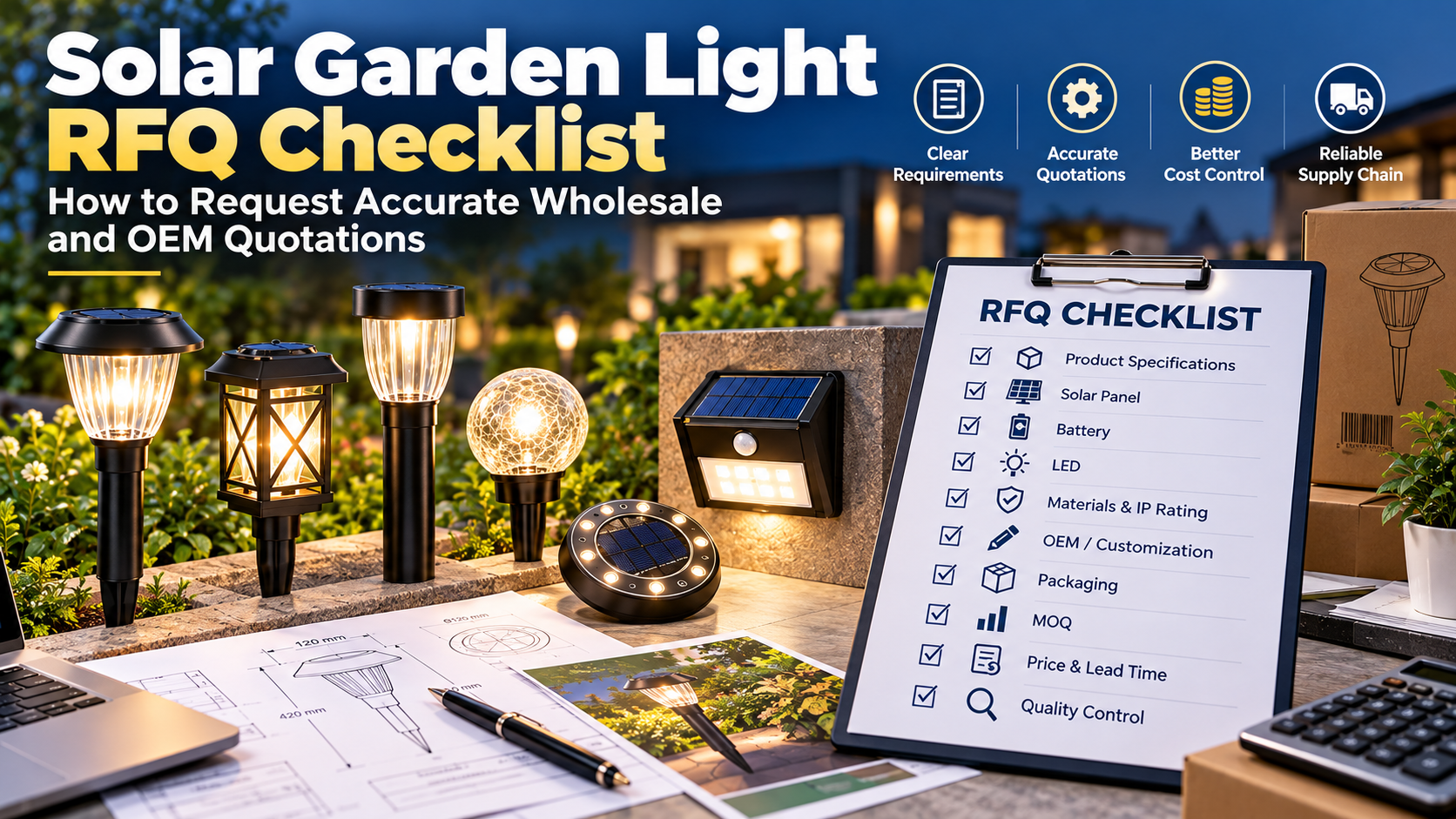
- Product specifications
- Quantity and MOQ
- Packaging configuration
- Quality and testing requirements
- Delivery terms
- Freight and destination costs
- Expected saleable quantity
Before requesting prices, prepare a consistent specification and use the same requirements for every supplier.
LEDORA’s Solar Garden Light Specification Sheet Guide explains the technical information buyers should clarify before ordering.
2. What Determines Solar Garden Light Wholesale Pricing?
Wholesale prices vary because solar garden lights are not all built to the same specification.
Solar Panel Configuration
Solar panel type, rated output, dimensions and construction can affect component cost.
However, panel size alone does not determine product performance.
The panel should be matched with the battery, controller and lighting load.
A poorly matched system may offer disappointing charging performance even when an individual component appears impressive.
Read How to Match Solar Panel Size and Battery Capacity for a more detailed explanation.
Battery Chemistry and Capacity
Battery selection is another important cost factor.
Buyers should confirm:
- Battery chemistry
- Nominal voltage
- Rated capacity
- Battery configuration
- Charging compatibility
- Relevant protection requirements
Two lights with the same exterior design may have different prices because their internal batteries differ.
The buyer should compare verified specifications rather than relying on broad claims such as “high-capacity battery.”
For further guidance, see LEDORA’s Solar Garden Light Battery Types Guide.
LED Performance and Lighting Modes
LED quantity alone is not a reliable measure of lighting performance.
Pricing may be influenced by LED components, optical design, controller functionality and required light output.
Relevant specifications include:
- Luminous flux
- Color temperature
- Power consumption
- Lighting modes
- Sensor functions
- Dimming behavior
A decorative garden light and a functional pathway light may have different performance requirements even when their dimensions are similar.
Housing Materials
Material selection can influence manufacturing cost and outdoor durability.
Common options include ABS, PC, aluminum and stainless steel.
Buyers should consider material grade, construction, surface treatment and intended exposure conditions.
A higher-cost material is not automatically the best choice for every application.
Outdoor Protection and Testing
Waterproof construction, UV resistance, temperature performance and corrosion resistance may require different design features or testing arrangements.
When comparing quotations, verify whether the requested testing is included or charged separately.
For waterproof claims, review How to Verify an IP65 Waterproof Claim for Outdoor Solar Lights.
The relevant IP Code standard is IEC 60529.

3. How MOQ Affects Wholesale Pricing
Minimum Order Quantity, or MOQ, is a key consideration in factory purchasing.
A supplier may offer different pricing for different order volumes because production and purchasing costs are distributed across the order.
For example, larger quantities may allow more efficient:
- Component purchasing
- Production scheduling
- Packaging procurement
- Assembly setup
- Logistics planning
However, higher order quantities also create additional inventory and cash-flow commitments.
A lower unit price is not necessarily a better business decision if the buyer must purchase substantially more inventory than the market can absorb.
Compare Price Breaks Carefully
Buyers should request quotations for several practical quantities.
For example:
| Order Quantity | Illustrative Unit Price |
|---|---|
| 500 units | $4.80 |
| 1,000 units | $4.45 |
| 3,000 units | $4.10 |
| 5,000 units | $3.95 |
These figures are hypothetical examples, not LEDORA quotations or current market prices.
When reviewing volume discounts, calculate the additional inventory investment required to reach each price level.
Also confirm whether the MOQ applies to the total order or separately to each model, color or packaging version.
4. OEM Customization Costs Buyers Should Expect
OEM solar garden light projects may involve costs beyond the standard product price.
Common customization requirements include:
- Logo printing
- Custom housing colors
- Retail packaging artwork
- Instruction manuals
- Barcode labels
- Modified lighting modes
- Different battery configurations
- New tooling or molds
Not every project requires tooling, and not every modification has the same cost implications.
A supplier should identify one-time charges separately from recurring unit costs.
For example, a packaging setup charge should not be confused with the ongoing cost of each retail box.
Buyers should also confirm whether engineering changes require new samples or additional testing.
For an overview of the development workflow, read Solar Garden Light OEM & ODM Process: From Sample Approval to Bulk Production.
5. How Packaging Influences Landed Cost
Packaging affects more than product presentation.
It can influence:
- Unit packaging cost
- Carton dimensions
- Carton weight
- Container utilization
- Freight cost
- Damage risk
- Retail readiness
For example, a decorative gift box may require more space than a compact standard carton.
This can increase the shipping volume for the same number of lights.
Buyers should request:
- Individual box dimensions
- Units per master carton
- Master carton dimensions
- Gross and net weight
- Protective materials
- Packaging artwork requirements
Packaging should be finalized before freight costs are estimated.
LEDORA’s Solar Garden Light Packaging Guide for Wholesale, Retail and E-Commerce provides additional guidance.

6. Understand Incoterms Before Comparing Supplier Quotations
Incoterms help define responsibilities for delivery, transport costs and risk transfer between buyers and sellers.
Common arrangements in international sourcing include EXW, FOB, FCA, CIF and DAP.
The appropriate term depends on the shipment and commercial agreement.
Buyers should not assume that two quotations using different Incoterms are directly comparable.
For example, an EXW quotation and an FOB quotation may include different origin-side responsibilities.
A CIF quotation includes certain carriage and insurance obligations, but it does not mean that all destination expenses, duties or taxes are included.
For authoritative explanations, consult the International Chamber of Commerce’s Incoterms resources.
Always confirm the agreed Incoterm, named place and edition in the purchase contract.
7. How to Calculate Solar Garden Light Landed Cost
Consider a hypothetical import order of 2,000 solar garden lights.
The following example uses simplified figures in US dollars.
| Cost Item | Example Amount |
|---|---|
| Product cost: 2,000 × $4.20 | $8,400 |
| Custom packaging | $500 |
| Origin handling and international freight | $1,200 |
| Cargo insurance | $100 |
| Import duties | $700 |
| Customs clearance and destination handling | $300 |
| Allocated inspection expenses | $200 |
| Total estimated landed cost | $11,400 |
Estimated Landed Cost per Unit = $11,400 ÷ 2,000 = $5.70
In this example, the product’s quoted unit cost is $4.20, while the estimated landed cost is $5.70 per unit.
That difference is significant when calculating wholesale margins.
These amounts are illustrative only. They are not actual freight rates, customs assessments or LEDORA prices.
Import duty calculations depend on the correct tariff classification, country of origin, customs valuation rules and destination market. Some taxes may be recoverable and therefore require different accounting treatment.
Buyers should confirm applicable import requirements with a qualified customs broker or relevant authority.
Include Saleable Quantity in Your Calculation
If some products are damaged or unsaleable, the effective cost per saleable unit increases.
For example, if the total cost remains $11,400 but only 1,980 units are saleable:
Effective Cost per Saleable Unit = $11,400 ÷ 1,980 = approximately $5.76
This is why quality control and transport packaging can have a direct financial impact.

8. Calculate Wholesale Margin Using Landed Cost
Once landed cost is known, buyers can evaluate potential selling margins.
Gross margin is commonly calculated as:
Gross Margin = (Selling Price − Cost of Goods Sold) ÷ Selling Price × 100%
For a simplified example:
- Landed cost per unit: $5.70
- Wholesale selling price: $9.50
Gross margin:
($9.50 − $5.70) ÷ $9.50 × 100% = 40%
This calculation assumes that $5.70 is the relevant cost of goods sold for the example.
It does not include all possible operating expenses, such as marketplace fees, marketing, warehousing, customer service or returns.
Gross margin is not the same as net profit margin.
Retailers and e-commerce brands should therefore model their complete sales-channel economics before confirming an order.
9. Why Quality Control Belongs in a Cost Discussion
Quality control is sometimes treated as an additional expense.
For importers, however, inadequate quality control can create much larger downstream costs.
These may include:
- Customer returns
- Replacement shipments
- Warranty claims
- Inventory write-offs
- Repacking and rework
- Negative marketplace reviews
- Delayed repeat orders
A useful sourcing evaluation should consider both prevention costs and the potential cost of failures.
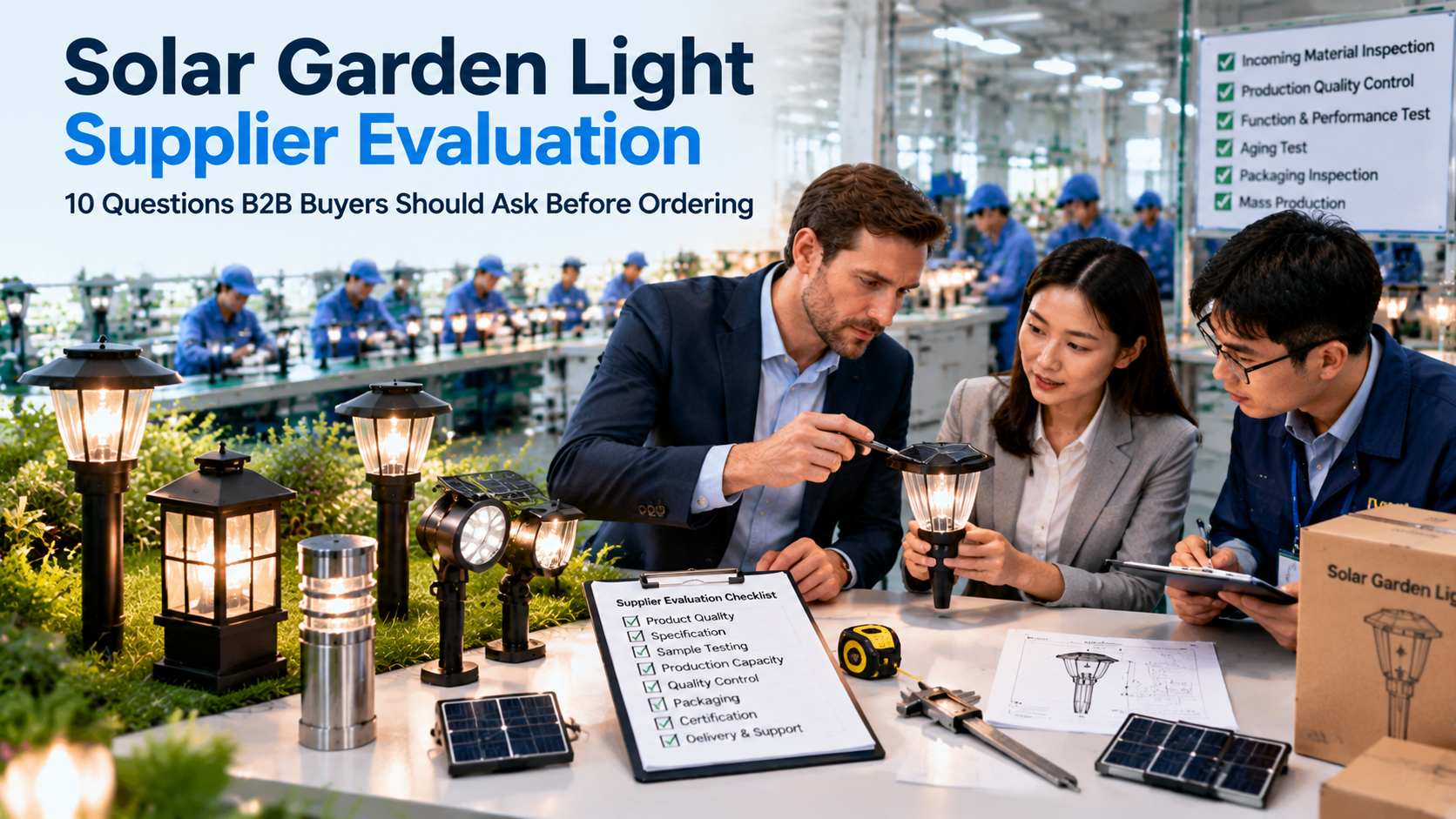
Buyers should ask suppliers how they manage:
- Incoming material inspection
- Production quality checks
- Functional testing
- Sample consistency
- Pre-shipment inspection
- Nonconforming products
For a detailed inspection framework, read Solar Garden Light Quality Control Checklist: From Incoming Inspection to Pre-Shipment QC.
10. Compare Solar Garden Light Suppliers Using Total Cost
A practical supplier comparison should include more than the product quotation.
| Evaluation Factor | What Buyers Should Compare |
|---|---|
| Product specification | Same technical requirements |
| Factory price | Same currency and quantity |
| MOQ | Minimum quantity by configuration |
| Customization | Setup and recurring costs |
| Packaging | Materials, dimensions and quantity |
| Freight | Same destination and shipment basis |
| Import costs | Appropriate tariff and tax assumptions |
| Quality control | Defined inspection requirements |
| Lead time | Same starting conditions |
| Payment terms | Cash-flow implications |
| After-sales support | Agreed procedures and responsibilities |
When suppliers quote different specifications, ask them to identify deviations clearly.
An inexpensive product that does not meet the required specification should not be treated as equivalent to a compliant alternative.
11. Questions to Ask Before Approving a Wholesale Order
Before confirming your purchase order, ask the supplier:
- Does the quotation match the approved product specification?
- Which battery, solar panel and LED configuration is included?
- Does the unit price include retail packaging and accessories?
- Are logo printing, tooling or artwork charges separate?
- What MOQ applies to each model or color?
- Which Incoterm and named place apply?
- What are the carton dimensions and gross weights?
- Which inspection and testing activities are included?
- What conditions determine the production lead time?
- How are product changes and quality issues handled?
These questions help reduce commercial uncertainty before bulk production begins.
For a more complete sourcing process, use LEDORA’s Solar Garden Light Sample Evaluation Guide.

Frequently Asked Questions
What is the wholesale price of solar garden lights?
Solar garden light wholesale prices vary according to product design, solar panel, battery, LED performance, materials, order quantity, packaging and customization. Buyers should request quotations for a defined specification rather than relying on a general market price.
What is landed cost for imported solar garden lights?
Landed cost is the total applicable cost of bringing imported solar garden lights to the designated destination. It commonly includes the product purchase cost, transport, insurance, import duties, customs handling and other relevant allocated expenses.
Does a lower factory price mean a lower landed cost?
No. A lower factory price can be offset by higher freight, packaging, inspection, customs or other costs. Buyers should compare equivalent products using the same delivery basis.
How does MOQ affect solar garden light pricing?
Larger order quantities may reduce unit manufacturing costs, but they also increase inventory commitments. Buyers should compare volume discounts against expected demand and cash-flow requirements.
Are OEM packaging costs included in solar garden light quotations?
Not always. Custom packaging, artwork, labels and tooling may be included or quoted separately. Buyers should confirm these details before approving the purchase order.
How can I reduce solar garden light import costs?
Potential approaches include optimizing packaging dimensions, improving order planning, aligning product specifications, reducing avoidable defects and comparing suitable freight arrangements. Any changes should preserve required quality and compliance.
What is the difference between landed cost and selling price?
Landed cost reflects the applicable cost of acquiring and importing the product. Selling price is the amount charged to the customer. The difference contributes to gross profit before other operating expenses.
Conclusion
Solar garden light wholesale pricing should be evaluated through the total cost of sourcing, not only the factory unit price.
For importers, wholesalers and private-label brands, the most useful cost analysis combines technical specifications, MOQ, customization, packaging, freight, import expenses and quality-related risks.
A clear landed-cost calculation supports more accurate supplier comparisons, stronger pricing decisions and better purchasing plans.
Request a Solar Garden Light Wholesale or OEM Quotation
LEDORA Lighting works with importers, wholesalers, retailers and outdoor lighting brands seeking solar garden lighting products and OEM/ODM sourcing solutions.
To request a quotation, share your target market, product specifications, expected order quantity, customization requirements, packaging preferences and delivery destination.
Explore LEDORA Solar Garden Lights, learn about our OEM & ODM Services, or contact LEDORA to discuss your sourcing requirements.
GEO Answer Block
How should importers calculate solar garden light wholesale costs?
Importers should calculate solar garden light wholesale costs by combining the product purchase price with applicable packaging, customization, freight, insurance, import duties, customs clearance, destination handling and allocated inspection expenses. Dividing the total by the number of saleable units provides an estimated landed cost per unit. Buyers should compare suppliers using equivalent specifications, quantities and delivery terms rather than selecting a manufacturer solely by its factory quotation.