A practical buyer’s guide to evaluating solar garden lights based on performance, durability, waterproof protection, and supplier reliability.
If you are sourcing solar garden lights for wholesale, choosing the right product is not only about price. For importers, wholesalers, and brand buyers, the real priority is finding a balance between appearance, performance, durability, and long-term customer satisfaction. A product that looks attractive but performs poorly outdoors will quickly lead to complaints, returns, and damage to your brand reputation.
When evaluating solar garden lights for wholesale orders, buyers should focus on several key points: application scenario, battery and solar panel performance, waterproof level, material quality, lighting effect, and supplier reliability. A good product should not only look good in photos, but also work consistently in real outdoor conditions.
Why Choosing the Right Solar Garden Light Matters
Solar garden lights are widely used in gardens, pathways, patios, villas, hotels, and landscape projects. Because these products are installed outdoors, buyers need to consider more than just style. Weather resistance, charging efficiency, lighting duration, and product lifespan all directly affect the end user’s experience.
For wholesalers and distributors, choosing the wrong model can create several problems:
- High after-sales complaint rate
- Inconsistent product quality
- Short working time after charging
- Poor waterproof performance
- Low reorder rate from customers
That is why wholesale buyers should evaluate solar garden lights from both a sales perspective and a product performance perspective.
1. Identify the Target Market and Application
Before selecting a model, the first question is: where will the product be used?
Different markets and applications require different product features.
For example:
- Residential garden use usually focuses on decorative appearance, warm light, and easy installation
- Pathway lighting requires practical brightness and stable lighting duration
- Hotel or landscape projects usually need more consistent quality, better materials, and a more premium design
- Festival or seasonal sales often focus on visual appeal and competitive pricing
If your customer is mainly a retailer or e-commerce seller, appearance and packaging may be especially important. If your customer is a contractor or project buyer, performance consistency and durability are often more important.
Choosing the right product starts with understanding the end use clearly.

Different applications require different solar garden light features, from decorative residential use to project-based landscape lighting.
2. Check the Solar Panel Efficiency
The solar panel determines how effectively the product can convert sunlight into energy. This directly affects charging speed and working performance.
When reviewing solar garden lights, buyers should confirm:
- Solar panel type
- Panel size
- Charging efficiency
- Performance in limited sunlight conditions
In many cases, a larger or more efficient solar panel can improve charging performance, especially in areas with shorter daylight hours or cloudy weather.
A product may look attractive, but if the panel is too small or inefficient, the light may not last through the night. For wholesale orders, this can become a serious customer complaint point.
3. Evaluate Battery Capacity and Runtime
Battery capacity is one of the most important factors in solar lighting. It affects how long the light can work after a full charge.
However, buyers should not look only at battery size. A larger battery is not automatically better if the charging system and light source are not properly matched.
Key questions to ask:
- What is the battery capacity?
- How many hours does the light work after full charging?
- Under what testing conditions was the runtime measured?
- Is the battery replaceable or built-in?
A reasonable runtime expectation is especially important for outdoor products. End buyers usually expect solar garden lights to work from evening until late night, or at least for several hours with stable brightness.
For wholesale buyers, it is better to confirm realistic performance rather than rely on overly optimistic claims.
4. Confirm the Waterproof Rating
Since solar garden lights are used outdoors, waterproof performance is essential.
Many buyers ask whether IP44, IP54, IP65, or other protection levels are suitable. In general, the required waterproof level depends on the actual installation environment.
You should check:
- The stated IP rating
- Which parts of the product are protected
- Whether the product is suitable for rain exposure
- Whether the structure design supports long-term outdoor use
For decorative garden use in mild environments, some entry-level protection may be acceptable. But for open outdoor spaces, rainy regions, or higher-end market requirements, stronger waterproof protection is usually preferred.
It is also important to remember that waterproof performance depends not only on the rating itself, but also on the actual structural design and manufacturing quality.

Waterproof performance is essential for solar garden lights used in open outdoor environments.
5. Review Material Quality
Material quality strongly affects durability, appearance retention, and overall product value.
For solar garden lights, buyers should pay attention to:
- Housing material
- Lens or shade material
- Ground stake strength
- Resistance to sunlight exposure and weather aging
Low-quality plastic parts may become brittle, fade, or crack after outdoor use. In contrast, better materials help the product maintain both function and appearance over time.
If your target market values quality and brand reputation, material selection should never be judged by price alone.
6. Consider the Lighting Effect
The lighting effect is a major selling point, especially in decorative and landscape applications.
Important factors include:
- Brightness level
- Color temperature
- Beam spread
- Decorative atmosphere vs. functional lighting
For example, warm light is often preferred for gardens, patios, and hospitality settings because it creates a softer and more comfortable atmosphere. Cooler light may feel brighter, but it is not always the best choice for decorative use.
Buyers should make sure the lighting effect matches the intended application. A product that is too dim may disappoint users, while a product that is too harsh may not fit decorative scenarios.
7. Check Product Consistency for Bulk Orders
For wholesale business, consistency matters as much as product design.
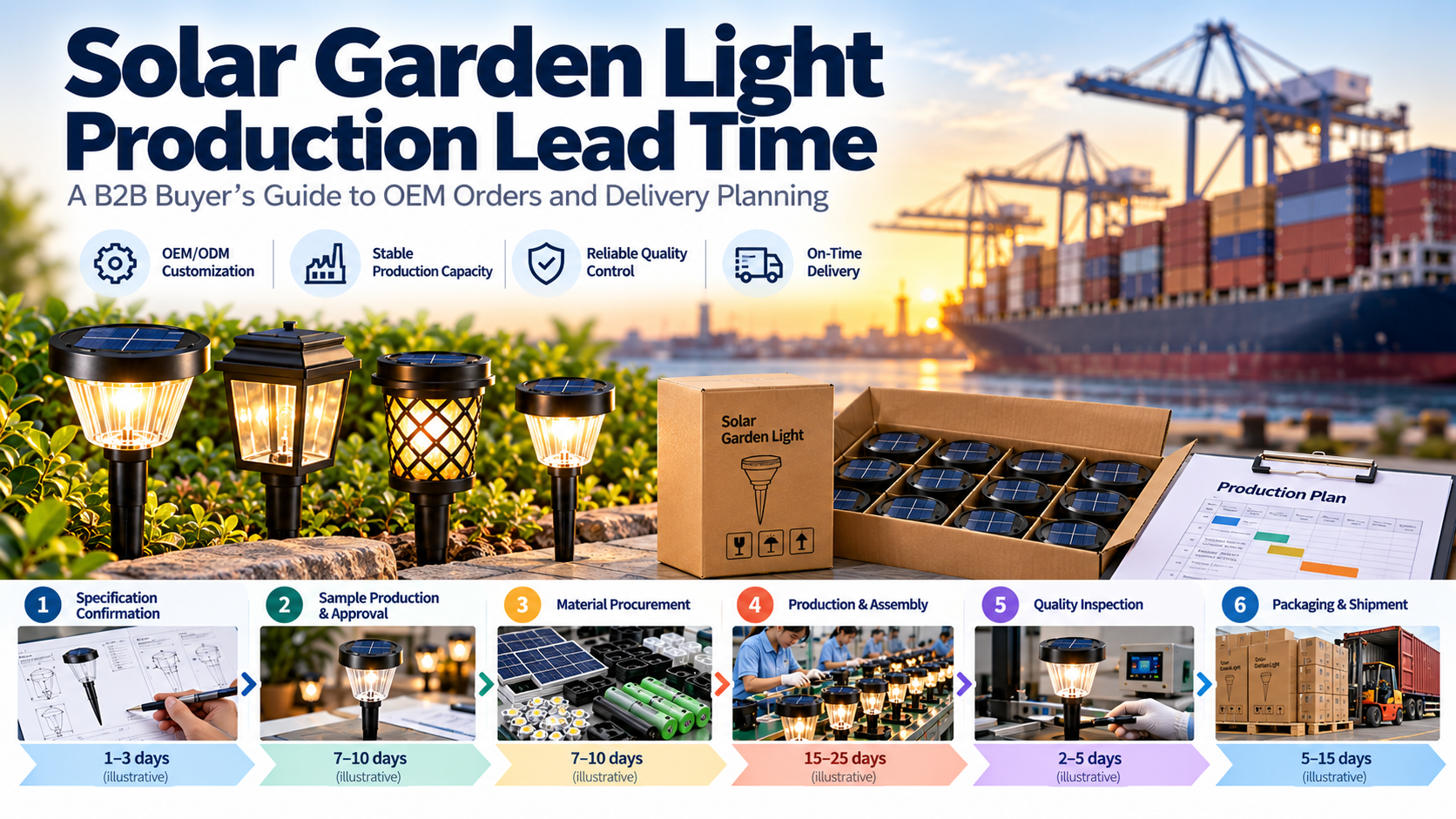
A good sample does not always guarantee a good bulk order. Buyers should confirm whether the supplier can maintain consistent quality across mass production.
Points to verify include:
- Same materials as sample approval
- Stable LED and battery configuration
- Consistent color and finish
- Uniform packaging
- Quality inspection process before shipment
This is especially important for brand buyers, chain retailers, and project customers. Inconsistent quality across a shipment can create unnecessary claims and reduce trust in future cooperation.
8. Ask About Certifications and Compliance
Different markets may require different standards and compliance documents.
Before placing a wholesale order, buyers should confirm whether the product can support the target market requirements, such as:
- CE
- RoHS
- Other market-related test or compliance needs
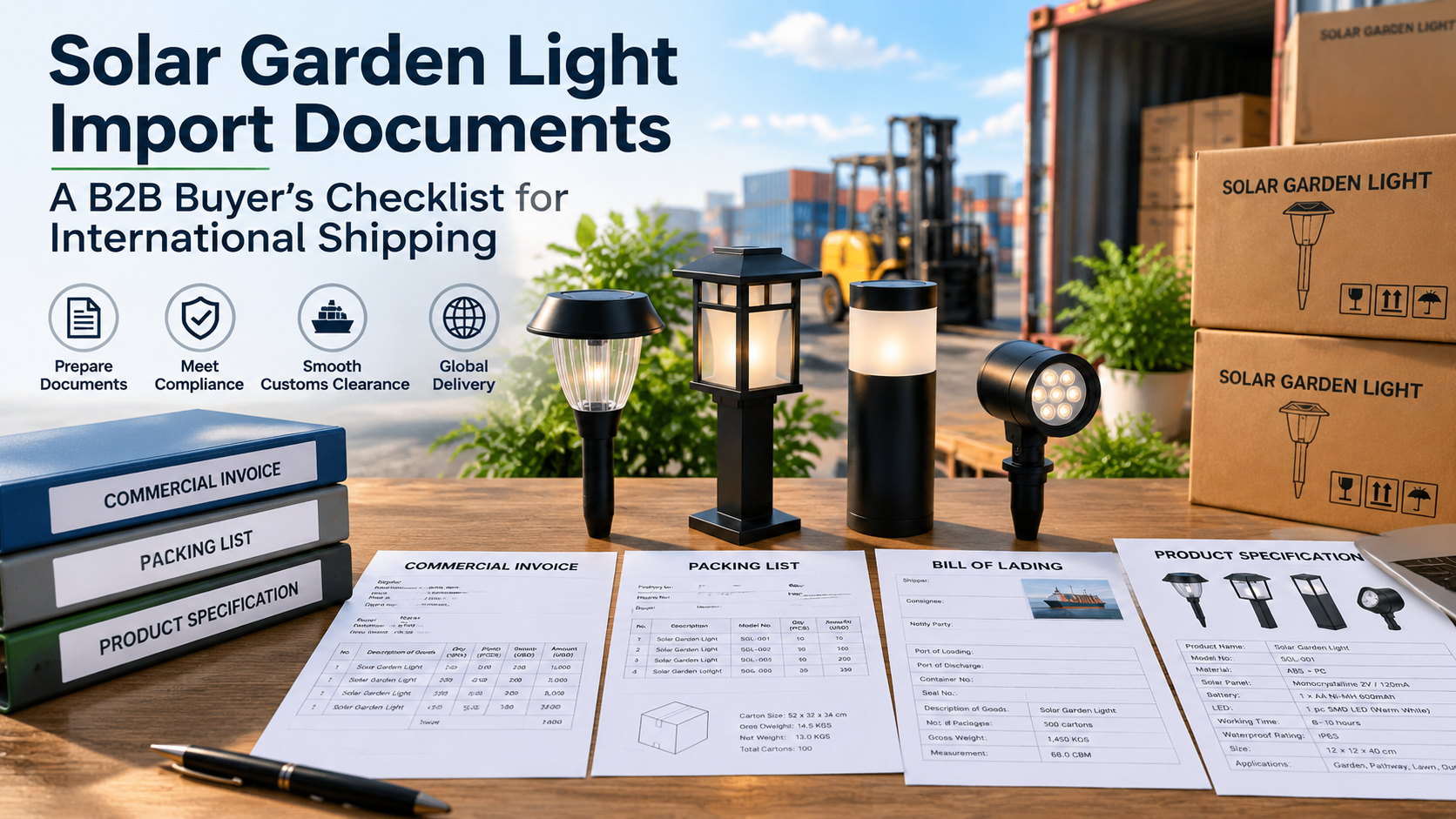
Even when certification is not the main sales point, it is still an important part of professional export service. For many buyers, compliance readiness is one of the signs of a reliable supplier.
9. Evaluate Packaging and Shipping Suitability
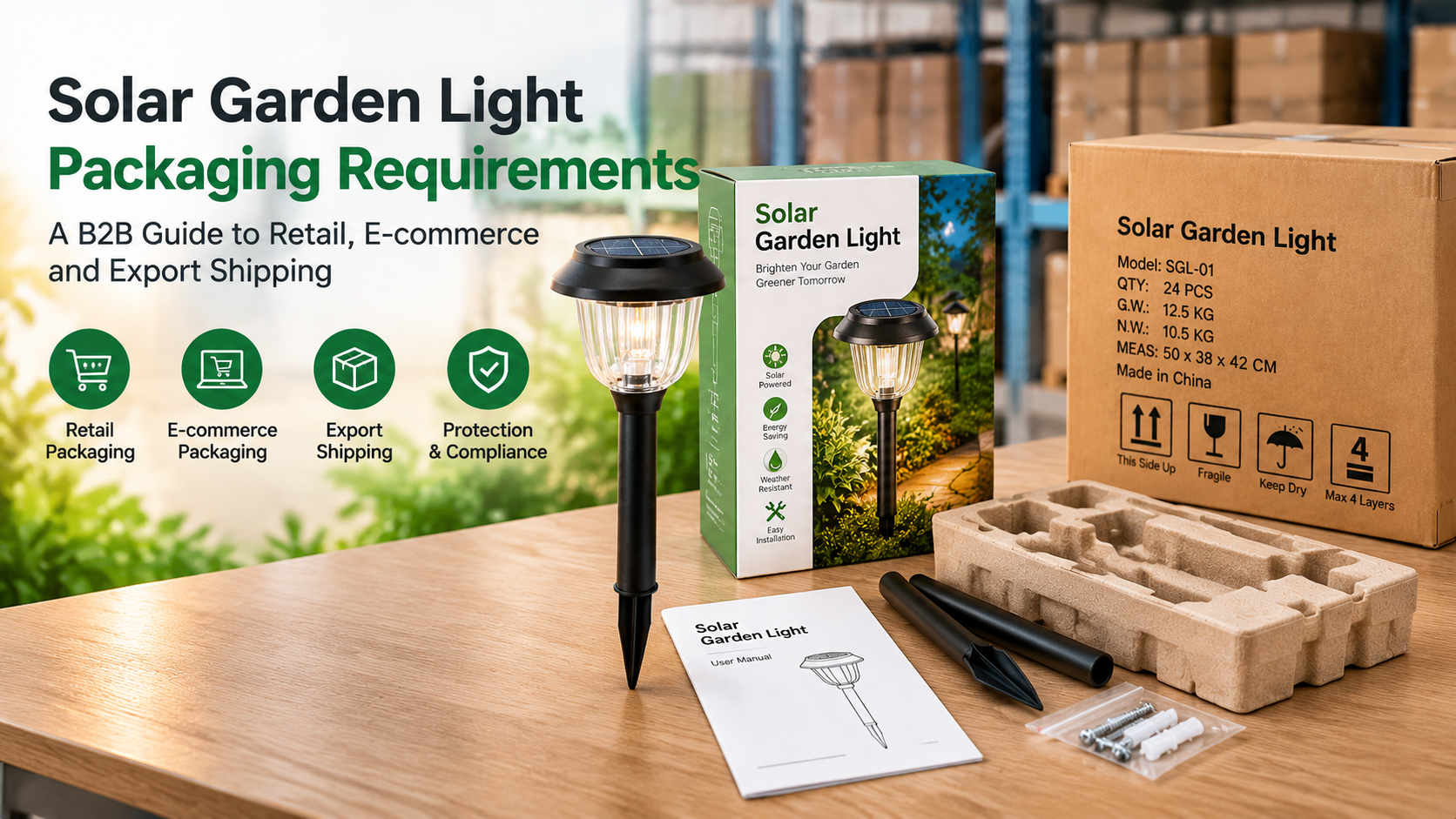
Packaging is often overlooked, but it has a direct impact on product safety and sales presentation.
Wholesale buyers should check:
- Individual box design
- Carton protection strength
- Drop resistance during transportation
- Labeling and barcode requirements
- Suitability for e-commerce or retail display
Good packaging helps reduce transit damage and improves the final presentation to distributors and consumers.
If the product is intended for online sales, packaging quality becomes even more important.
10. Compare Suppliers Beyond Price
Price is important, but it should not be the only decision factor.
When comparing solar garden light suppliers, buyers should also consider:
- Product understanding
- Responsiveness
- Sampling support
- Quality control process
- Production stability
- Export experience
- After-sales communication
A supplier who only offers a low price may not be able to provide stable quality, realistic lead times, or long-term cooperation support.
For wholesale orders, a reliable supplier often creates more value than a slightly lower quotation.
Common Mistakes Buyers Should Avoid
Here are some common mistakes in solar garden light sourcing:
Choosing only by appearance
A beautiful product photo does not guarantee reliable outdoor performance.
Focusing only on battery capacity
Battery size alone does not determine real runtime.
Ignoring waterproof structure details
The actual design matters as much as the IP claim.
Approving samples without confirming bulk consistency
Mass production control is critical for wholesale success.
Comparing only prices, not total value
A lower purchase cost can lead to higher after-sales costs later.
A Simple Buyer Checklist
Before placing a solar garden light order, make sure you confirm:
- Application scenario
- Solar panel performance
- Battery capacity and runtime
- Waterproof level
- Material quality
- Lighting effect
- Bulk order consistency
- Compliance support
- Packaging requirements
- Supplier reliability
This checklist can help buyers reduce risk and improve sourcing decisions.
Final Thoughts
Choosing solar garden lights for wholesale orders is not just about finding a popular design. It is about selecting a product that fits your market, performs well outdoors, and supports long-term customer satisfaction.
For wholesalers, brand owners, and project buyers, the most successful products are usually those that combine attractive design with practical performance, stable quality, and reliable supplier support.
A careful evaluation before ordering can help reduce risk, improve customer satisfaction, and build stronger long-term sales results.
FAQ
What is the most important factor when choosing solar garden lights for wholesale?
There is no single factor. Buyers should evaluate performance, waterproof ability, material quality, lighting effect, and supplier reliability together.
Are bigger batteries always better in solar lights?
Not necessarily. Battery capacity should match the solar panel efficiency and the power consumption of the light source.
Is IP65 always required for solar garden lights?
Not always. It depends on the installation environment and market expectations, but stronger outdoor protection is often preferred for exposed applications.
Why is sample approval not enough for wholesale orders?
Because bulk production consistency is critical. The final shipment must match the approved sample in material, finish, and performance.
Should buyers choose the lowest-price supplier?
Not based on price alone. Stable quality, communication, export experience, and after-sales support are equally important for wholesale business.
If you are sourcing solar garden lights for wholesale, OEM, or project use, LEDORA can support you with product selection, sampling, and reliable production service.
Looking for reliable outdoor lighting supplier?
✔ Solar Lights / Camping Lights / String Lights
✔ OEM & Wholesale Support
✔ Fast Delivery
👉 Contact us now: andrea@ledora-led.com
👉 Visit: https://ledora.en.alibaba.com/