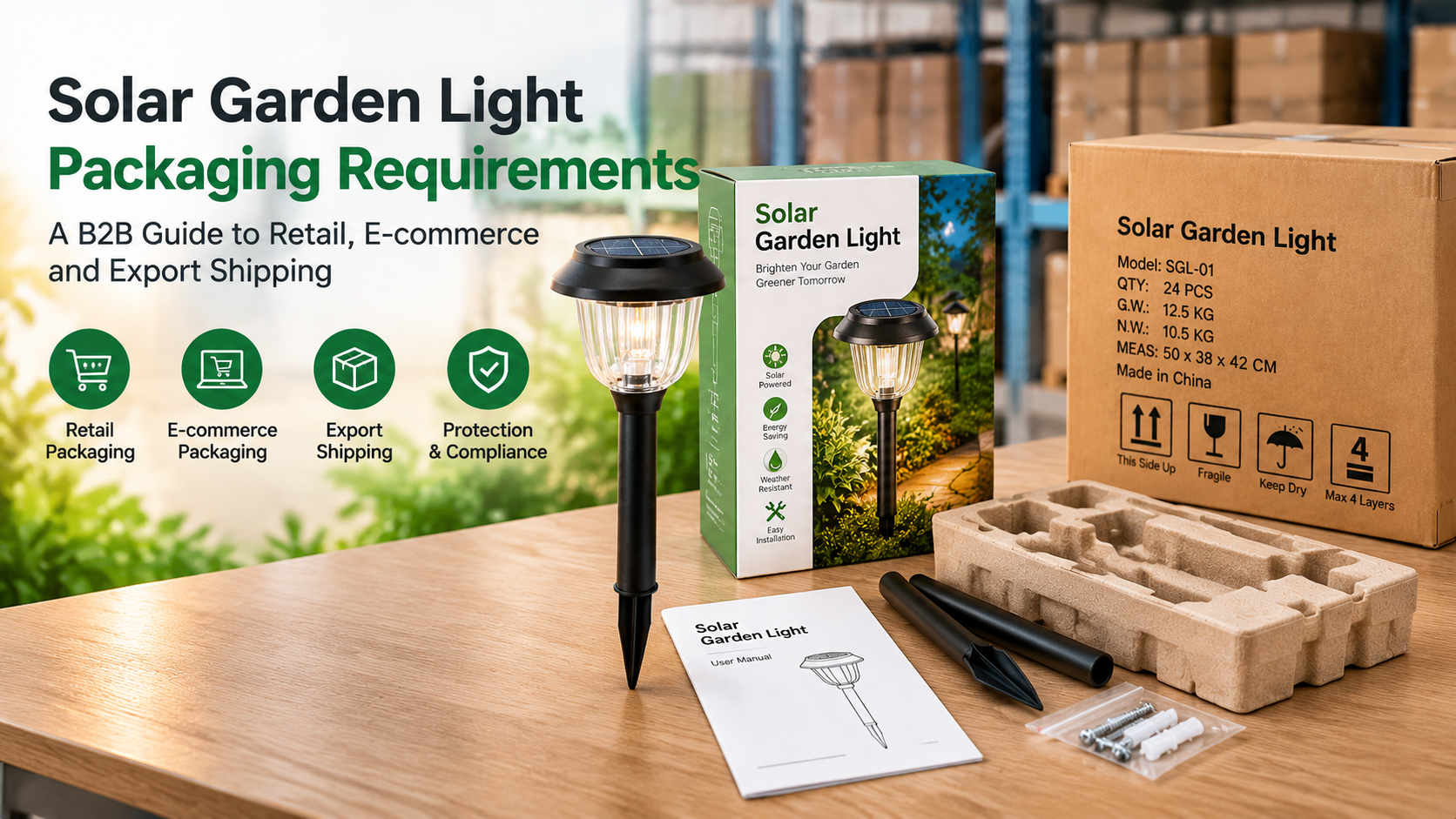
Solar garden light packaging must protect more than the visible lamp body.
A complete solar lighting package may contain:
- Solar panels
- Rechargeable batteries
- Transparent lenses
- Stainless steel or coated metal surfaces
- Plastic ground stakes
- Mounting screws
- Remote controls
- Cables
- Connectors
- Instruction manuals
- Barcode labels
Each component creates a different packaging risk.
A decorative solar flower light may have long flexible stems that can bend during transportation. A stainless steel ground light may require surface protection against scratches. A pathway light may include pointed stakes that can damage the lamp housing or carton. A lithium-powered motion sensor light may also require additional transport documentation and battery-related packaging controls.
For importers, wholesalers, retailers, e-commerce sellers and private-label brands, good packaging must achieve four objectives:
- Protect the product during transportation
- Present the product clearly to the final buyer
- Provide correct product and compliance information
- Control carton volume, shipping cost and packaging waste
The cheapest packaging is not always the lowest-cost solution.
Weak packaging can result in:
- Scratched products
- Broken stakes
- Cracked lenses
- Damaged solar panels
- Missing accessories
- Poor customer reviews
- Product returns
- Retail rejection
- Repacking costs
- Delayed shipments
This guide explains how buyers can select, customize and inspect solar garden light packaging before bulk production.
Buyers developing a complete private-label outdoor lighting range can also review LEDORA’s Solar Garden Lights Manufacturer and OEM Supplier page or explore the current Solar Garden Light Collection.

Why Solar Garden Light Packaging Requires Special Attention
Solar garden lights combine electrical components, outdoor housings and decorative structures in one product.
Unlike a simple plastic accessory, a solar light may contain fragile or sensitive parts such as:
- Solar panel surfaces
- Battery connections
- LED lenses
- Light sensors
- PIR sensor windows
- Thin metal covers
- Long ground stakes
- Decorative stems
- Remote controls
- External cables
Damage may not always be visible from the outside of the package.
For example, a product may arrive with an undamaged box but still have:
- A loose battery connector
- A cracked internal solar panel connection
- A deformed switch
- A broken solder joint
- A scratched stainless steel surface
- A bent ground stake
- A remote-control battery displaced during transport
Packaging must therefore be designed around the complete product structure.
Buyers should not simply select a box according to product dimensions. They should consider:
- Product weight
- Center of gravity
- Fragile components
- Sharp components
- Surface finish
- Accessory quantity
- Transportation method
- Retail channel
- Expected handling frequency
- Destination-market requirements
The Three Packaging Levels
Solar garden light packaging usually includes three different levels.
1. Individual Product Packaging
This is the package received by the retailer or final consumer.
Common options include:
- Neutral brown box
- Printed color box
- Window box
- E-commerce mailer box
- Multipack box
- Display-ready box
The individual package should protect the product and contain all required consumer information.
2. Inner or Multipack Packaging
An inner carton may contain several individual boxes.
It can help:
- Organize products
- Separate different models or colors
- Improve carton strength
- Simplify warehouse handling
- Reduce movement inside the master carton
Not every product requires an inner carton.
The decision depends on:
- Product size
- Individual-box strength
- Units per carton
- Retail packing method
- Shipping requirements
3. Master Carton
The master carton protects products during:
- Factory handling
- Warehouse storage
- Container loading
- Air shipment
- Sea shipment
- Courier transportation
- Pallet handling
The master carton should be designed according to the actual packed product rather than calculated only from empty individual-box dimensions.

Packaging Requirements by Sales Channel
Different sales channels require different packaging strategies.
| Sales Channel | Recommended Starting Packaging | Main Priorities |
|---|---|---|
| Traditional wholesale | Neutral box or simple color box with strong master carton | Cost, carton efficiency and product protection |
| Supermarket retail | Printed color box or display-ready multipack | Shelf presentation, barcode and clear product information |
| Garden center | Color box with application images and product window where suitable | Visual appeal, product understanding and outdoor positioning |
| Hardware retailer | Strong color box or neutral technical box | Installation information, specifications and accessories |
| E-commerce | Reinforced individual box or mailer-ready packaging | Drop resistance, compression protection and low damage rate |
| Amazon or marketplace seller | Channel-specific retail packaging with barcode and shipping protection | Label accuracy, individual protection and customer presentation |
| Landscape project | Neutral protective packaging with model and project labels | Product identification, quantity control and installation efficiency |
| Private-label brand | Customized retail packaging | Brand identity, consistency and market differentiation |
| Seasonal promotion | Compact color box, multipack or display box | Target price, visual design and carton efficiency |
The packaging selected for one channel should not automatically be used for another.
A box that performs well on a retail shelf may not be strong enough for direct courier delivery.
A reinforced e-commerce box may protect the product well but use too much space for supermarket display.
Wholesale Packaging
Traditional wholesale buyers often prioritize:
- Competitive packaging cost
- Efficient carton quantity
- Easy warehouse handling
- Clear model identification
- Low transportation damage
- Stable repeat-order specifications
A neutral brown box can be suitable when:
- Products will be repacked by the importer
- The buyer applies its own labels locally
- Retail presentation is not required
- The order contains several models
- Cost control is important
However, neutral packaging should still include enough information to prevent warehouse confusion.
At minimum, the package may need:
- Product model
- Lighting color
- Pack quantity
- Barcode or SKU
- Buyer reference number
- Country-specific label, where required
Retail Packaging
Retail packaging must communicate the product quickly.
A customer looking at a solar garden light box should be able to understand:
- What the product is
- How many pieces are included
- Where it can be used
- What lighting color it provides
- How it is installed
- How solar charging works
- Whether accessories are included
Retail packaging often uses:
- Product photography
- Nighttime application scenes
- Feature icons
- Installation illustrations
- Product specifications
- Lighting-mode explanations
- Multilingual text
- Barcode and item number
The packaging should not make claims that exceed the actual approved product specification.
For example, packaging should not state:
- IP68 when the exact model is IP65
- Twelve hours at full brightness when the test used a flashing mode
- A larger battery than the mass-production specification
- Stainless steel when only one decorative cover is metal
- A motion sensor function that the model does not include
The product, instruction manual, website listing and packaging should all use consistent specifications.
E-commerce Packaging
E-commerce packaging faces more handling stages than many traditional retail shipments.
A product may pass through:
- Factory packing
- Export transportation
- Import warehouse
- Fulfillment center
- Conveyor systems
- Sorting equipment
- Courier vehicle
- Final delivery
The International Safe Transit Association’s ISTA 3L procedure is designed around hazards found in e-commerce retailer fulfillment and direct-to-consumer delivery. ISTA identifies risks including shock, vibration, compression, temperature and humidity. (国际安全运输协会)
For e-commerce solar garden lights, buyers should pay special attention to:
- Box compression strength
- Product movement inside the box
- Lens and solar panel protection
- Ground-stake separation
- Corner protection
- Accessory bags
- Carton sealing
- Barcode position
- Customer opening experience
“Amazon-ready packaging” should not be treated as a precise technical specification.
The buyer should define exactly what is required, such as:
- Individual courier shipment
- Retail box placed inside a mailer carton
- Product shipped in its own container
- Barcode applied by the factory
- Polybag warning requirement
- Drop test
- Compression test
- Maximum package dimensions
- Maximum package weight

Packaging Risks by Solar Light Category
Different solar light structures require different protection methods.
| Product Category | Main Packaging Risks | Recommended Protection |
|---|---|---|
| Decorative flower lights | Bent stems, crushed petals, surface deformation | Shaped insert, stem fixing and sufficient box height |
| Solar firefly lights | Flexible wires tangled or permanently bent | Organized winding, paper bands and separated solar panel |
| Solar pathway lights | Broken stakes, scratched lamp body and loose sections | Stake compartment, individual wrapping and fitted insert |
| Solar ground lights | Scratched metal, cracked lens and pressure damage | Protective film, individual compartment and rigid insert |
| Solar fence lights | Surface scratches, missing screws and lens damage | Accessory bag, individual sleeve and divided multipack box |
| Motion sensor lights | Damaged PIR window, loose battery and broken bracket | Sensor-window protection, bracket separation and strong insert |
| Solar string lights | Tangled cable, broken bulbs and damaged controller | Cable reel, winding card, bulb protection and controller compartment |
| Remote-controlled lights | Missing remote, displaced battery and incorrect accessories | Fixed remote compartment and sealed accessory bag |
| External-panel products | Scratched panel, broken cable and connector damage | Separate panel compartment and cable-strain protection |
The insert should prevent one component from damaging another.
A pointed ground stake should not be packed directly against:
- Solar panel
- Transparent lens
- Cable
- Battery cover
- Decorative metal surface
Protecting the Solar Panel
The solar panel is one of the most important functional components in the package.
Packaging should prevent:
- Scratches
- Direct pressure
- Sharp-object contact
- Cable pulling
- Connector deformation
- Surface contamination
Possible protection methods include:
- Protective film
- Tissue paper
- Non-abrasive bag
- Separate compartment
- Corrugated insert
- Molded pulp tray
- Soft surface pad
Protective film should be easy to remove without leaving adhesive residue.
For products with an external solar panel, the panel and lamp body should be separated so that:
- The panel cannot strike the light
- The cable is not sharply folded
- The connector is not under pressure
- The spike does not scratch the panel
Buyers can review LEDORA’s Solar Panel and Battery Matching Guide for additional information about solar panel specifications and product configuration. The article is already part of LEDORA’s solar garden lighting content cluster. (–)
Protecting Transparent PC and Plastic Lenses
Transparent and frosted lenses can be damaged by:
- Scratching
- Compression
- Impact
- Contact with metal parts
- Contact with rough corrugated board
- Loose accessories
Suitable protection may include:
- PE bag
- Tissue paper
- Protective film
- Molded insert
- Individual compartment
- Corrugated sleeve
A transparent lens should not rub continuously against an unfinished carton surface during long-distance transportation.
For a more detailed explanation of ABS, PC, stainless steel and aluminum components, read LEDORA’s Solar Garden Light Materials Guide. (–)
Protecting Stainless Steel and Coated Metal Surfaces
Stainless steel and painted metal products may arrive functional but still become unsellable because of appearance defects.
Common problems include:
- Fingerprints
- Scratches
- Dents
- Paint abrasion
- Coating chips
- Metal-to-metal contact
- Rust caused by moisture contamination
Protection options include:
- Removable protective film
- Soft non-woven sleeve
- PE bag
- Tissue paper
- Individual compartment
- Moisture control where necessary
The protective material should not react with the coating or leave marks after long storage.
For multipack stainless steel ground lights, each unit should normally be prevented from contacting adjacent products.
Protecting Ground Stakes and Mounting Accessories
Ground stakes are frequently overlooked during packaging development.
Common problems include:
- Stake tips puncturing the box
- Stakes scratching the lamp body
- Thin stakes bending
- Stake sections becoming loose
- Missing extension poles
- Screws and anchors moving inside the package
Suitable methods include:
- Dedicated accessory compartment
- Corrugated sleeve
- Paper band
- Accessory bag
- Fixed position in molded tray
- Tip protection where required
The packing method should also make assembly easy for the final customer.
A customer should not need to search through several loose components to understand how the product is installed.
Common Individual Packaging Options
| Packaging Type | Advantages | Limitations | Suitable Applications |
|---|---|---|---|
| Neutral brown box | Low cost, easy to source and suitable for wholesale | Limited retail presentation | Wholesale, projects and local repacking |
| Printed color box | Strong brand presentation and product explanation | Higher artwork and printing cost | Retail, private label and e-commerce |
| Window box | Allows customers to see the product | Window may reduce box strength and increase plastic use | Selected decorative retail products |
| E-commerce mailer box | Better direct-shipment protection | May use more material and volume | Direct-to-consumer orders |
| Multipack box | Suitable for four-, six- or eight-piece sets | Internal separation must be controlled | Pathway, fence and ground lights |
| Display-ready box | Efficient shelf display | Requires retailer-specific dimensions | Supermarkets and garden centers |
| Blister packaging | Clear product visibility | Limited suitability for larger products and sustainability concerns | Small accessories or compact lights |
| Gift box | Premium appearance | Higher cost and shipping volume | Seasonal, decorative and premium products |
The package should be selected according to the product and sales channel rather than appearance alone.
Internal Packaging Materials
Corrugated Inserts
Corrugated-board inserts can provide:
- Product separation
- Structural support
- Accessory compartments
- Reduced plastic use
- Easier recycling
The insert must be tested with the actual product weight and structure.
Thin paperboard that looks correct in a sample may collapse during transport.
Molded Pulp
Molded pulp can be suitable for:
- Shaped product protection
- Lens protection
- Product positioning
- Plastic reduction
- Retail and e-commerce packages
The tray design should avoid excessive pressure on:
- Solar panels
- Sensor windows
- Decorative stems
- Thin lenses
EPE or Foam
Foam can provide strong cushioning for fragile or higher-value products.
However, buyers should consider:
- Material cost
- Package volume
- Local packaging rules
- Recycling requirements
- Customer expectations
Foam should not be added automatically when a paper-based structure can provide sufficient protection.
PE Bags and Protective Sleeves
Bags can protect against:
- Scratches
- Dust
- Fingerprints
- Surface rubbing
They do not provide significant impact protection by themselves.
Paper Bands and Cable Ties
Paper bands, reusable ties or suitable cable ties can organize:
- Cables
- Decorative stems
- String lights
- Extension poles
- Accessories
The fixing method should not leave permanent marks or deform the product.
Packaging Artwork and Required Information
A solar garden light color box normally needs a structured information layout.
Front Panel
The front may include:
- Brand name
- Product name
- Main product image
- Nighttime application image
- Pack quantity
- Main lighting color
- One or two key functions
Do not overload the front panel with technical text.
Back Panel
The back may include:
- Product description
- Main specifications
- Charging instructions
- Installation steps
- Lighting modes
- Warnings
- Applications
- Company information
- Contact information
Side Panels
Side panels may include:
- Product dimensions
- Battery specification
- Solar panel specification
- Material
- Waterproof rating
- Working-time reference
- Barcode
- Model number
- Country of origin
- Recycling or disposal information where applicable
Bottom or Top Panel
These areas may include:
- Batch number
- Production date
- SKU
- Color identification
- Carton reference
- Quality-control mark
All information should match the approved product and quotation.

Barcodes, SKUs and Product Identification
Retail and e-commerce buyers may require:
- GTIN
- EAN
- UPC
- Retailer-specific SKU
- FNSKU
- Carton barcode
- Batch code
- QR code
- Serial number
The correct barcode depends on:
- Sales channel
- Country
- Retailer
- Product level
- Pack quantity
- Logistic level
GS1 uses Global Trade Item Numbers to identify trade items and supports different barcode structures for retail products, outer cases and logistics units. Buyers should confirm which identifier belongs on the consumer package and which belongs on the outer carton. (GS1 Singapore)
Barcode inspection should confirm:
- Correct number
- Correct size
- Suitable contrast
- Clear print
- Flat application
- No tape over the code
- No fold through the code
- Successful scanning
- Correct relationship between product and carton barcode
A barcode image should not be approved only by visual appearance.
It should be scanned from the actual printed package.
Instruction Manuals
Solar garden light manuals should explain:
- Product components
- Assembly
- Switch position
- First-use charging
- Solar panel placement
- Light-sensor operation
- Lighting modes
- Motion-sensor operation
- Remote-control functions
- Battery information
- Cleaning
- Storage
- Troubleshooting
- Disposal or recycling information
- Warnings
Common customer complaints can often be reduced by explaining:
- The switch must be turned on before charging
- The solar panel must receive direct sunlight
- The light may not activate under bright indoor lighting
- Cloudy weather can reduce runtime
- Protective film should be removed from the panel
- USB runtime may differ from outdoor solar charging
- Motion-sensor modes provide different operating times
The instruction manual should use the exact remote-control layout and mode sequence of the final product.
Packaging for Lithium-Powered Solar Lights
Some brighter pathway, wall and motion sensor lights use lithium-ion batteries.
Lithium-powered products may require additional consideration for:
- Battery classification
- UN 38.3 information
- Battery test summary
- MSDS or SDS
- Battery watt-hour rating
- Short-circuit protection
- Accidental activation prevention
- Product movement inside the package
- Package marks and labels
- Carrier requirements
The IATA 2026 battery guidance distinguishes between lithium batteries shipped separately, packed with equipment and contained in equipment. It also contains specific sections covering packaging, marking, labelling and documentation. The exact requirements depend on the product and transport configuration.
Buyers should confirm current requirements with:
- Supplier
- Freight forwarder
- Carrier
- Testing provider
- Compliance professional
A packaging design used for Ni-MH decorative lights should not automatically be copied for lithium-powered motion sensor products.
Master Carton Design
The master carton must protect the complete packed quantity during handling and transport.
Important fields include:
| Carton Information | What Should Be Confirmed |
|---|---|
| Units per carton | Exact individual boxes or sets |
| Carton dimensions | Length × width × height |
| Net weight | Product weight without export packaging |
| Gross weight | Total packed carton weight |
| Carton material | Board structure and strength |
| Shipping marks | Buyer, model, quantity and carton number |
| Barcode | Carton or logistics barcode where required |
| Handling symbols | According to buyer and shipping requirements |
| Carton sealing | Tape, glue, staples or straps where appropriate |
| Inner protection | Divider, liner, corner or top-bottom pad |
| Pallet configuration | Cartons per layer and layers per pallet |
| Container loading | Estimated cartons and loading method |
Carton information should be confirmed after the final individual package is approved.
Changing the color box may change:
- Carton quantity
- Carton dimensions
- Gross weight
- Container loading
- Shipping cost
Carton Volume and Dimensional Weight
Carton size affects freight cost.
Carton Volume
A basic CBM calculation is:
Carton CBM = Length × Width × Height in meters
For example, a carton measuring:
60 × 40 × 40cm
has a volume of:
0.60 × 0.40 × 0.40 = 0.096m³
Dimensional Weight
Air courier and airfreight providers may calculate chargeable weight according to actual or dimensional weight.
The dimensional-weight formula and divisor vary by:
- Carrier
- Service
- Country
- Shipping route
Buyers should obtain the final packed dimensions before confirming freight.
Reducing unnecessary empty space can help:
- Lower freight costs
- Improve pallet efficiency
- Increase container loading
- Reduce product movement
- Reduce packaging material
However, reducing carton size too aggressively can remove necessary product protection.

Packaging Performance Testing
Packaging testing should reflect the actual distribution channel.
Common tests may include:
- Individual-package drop test
- Master-carton drop test
- Vibration test
- Compression test
- Stacking test
- Edge and corner impact
- Temperature and humidity conditioning
- Pallet stability test
- Courier trial shipment
ISTA notes that packaged-product testing can help evaluate the package’s ability to withstand transport hazards. For e-commerce shipments, ISTA 3L considers repeated fulfillment and final-delivery handling rather than only one transport stage.
The test plan should define:
- Product model
- Packaging version
- Test sample quantity
- Drop height
- Drop orientation
- Compression load
- Vibration duration
- Conditioning requirements
- Acceptance criteria
A package should not be declared acceptable simply because the outer box remains closed.
After testing, inspect:
- Solar panel
- Lens
- Housing
- Stakes
- Battery connection
- Switch
- Sensor
- Lighting function
- Accessories
- Packaging appearance
Packaging Acceptance Criteria
Before testing begins, buyers and suppliers should agree on what counts as a failure.
Possible failure criteria include:
- Product does not work
- Solar panel cracked
- Lens cracked
- Housing broken
- Ground stake broken
- Metal surface scratched beyond limit
- Battery disconnected
- Accessory missing
- Box opens during testing
- Barcode becomes unreadable
- Retail box severely crushed
- Product moves outside its insert
- Water or moisture enters packaging during conditioning
- Customer-facing packaging is no longer saleable
The acceptance criteria may differ between:
- Wholesale neutral packaging
- Premium retail packaging
- Direct-to-consumer packaging
- Project supply packaging
Packaging Sustainability and EU Market Considerations
Packaging sustainability is becoming more important for retail and private-label programs.
Buyers may evaluate:
- Material reduction
- Recyclable structures
- Paper-based inserts
- Reduced mixed materials
- Reduced empty space
- Recycled paper content
- Clear material identification
- Easy separation of components
- Elimination of unnecessary plastic
For products intended for the European Union, buyers should review Regulation (EU) 2025/40 on packaging and packaging waste.
The regulation applies from 12 August 2026, although different detailed requirements, implementing acts and transition dates apply at different stages. Buyers should confirm the obligations relevant to their product, packaging and market rather than assuming every requirement takes effect at the same time. (EUR-Lex)
Packaging minimization should not mean reducing protection until products are damaged.
A damaged product creates waste from:
- Product replacement
- Replacement packaging
- Additional shipping
- Returned goods
- Customer disposal
The most sustainable packaging is normally the minimum structure that can still protect the product through the intended distribution channel.

The Packaging Approval Process
A structured packaging-development process helps prevent errors during mass production.
| Stage | Main Work | Buyer Approval Point |
|---|---|---|
| 1. Requirement collection | Confirm channel, market, pack quantity, protection and labeling | Packaging requirement sheet |
| 2. Structure proposal | Select box, insert and carton arrangement | Structure concept |
| 3. Dieline preparation | Create box and insert dimensions | Dieline approval |
| 4. Artwork design | Add logo, images, text and barcode | Digital artwork approval |
| 5. White sample | Test dimensions, fit and protection | Structure approval |
| 6. Printed sample | Confirm color, printing and finish | Appearance approval |
| 7. Packaging test | Conduct drop, compression or transport test | Performance approval |
| 8. Golden packaging sample | Seal final product and packaging reference | Final approval |
| 9. Mass production | Print and assemble approved version | In-process inspection |
| 10. Pre-shipment inspection | Compare bulk packaging with approved sample | Shipment release |
The buyer should approve structure before completing final artwork.
Changing the box dimensions after artwork is completed may require:
- New dieline
- New artwork layout
- New barcode position
- New print sample
- New carton dimensions
Packaging Specification Sheet
The final packaging specification should record:
Individual Package
- Packaging type
- Box dimensions
- Box material
- Printing method
- Surface finish
- Insert material
- Product arrangement
- Accessories
- Manual
- Barcode
- Package weight
Master Carton
- Carton dimensions
- Board structure
- Units per carton
- Inner carton quantity
- Net weight
- Gross weight
- Shipping marks
- Carton barcode
- Sealing method
- Pallet quantity
Artwork
- Approved file version
- Language
- Product images
- Model number
- Product specifications
- Battery information
- Solar panel information
- Waterproof rating
- Warnings
- Company information
- Barcode number
Testing
- Drop-test method
- Compression requirement
- Vibration requirement
- Courier trial requirement
- Acceptance criteria
- Test date
- Approved sample reference
Packaging Quality Control Before Shipment
Packaging inspection should be included in the final pre-shipment process.
| Inspection Area | What to Check |
|---|---|
| Box structure | Correct dimensions, folds, tabs and closure |
| Printing | Correct artwork, color and text |
| Product image | Matches actual product |
| Specifications | Match approved production configuration |
| Barcode | Correct and scannable |
| Manual | Correct language and functions |
| Product position | Correct orientation and secure fit |
| Accessories | Correct quantity and compartment |
| Surface protection | Protective film, bag or sleeve included |
| Multipack quantity | Correct number of units |
| Master carton | Correct dimensions and carton strength |
| Shipping marks | Correct buyer and model information |
| Carton quantity | Correct units per carton |
| Gross weight | Matches approved packing information |
| Sealing | Secure and consistent |
| Drop test | Meets agreed result |
| Golden sample | Bulk packaging matches approval |
Packaging inspection should use randomly selected cartons from different parts of the shipment.
For the complete product and packaging inspection workflow, read LEDORA’s Solar Garden Light Quality Control Checklist. (–)

Common Packaging Mistakes
Mistake 1: Designing the Box Before Confirming the Product
Product dimensions, accessories and structure should be finalized before packaging development.
Mistake 2: Using Product Renderings That Do Not Match the Real Light
Incorrect images may show:
- Different LED quantity
- Different lighting color
- Different solar panel
- Different housing
- Different accessories
This can create customer complaints and retailer rejection.
Mistake 3: Packing Ground Stakes Against the Solar Panel
Pointed accessories should be separated from sensitive surfaces.
Mistake 4: Leaving Too Much Empty Space
Excessive empty space allows the product to move and increases freight cost.
Mistake 5: Making the Package Too Tight
Overly tight packaging can place pressure on:
- Lens
- Sensor window
- Solar panel
- Decorative stems
- Switches
Mistake 6: Using the Retail Box as a Courier Box Without Testing
Retail packaging may not be designed for direct shipping.
Mistake 7: Forgetting Protective Film on Metal or Clear Surfaces
Stainless steel, painted metal and transparent lenses can be damaged before reaching the customer.
Mistake 8: Printing Incorrect Battery or Runtime Information
Packaging information must match the approved production components and testing conditions.
Mistake 9: Failing to Scan the Printed Barcode
A digitally correct barcode can become unreadable after printing or application.
Mistake 10: Changing the Packaging Material Without Approval
A thinner box or weaker insert can change transport performance.
Mistake 11: Ignoring Carton Gross Weight
Overly heavy cartons may be difficult to handle and more likely to be dropped.
Mistake 12: Approving Only a Digital Artwork File
Buyers should also approve the physical packaging structure and printed result.
Packaging Red Flags in Quotations
Buyers should request clarification when a quotation does not identify:
- Individual-box type
- Individual-box dimensions
- Pack quantity
- Units per carton
- Master-carton dimensions
- Net weight
- Gross weight
- Insert material
- Surface protection
- Instruction manual
- Barcode responsibility
- Artwork responsibility
- Drop-test requirement
- Packaging MOQ
- Packaging lead time
Other warning signs include:
- “Standard packaging” with no explanation
- The same carton dimensions for different pack quantities
- No separation between metal products
- No protection for the solar panel
- No packaging sample before production
- No barcode scan test
- No carton-weight confirmation
- Supplier unwilling to confirm packaging changes
- Bulk packaging different from approved sample
How to Balance Packaging Cost and Protection
The lowest packaging cost does not always create the lowest total landed cost.
Buyers should consider:
Total packaging value = Packaging cost + Freight cost + Damage risk + Return risk + Repacking cost
A more expensive insert may reduce:
- Product movement
- Lens damage
- Surface scratches
- Return rate
A smaller box may reduce freight, but only when it still protects the product.
The most efficient approach is to test several options.
For example:
Option A
- Larger box
- Simple insert
- Higher freight cost
- Good protection
Option B
- Smaller box
- Better-shaped insert
- Lower freight cost
- Good protection
Option C
- Smallest possible box
- Minimal protection
- Lowest initial packaging cost
- Higher damage risk
Option B may provide the best total result even when the insert costs more.
OEM and Private-Label Packaging with LEDORA
LEDORA supports OEM and ODM packaging discussions for selected solar garden lighting products.
Available options may include:
- Neutral brown box
- Customized color box
- Private-label packaging
- Multipack box
- Retail-ready packaging
- E-commerce packaging
- Customized logo
- Product labels
- Barcode labels
- Shipping marks
- Instruction manuals
- Multilingual packaging
- Customized carton quantity
LEDORA’s current website lists custom packaging, logo customization, sample support and export packaging among its OEM and wholesale services. (–)
Packaging customization should begin with the buyer’s sales channel.
Buyers should provide:
- Product model
- Pack quantity
- Target market
- Sales channel
- Brand files
- Barcode
- Required languages
- Package size limitation
- Drop-test requirement
- Carton-weight limitation
- Sustainability requirement
- Order quantity
The packaging MOQ and lead time depend on:
- Box structure
- Printing method
- Packaging supplier
- Artwork
- Quantity
- Surface finish
- Insert tooling
- Testing requirements
Learn more about LEDORA’s product and manufacturing capabilities on the About LEDORA page.
Questions to Ask a Solar Garden Light Supplier
Before approving packaging, ask:
- What individual packaging is included in the quotation?
- What are the individual-box dimensions?
- What material is used for the box and insert?
- How is the solar panel protected?
- How are ground stakes and accessories separated?
- Is protective film applied to metal or transparent surfaces?
- Is the package suitable for retail or direct e-commerce delivery?
- Has a drop test been completed?
- Has a compression or vibration test been completed?
- How many units are packed in each carton?
- What are the master-carton dimensions?
- What are the net and gross weights?
- Can the barcode be printed and scanned before production?
- Who is responsible for artwork and translation?
- Can the instruction manual be customized?
- What is the MOQ for custom color boxes?
- Will custom packaging change the production lead time?
- Will custom packaging change the carton quantity?
- Can a printed packaging sample be provided?
- Will bulk packaging be compared with the approved golden sample?
- Are lithium battery marks or documents required?
- Does the packaging meet destination-market requirements?
- Can recyclable or paper-based inserts be used?
- Can carton-loading information be provided before shipment?
Buyers can also review LEDORA’s Solar Garden Light Wholesale Buying Guide for additional product, supplier and packaging considerations. (–)
Frequently Asked Questions
What is the best packaging for solar garden lights?
There is no single best packaging. The correct option depends on the product structure, sales channel, transport method, retail presentation and target cost.
Is a neutral brown box suitable for wholesale orders?
Yes. Neutral brown boxes can be suitable for traditional wholesale and project orders when retail presentation is not required. The box should still provide adequate protection and product identification.
Do e-commerce solar lights need stronger packaging?
Usually yes. Direct-to-consumer products may experience more handling, sorting, drops and compression than traditional palletized retail shipments.
Should a retail color box be used as the shipping box?
Only when it has been designed and tested for that distribution method. Many retail boxes require an additional mailer or export carton.
How should solar panels be protected inside the box?
Solar panels should be protected from scratches, sharp objects, pressure, cable pulling and movement. Protective film and a separate compartment may be used depending on the product.
How should solar ground lights be packed?
Metal and transparent surfaces should be separated to prevent scratching. Ground stakes and accessories should not press against the lens or solar panel.
What information should appear on a solar light color box?
Typical information includes product name, model, quantity, application, solar panel, battery, material, waterproof rating, lighting modes, installation, warnings and barcode.
Should the packaging include a user manual?
Yes. The manual should explain assembly, charging, switch operation, installation, lighting modes, troubleshooting and relevant warnings.
Can LEDORA print customized barcodes?
Barcode printing can be discussed as part of an OEM packaging project. The buyer should provide the correct code and confirm the required label position and format.
Should the barcode be tested before bulk production?
Yes. The printed barcode should be scanned on the actual packaging sample before mass production.
What packaging is suitable for multipack pathway lights?
A fitted multipack box with separated lamp bodies, organized stakes and protected solar-panel surfaces is usually more suitable than placing loose products in one box.
Can packaging affect shipping cost?
Yes. Individual-box size, units per carton, carton dimensions and gross weight can affect courier, airfreight, sea freight and container-loading costs.
Can LEDORA customize packaging materials?
Selected packaging structures, materials, inserts, labels and artwork can be discussed according to the product, order quantity and target market.
Do lithium-powered solar lights need special packaging?
Lithium-powered products may be subject to additional transport, packaging, marking and documentation requirements depending on the battery and shipping configuration.
Should packaging be checked during pre-shipment inspection?
Yes. Inspectors should verify artwork, structure, accessories, barcode, carton quantity, dimensions, weights, shipping marks and comparison with the approved sample.
Final Recommendation
Solar garden light packaging should not be treated as an accessory added after the product is finished.
It is part of the complete product system.
A reliable packaging solution should balance:
- Product protection
- Retail presentation
- E-commerce handling
- Barcode accuracy
- Instruction clarity
- Carton efficiency
- Freight cost
- Sustainability
- Destination-market requirements
- Bulk-production consistency
For wholesale buyers, the correct approach is not:
Choose the cheapest available box.
The better approach is:
Identify the product risks and sales channel, then design and test the minimum packaging structure that provides reliable protection.
A well-designed package helps reduce:
- Scratches
- Broken stakes
- Cracked lenses
- Solar-panel damage
- Missing accessories
- Incorrect product information
- Freight costs
- Customer returns
- Repacking work
LEDORA supplies solar pathway lights, ground lights, fence lights, decorative lights and motion sensor products for wholesalers, retailers, e-commerce sellers and private-label brands.
Buyers can review:
- Solar Garden Lights Manufacturer and OEM Supplier
- Solar Garden Light Materials Guide
- Solar Garden Light Quality Control Checklist
- Solar Panel and Battery Matching Guide
- Solar Garden Light Product Collection
Request a Solar Garden Light Packaging Proposal
Contact LEDORA to request:
- Latest solar garden light catalogue
- Product and packaging comparison
- Neutral packaging options
- Private-label color box
- E-commerce packaging proposal
- Multipack packaging
- Instruction manual customization
- Barcode and label support
- Master-carton information
- Sample quotation
- Bulk-order pricing
- Estimated production lead time
Contact LEDORA for a Solar Garden Light Packaging and Quotation Proposal
Please provide:
- Target product model
- Estimated quantity
- Pack quantity
- Destination market
- Sales channel
- Logo and brand files
- Barcode requirements
- Required languages
- Packaging test requirements
- Sustainability requirements
Our team will help you compare suitable packaging structures for wholesale, retail, e-commerce and private-label solar lighting programs.
Buyers can also visit the LEDORA Official Alibaba Supplier Page to review additional products and supplier information.