Solar Garden Light Temperature Testing: Quick Answer
Temperature testing for solar garden lights is used to evaluate how the product, components or materials respond to defined hot, cold or changing temperature conditions.
For B2B buyers, temperature can affect several parts of a solar lighting system:
Battery
Solar Panel
Charging Circuit
LED
Controller
PIR Sensor
Plastic Housing
Lens
Gaskets and Seals
Adhesives
Cables and Connectors
A useful evaluation framework is:
Product Configuration + Temperature Range + Exposure Time + Operating State + Temperature Change Method + Recovery Period + Acceptance Criteria + Test Record
The key sourcing principle is:
“Outdoor Use” Is Not a Temperature Specification
If temperature performance matters for the target market, the buyer should define the requirement and ask how it was verified.
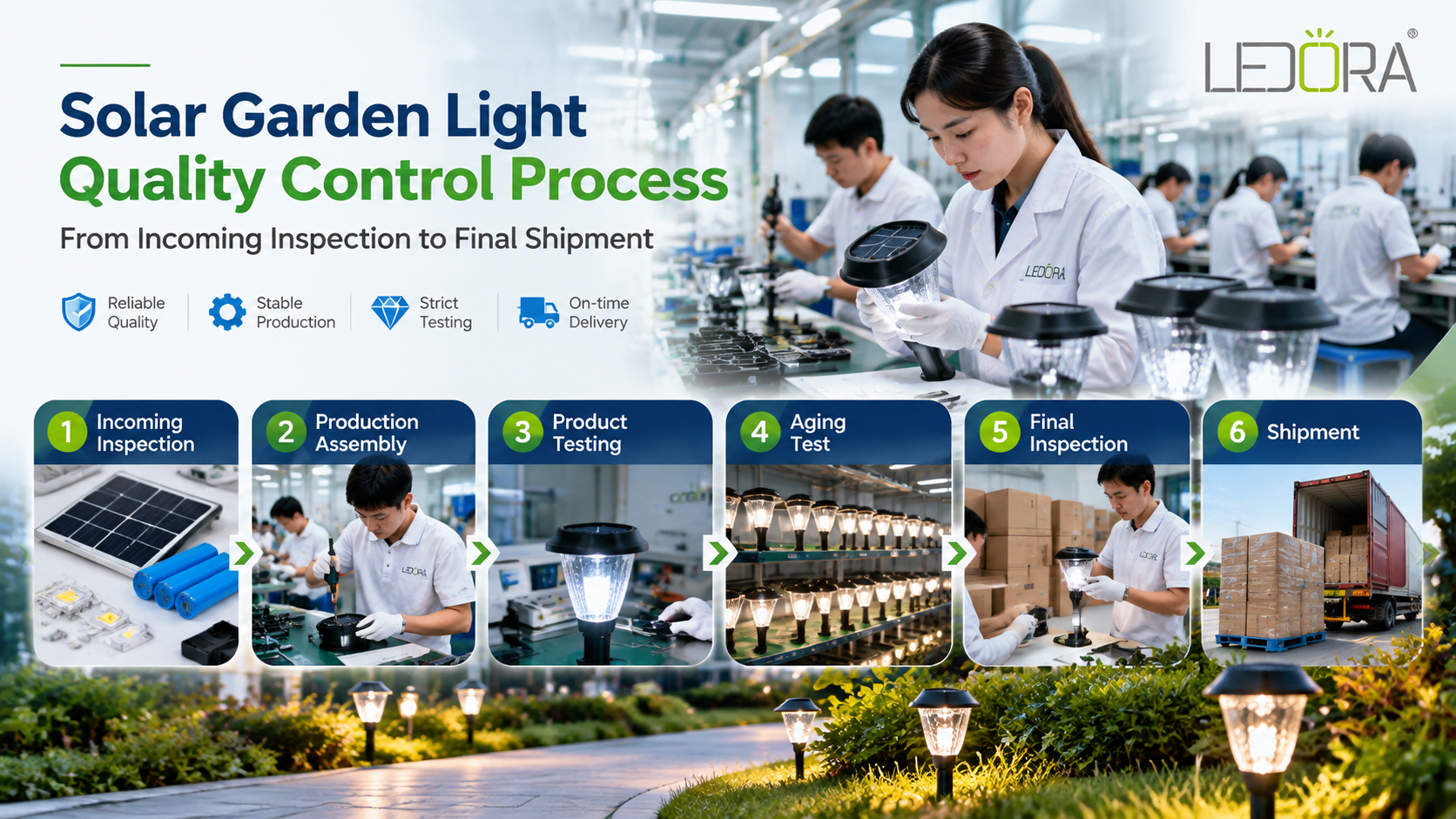
LEDORA’s Solar Garden Light Quality Control Checklist explains the broader production inspection process.
This guide focuses specifically on heat, cold and temperature-change risks.
Why Temperature Matters for Solar Garden Lights
Solar garden lights operate outdoors throughout the year.
Unlike an indoor decorative lamp, the same outdoor product may experience:
- hot daytime temperatures
- cooler nights
- seasonal temperature changes
- direct solar heating
- cold winter conditions
- repeated heating and cooling
At the same time, a solar light contains several materials and electrical components that do not necessarily respond to temperature in the same way.
The system may include:
Plastic + Metal + Glass or Lens + Battery + PCB + LED + Gasket + Adhesive + Solar Panel
Temperature changes can therefore affect both electrical performance and mechanical construction.
For B2B sourcing, the important question is not:
Can this solar light work outdoors?
A better question is:
Under which temperature conditions has this exact product configuration been evaluated?

Temperature Can Affect More Than the Battery
Battery performance is an important part of outdoor temperature evaluation, but it is not the only issue.
Temperature can also affect:
- plastics
- gaskets
- adhesives
- electronic components
- cable flexibility
- mechanical joints
- sensor behavior
- LED operation
- charging behavior
This is why temperature testing should be treated as a system-level reliability question, not simply a battery question.
Step 1: Define the Target Market
Begin with the actual sales environment.
Record:
Target Country / Region: ______
Application: ______
Installation: ______
Expected Environment: ______
A solar pathway light sold into a mild climate may face different environmental conditions from a product intended for a region with severe winter cold or intense summer heat.
The product requirement should therefore follow the intended application rather than using one generic temperature claim for every market.
Step 2: Define the Product Configuration
Temperature test results are useful only when buyers know what was tested.
Record:
Model Number: ______
Housing Material: ______
Lens Material: ______
Battery Chemistry: ______
Battery Voltage: ______
Battery Capacity: ______
Solar Panel: ______
LED: ______
Controller: ______
Sensor: ______
Seal / Gasket Structure: ______
LEDORA’s Solar Garden Light Specification Sheet explains why the product configuration should be frozen before comparing technical evidence.
If the battery, housing, gasket or controller changes after testing, the buyer should determine whether the existing result still represents the production product.
Step 3: Understand High-Temperature Risk
High-temperature exposure can affect different components in different ways.
Depending on product construction, buyers may need to evaluate:
- battery behavior
- charging system
- LED and controller operation
- plastic deformation
- adhesive performance
- gasket condition
- cable condition
- surface appearance
The purpose is not to assume that heat will cause all of these failures.
The purpose is to identify which risks are relevant to the actual product.
High Ambient Temperature Is Not the Same as Product Temperature
This distinction matters.
If the ambient air temperature is:
40°C
that does not automatically mean every component inside a sun-exposed solar light is also exactly:
40°C
Dark housings, enclosed compartments and direct sunlight can influence internal or surface temperatures.
Therefore, a professional test record should clearly identify what is being reported:
Ambient Temperature
Chamber Temperature
Surface Temperature
or:
Internal Component Temperature
Do not mix these values.
Step 4: Understand Low-Temperature Risk
Cold conditions can also influence solar-light performance.
Depending on the product, low temperatures may affect:
- battery charge/discharge behavior
- available runtime
- plastic flexibility
- seals
- cables
- electronics
- sensor operation
A solar light that performs well during a warm factory test should not automatically be assumed to perform identically in winter conditions.
LEDORA already discusses seasonal performance in Why Do Solar Garden Lights Perform Worse on Cloudy Days and in Winter?
Temperature is only one part of winter performance.
Reduced solar irradiation and shorter charging periods can also affect the available energy.

Step 5: Pay Special Attention to the Battery
The battery is a critical part of solar-light temperature performance.
A useful battery specification should identify:
Battery Chemistry
Nominal Voltage
Rated Capacity
Cell Configuration
Battery Supplier / Model Where Required
Different battery systems should not be compared by mAh alone.
LEDORA explains this in Solar Garden Light Battery Types: Ni-MH vs Li-ion vs LiFePO4
Temperature evaluation should also distinguish between:
Charging
and:
Discharging
because these are not necessarily governed by identical operating limits.
Do Not Invent a Universal Battery Temperature Range
Avoid statements such as:
All Li-ion batteries work from -20°C to 60°C.
or:
LiFePO4 is always safe to charge below 0°C.
The allowable conditions depend on the actual cell, battery design and manufacturer specifications.
For a B2B order, ask for the applicable battery documentation for the cell or pack being supplied.
Where IEC 62133-2 is relevant to the specific portable lithium cell or battery, the current consolidated publication is IEC 62133-2:2017+A1:2021
IEC describes it as covering safety requirements and tests for portable sealed secondary lithium cells and batteries under intended use and reasonably foreseeable misuse.
It should not be described as a universal outdoor solar-light temperature-performance standard.
Step 6: Connect Temperature With Runtime
Cold or hot conditions can influence the energy system, so runtime should not be treated as a fixed number independent of environment.
If a supplier states:
Runtime: 12 Hours
ask:
At what temperature?
After what charging procedure?
In which lighting mode?
With which battery?
At what starting state of charge?
LEDORA’s How Long Do Solar Garden Lights Stay On at Night? explains why runtime should always be connected to test conditions.
A useful comparison is:
Battery + Temperature + Charging Condition + Lighting Mode + Runtime
not simply:
Battery mAh + Claimed Hours
Step 7: Connect Temperature With Solar Charging
The solar panel and battery operate as one energy system.
LEDORA’s Solar Panel Size and Battery Capacity for Solar Garden Lights explains why panel voltage, current and power should be evaluated together with battery capacity and LED load.
For temperature-related evaluation, record:
Charging Method: ______
Ambient / Test Temperature: ______
Starting Battery Condition: ______
Charging Duration: ______
Panel Condition: ______
Battery Condition After Charging: ______
Do not compare a laboratory USB charge with outdoor solar charging as though they were the same test.
Step 8: Evaluate Plastic Housing and Lens Materials
Outdoor solar lights commonly use materials such as:
- ABS
- PC
- stainless steel
- aluminum
- combinations of plastics and metals
LEDORA’s ABS vs PC vs Stainless Steel vs Aluminum for Solar Garden Lights explains their different sourcing considerations.
Temperature evaluation for plastics may consider:
- deformation
- cracking
- brittleness
- dimensional change
- fit
- surface condition
But material family alone is not enough.
ABS
does not describe every ABS grade.
PC
does not describe every PC formulation.
Where temperature performance is important, buyers should evaluate the actual approved material.
Step 9: Do Not Confuse Temperature Testing With UV Testing
High temperature and ultraviolet radiation are different environmental stresses.
A product may experience both outdoors, but they should not be treated as the same test.
LEDORA’s UV Resistance Testing for Outdoor Solar Lights covers plastic yellowing, fading, cracking and weathering-related evaluation.
The distinction is:
Temperature Test → Heat / Cold / Temperature Change
UV Test → Radiation / Weathering Exposure
One does not automatically replace the other.
Step 10: Evaluate Gaskets and Sealing Interfaces
Outdoor solar lights may use:
- gaskets
- O-rings
- sealants
- adhesives
- cable glands
- compression seals
Temperature changes can influence dimensions and material behavior.
This becomes important around potential water-entry points such as:
- housing seams
- lens joints
- cable entries
- switches
- battery covers
- PIR windows
- solar-panel joints
LEDORA explains these areas in How to Verify an IP65 Waterproof Claim for Outdoor Solar Lights
Temperature Testing Does Not Prove IP65
This is an important sourcing distinction.
A product can survive a temperature test and still have poor ingress protection.
Likewise, a product can meet an IP requirement but still have temperature-related material or battery problems.
Therefore:
Temperature Test ≠ IP Test
The two can complement each other in an outdoor reliability program.

Step 11: Understand Temperature Change Testing
Constant high-temperature exposure and temperature-change testing answer different questions.
A constant-temperature test may expose a product to one defined condition.
Temperature-change testing exposes the specimen to specified changes between temperature conditions.
The current official standard IEC 60068-2-14:2023 — Environmental Testing, Test N: Change of Temperature provides tests using specified ambient temperature changes to analyze their effects on specimens.
IEC 60068-2-14:2023 is the seventh edition and replaced the 2009 edition.
For B2B buyers, the important point is not simply:
Temperature Cycling Passed
Ask for the actual test conditions.
What Should a Temperature-Change Test Record Include?
A useful record may identify:
Product Model: ______
Specification Version: ______
Sample Quantity: ______
Low Temperature: ______
High Temperature: ______
Dwell / Exposure Time: ______
Transition Method: ______
Number of Cycles: ______
Operating State: ______
Recovery Condition: ______
Acceptance Criteria: ______
Final Result: ______
Without these conditions, the phrase:
Passed Temperature Cycling
has limited purchasing value.
Step 12: Define Whether the Product Is Operating
A product can be tested:
Powered / Operating
or:
Unpowered / Storage Condition
These are different situations.
If the objective is functional performance, the test plan may need checks before, during or after exposure as appropriate.
Record:
Operating During Test: Yes / No
Lighting Mode: ______
Battery State: ______
Function Before Test: ______
Function After Test: ______
Step 13: Define the Acceptance Criteria Before Testing
Do not wait until the test finishes to decide what counts as failure.
Possible evaluation items can include:
- LED function
- charging function
- sensor function
- housing condition
- lens condition
- seal condition
- cracking
- deformation
- connector condition
- mode operation
- abnormal shutdown
The actual acceptance criteria should follow the product requirement and applicable test plan.
Step 14: Inspect the Product Before Exposure
Record the initial condition.
Check:
Appearance
Housing
Lens
Cable
Connector
Gasket
LED Function
Sensor Function
Battery Condition
Charging Function
Photographs can provide a useful before-test reference.
Step 15: Perform the Defined Temperature Exposure
Do not change the procedure during the test without recording the change.
The test should follow the approved:
Temperature + Duration + Transition + Cycle + Operating State
conditions.
If the buyer requests a standardized test, use the applicable standard and laboratory procedure rather than a factory-created interpretation.
Step 16: Allow the Required Recovery Period
After environmental exposure, the product may require a defined recovery or stabilization condition before final evaluation.
Record:
Test End Time: ______
Recovery Condition: ______
Recovery Duration: ______
Inspection Time: ______
This prevents inconsistent evaluation immediately after one test and hours later after another.
Step 17: Recheck Function After Temperature Exposure
After the test, check applicable functions again.
For example:
- LED operation
- charging
- lighting modes
- dusk-to-dawn control
- PIR
- switch
- remote control
- timer
Compare:
Before Test
with:
After Test
The objective is to identify changes associated with the defined exposure.
Step 18: Inspect Mechanical Condition
Look for:
- cracks
- deformation
- loosened components
- lens movement
- cable damage
- seal displacement
- adhesive failure
- unusual gaps
- condensation where relevant
- surface changes
A product may still illuminate while showing a mechanical problem.

Temperature Test vs Aging Test
These terms should not be used interchangeably.
Aging / Burn-In Test
Focus:
Extended Product Operation
Typical objective:
Identify early functional instability.
LEDORA explains this within its Solar Garden Light Quality Control Checklist, where production QC includes charging, runtime and functional checks.
Temperature Test
Focus:
Defined Thermal Environment
Typical objective:
Evaluate product or component behavior under specified temperature conditions.
A supplier saying:
We age the product for eight hours
does not automatically mean:
We performed a high/low-temperature test.
Temperature Test vs Salt Spray Test
Salt spray testing evaluates corrosion-related behavior under defined salt-spray conditions.
Temperature testing evaluates thermal exposure.
LEDORA’s Salt Spray Testing for Outdoor Solar Lights explains why corrosion evidence should include the material, surface treatment, method, duration and acceptance criteria.
Therefore:
Temperature Resistance ≠ Corrosion Resistance
Temperature Test vs Photometric Test
Temperature testing also does not replace optical measurement.
If buyers need evidence for:
- lumens
- CCT
- beam distribution
- luminous intensity
- IES data
use appropriate photometric evidence.
LEDORA explains this in How to Read a Photometric Test Report for Solar & Outdoor LED Lights
A complete B2B quality system can use different tests for different questions.
Why Temperature and CCT Should Not Be Confused
Color temperature, or CCT, describes the color appearance of light.
Environmental temperature describes thermal conditions.
For example:
3000K CCT
does not mean the product operates at:
3000 Kelvin environmental temperature.
LEDORA explains lighting color separately in 2700K vs 3000K vs 4000K vs 6500K: Outdoor Solar Light Color Temperature Guide
For technical documentation, use:
CCT
for lighting color and:
Operating / Test Temperature
for thermal conditions.
Temperature and PIR Sensor Performance
PIR solar lights add another component that should be considered during environmental evaluation.
The buyer may need to verify:
- sensor function
- trigger behavior
- control logic
- high-light duration
- return mode
before and after the applicable environmental exposure.
LEDORA explains the control logic in PIR Motion Sensor vs Dusk-to-Dawn Solar Lights
Do not assume:
LED Works = PIR Works
They are separate functions.
Temperature and Packaging
Temperature testing of the product and transport packaging testing also answer different questions.
Packaging should protect the product through the expected distribution process.
LEDORA’s Solar Garden Light Packaging for Wholesale, Retail and E-commerce covers packaging specification, drop, compression and vibration considerations.
For B2B sourcing:
Product Temperature Test ≠ Packaging Distribution Test
Both may be relevant, but they serve different purposes.

What Should Buyers Ask a Solar Light Supplier?
Instead of asking only:
Is this product temperature resistant?
ask:
What is the specified operating temperature range for this model?
What battery model is used?
What are the battery manufacturer’s charging and discharging temperature limits?
Has the finished product been evaluated at high temperature?
Has it been evaluated at low temperature?
Has temperature-change testing been performed?
What temperatures were used?
How long was each exposure?
How many cycles were performed?
Was the product operating during the test?
Which lighting mode was used?
Were charging and PIR functions checked afterward?
What were the acceptance criteria?
Does the report identify the exact model?
These questions provide more useful information than:
Passed High and Low Temperature Test.
Example of a Better RFQ Requirement
A weak RFQ says:
Need outdoor solar lights that can work in hot and cold weather.
A stronger RFQ says:
Please state the specified operating and storage temperature ranges for the quoted solar garden light and identify the battery cell or pack used. Where temperature test evidence is available, please provide the test method, high and low temperatures, exposure duration, number of cycles where applicable, operating state, sample quantity and acceptance criteria. The tested configuration should correspond to the quoted battery, housing, controller, LED and sensor configuration.
This gives the supplier a much clearer requirement.
Solar Garden Light Temperature Test Record Template
Product Identification
Model: ______
PO Number: ______
Specification Version: ______
Production Batch: ______
Golden Sample Reference: ______
Product Configuration
Housing: ______
Lens: ______
Battery: ______
Solar Panel: ______
LED: ______
Controller: ______
Sensor: ______
Test Conditions
Test Method / Standard: ______
High Temperature: ______
Low Temperature: ______
Exposure Time: ______
Transition Condition: ______
Number of Cycles: ______
Operating During Test: Yes / No
Lighting Mode: ______
Battery Starting Condition: ______
Pre-Test Results
LED: Pass / Fail
Charging: Pass / Fail
PIR: Pass / Fail / N/A
Dusk-to-Dawn: Pass / Fail
Housing: Pass / Fail
Lens: Pass / Fail
Seal: Pass / Fail
Post-Test Results
LED: Pass / Fail
Charging: Pass / Fail
PIR: Pass / Fail / N/A
Dusk-to-Dawn: Pass / Fail
Housing: Pass / Fail
Lens: Pass / Fail
Seal: Pass / Fail
Cracking: Yes / No
Deformation: Yes / No
Other Abnormality: ______
Final Result
Acceptance Criteria: ______
Pass / Fail: ______
Inspector: ______
Date: ______
Common Temperature Testing Mistakes
Mistake 1: Writing Only “High and Low Temperature Tested”
Without conditions, the claim has limited technical value.
Mistake 2: No Product Model on the Report
The buyer cannot clearly connect the evidence to the purchased product.
Mistake 3: Testing a Different Battery
Battery configuration matters.
Mistake 4: No Operating State
The buyer does not know whether the light was powered, charging, discharging or stored.
Mistake 5: No Exposure Duration
Temperature alone does not describe the complete procedure.
Mistake 6: No Cycle Information
A temperature-change claim should explain the applicable cycling conditions.
Mistake 7: Confusing Temperature Testing With Aging
Extended operation at room conditions is not automatically high/low-temperature testing.
Mistake 8: Using Temperature Testing as Proof of IP65
Thermal exposure does not establish an ingress-protection classification.
Mistake 9: Using Temperature Testing as Proof of UV Resistance
Heat and UV radiation are different environmental stresses.
Mistake 10: Making Universal Battery Claims
Use the specifications and evidence for the actual battery being supplied.
Mistake 11: No Acceptance Criteria
The buyer needs to know what constituted a pass or failure.
Mistake 12: Changing Components After Testing
Changing the battery, housing, gasket or controller can affect the relevance of previous evidence.
B2B Temperature Verification Checklist
Before accepting a temperature-related claim, confirm:
- Product model identified
- Specification version identified
- Tested configuration identified
- Battery identified
- Housing material identified
- Test method identified
- High temperature identified
- Low temperature identified
- Exposure duration identified
- Temperature transition identified where applicable
- Cycle count identified where applicable
- Operating state identified
- Lighting mode identified where applicable
- Sample quantity identified
- Pre-test function recorded
- Post-test function recorded
- Charging function checked where required
- PIR checked where applicable
- Housing inspected
- Lens inspected
- Seals inspected
- Cracking checked
- Deformation checked
- Acceptance criteria defined
- Result recorded
- Report traceable to the tested product
Frequently Asked Questions
Why is temperature testing important for solar garden lights?
Solar garden lights combine batteries, LEDs, controllers, plastics, seals, sensors and solar charging components. Temperature can influence several parts of this system, so buyers may need to evaluate thermal performance for the intended market and application.
What is a solar light high-temperature test?
It is a defined test in which the product or component is exposed to a specified high-temperature condition according to an internal procedure or applicable standardized method. The temperature, duration, operating state and acceptance criteria should be documented.
What is a solar light low-temperature test?
It evaluates the product or component under a defined low-temperature condition. Buyers should check the actual temperature, exposure time, product state and post-test acceptance criteria.
What is temperature cycling?
Temperature cycling exposes a specimen to repeated changes between defined temperature conditions. The applicable test should identify the temperature levels, transition method, exposure periods and number of cycles.
What is IEC 60068-2-14?
IEC 60068-2-14:2023 is an international environmental-testing standard covering Test N, change of temperature. It provides tests using specified ambient temperature changes to analyze their effects on specimens.
Does IEC 60068-2-14 mean a solar light is certified?
Not automatically. A supplier should identify the actual test procedure, product, laboratory evidence and applicable conformity arrangement rather than simply using the standard number as a marketing claim.
Does high-temperature testing prove outdoor lifetime?
No. A temperature test provides information under its defined conditions. It should not automatically be converted into a specific number of years of outdoor service.
Does a temperature test prove IP65?
No. IP testing and temperature testing evaluate different characteristics.
Does a temperature test prove UV resistance?
No. UV/weathering and temperature testing are different environmental evaluations.
Can temperature affect solar light runtime?
Yes, temperature can influence parts of the energy system, particularly the battery. Runtime comparisons should therefore identify relevant charging, operating and environmental conditions.
Can cold weather reduce solar-light performance?
Cold conditions may affect battery behavior, while winter can also bring shorter days and reduced solar irradiation. These factors should be evaluated separately rather than attributing every winter performance change to temperature alone.
Should PIR solar lights receive temperature testing?
Where environmental performance is important, the applicable test plan can include functional verification of the PIR system before and after exposure.
Should every solar garden light use the same temperature test?
No. The test conditions should reflect the product design, target market, buyer requirement and applicable standards.
What should a temperature test report contain?
A useful report should identify the product, configuration, temperature conditions, exposure duration, cycling conditions where applicable, operating state, sample quantity, acceptance criteria, pre- and post-test results and final conclusion.
Conclusion
For professional B2B sourcing, the statement:
Suitable for Outdoor Use
is not enough to describe temperature performance.
A stronger evaluation is:
Target Market → Product Configuration → Battery → High Temperature → Low Temperature → Temperature Change → Functional Verification → Physical Inspection → Acceptance Criteria → Test Record
Temperature testing should also remain part of a larger outdoor reliability system.
Temperature Testing evaluates thermal conditions.
IP Testing evaluates ingress protection.
UV Testing evaluates weathering-related material behavior.
Salt Spray Testing evaluates corrosion-related performance.
Aging Testing evaluates operational stability under its defined conditions.
Runtime Testing evaluates operating duration under defined charging and lighting conditions.
Photometric Testing evaluates lighting performance.
For importers, wholesalers and private-label brands, the objective is not to collect the largest number of test names.
The objective is to match each important product claim with the appropriate evidence.
Looking for OEM Solar Garden Lights With Defined Technical Specifications?
LEDORA Lighting supplies solar garden and outdoor lighting products for importers, wholesalers, retailers, e-commerce brands and OEM/ODM buyers.
Explore the product range:
Define the product before ordering:
Solar Garden Light Specification Sheet: B2B RFQ Checklist
Review the complete production inspection process:
Solar Garden Light Quality Control Checklist
Review LEDORA’s OEM workflow:
Solar Garden Light OEM & ODM Process
Continue with related technical guides:
Solar Panel Size and Battery Capacity for Solar Garden Lights
Solar Garden Light Battery Types
How Long Do Solar Garden Lights Stay On at Night?
Why Do Solar Garden Lights Perform Worse on Cloudy Days and in Winter?
How to Verify an IP65 Waterproof Claim
UV Resistance Testing for Outdoor Solar Lights
Salt Spray Testing for Outdoor Solar Lights
PIR Motion Sensor vs Dusk-to-Dawn Solar Lights
How to Read a Photometric Test Report for Solar & Outdoor LED Lights
Authoritative external technical references:
IEC 60068-2-14:2023 — Environmental Testing: Change of Temperature
IEC 62133-2:2017+A1:2021 — Safety Requirements for Portable Secondary Lithium Cells and Batteries