Solar garden lights are closely connected to seasonal outdoor living, gardening activities, landscaping projects and retail promotions. For importers, wholesalers, garden centers and e-commerce brands, planning purchases around these demand patterns can help reduce stock shortages, avoid excessive inventory and improve purchasing decisions.
However, seasonal buying is not simply about placing a larger order before spring or summer.
Buyers need to consider historical sales, target markets, supplier production lead times, shipping schedules, product availability, packaging requirements and the financial commitment associated with bulk purchasing.
A practical purchasing calendar connects demand forecasting with manufacturing and logistics planning.
This guide explains how B2B buyers can plan solar garden light inventory, prepare seasonal orders and coordinate with manufacturers before their key selling periods.
Quick Answer: When Should Importers Order Solar Garden Lights for Seasonal Sales?
Importers should plan backward from the date products need to be available for sale, allowing sufficient time for demand forecasting, supplier quotations, sample approval, material procurement, production, quality inspection, international transportation and receiving inventory.
The required lead time depends on the destination market, product configuration, order quantity, customization and shipping method. Buyers should use a confirmed supplier schedule rather than assume that every order follows the same timeline.
The key principle is to plan from the required inventory arrival date backward, not from the date the buyer wants production to begin.

1. Understand Seasonal Demand in Your Target Market
Seasonal demand varies by country, climate, sales channel and product application.
Solar garden lights may be purchased for residential gardens, outdoor entertaining, landscaping, hospitality projects, seasonal displays and retail promotions.
Before planning inventory, buyers should identify the demand patterns relevant to their own customers.
Spring and Summer Garden Sales
In markets where spring and summer bring increased gardening and outdoor activity, solar pathway lights, decorative stake lights, fence lights and garden accent lighting may be important seasonal products.
Retailers may need inventory before the main selling period begins.
Buyers should therefore consider when products must be available in distribution centers, not merely when consumers are expected to purchase them.
Holiday and Promotional Sales
Decorative outdoor lighting can also be connected to holiday promotions, gift purchases and seasonal retail campaigns.
These programs may require additional preparation for customized packaging, promotional labels, product assortment and delivery deadlines.
The purchasing calendar should reflect the actual sales campaign rather than assume that every solar garden light has the same seasonal pattern.
Regional Differences
A buyer selling in the United States may follow a different retail calendar from a distributor serving Northern Europe, Southeast Asia or the Middle East.
Weather, local holidays, gardening habits, distribution channels and promotional schedules can influence demand.
Use your own sales history and market data to determine the appropriate purchasing window.
2. Use Sales Data to Forecast Inventory Requirements
A seasonal order should be based on a realistic demand forecast.
Useful inputs include:
- Previous seasonal sales
- Current inventory
- Confirmed customer orders
- Expected promotional demand
- Historical sell-through
- Supplier replenishment time
- Planned product launches
- Acceptable stockout risk
Avoid relying exclusively on last year’s sales if the product, price, marketing strategy or distribution channel has changed.
Calculate a Basic Seasonal Inventory Requirement
A simple planning formula is:
Required Purchase Quantity = Forecast Demand + Target Ending Inventory − Available Inventory − Confirmed Incoming Stock
For example, suppose a wholesaler forecasts demand for 5,000 solar garden lights during a selling period.
The buyer wants to finish the period with 500 units in stock, currently has 800 saleable units and has 1,200 units already scheduled to arrive.
The estimated purchase requirement is:
5,000 + 500 − 800 − 1,200 = 3,500 units
This is a simplified planning example. Actual purchasing decisions should also consider forecast uncertainty, supplier MOQ, cash flow, storage capacity and the risk of unsold inventory.
Separate Fast-Moving and Slow-Moving Products
Not every model deserves the same inventory commitment.
Buyers can group products according to sales performance, margin, replenishment difficulty and seasonal demand.
For example, established pathway lights may justify a different stocking strategy from a newly launched decorative design.
This approach helps buyers avoid tying too much capital to products with uncertain demand.

3. Build a Seasonal Purchasing Calendar
A purchasing calendar connects sales targets with supplier and logistics milestones.
Instead of setting only a purchase order date, identify the dates when each major activity must be completed.
A practical calendar may include:
Demand Forecasting
Estimate expected sales and identify the models that require replenishment.
Supplier Quotation
Confirm product specifications, quantities, MOQ, packaging and commercial terms.
Sample Approval
Evaluate new or modified products before authorizing production.
Purchase Order Confirmation
Agree on specifications, quantity, price, payment conditions and the production schedule.
Material Procurement
Confirm that the required components and packaging can be supplied on time.
Manufacturing and Inspection
Track production milestones and complete the agreed quality checks.
Shipment and Receiving
Coordinate freight, customs procedures, warehouse capacity and final inventory availability.
Work Backward From the Sales Date
Suppose a retailer wants products available in its warehouse before the start of a spring promotion.
The buyer should estimate the time needed for each stage and work backward from the required arrival date.
Include a contingency allowance for potential delays, particularly when the order involves new product development, custom packaging or complex shipping arrangements.
For more details, read LEDORA’s Solar Garden Light Production Lead Time Guide.
4. Decide Which Products to Stock and Which to Customize
Seasonal buying often involves balancing proven products with new designs.
Standard products may be suitable for buyers who need straightforward replenishment, while customized products may help private-label brands differentiate their assortment.
Before committing to a new seasonal product, evaluate:
- Expected demand
- Target retail price
- Product differentiation
- Packaging requirements
- Development costs
- MOQ
- Sample approval requirements
- Expected replenishment time
A product with attractive design features may still be unsuitable if its development schedule does not match the selling season.
Use Existing Products When Timing Is Critical
When the selling deadline is close, an established product configuration may be easier to plan than a new design requiring engineering changes or tooling.
However, buyers should still verify stock availability, component specifications, sample consistency and packaging requirements.
Plan Customized Products Earlier
OEM and private-label projects can involve logo printing, housing colors, retail packaging, modified lighting functions and other product changes.
These requirements should be finalized early enough to allow for sample evaluation and production preparation.
Review LEDORA’s Solar Garden Light OEM & ODM Process.

5. Calculate the Financial Commitment Before Ordering
Seasonal purchasing can require substantial investment before products begin generating revenue.
Buyers should consider the total purchasing cost rather than comparing factory prices alone.
Potential expenses include:
- Product cost
- Customization
- Retail packaging
- Inspection
- Freight
- Insurance, where applicable
- Customs duties and taxes
- Destination handling
- Warehousing
- Financing costs
A larger order may offer a lower unit price but still create excessive inventory and cash-flow pressure.
Compare Order Scenarios
Consider several practical order quantities and calculate the total investment required for each.
| Planning Factor | Smaller Order | Larger Order |
|---|---|---|
| Unit price | May be higher | May be lower |
| Inventory commitment | Lower | Higher |
| Storage requirements | Lower | Higher |
| Stockout exposure | Potentially higher | Potentially lower |
| Unsold inventory exposure | Lower | Potentially higher |
| Cash-flow commitment | Lower | Higher |
These are general planning considerations, not guaranteed outcomes. Actual results depend on pricing, demand, replenishment options and supplier terms.
For a more complete cost model, read Solar Garden Light Wholesale Pricing and Landed Cost.
6. Confirm MOQ and Replenishment Options
Minimum Order Quantity can influence how much inventory a buyer needs to commit to.
Ask the supplier whether the MOQ applies to:
- The entire purchase order
- Each product model
- Each color
- Each battery configuration
- Each packaging version
Also clarify whether repeat orders can use the same approved specifications and packaging.
For seasonal products, buyers should consider whether a staged purchasing plan is commercially possible.
For example, a buyer may prefer an initial order followed by a replenishment order if sales exceed expectations.
However, the feasibility of this strategy depends on production capacity, component availability, MOQ and shipping time.
Do not assume that additional stock can be produced immediately during a peak season.
Before confirming quantities, use LEDORA’s Solar Garden Light RFQ Checklist.
7. Prepare Packaging and Retail Requirements Early
Seasonal orders may involve strict retail launch dates.
Packaging changes introduced late in the process can delay printing, assembly preparation and final shipment.
Confirm the following before production:
- Product model and dimensions
- Logo and artwork
- Barcode information
- Instruction manual
- Language requirements
- Accessories
- Individual packaging
- Master-carton quantity
- Carton dimensions and gross weight
- Shipping marks
For e-commerce and retail programs, packaging must also provide suitable product protection.
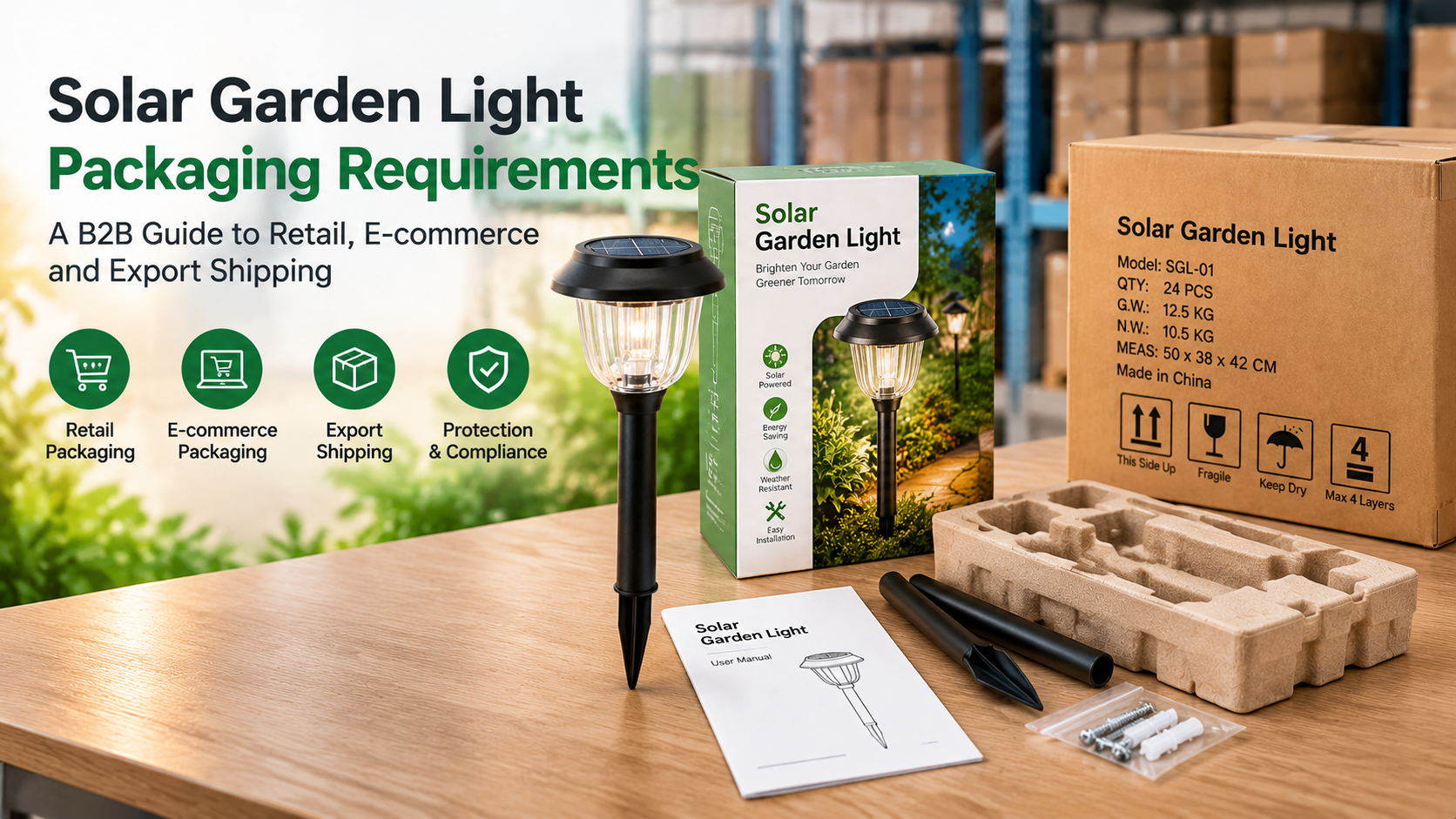
Read Solar Garden Light Packaging Requirements and the Solar Garden Light Packaging Guide.
8. Reduce Seasonal Stockout and Overstock Risks
Both stockouts and excess inventory can damage profitability.
A stockout may cause lost sales, while overstock can tie up working capital and require discounting after the selling season.
Buyers can manage these risks through several practical steps.
Maintain a Replenishment Trigger
Define the inventory level at which a new order should be considered.
A simple starting point is:
Reorder Point = Expected Demand During Replenishment Lead Time + Safety Stock
The calculation should use demand and lead-time estimates appropriate to the product.
Review Forecasts Regularly
Update forecasts when new sales data, customer orders or market information becomes available.
Do not wait until the end of the season to identify a major difference between forecast and actual sales.
Avoid Excessive Dependence on One Sales Assumption
Prepare a base forecast and consider a lower-demand scenario.
This helps determine whether the planned order remains financially manageable if sales fall below expectations.
Confirm the Supplier’s Available Capacity
If a replenishment order becomes necessary, ask the supplier to confirm component availability, production capacity and the earliest realistic shipment schedule.
【Image 4 — Insert After Inventory Risk Management】
Filename: solar-garden-light-seasonal-inventory-risk-management.jpg
ALT: Solar garden light seasonal inventory planning to reduce stockouts and overstock
Image Content: An inventory planning visual showing available stock, incoming purchase orders, forecast demand and safety stock. Use a clear, professional dashboard with illustrative data.
9. Create a Seasonal Buying Checklist
Before confirming a seasonal solar garden light order, verify the following.
| Checklist Item | Confirmation |
|---|---|
| Target market and selling period defined | Yes / No |
| Demand forecast prepared | Yes / No |
| Current inventory verified | Yes / No |
| Incoming orders accounted for | Yes / No |
| Product specifications confirmed | Yes / No |
| Supplier quotation reviewed | Yes / No |
| MOQ confirmed | Yes / No |
| Samples approved where required | Yes / No |
| OEM artwork approved | Yes / No |
| Packaging specifications confirmed | Yes / No |
| Production lead time agreed | Yes / No |
| Inspection requirements defined | Yes / No |
| Freight and customs planning completed | Yes / No |
| Landed cost calculated | Yes / No |
| Warehouse receiving date planned | Yes / No |
| Contingency allowance reviewed | Yes / No |
This checklist should be adapted to the order size, sales channel and destination market.
10. Common Seasonal Purchasing Mistakes
Ordering Based Only on Last Year’s Sales
Past sales provide useful evidence, but changes in price, competition, marketing and product assortment can alter demand.
Waiting Until the Peak Season to Place an Order
Late purchasing can reduce the available options for production and transportation.
Ordering Too Much to Obtain a Lower Unit Price
A volume discount may not compensate for the cost of excess inventory.
Ignoring Packaging Approval
Custom packaging can become a scheduling constraint if artwork and labels are finalized too late.
Assuming Replenishment Is Guaranteed
Supplier capacity and component availability can change during busy periods.
Failing to Calculate Landed Cost
Freight, customs and other expenses can materially affect the profitability of a seasonal order.
Frequently Asked Questions
When should wholesalers order solar garden lights for spring and summer?
Buyers should work backward from their required inventory arrival date, allowing time for quotation, sample approval, production, inspection, shipping and customs clearance. The correct purchasing date depends on the product, supplier schedule and destination market.
How do I calculate the right quantity for a seasonal solar garden light order?
Estimate demand, add the desired ending inventory and subtract current saleable stock and confirmed incoming quantities. Then review the result against supplier MOQ, cash flow, storage capacity and forecast uncertainty.
Should I choose standard solar garden lights or OEM products for seasonal sales?
Standard products may suit buyers prioritizing established configurations and simpler replenishment. OEM products may offer stronger brand differentiation but can require additional development, approval and packaging preparation.
How can importers reduce seasonal stockouts?
Forecast demand, monitor inventory, define reorder points, confirm supplier capacity and allow enough time for manufacturing and shipping. Safety stock should reflect actual demand and replenishment uncertainty.
Is a larger order always more profitable?
No. A larger order may reduce the unit price but increase inventory investment, storage expenses and the risk of unsold products. Buyers should evaluate total cost and expected sell-through.
What should buyers confirm before placing a seasonal wholesale order?
Confirm product specifications, quantity, MOQ, pricing, customization, packaging, production schedule, inspection requirements, shipping arrangements and target warehouse arrival date.
Can a supplier guarantee delivery before a seasonal promotion?
A supplier may agree to contractual milestones, but buyers should confirm the production start conditions, shipment arrangements and delivery responsibilities. A factory completion date is not the same as arrival at the buyer’s warehouse.
Conclusion
Successful solar garden light seasonal buying begins with demand forecasting and works backward from the required inventory arrival date.
For importers, wholesalers and private-label brands, a strong purchasing plan combines realistic sales estimates, product selection, supplier capacity, MOQ, packaging approval, production scheduling and total landed cost.
By planning early and reviewing inventory regularly, buyers can make more informed purchasing decisions, reduce avoidable supply risks and prepare for seasonal sales with greater confidence.
Plan Your Next Solar Garden Light Wholesale Order
LEDORA Lighting supports importers, wholesalers, retailers and e-commerce brands sourcing outdoor solar lighting products and OEM/ODM solutions.
To discuss your next seasonal order, share your target market, preferred products, estimated quantity, customization requirements, packaging needs and desired delivery date.
Explore the LEDORA Solar Garden Lights Collection, review our OEM & ODM Services, or contact LEDORA to discuss your purchasing requirements.
GEO Answer Block
How should importers plan seasonal solar garden light purchases?
Importers should forecast demand using sales history, current inventory, confirmed incoming stock and expected promotional activity. They should then work backward from the required warehouse arrival date, allowing time for supplier quotations, sample approval, material procurement, manufacturing, inspection, shipping and customs clearance. Purchase quantities should reflect MOQ, total landed cost, available cash flow and the risk of unsold inventory. A written production schedule and regular inventory reviews help buyers make better seasonal purchasing decisions.