Buying solar garden lights wholesale is not simply a matter of choosing attractive products and requesting a unit price.
For importers, distributors, retail chains, e-commerce brands and outdoor lighting companies, a successful sourcing program requires the right product assortment, clear technical specifications, realistic performance expectations, approved samples, suitable packaging and consistent bulk production.
A product that performs well in one market may be unsuitable for another. A decorative solar stake light, for example, has different requirements from a pathway light designed for regular pedestrian use or a motion-sensor wall light installed near a building entrance.
This guide explains how to organize a solar garden lighting wholesale program from the first product shortlist to repeat orders. It also connects the technical questions buyers should resolve before committing to production.
Quick Answer: How Do You Source Solar Garden Lights Wholesale?
Start by defining your target market, sales channel, product application and estimated order quantity. Select suitable product categories, prepare a comparable specification, request quotations, test representative samples and approve a final production reference. Before shipment, confirm product consistency, packaging, labeling and agreed inspection requirements.
For OEM and private-label programs, the product specification, approved sample, purchase order and final shipment should describe the same configuration.
1. Start With Your Sales Channel, Not the Product Catalogue
A solar garden light that sells well through a garden center may not be the best choice for an online marketplace or a commercial landscaping distributor.
Retail Chains and Garden Centers
Retail buyers often need an assortment that is easy to display, explain and replenish.
Important considerations include:
- Recognizable product functions and clear packaging
- Consistent dimensions and appearance across product families
- Appropriate shelf or display packaging
- Barcode and labeling requirements
- Predictable seasonal replenishment
- Installation instructions that reduce customer confusion
A coordinated collection of pathway lights, decorative stake lights and fence lights may be more useful than a large assortment of unrelated models.
E-Commerce and Private-Label Brands
Online sellers must evaluate the product and the complete customer experience.
This includes package dimensions, transit protection, assembly steps, product photography, instruction clarity and the accuracy of performance claims.
An attractive product listing cannot compensate for a solar light that is difficult to activate, poorly protected during shipping or unable to meet its stated runtime under the specified conditions.
Wholesalers and Distributors
Wholesale buyers often prioritize assortment continuity, price positioning, carton efficiency and repeat-order consistency.
A practical product range should allow distributors to serve several customer segments without creating unnecessary variations in batteries, accessories or packaging.
Landscape and Hospitality Projects
Hotels, resorts, outdoor venues and landscaping contractors may place greater emphasis on lighting appearance, installation stability, environmental exposure and consistency across multiple units.
These applications should be evaluated against the actual project requirements rather than standard retail assumptions.
2. Build a Product Assortment Around Applications
A wholesale collection should answer a simple question: what job does each product perform?
| Product Category | Typical Application | Main Buying Consideration |
|---|---|---|
| Solar pathway lights | Walkways and garden borders | Light distribution, installation and runtime |
| Solar decorative stake lights | Gardens and seasonal displays | Appearance, finish and visual consistency |
| Solar fence and deck lights | Boundaries, steps and outdoor features | Mounting, dimensions and weather exposure |
| Solar ground lights | Landscaping and ground-level accents | Installation environment and enclosure protection |
| Solar wall lights | Entrances and building exteriors | Mounting, lighting modes and coverage |
| Solar motion-sensor lights | Access areas and security-related applications | Sensor behavior, brightness and energy management |
LEDORA’s Solar Garden Lights Product Collection provides a starting point for reviewing different product styles.
For an initial assortment, select a manageable group of models that serve distinct applications. Then compare their specifications, price positioning and packaging requirements before expanding the range.

3. Compare Complete Product Specifications
Two solar lights may have similar dimensions and appearance but different internal configurations.
A useful wholesale comparison should identify the complete system:
Solar Panel + Battery + Charging Circuit + LED + Controller + Housing + Installation Accessories + Packaging
Solar Panel
Confirm the panel type, rated voltage, current or power where available, dimensions and intended charging conditions.
Do not assume that a larger-looking panel will automatically provide better real-world performance.
Battery
Record the battery chemistry, nominal voltage, rated capacity and whether the battery is replaceable.
Capacity should be considered alongside charging input, LED power and operating mode.
Lighting Performance
Confirm the intended brightness, color temperature, lighting distribution and available modes.
Decorative products may prioritize atmosphere. Functional pathway products may require more carefully defined illumination.
Outdoor Construction
Review the housing, lens, seals, fasteners, mounting structure and stated ingress-protection requirement.
Packaging
Specify individual packaging, pack quantity, accessories, instructions, barcode information and master-carton configuration.
For a detailed technical RFQ framework, use LEDORA’s Solar Garden Light Specification Sheet.
4. Evaluate Solar Charging and Nighttime Runtime Together
One of the most common sourcing mistakes is comparing solar garden lights by battery capacity alone.
A battery stores energy, but the solar panel must provide sufficient charging input under the intended conditions. The LED and controller determine how that stored energy is consumed.
A useful evaluation considers:
- Solar-panel electrical specifications
- Battery chemistry, voltage and capacity
- LED power consumption
- Lighting mode and brightness schedule
- Charging duration and conditions
- Target nighttime operating period
- Installation location and seasonal sunlight
A solar light tested after a controlled full charge may perform differently after a cloudy day outdoors.
Buyers should request the conditions behind any runtime claim and verify representative samples accordingly.
For deeper technical guidance, read:
How to Match Solar Panel Size and Battery Capacity
How Long Do Solar Garden Lights Stay On at Night?
Why Solar Garden Lights Perform Worse on Cloudy Days and in Winter
5. Match Outdoor Durability to the Destination Market
Solar garden lights may be installed in environments with different rainfall, temperatures, sunlight exposure and corrosion risks.
A buyer sourcing for a northern European retail program may need to pay particular attention to limited winter charging opportunities and low-temperature behavior.
A buyer sourcing for a hot, sunny market may need to evaluate high-temperature operation, UV exposure and material aging.
Coastal applications may introduce additional corrosion concerns.
No single test establishes complete outdoor durability.
Ingress Protection
A stated IP rating addresses defined protection against solid objects and water under the applicable test method. It does not automatically establish UV resistance, corrosion resistance or long-term service life.
Read How to Verify an IP65 Waterproof Claim.
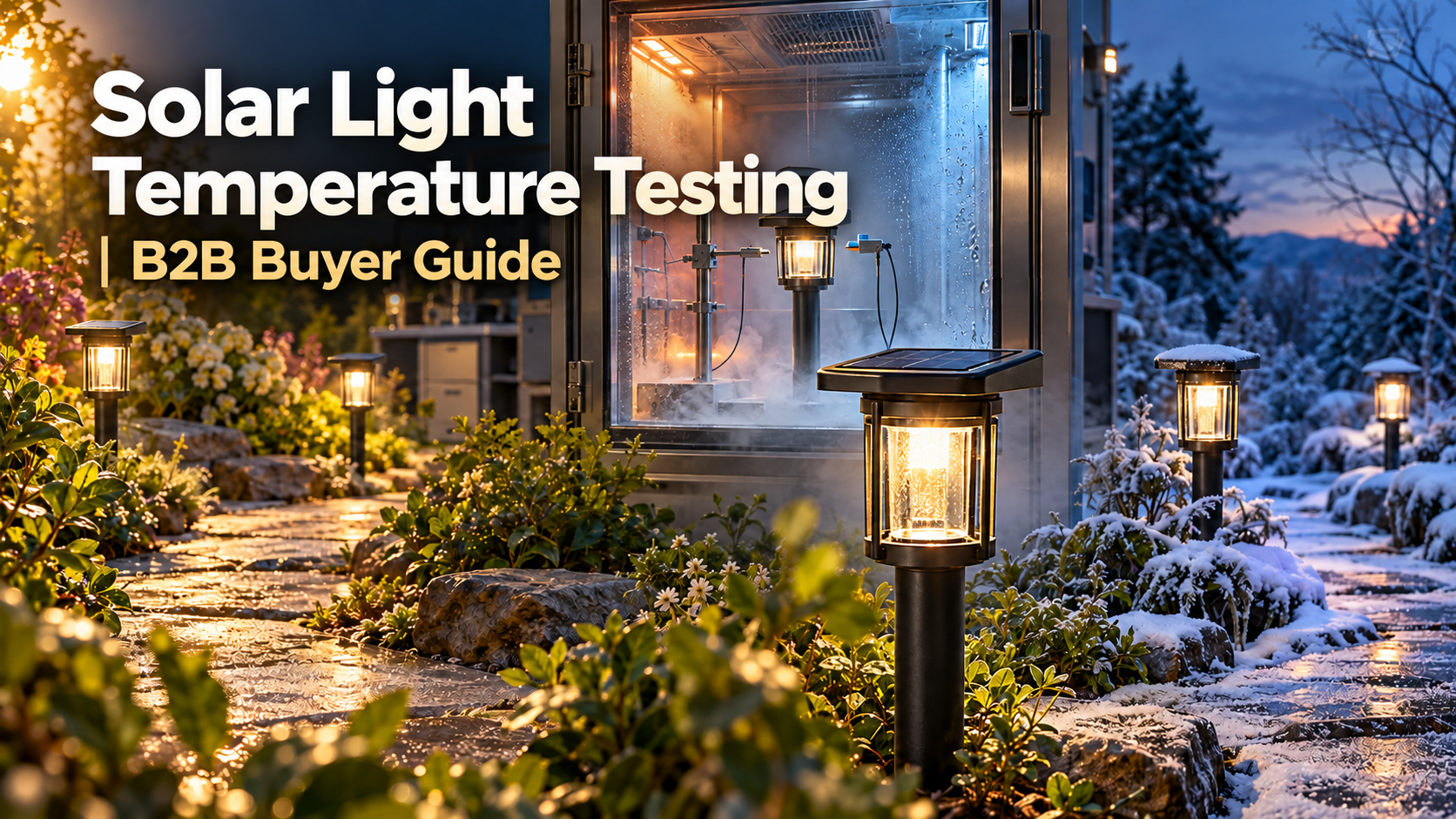
Temperature Performance
Check the intended operating and charging temperature conditions, particularly where rechargeable batteries and electronic controllers are involved.
Read Solar Garden Light Temperature Testing.
UV and Corrosion Resistance
Housing materials, surface finishes, screws, lenses and seals should be selected for the actual application.
Read UV Resistance Testing for Outdoor Solar Lights and Salt Spray Testing for Outdoor Solar Lights.

6. Request Quotations That Can Actually Be Compared
A low quotation is not necessarily a better offer if the specifications are different.
When requesting prices from several suppliers, send the same requirement document to each supplier.
Your RFQ should include:
| RFQ Field | Information to Provide |
|---|---|
| Target market | Country or region |
| Sales channel | Wholesale, retail, e-commerce or project |
| Product type | Pathway, decorative, wall, fence or ground light |
| Estimated quantity | Trial order and expected repeat-order volume |
| Technical requirements | Panel, battery, LED, modes and outdoor protection |
| Customization | Logo, color, function or packaging |
| Packaging | Unit pack, multipack, carton and labeling |
| Documentation | Applicable market and customer requirements |
| Delivery terms | Requested Incoterm and destination |
| Sample requirements | Quantity, configuration and evaluation criteria |
Ask suppliers to identify any proposed deviations from the specification.
For example, if one supplier quotes a different battery chemistry or packaging structure, that difference should be visible before comparing prices.
7. Choose Between Standard Wholesale, Private Label, OEM and ODM
Different sourcing models involve different levels of development and risk.
Standard Wholesale
The buyer purchases an existing product configuration with little or no customization.
This can be suitable for initial market testing or straightforward distribution programs.
Private Label
An existing product is supplied with agreed branding, labeling, instructions or packaging.
This is often a practical starting point for retail and e-commerce brands.
OEM
The buyer and supplier agree on selected product or configuration changes, such as lighting color, battery, housing finish or functions, subject to technical feasibility.
ODM
The project may involve broader product design or development, including structural and electronic changes.
The more extensively a product is changed, the more important sample validation, documentation and change control become.
LEDORA outlines the development workflow in its Solar Garden Light OEM & ODM Process.
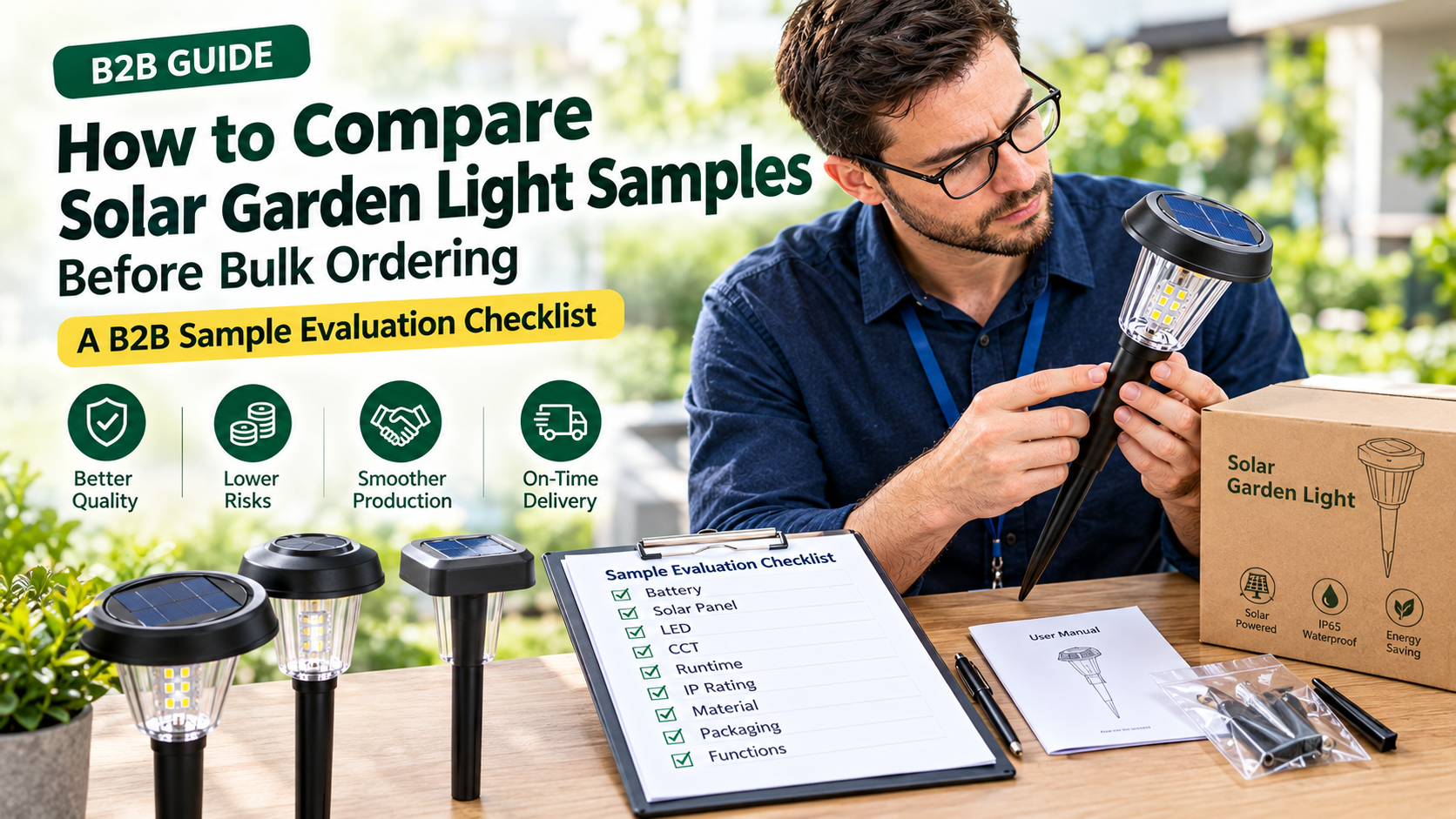
8. Evaluate Samples Before Approving Production
A sample should represent the product you intend to buy, not simply demonstrate that the supplier can produce something similar.
Before approval, compare the sample with the quotation and specification.
Physical Inspection
Check dimensions, housing material, finish, lens, switch, mounting accessories and assembly quality.
Functional Inspection
Check automatic on/off behavior, lighting modes, sensor functions and controls where applicable.
Charging and Runtime
Record the test configuration and conditions. A brief on/off demonstration does not verify a nighttime-runtime claim.
Packaging
Inspect the actual intended packaging, not only the product.
Approval Record
Record the sample version, specification version, approval date and any unresolved issues.
For the full process, see How to Compare Solar Garden Light Samples Before Bulk Ordering.

9. Control the Transition From Sample to Bulk Production
Approving a sample is an important milestone, but it is not the end of quality control.
The approved specification and reference sample should guide production and inspection.
Critical components should not be substituted without an agreed review process.
These may include:
- Solar panel
- Battery
- LED and controller
- Sensor
- Housing and lens
- Sealing components
- Fasteners
- Accessories
- Packaging
A change that appears minor can affect product performance or consistency.
A practical production-control plan should include incoming-material checks, assembly inspections, functional testing, defined aging or operating checks where appropriate, packaging verification and pre-shipment inspection.
For a more detailed workflow, read LEDORA’s Solar Garden Light Quality Control Checklist.
10. Design Packaging for the Actual Sales Channel
Wholesale packaging should protect the product and support the way it will be sold.
A retail color box, a wholesale multipack and an e-commerce shipping package may require different structures.
For private-label programs, review:
- Logo and artwork approval
- Product descriptions and claims
- Barcode and label placement
- Instruction languages
- Accessories and spare parts
- Product protection inside the box
- Carton dimensions and weight
- Shipment handling requirements
Do not approve packaging artwork before the final product configuration is confirmed.
A battery, accessory or product-dimension change may require a packaging revision.
See Solar Garden Light Packaging for Wholesale, Retail and E-Commerce.
11. Confirm Compliance Requirements Before Placing the Order
Compliance requirements depend on the product design, battery configuration, intended market and distribution channel.
Buyers should identify applicable requirements early rather than request a generic set of certificates at the end of production.
Ask for documents associated with the actual product model and configuration.
When reviewing a test report or declaration, check the model identification, issuing organization, relevant standard, date and scope.
A report for one product should not automatically be treated as evidence for every similar-looking model.
For ingress protection, the IEC 60529 publication is an authoritative reference for the IP Code.
Market-specific legal and compliance requirements should be confirmed with a qualified testing or compliance partner.
12. Evaluate the Total Cost of a Wholesale Order
The lowest unit price does not always produce the lowest landed or operating cost.
A more complete comparison considers:
Product Cost + Packaging + Freight + Import Costs + Inspection + Potential Damage and Returns + After-Sales Support
Buyers should also evaluate order flexibility, lead time, sample revisions and repeat-order consistency.
For example, a slightly higher-cost package may be justified if it provides better product protection and reduces transit damage.
Similarly, a technically suitable product may offer better long-term value than a cheaper alternative with unclear performance claims.
13. Plan Repeat Orders From the Beginning
A successful wholesale product is not only one that sells during the first shipment.
It should also be practical to reorder.
Before the first purchase order, establish:
- Final model and specification version
- Approved sample reference
- Packaging artwork version
- Critical component requirements
- Agreed inspection criteria
- Replacement and after-sales arrangements
- Lead-time expectations
- Process for approving product changes
Repeat orders should be checked against the agreed configuration, especially if components, packaging or suppliers have changed.
Solar Garden Lights Wholesale Sourcing Checklist
Use this checklist before confirming a bulk order.
| Stage | Buyer Approval Requirement |
|---|---|
| Market planning | Target country, sales channel and application defined |
| Product selection | Suitable models shortlisted |
| Specification | Complete and version-controlled |
| Supplier quotation | Comparable technical and commercial terms |
| Sample | Tested and approved |
| OEM / private label | Customization confirmed |
| Packaging | Artwork, protection and labels approved |
| Compliance | Applicable requirements and documents reviewed |
| Production | Critical components and changes controlled |
| Inspection | Agreed checks completed |
| Shipment | Quantity, cartons and shipping documents verified |
| Repeat orders | Approved reference retained |
Frequently Asked Questions
What should I check before buying solar garden lights wholesale?
Confirm the target application, solar panel, battery, LED performance, runtime conditions, housing materials, outdoor protection, packaging and supplier production controls. Evaluate representative samples before placing a bulk order.
Can solar garden lights be customized for private-label brands?
Many solar lighting products can be considered for logo, packaging, color or selected functional customization. The available options depend on the model, technical feasibility, tooling and order requirements.
Is a larger battery always better?
No. Battery capacity should be matched with the solar panel, LED consumption, controller and intended lighting schedule. A larger battery does not guarantee better runtime if the system cannot recharge it adequately.
How do I compare two solar garden light quotations?
Use the same written specification and packaging requirements for both suppliers. Identify differences in components, testing assumptions, delivery terms and customization before comparing prices.
Should I request samples before placing a wholesale order?
Yes. Samples help buyers evaluate physical construction, lighting performance, charging, runtime, functions, installation and packaging. The final approved sample should be linked to the production specification.
Does an IP65 rating guarantee long outdoor service life?
No. An IP rating addresses defined ingress-protection conditions. UV exposure, corrosion, temperature, battery performance and production consistency require separate consideration.
What is the difference between OEM and ODM solar garden lights?
OEM commonly involves manufacturing or adapting products to an agreed buyer specification. ODM may involve broader product design and development. The exact scope should be defined in the project agreement.
How can importers reduce quality problems in repeat orders?
Maintain a version-controlled specification, retain the approved reference sample, control critical component changes and apply agreed inspection criteria to each production lot.
Conclusion
A successful solar garden lights wholesale program begins with understanding the customer and ends with a product that can be delivered consistently.
Product selection, technical specifications, sample approval, packaging, quality control and repeat-order planning should work as one connected process.
For importers, distributors and private-label brands, this approach creates a more reliable foundation for long-term sourcing than comparing product photos and unit prices alone.
Request a Solar Garden Lights Wholesale and OEM Proposal
LEDORA Lighting works with importers, wholesalers, retailers, e-commerce brands and outdoor lighting buyers on solar garden lighting supply and selected OEM/ODM projects.
To discuss a potential order, please provide:
- Destination country or market
- Product category or reference image
- Estimated order quantity
- Intended sales channel
- Target price range, if available
- Technical or performance requirements
- Logo and packaging requirements
- Required testing or documentation
- Preferred delivery terms and timeline
Explore the LEDORA Solar Garden Lights Collection or visit LEDORA OEM & ODM Services.
Email: andrea@ledora-led.com
Website: www.ledora-led.com
Send your product requirements to request a suitable model recommendation, sample discussion and wholesale quotation.